Comprehensive Evaluation Of Antioxidant Activity Of Cistanche Deserticola Polysaccharides By Multiple Indexes
Apr 13, 2023
Junjie1 ,Gao Lianchun1 ,Meng Xinrui1 ,Wang Menghan1 ,Liu Xiaohua1 . 1. School of Pharmaceutic,Lanzhou University,Lanzhou 730000,China; 2. Guangzhou Yuming Biological Technology Co,LTD,Guangzhou 511400,China Corresponding author:Liu Xiaohua,E-mail:liuxiaoh@ lzu.edu.cn
【Abstract】 Objective:To evaluate the antioxidant activity of Cistanche deserticola polysaccharides by various indexes in vivo and vitro. Methods:Antioxidant experiments in vitro focused on the free radical scavenging rate of Cistanche deserticola polysaccharides including DPPH scavenging,hydroxyl radical(·OH)scavenging,potassium ferricyanide reduction and nitrite scavenging method. The body weight and spleen index of mice were concerned,and the contents of superoxide dismutase(SOD),glutathione peroxidase(GSH-Px)and malondialdehyde(MDA) in serum,liver and brain tissues were detected in d-galactose aging model mice. Results:C80 had better DPPH and OH·scavenging effect in vitro.The weight gain rate and spleen index of mice(P<0.05)were improved,and the SOD,GSH-Px activities and MDA content in serum,liver and brain tissues had significant differences(P<0.01)using C80 could in mouse aging model,but there was no difference between high and low dose groups(P>0.05). Conclusion:C80 has good antioxidant activity in vivo and vitro.
【Key words】cistanche deserticola polysaccharide;free radicals;clearance;antioxidant activity;aging model
In recent years, the "beauty economy" has developed rapidly, and the consumption scale of China's skincare industry has been expanding year by year. Anti-aging skincare products have gradually become the focus of consumption. According to Euromonitor data, the size of China's anti-aging market reached 64.6 billion yuan in 2020, accounting for 28.8% of China's skincare market share, and it is about to surpass hydration to become the largest category of skincare products [1]. Anti-aging cosmetics refer to cosmetics that can resist aging, resist oxidation, and resist wrinkles, also known as anti-aging skincare products.
Artificial antioxidants, such as butyl hydroxyanisole (BHA) and butylhydroxytoluene (BHT), which dominate the market, have strong toxic side effects and have adverse effects on organs such as the liver, spleen, and lungs, causing damage. Compared to synthetic antioxidants, natural antioxidants are safer and more easily accepted by the public, while plant polysaccharides are considered the most active natural antioxidants that can directly or indirectly act on free radicals [2].

Benefits of cistanche tubulosa—Antioxidant
Click here to view Cistanche deserticola antioxidant products
【Ask for more】 Email: xue122522@foxmail.com / Whats App: 0086 18599088692 / Wechat: 18599088692
Cistanche deserticola Y.C.Ma, an Orobanchaceae plant, takes dry fleshy stems with scales as authentic medicine. It is a commonly used Chinese medicine for tonifying the kidney and invigorating the yang. It has the functions of tonifying the kidney, tonifying essence, and moistening dryness. Its frequency of appearance in ancient anti-aging prescriptions is second only to ginseng. Modern medical research has shown that polysaccharides from Cistanche deserticola have pharmacological effects such as enhancing immunity and antioxidation [2]. The active components of Cistanche deserticola, such as phenylethanoid glycosides and polysaccharides, have certain effects on delaying skin aging [3]. At present, the research on the anti-oxidation effect of Cistanche deserticola polysaccharide focuses on the anti-oxidation study in vivo. Through the experimental aging model of mice caused by D-neneneba galactose [5-11], the superoxide dismutase (SOD) and other indicators in the lung, liver, heart, and other tissues of mice are detected to verify whether Cistanche deserticola polysaccharide has an anti-oxidation effect. The polysaccharides from Cistanche deserticola are often prepared using traditional water extraction and alcohol precipitation methods, which have low extraction rates, poor solubility, and difficulty in later purification. Additionally, the naturally structured polysaccharides obtained have high molecular weight, high viscosity, and low bioavailability [12].
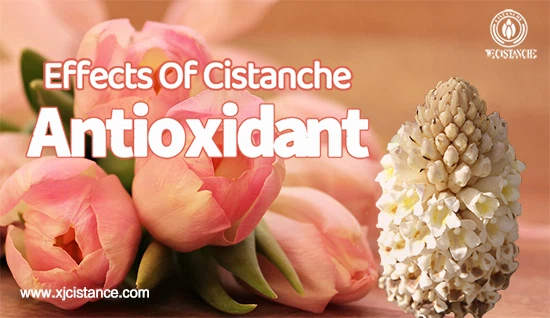
Effects Of Cistanche—Antioxidant
This experiment used composite enzyme-assisted ultrasound technology [13] to extract polysaccharides from Cistanche deserticola. According to the alcohol precipitation concentration, the polysaccharides were divided into three parts to obtaining Cistanche deserticola polysaccharides. This experiment also combines in vivo and in vitro antioxidant experiments to comprehensively evaluate multiple indicators and scientifically elucidate the antioxidant activity of Cistanche deserticola polysaccharides.
1 Material and Methods
1.1 Instruments and test drugs
UV visible spectrophotometer UV-1700 (Shimadzu Company, Japan), optical microscope BX43 (imaging system DP27) (Olympus Corporation). Cistanche deserticola comes from Gansu Huiqin Biotechnology Co., Ltd. After being identified by Associate Professor Yang Zhigang from the School of Pharmacy of Lanzhou University, this product is a dry, scaly, succulent stem of Cistanche deserticola Y. C.Ma, a plant in the Orobaceae family. 1,1-Diphenyl-2-picrylphenylhydrazine (DPPH), ferrous sulfate, naphthalene ethylenediamine hydrochloride, rhodamine B, ascorbic acid, and vitamin E were purchased from McLean Biochemical Technology Co., Ltd. GSH Px kit, malondialdehyde kit, T-SOD kit, and Coomassie Brilliant Blue kit were purchased from Nanjing Jiancheng Bioengineering Research Institute.

Main Chemical Constituents of Cistanche deserticola
1.2 Experimental animals:
50 clean-grade male Kunming mice, provided by the Animal Center of Lanzhou University, with quality qualification number: SCXK (Gan) 2013-0002.
1.3 Preparation of Cistanche deserticola polysaccharides [13]
The medicinal powder of Cistanche deserticola was extracted 3 times with ethyl acetate and ethanol at a ratio of 8, 8, and 6 times, and defatted for 2 hours each time; After degreasing, add papain (2%), cellulase (2%) and pectinase (0.4%) to the powder, add water to make the ratio of material to liquid 1 ∶ 20, extract in three times (8, 7, 5 times), temperature 54.1 ℃, pH 5.2, enzymolysis for 2 hours, and then conduct ultrasonic extraction, each time for 45 minutes, extract twice, filter and combine the filtrate, then centrifuge the supernatant, and concentrate it to one-tenth of the original volume. Drip 95% ethanol into the concentrated solution while stirring until the total ethanol concentration of the filtrate reaches 30%. Then, let it stand and centrifuge to obtain the corresponding precipitate. Freeze dry to obtain the corresponding Cistanche deserticola ma polysaccharide 1 (C30). The supernatant continues to precipitate with ethanol until the total ethanol concentration of the filtrate reaches 50%. Centrifuge dry to obtain Cistanche deserticola polysaccharide 2 (C50), and then continue to precipitate with ethanol until the total ethanol concentration of the filtrate reaches 80%, Obtain Cistanche deserticola polysaccharide 3 (C80 for short).
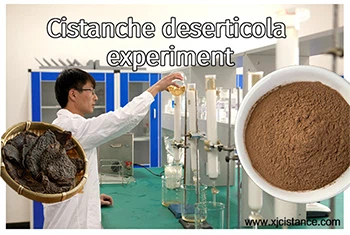
Experimental Study on Cistanche deserticola
1.4 In vitro oxidation experimental method
The DPPH free radical scavenging ability is measured by absorbance at 517nm [14]. The hydroxyl radical scavenging capacity was determined by rhodamine B-spectrophotometry [15]. Based on the principle that hydroxyl radical can rapidly oxidize rhodamine B to make it fade, the antioxidant capacity of polysaccharide was determined at 545nm according to the fading degree. The reduction force was determined using the potassium ferrocyanide reduction method [16]; The determination of nitrite-free radical scavenging ability was carried out using the naphthalene ethylenediamine hydrochloride method [17].
1.5 In vivo antioxidant test methods
50 Kunming male mice were randomly divided into 5 groups and fed adaptively for 7 days. They were weighed. Every morning, the mice in the C80 group, model group, and positive group were injected with D-neneneba galactose solution according to 150mg/kg to make the aging model, while the mice in the blank group were injected with normal saline according to the same volume. Every afternoon, the positive group mice were gavaged with vitamin E suspension at a dose of 50mg/kg. The C80 high concentration group was gavaged at a dose of 400mg/kg, the C80 low dose group was gavaged at a dose of 200mg/kg, and the blank and positive groups were gavaged with physiological saline at the same volume. The weighing was performed every seven days, and the experiment lasted for twenty-eight days [18-19].
The mice were used to take blood from eyeballs, dissect the mice, take out the liver, spleen, and brain tissues, measure the spleen index, and detect the contents of superoxide dismutase (SOD), glutathione peroxidase (GSH Px) and malondialdehyde (MDA) in serum, liver tissues, and brain tissues.
1.6 Statistical Methods
SPSS 20 statistical software was used, single factor analysis (ANOVA) was used, and the LSD method was used for pairwise comparison. P<0.05 indicates a statistically significant difference.
2 Results
2.1 Results of in vitro oxidation experiment
As the concentration of Cistanche deserticola polysaccharides increases, the clearance rates of C30, C50, C80, DPPH radicals, hydroxyl radicals, potassium ferricyanide reduction method, and sodium nitrite radical scavenging ability all increase with the increase of concentration. Compared with vitamin C, the clearance rates of DPPH free radicals and hydroxyl free radicals were better. At the same concentration, different in vitro antioxidant experiments showed that the clearance rate of C80 was significantly higher than that of C50 and C30, indicating that C80 had a better free radical scavenging effect, followed by C50. From the comprehensive analysis of four in vitro antioxidant experiments, it can be concluded that C80 has the best in vitro antioxidant activity. Therefore, C80 was selected for in vivo antioxidant experiments. See Figure 1-4.

Figure 1 DPPH free radical scavenging rate of Cistanche deserticola polysaccharides

Figure 2 Hydroxyl radical scavenging rate of Cistanche deserticola polysaccharides

Figure 3 Potassium ferrocyanide reduction method of Cistanche deserticola polysaccharides

Figure 4 Clearance rate of sodium nitrite from Cistanche deserticola polysaccharides
2.2 Results of in vivo antioxidant experiments
2.2.1 The effect of C80 on weight gain rate and spleen index in mice.
There was a statistically significant difference in weight gain rate and spleen index between groups (P<0.01). The weight gain rate of the blank group was significantly higher than that of the model group, and the difference was statistically significant (P. After administering the medication, the weight of each group of mice increased. The spleen is an important immune organ in mice. Compared with the spleen index of the model group, the spleen index of the blank group is higher, and the difference is statistically significant (P<0.01), indicating successful modeling. The spleen index of each administration group significantly increased compared to the model group (P<0.01), indicating that C80 has a certain recovery effect on the immune function of aging model mice. See Table 1.
Table 1 Weight gain rate and spleen index of mice
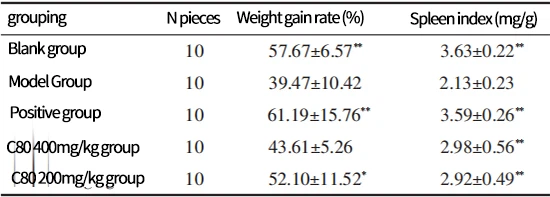
Note: Compared with the model group, * P<0.05, * * P<0.01
2.2.2 The effect of C80 on the content of MDA, GSH-Px, and SOD in serum.
In serum, there were statistically significant differences in MDA, GSH-Px, and SOD between groups (P<0.01). Compared with the model group, the blank group showed a significant increase in the activity of SOD and GSH-Px in the serum, while the level of MDA was significantly reduced, with statistical significance (P<0.01), indicating the successful construction of the anti-aging model in mice. Compared with the model group, the activity of SOD and GSH-Px in the high and low concentration groups of C80 significantly increased, while the level of MDA significantly decreased, and the difference was statistically significant (P<0.01); Compared with the positive group, the high-dose, and low-dose C80 groups showed better enhancement of SOD, GSH-Px activity, and decreased MDA levels compared to the low-dose C80 group. This indicates that C80 in serum has good antioxidant activity in mice, and the effect of high concentrations is better. See Table 2.
Table 2 Effect of C80 on MDA, GSH-Px, and SOD levels in serum

Note: Compared with the model group, * P<0.05, * * P<0.01
2.2.3 The effect of C80 on the content of MDA, GSH-Px, and SOD in the liver.
In the liver, there were statistically significant differences in MDA, GSH-Px, and SOD levels between groups (P<0.05). Compared with the model group, there was a statistically significant difference in the content of SOD, GSH-Px, and SOD in the liver homogenate between the blank group and the model group (P<0.01). The enzyme activity increased and the MDA level decreased, and there was a statistical difference (P<0.01), indicating that the construction of the anti-aging model in mice was successful. The SOD and GSH-Px enzyme activities in the liver of each treatment group were significantly increased compared to the model group (P<0.05), while the MDA level was significantly reduced (P<0.05). Compared with the positive group, there was a significant difference in the model group, while there was no difference between the high-dose group and the low-dose group (P>0.05). Therefore, it can be concluded that C80 can regulate the high concentration and imbalance of reactive oxygen species in the liver tissue of aging model mice, and has good antioxidant properties.
Table 3 Effect of C80 on MDA, GSH-Px, and SOD content in the liver
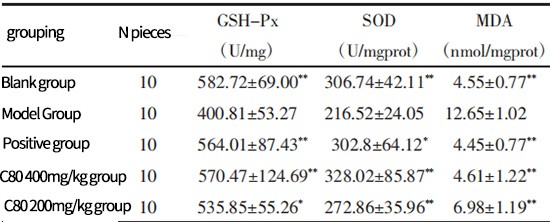
Note: Compared with the model group, * P<0.05, * * P<0.01
2.2.4 The effect of C80 on the content of MDA, GSH-Px, and SOD in brain tissue.
In brain tissue, there were statistically significant differences in MDA, GSG-Px, and SOD (P<0.01). In brain tissue, compared with the model group, the activity of SOD and GSH-Px enzymes in the blank group increased, while the level of MDA decreased, with significant differences (P<0.01), indicating the successful construction of the anti-aging model in mice. Compared with the model group, the activity of SOD and GSH-Px enzymes in the brain homogenate of each treatment group increased, while the level of MDA decreased, with significant differences (P<0.01). Comparison between each administration group, model group, and the positive group showed significant differences between the model group and the positive group, while there was no difference between the high-dose group, low-dose group, and positive group. This indicates that C80 and vitamin E have similar therapeutic effects, both have good antioxidant activity and can pass the blood-brain barrier. See Table 4.
Table 4 The effect of C80 on the content of MDA, GSH-Px, and SOD in brain tissue

Note: Compared with the model group, * P<0.05, * * P<0.01
3 Discussion
Plant polysaccharides have attracted great attention due to their universal and excellent immune activity and relatively low toxicity. Traditional water extraction and alcohol precipitation methods have been used to obtain polysaccharides from Cistanche deserticola, which, as macromolecular compounds, have low bioavailability after oral administration [20]. Unlike the traditional water extraction and alcohol precipitation method, this experiment used a combination of composite enzymes and a physical ultrasonic chain breaking method to extract polysaccharides from Cistanche deserticola, and then used graded alcohol precipitation to obtain three types of polysaccharides: C30, C50, and C80. Due to ultrasonic extraction, the ultra-long polysaccharide chains were broken and turned into short-chain polysaccharides, so C80 easily crossed the blood-brain barrier of mice, which can play its advantages.

Cistanche tea—Antioxidant
In this study, in vitro antioxidant experiments were conducted to screen the antioxidant activity of three polysaccharides from Cistanche deserticola using four experimental methods: DPPH free radical, hydroxyl free radical, potassium ferricyanide reduction method, and nitrite reduction method. The three polysaccharides showed significant effects on DPPH free radical and hydroxyl free radical, with Cistanche deserticola C80 polysaccharide performing the best, followed by C50. According to the results of the antioxidant experiment in vitro, C80 was selected to construct the oxidative stress model of D-neneneba galactose mice. The blood, liver, and brain tissues of the mice were collected, and the contents of MDA, GPH Px, and SOD were detected. The results showed that C80 had a repair function on the oxidative stress-injured mice, and had better antioxidant activity in vivo.
This experiment combines in vitro chemical methods with in vivo animal experiments and evaluates the antioxidant activity of Cistanche deserticola polysaccharides obtained by composite enzyme combined with ultrasound method using multiple indicators. The results show that the C80 obtained by this process has good antioxidant activity. The composite enzyme combined with the ultrasound method has advantages such as a simple process, fast operation, and low energy consumption, and has good application prospects in the extraction of effective ingredients from natural plants.
reference
[1] Micro hotspot research institute. Final version: Network attention analysis report on anti-aging skincare industry [R/OL] (. 2021-12-27) [2022-12-30]. www.doc88. com
[2] Meng Qinglong, Jinsha, Liu Yajing, et al. Research progress on the pharmacological effects of plant polysaccharides [J]. Food Industry Science and Technology, 2020, 41 (11): 335-341
[3]Ma Jingmei, Song Xinbo, Zhang Lijuan, et al. Research progress on the anti-aging function of Cistanche deserticola [J]. Journal of Food Safety and Quality Testing, 2021, 12 (11): 4429-4437
[4]Hao Shanshan, Chen Sumei, Yan Donghai, et al. Research progress on the application of Cistanche deserticola in cosmetics Daily Chemical Science, 2021, 44 (9): 36-41
[5] Yan Lei, Hu Jiangping, Sun Xiaodong, et al. Study on the anti fatigue effect and mechanism of Cistanche deserticola polysaccharide on aging mice induced by D-neneneba galactose [J]. Hebei Traditional Chinese Medicine, 2019, 41 (1): 96-100
[6] Wu Bo, Fu Yumei. Effect of Cistanche deserticola polysaccharides on lipid peroxidation in aging mice [J]. Journal of Guangzhou Medical College, 2004, 32 (4): 27-28
[7] Sun Yun, Xu Feng, Yang Xuanxuan, et al. The effect of Cistanche deserticola polysaccharides on lung nitric oxide and cell apoptosis in aging mice [J]. Chinese Pharmacological Bulletin, 2003, 19 (6): 683-686
[8] Sun Yun, Wang Dejun, Zhu Jin, et al. Effects of Cistanche deserticola polysaccharides on the relationship between lung protein content and antioxidant function in aging mice [J]. Chinese Pharmacological Bulletin, 2001 (1): 101-103 9]
[9]Xu Hui, Wei Xiaodong, Ouqin, et al. Study on the anti-aging effect of different components of Cistanche deserticola [J]. Heilongjiang Medical Science, 2011, 34 (1): 1-2
[10] Xu Hui, Wei Xiaodong, Zhang Pengxia, et al. Study on the protective effect of Cistanche deserticola polysaccharides on liver mitochondria in aging rats [J]. Chinese Journal of Gerontology, 2008, 28 (9): 866-867
[11] Zhang Hongquan, Li Yuan, Song Yuanyuan. Effects of Cistanche deserticola polysaccharides on immune cells and telomerase activity in aging mice [J]. Chinese Journal of Pharmacy, 2011, 46 (14): 1081-1083
[12] Yang Xiuyan, Xue Zhiyuan, Yang Yafei, et al. Study on the composite enzyme combined with ultrasound extraction process, physicochemical properties, and antioxidant activity of Astragalus polysaccharides [J]. Chinese Journal of Traditional Chinese Medicine, 2018, 43 (11): 2261-2268
[13] Liu Xiaohua, Chen Xinping, Cheng Shihong, et al. A method for extracting polysaccharides from Cistanche deserticola and its application: ZL202011059609.8 [P]. 2020 September 30
[14] Xue Zhiyuan. Comparative study on the anti osteoporosis, antioxidant, and anti liver injury effects of Hongqi and Huangqi [D] Lanzhou: Lanzhou University, 2018
[15] Li Xiang, Wang Hongqing. Spectrophotometric determination of antioxidant activity of vegetables with butyl rhodamine B-Fe2+- H2O2 system [ J ]. Journal of Xinyang Agricultural College, 2007 (173): 120-121.
[16] Wu Shiyun, Zhang Xiaowei, Yao Liya, et al. Study on the antioxidant activity of Terminalia chebula [J]. Jiangsu Agricultural Science, 2011, 39 (1): 368-370
[17] Mo Xiaoning, Li Ai, Yu Qiming, et al. Study on the ultrasonic extraction process and nitrite scavenging activity of ginkgo biloba polysaccharides [J]. Food Science and Economics, 2019, 44 (2): 90-93
[18] Ye Wenbin, He Yupeng, Gong Zhengrong, et al. Antioxidant effect of active polysaccharides from processing waste of Astragalus membranaceus and Astragalus membranaceus on aging mice [J]. Journal of Anhui Agricultural University, 2020, 47 (6): 887-893
[19] Lei Fengfeng, Yue Shuqin, Sun Ligang, et al. The regulatory effect of total polysaccharides of Astragalus membranaceus on free radical scavenging and antioxidant capacity in aging rats [J]. Shandong Medical Journal, 2015, 55 (11): 11-13
[20] Qi Yun, Cai Runlan, Wang Xiangyan, et al. Study on the absorption and transport of polysaccharides from Cistanche deserticola in vitro using bioassay [J]. Chinese Journal of Traditional Chinese Medicine, 2010, 45 (7): 527-530