Drying Technology Of Dried Cistanche: Detailed Methods, Quality Control And Storage Maintenance
Feb 24, 2026
Dried Cistanche: Drying, Stabilization, and Quality Improvement

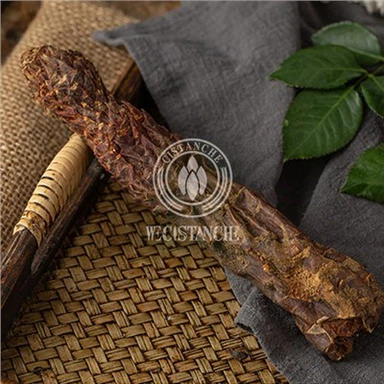
Cistanche tubulosa
Freshly sliced Cistanche has a moisture content of 70%–80%, with a crisp, tender texture. It is susceptible to microbial contamination, rot, and deterioration, making long-term storage and long-distance transportation impossible. Therefore, drying treatment is required to reduce the moisture in fresh slices to a safe range, stabilize its active ingredients, enhance stability, and produce dried Cistanche that can be stored, transported, and used for a long time.
Drying is one of the core steps in Cistanche processing, with the key objectives of dehydration, activity preservation, and quality fixation. The selection and operation specifications of drying technologies directly determine the appearance, taste, active ingredient content, and shelf life of the final product.
Traditional drying methods for Cistanche mainly include natural sun drying and shade drying. These methods rely on the natural environment and are low-cost but are greatly affected by weather, slow, prone to contamination, and unstable in quality. Modern processing mainly adopts artificial drying methods, such as hot air drying, vacuum drying, and freeze drying, which can effectively control drying conditions, improve efficiency, and ensure stable product quality.

Drying of Cistanche tubulosa
At present, large-scale processing plants mainly use artificial drying methods, while small-scale or household processing can still use traditional methods. The operation procedures, technical points, and quality control standards of various drying methods are described in detail below.
1. Traditional Drying Methods: Natural, Simple,and Efficient
Traditional drying methods are summarized by working people through long-term practice. Relying on the natural environment (sunlight, wind), they require no complex equipment, feature low cost and simple operation, and are suitable for small-scale or household processing. They mainly include natural sun drying and shade drying, among which natural sun drying is the most widely used.
Natural Sun Drying
Natural sun drying uses solar heat and wind to evaporate moisture from fresh slices. This method retains the natural flavor and active ingredients of Cistanche to the greatest extent at extremely low cost, making it the main traditional method for processing dried Cistanche.
The operation procedure is as follows: Step 1: Select a suitable drying site. The site should be flat, dry, ventilated, sunny and pollution-free, far away from farmland, sewage ditches, toilets,and other pollution sources to avoid contamination by sand, dust, and insects. It should be smooth enough for placing trays or drying nets, with sufficient sunlight and good ventilation.
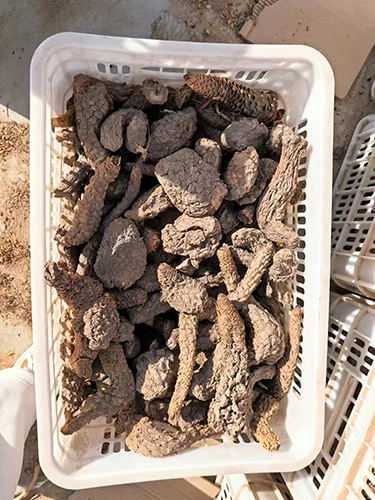
Drying of Cistanche tubulosa
Step 2: Spread fresh slices. Spread the prepared fresh slices evenly on clean trays, drying nets or bamboo mats at a thickness of 1–2 cm. Overlapping should be avoided to ensure full exposure to sunlight and air circulation.
Step 3: Control during drying. Drying usually takes 3–5 days, depending on weather conditions (temperature, humidity, wind). The slices should be turned gently 2–3 times a day to ensure uniform drying and avoid breakage.
Step 4: Judge the endpoint of drying. Qualified dried slices meet the following criteria:
Appearance: pale yellow or light brown, dry and glossy;
Texture: hard, crisp, not easily broken, with a grayish-white or yellowish-white cross-section;
Moisture content: controlled at 12%–15%.
Step 5: Collection and storage. After drying, cool the slices to room temperature, then pack them in clean, dry, breathable bags (non-woven bags, kraft paper bags) or containers (ceramic jars, glass jars), and store in a cool, dry, ventilated, and dark warehouse.
Advantages: low cost, simple operation, and natural flavor preserved.Disadvantages: greatly affected by weather, slow speed, easy contamination, unstable quality, and unsuitable for large-scale standardized production.
Shade Drying

Cistanche tubulosa
Shade drying is performed in a cool, ventilated, dry, and dark environment using natural wind to evaporate moisture. It is suitable for rainy areas or heat-sensitive high-quality slices to avoid degradation of active ingredients caused by direct sunlight.
The procedure is similar to sun drying, except that no direct sunlight is required. Drying takes 7–10 days. The product has relatively stable quality and complete active ingredients, but low efficiency, making it only suitable for small batch processing.
2. Modern Drying Methods: Scientific, Controllable, and Stable
With the large-scale and standardized development of the Cistanche processing industry, modern drying methods have become mainstream due to fast speed, high efficiency, controllable conditions, and stable quality. The main methods are hot air drying, vacuum drying, and freeze drying.

Processing of sliced Cistanche tubulosa
Hot Air Drying: Efficient and Cost-Effective
Hot air drying uses hot air generated by a heater to evaporate moisture via forced convection. It is fast, efficient, controllable, moderately costly, and suitable for large-scale standardized processing.
Core equipment: hot air dryer (small scale: 50–100 kg/day; large scale production line: over 1000 kg/day).
Three-stage drying parameters:
Preheating: 40–50 °C for 1–2 h
Constant rate: 60–70 °C for 3–4 h
Deceleration: 50–60 °C for 1–2 h
Relative humidity: 30%–40%.Spread thickness: 1–2 cm.Active ingredient retention rate: above 85%.
Advantages: fast, efficient, large-scale capable, stable quality, moderate cost.Disadvantages: high temperature may slightly degrade some heat-sensitive ingredients.
Vacuum Drying: Low Temperature, High Activity Preservation
Vacuum drying is performed in a vacuum environment to lower the boiling point of water, allowing moisture to evaporate at low temperatures. It minimizes damage to active ingredients and is suitable for high-quality, high-value-added products.
Parameters:
Vacuum degree: 0.06–0.08 MPa
Temperature: 30–40 °C
Spread thickness: 0.5–1 cm
Active ingredient retention rate: above 90%
Advantages: low temperature, excellent quality, high purity, and less contamination.Disadvantages: high equipment and operation costs, lower efficiency.
Freeze Drying: Ultimate Preservation, Premium Quality
Freeze drying (lyophilization) freezes slices below the freezing point to turn moisture into ice, then sublimates ice directly into water vapor under a vacuum. It is the most advanced method, maximally preserving active ingredients, natural flavor, and appearance.
Procedure:
Pre freezing: −40 °C to −30 °C for 2–3 h
Sublimation drying: 0.001–0.005 MPa, 8–12 h
Desorption drying: 30–40 °C for 2–3 h. Final moisture: 12%–15%.Active ingredient retention rate: above 95%.
The product is loose, porous, easy to pulverize, with appearance close to fresh slices.
Advantages: premium quality, maximum activity retention, high purity.Disadvantages: extremely high cost, low efficiency, and only for high-end products.

Cistanche tubulosa slice
Click here to view Cistanche for Kidney disease products
【Ask for more】 Email:cindy.xue@wecistanche.com / WhatsApp: 0086 18599088692 / Wechat: 18599088692
3. Quality Control and Storage of Dried Cistanche
Quality control runs through the entire drying process. Scientific storage effectively extends shelf life and maintains stability.
Quality Standards for High-Quality Dried Cistanche
Appearance: pale yellow or light brown, dry, glossy, uniform slices, no damage, mold, insects, or impurities; freeze-dried product is loose and porous.
Texture: hard and crisp (hot air/sun drying) or loose and porous (freeze drying).
Odor: characteristic sweet aroma, no off odor, moldy or sour smell.
Moisture content: 12%–15%.
Active ingredients (per Chinese Pharmacopoeia):
Echinacoside ≥ 1.0%
Verbascoside ≥ 0.2%
Polysaccharides ≥ 10%
Alkaloids ≥ 0.1%
Hygiene: meets traditional Chinese medicinal materials standards, with limited microbial and heavy metal contents and no pesticide residues.
Storage and Maintenance

Cistanche tubulosa slice
Core requirements: moisture-proof, insect-proof, mold-proof, light-proof, high-temperature-proof.
Packaging: clean, dry, breathable, and sealed materials; vacuum packaging for long-term storage.
Environment: 10–20 °C, relative humidity < 60%, cool, dry, ventilated, dark.
Anti-mold and insect-proof: use desiccants and insect repellents (isolated from products).
Regular inspection: check appearance, odor, texture,e and moisture.
Shelf life: 1–2 years under proper conditions; 2–3 years for freeze-dried products.
Through drying, fresh Cistanche is transformed into stable, stable,e and transportable dried products. As an important intermediate in the industrial chain, dried Cistanche is widely used in traditional Chinese medicine, health products, and food additives. Next, we will introduce the preparation process of Cistanche extract, showing how dried products are further processed into high-value-added extracts.