Effects Of Cistanche On Antioxidant Ability Of Kidney in Fluorosis Rats
Mar 05, 2022
Li Xiaomei, Zhong Yueqin, Zhu Xiankun
The Affiliated Hospital of Zunyi Medical College, Guizhou 563000
Chinese Library Classification Number: R 599.9 Document Identification Code: B Article Number: 1001-1889 (2015) 04-02273-01
Contact: joanna.jia@wecistanche.com
The kidney is the main excretory organ of fluoride. Excessive intake of fluoride can accumulate in the kidney and cause oxidative damage. This study observed the effect of Cistanche Tablets on the oxidative damage of the kidneys caused by fluoride.

Echinacoside in cistanche can boost the immune system
1 Objects and methods
Fifty-six male Wistar rats were selected and randomly divided into 7 groups according to double-blind hair. Each group was 8 rats. They were a blank control group (normal saline + tap water) and a fluoride-exposed group (normal saline + containing 50, 100, 150 mg / L sodium fluoride tap water), cistanche tablets and fluoride combined action group (200 mg/kg cistanche normal saline + 50, 100, 150 mg/L sodium fluoride tap water). During the experiment, the animals had free access to water and food, and the experiment period was 8 weeks. Cut out 0.1 g of kidney tissue from each group and grind to prepare a single cell suspension (1×10⁷ cells/ml). Take 200 μl of the cell suspension and place it in a flow tube, and add 2 ml2.7-2 to each tube. Chloroacetoacetate fluorescein DEFC-DA, mix well, let stand at room temperature for 20 minutes, centrifuge, and discard the supernatant. After washing with PBS, add 0.6 ml PBS to each tube and mix well, test the fluorescence intensity of intracellular DCF on the machine, and determine the intracellular activity oxygen. Refer to the instructions of Trizol (Invitrogen, USA) to extract total RNA from rat kidney tissue, take 1 μg of total RNA, add the corresponding reagents and mix well, put it in the PCR instrument, and then at 29 ℃ for 10 min, 48 ℃ for 1 h to 85 ℃ for 5 min, and finally 4 ℃. Then add cDNA, SYBR Green Master 10 μl, upstream and downstream primers 0.2 μl, and finally dilute to 20 μl with DNA-free, RNase water, mix well, and move to the PCR plate to set up fluorescence quantitative PCR. The parameters are as follows: 95 ℃ After 2 min 1 cycle, 95 ℃ 15 s 69 ℃ 1 min 40 cycles and 4 ℃.
Primer sequence, SOD upstream AAGCGGTGAACCAGTTGTG downstream CCAGTGCTCCAACATGCC; GSH-Px upstream TGAGAAGTGCGAGGTGAATG downstream AACACCGTCTG- GACCTACCA; GAPDH upstream ACCACAGTCCATGCCAT- CATGTA downstream TCGCCACCACCCTGTT. The data were analyzed using SAS 9.0 for statistical analysis. Differences between groups were analyzed by variance analysis, and P<0.05 was considered significant.
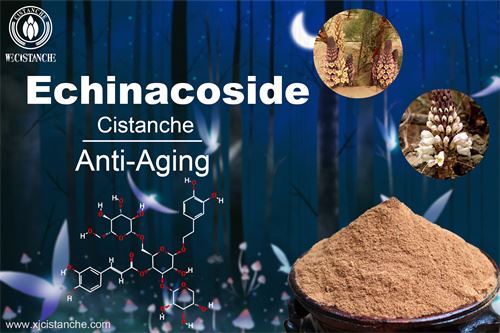
Echinacoside in cistanche can anti-aging
2 Results
Compared with the blank control, the expression of ROS in renal tissue increased after fluorine treatment and there was a dose-effect relationship. Cistanche can improve the increase in renal tissue ROS content caused by fluoride. Compared with the blank control, the expression of GXH-Px and SOD mRNA in renal tissues decreased after fluorine treatment. Cistanche can improve the decline of GXH-Px and SOD mRNA expression in kidney tissue caused by fluoride, as shown in Table 1.
Table 1 Serum MDA, GXH-Px, SOD content of rats in each group

3 Discussion
This study found that the antioxidant capacity decreased with the increase of the fluoride dose in drinking water. Serological test results show that fluoride can increase the serum MDA content, inhibit the activities of GSH-Px and SOD, and there is a dose-effect relationship. The results of RT-PCR in kidney tissue showed that fluoride decreased the expression of GSH-Px and SOD mRNA in rat kidney tissue, indicating that chronic fluorosis can cause oxidative stress and cause body damage and oxidative invasion of the kidneys. However, most studies believe that fluorine can cause lipid peroxidation in the body, promote the increase of renal tissue MDA, and reduce the activity of the antioxidant enzyme SOD. Our results are consistent with most studies.
Studies have found that cistanche can cause liver oxidative stress damage to carbon tetrachloride
It has a protective effect[1-2], but there is no report on the correlation between cistanche and chronic fluorosis causing kidney oxidative stress damage. Therefore, this study explores the influence of cistanche on fluorosis-induced kidney oxidative stress damage. Studies have found that cistanche can increase the antioxidant capacity of the kidneys in kidney damage caused by fluoride, improve the state of oxidative stress in the kidneys, and reduce kidney damage. Therefore, cistanche can reduce kidney damage caused by fluorosis, and is the most effective for protecting against kidney damage caused by fluoride. However, how Bossica cistanche exerts its biological effects needs further research.

Echinacoside in cistanche can neuroprotection
References
[1] Yang Xiuwei, Yan Zhongkai. Effect of Cistanche Ethanol Extract on Liver Tissue of Mice Poisoned by Carbon Tetrachloride
The anti-lipid peroxidation effect [J]. Chinese Pharmaceutical Journal, 1995. 30 (2):. 84-86.
[2] Zhao Wenxi. Cistanche cistanche water extract on oxidative stress in liver of mice with liver injury induced by carbon tetrachloride intervention effect of [J]. Chinese Journal of Traditional Chinese Medicine, 2013. 38 (6) :. 875-878.

Echinacoside cistanche can treat diabetes