From Ancient Herbal Wisdom To Modern Functional Foods
Sep 02, 2026
Development & Real-World Application of Traditional Chinese Medicine (TCM)–Based Health Foods
Abstract
With the significant improvement of living standards and the rise of health awareness in modern society, consumers' expectations of food have shifted from basic sustenance to higher-level wellness goals. Against this backdrop, health foods developed from Traditional Chinese Medicine (TCM) theory and ingredients have become a market focus due to their distinctive wellness benefits. This paper aims to explore the multiple advantages of TCM in the development and application of health foods, the current state of the field, major existing problems, and practical strategies. Through integrated analysis, this paper provides a solid theoretical foundation and actionable guidance for companies in the health-food sector, helping them better utilize herbal resources and develop high-quality products that meet market demand.
Keywords: Traditional Chinese medicine; health foods; development and application
Introduction
As the crystallization of several thousand years of Chinese wisdom, TCM features a unique theoretical system, abundant medicinal resources, and widely recognized clinical experience, offering valuable assets for the development of modern health foods. In recent years, the global health industry has expanded rapidly, and consumer demand has grown for wellness products perceived as natural, safe, and effective. TCM-based health foods are therefore entering an unprecedented window of opportunity. However, how to use herbal resources scientifically, solve technical difficulties in product development, and compete in an increasingly crowded market are urgent challenges. This paper analyzes the application of TCM in health foods from multiple angles, with the goal of offering practical reference and insight to relevant enterprises.

1. Advantages of Traditional Chinese Herbs in Health Foods
1.1 Abundant natural resources and diversity
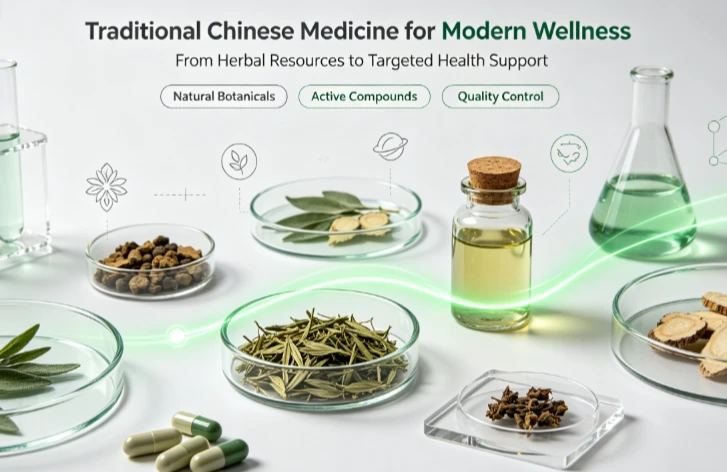
China-the birthplace of TCM-has recorded over 12,807 types of medicinal resources, widely distributed across environments ranging from high mountains to deep seas, plains to forests. Many well-known and precious materials such as ginseng, goji berry (wolfberry), dong quai (Angelica sinensis), and astragalus are rich in nutrients and bioactive properties, forming an extensive raw-material reservoir for the development of health foods.
Importantly, the diversity of herbal resources is not only about the number of species, but also their medicinal parts and functional diversity. Different parts of the same plant (root, stem, leaf, flower, fruit, seed) can carry markedly different medicinal value; even the same herb may vary significantly in functional profile depending on growth stage, harvest timing, and processing methods. This diversity creates broad possibilities for R&D: developers can flexibly select and adjust formulas according to target populations and specific health needs, designing products that are more targeted or personalized [1].
Regional characteristics also matter. Differences in climate and soil lead to distinctive production areas across China-e.g., ginseng in the Northeast, goji berries in the Northwest, and coptis in Sichuan-often associated with premium quality and distinct wellness value, offering more diversified choices for health-food development.
1.2 Deep cultural background and a coherent theoretical system
TCM wellness culture, an important part of traditional Chinese culture, has evolved over millennia into a distinctive system of health-maintenance concepts and methods. Classical texts such as the Huangdi Neijing and Compendium of Materia Medica record not only the properties, meridian associations, functions, and compatibility principles of herbs, but also extensive wellness thinking-such as yin–yang balance, five-element interactions, and zang-fu (organ) and meridian theory-providing a strong conceptual foundation and unique perspective for health-food R&D.
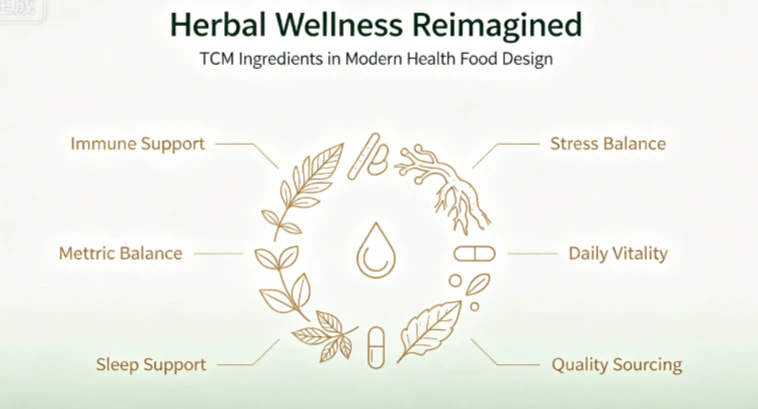
TCM emphasizes "food and medicine share the same origin," viewing food and medicinal substances as overlapping tools for regulating bodily function. This supports a development approach that values whole-body regulation and individual differences. For modern "sub-health" patterns-fatigue, sleep disturbance, anxiety-TCM-informed formulation can select herbs traditionally used to support qi and blood and to calm the mind, guiding development toward products intended to help such everyday complaints. TCM also emphasizes prevention first: by promoting systemic balance and resilience, one can reduce the likelihood of illness. This concept has strong relevance in the health-food field and can guide the development of products positioned around immune support and endocrine balance to meet consumers' health-management expectations [2].
1.3 Distinct pharmacological characteristics and safety profile
Compared with single-target synthetic drugs, many herbal materials exhibit multi-target, multi-pathway, multi-stage biological mechanisms, potentially influencing multiple body systems and producing a comprehensive wellness effect. This broad activity makes herb-based health foods more flexible in formulation design: certain herbs show antioxidant, anti-inflammatory, or anti-tumor-related activities, which can inform products positioned for healthy aging, immune support, and risk reduction; others may influence glucose, lipid, and blood-pressure regulation and are often discussed in relation to chronic metabolic concerns. These properties provide scientific rationale for product development while expanding consumer choice.
Herbal materials are also often viewed as relatively mild and suitable for longer-term wellness use. In addition, classical compatibility rules and processing methods can reduce toxicity and improve tolerability, supporting safety and effectiveness. With modern research, more active constituents have been isolated and studied-e.g., ginsenosides, astragalus polysaccharides, and goji polysaccharides-and such research provides additional scientific and technical support for modern health-food development.
Note for Western readers: In EU/US markets, health foods/dietary supplements cannot legally claim to "treat, cure, or prevent" disease without drug approval. TCM-inspired products can be developed and communicated responsibly by focusing on structure/function support and by using evidence-based wording.
2. Current State of TCM-Based Health Food Development and Application
2.1 Market demand and consumer trends
In recent years, driven by rising health awareness, demand for TCM-based "food-as-medicine" products has grown rapidly. Statistics cited in this paper indicate that in 2023 China's "medicine and food homology" industry reached 37.263 billion RMB, and in Q1 2024 the market size reached 12.254 billion RMB, representing 31.54% year-on-year growth. This growth reflects both long-standing wellness habits among older consumers and the younger generation's interest in "new wellness" lifestyles. On social platforms such as Xiaohongshu, from March to June 2024, related posts reportedly reached 160,300 notes and generated 16.14 million interactions, suggesting increasing public attention [3].
In terms of consumer demographics, one dataset cited reports that males account for 56.1% of consumers in this category, and the population using food-based wellness is becoming younger, with a rising proportion under 35. Youth penetration is especially notable in "three-high" (high blood pressure, high blood sugar, high blood lipids) segments, liver support, and sleep-support products. Materials such as notoginseng (Sanqi), American ginseng, gastrodia, and reishi reportedly show year-on-year growth rates above 120%, highlighting strong demand.
2.2 R&D challenges and technological innovation
Despite strong demand, R&D still faces major challenges. Functional evaluation of TCM health foods is often detached from TCM theory, relying instead on Western functional-food evaluation methods, which can dilute the distinctive advantages of herbal products. The boundary between TCM health foods and proprietary Chinese medicines can be blurred; some sellers intentionally confuse these categories, making it difficult for consumers to distinguish them.
Other common issues include insufficient scientific data for dosage selection and compatibility rationale, as well as insufficient safety-evaluation experiments. To meet these challenges, technological innovation is crucial. Modern methods-systems biology, network pharmacology, metabolomics-can help clarify the scientific basis of core functions. Modern toxicology can support safety-evaluation systems tailored to herbal health foods. Meanwhile, technologies such as ultrafine grinding, cell-wall breaking, and extraction can increase yields of active constituents and improve bioavailability, strengthening product performance.
2.3 Laws, policies, and regulatory environment
Regulation strongly shapes R&D and commercialization. In recent years, authorities in China have strengthened oversight of the health-food sector and increased enforcement against false advertising, illegal promotions, and consumer fraud. Updated regulations such as the advertising law and food safety law, as well as special rectification plans targeting fraud and false claims, have standardized marketing and sales behavior.
However, current review procedures for TCM health foods can be complex and time-consuming, and existing technical review standards may not meet the needs of industry development. For example, while "immune enhancement" products rank highly among approved functional claims, current evaluation standards may cover only partial cellular immune indicators and need further refinement. Establishing technical standards better suited to herbal health foods is therefore an urgent requirement for healthy industry development.
2.4 Brand building and market expansion
In intense competition, brand building and market expansion have become key to competitiveness. By building a credible brand image, companies increase awareness and trust. Some enterprises integrate TCM concepts with modern technology to develop "medicine-food homology" products that better match modern needs, improving convenience and taste to fit diverse preferences.
In market expansion, companies increasingly combine offline experience-based marketing with e-commerce and social media. One dataset cited indicates that in 2023, China's e-commerce sales in this category increased 0.7% year-on-year while unit volume continued to rise, suggesting significant online potential. Some enterprises also design products around gifting and social-visit scenarios through targeted or seasonal marketing, expanding use-cases and channels [4].
3. Strategies for Developing and Applying TCM-Based Health Foods
3.1 Empower R&D with modern science for more precise development
Modern science is reshaping TCM health-food development: instead of relying mainly on tradition and trial-and-error, R&D increasingly uses data and validated experiments. With rapid advances in high-throughput sequencing, gene editing, and metabolomics, scientists can identify active substances within complex herbal matrices and better understand metabolism in the human body. For example, with high-throughput methods, researchers can analyze genetic information to screen for biological pathways relevant to specific wellness objectives.
This paper cites Tong Ren Tang as an example: its reishi spore powder product represents a combination of modern biotech and TCM. Through research into active constituents, compounds such as polysaccharides and triterpenes have been associated with immune modulation and anti-tumor-related activity. By optimizing production processes, the company reportedly improved bioavailability, making the product easier to absorb. Such success can enhance brand image and align with consumer preference for products supported by modern validation.
3.2 Cross-industry integration to expand diversified use scenarios
Cross-industry cooperation is an important route to broaden application scenarios. When herbal components are integrated into functional beverages, snacks, and condiments, consumers can obtain herbal constituents in daily-life contexts. Wanglaoji herbal tea is cited as a successful example: it combines botanical ingredients such as honeysuckle and chrysanthemum with beverage products to create a distinctive wellness drink. This approach both expands beverage choices and supports broader adoption of TCM-based health foods in the food industry [5].
3.3 Strengthen brand building to enhance competitiveness
Brand building is essential for long-term development. A strong brand not only improves market competitiveness but also increases consumer trust and loyalty. Companies should craft brand narratives by drawing from the culture and history behind TCM, linking brand identity with traditional culture to form distinctive brand value. Tong Ren Tang is again cited as a legacy brand whose deep cultural roots strengthen consumer trust.
At the same time, product quality is the foundation of brand building. Enterprises must strengthen controls over raw-material sourcing, processing, and quality testing to ensure compliance with relevant standards and regulations.
3.4 Increase research investment to drive innovation
Deeper R&D investment can reveal the untapped value of herbal resources and lead to more innovative, competitive products. Enterprises should strengthen collaboration with universities and research institutes to develop active-constituent research, extraction methods, functional evaluation, and safety evaluation. Through industry–academia–research collaboration, resources and strengths can be integrated into a synergistic innovation model.
Companies should also focus on technology adoption and commercialization-introducing advanced manufacturing equipment, improving efficiency and product quality, and converting research findings into practical products. The paper cites a TCM health-food enterprise in Xi'an that, through cooperation with academic and research partners, developed an innovative product with clear wellness features and improved taste and quality via advanced processing and packaging. Commercial success reportedly delivered strong economic benefit and supported industrial innovation [6].
A NEW TCM HERB Cistanche Extract Supplement for BPH and Sexual Performance


4. Conclusion
In summary, TCM-based health foods have become a core component of China's "big health" industry. In production and R&D, using TCM theory as guidance and combining it with modern high technology, the industry can pursue constitution-based (TCM body-type) wellness design while ensuring safety and reliability. Scaling and strengthening the industry can support sustainable development of China's health sector, boost innovation in national health industries, and promote the global influence of TCM and Chinese-style wellness.
References
[1] Wu Xiuni, Li Mengqi, Hong Zhenyu. Current Status and Development of TCM Health Foods. Health Vision (Jiankang Dashiye), 2020(6):132.
[2] Wang Zhigang, Liu Bin, Yu Chunyuan. Approval Status and Development Prospects of Health Foods Containing Animal-Derived TCM Ingredients. Capital Food & Medicine, 2017, 24(23):22–23.
[3] Jiang Lei. Advantages and Development Direction of TCM Health Foods. Modern Health Preservation (Lower Monthly Edition), 2019(9):154–155.
[4] Chen Ke, Zou Huiliang, Chen Min. Developing Higher-Value TCM Health Foods for Specific Populations. China Food, 2019(20):2.
[5] Ma Jiamu, Liu Xiaoyun, Ren Xueyang, et al. Formula Design and Evaluation of a Bletilla-Based Stomach-Protecting and Liver-Supporting Health Food Using AHP-SOM Clustering–TOPSIS. Chinese Traditional and Herbal Drugs, 2021, 52(18):5676–5687.
[6] Jiao Aonan, Wang Chengcheng, Mo Yingning. SWOT–PEST-Based Analysis of China's TCM Health-Food Market Development. Food and Drug, 2021, 23(05):438–444.