Hemodialysis Raises Oxidative Stress Throughcarbon-centered Radicals Despite Improved Biocompatibility Ⅱ
Feb 21, 2024
Results
Profile of the patient's group. Clinical demographic information on the patients is summarized in Table 2. There were no significant differences in age, male/female ratio, and duration of renal replacement therapy between the two groups. Estimation of ESR spectra in MULTls and i-STrap. The TheESR spectra of the 'OH, O,", RO, ROO, and 'O, adducts of the spin-trapping agent observed in the process of the MULTIS


and the i-STrap measurements were in concordance with the previously reported spectra of the corresponding radical The adducts. The confirmed The by The hyperfine coupling constants (SupplementalFig. 1*).23,27) The ESR spectra obtained from the i-STrap measurements were also in agreement with the data from a previous) In both methods, the signal intensity increased with an increase in the concentration of the relevant spin-trapping reagent and decreased with the addition of sera, suggesting that these methods are based on competitive reactions of antioxidants in sera or whole blood.


Supportive Service Of Wecistanche-The largest cistanche exporter in the China:
Email:wallence.suen@wecistanche.com
Whatsapp/Tel:+86 15292862950
Shop For More Specifications Details:
https://www.xjcistanche.com/cistanche-shop
CLICK HERE TO GET NATURAL ORGANIC CISTANCHE EXTRACT WITH 25% ECHINACOSIDE AND 9% ACTEOSIDE FOR KIDNEY FUNCTION
Effect of HD on multiple
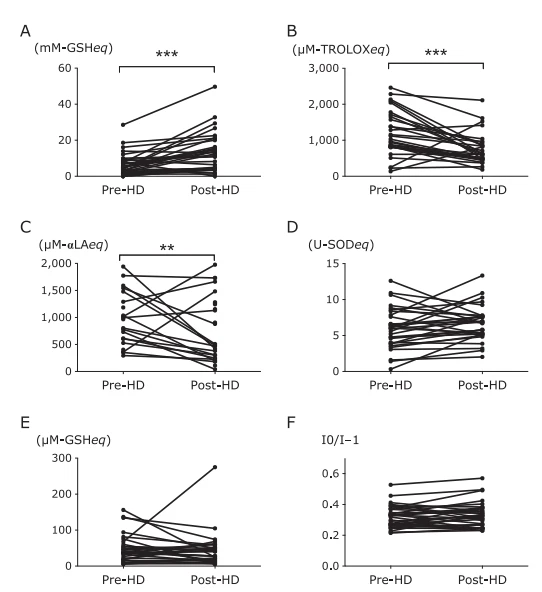
Ros scavenging activities were measured by MULTlS and i-STrap. First, we analyzed the changes in multiple ROS scavenging activities before and after HD in the entire patient cohort using the MULTIS method. The individual scavenging activity values are shown in Table 3, and the graphic depictions of changes in the pre- to post-HD values are shown inFig.1A-F. The "OH scavenging activity of the HD patients before dialysis was 6.37 mM-GSHeg (95% CI: 4.16 to 8.59), a number consistent with the previously reported "OH scavenging activity in patients with stage 5 CKD.22 Scavenging activity was significantly improved after one HD session, and the difference between pre- and post-HD values was significant (mean difference: 6.9495% CI3.96 to 9.91,p<0.0001; Fig.1A). In contrast, scavenging activities against RO and ROOwere significantly altered after one HD treatment (for RO', mean difference -441,95% CI of difference -665 to -216, p<0.001Fig.1B; for ROO', mean difference -526, 95% CI of difference845 to -208,p=0.002, Fig.1C). There were no significant differences between pre-and post-HD serum scavenging activities against O," (mean difference 0.698, 95% CI of difference -0.202 to 1.60,p=0.124; Fig.1D)and'0,(mean difference-3.98,95% CI of difference -23.2 to 25.2,p=0.675; Fig.1E)The lipophilic scavenging activity showed no significant difference during the HD session (mean difference 0.0106,95%CI of difference -0.00988 to 0.0310,p=0.300; Fig.1F). Differences in the effect of hemodialysis on ROSscavenging activities depending on the presence or absence of diabetes. Since diabetes considerably contributes to the pathophysiological status of HD patients, we examined the impact of diabetes on ROS scavenging activities. An increase in "OH scavenging activity was observed in both the non-DM and DMgroups (mean difference 5.48,95% CI 1.72 to 9.23,p=0.007 forthe non-DM group; mean difference 9.08, 95% CI 3.79 to 14.40p=0.003 for the DM group; Fig.2A). Concurrently, a decrease inRO'scavenging activity was observed in both the non-DM andDM groups(mean difference -579,95% C -927 to -231.p=0.003 for the non-DM group; mean difference -245,95% C488 to -1.85,p=0.043 for the DM group; Fig. 2B).Conversely, a significant decrease in ROO was only observedin the DM group (mean difference -642, 95% CI -1113 to -170p=0.012 for the DM group; mean difference -433, 95% C-911to 45.1,p=0.073 for the non-DM group; Fig.2C). This tendencywas the same for the lipophilic carbon-centered radical (displayedas the 10/I-1 value), and the scavenging activity was significantlyreduced in only the DM group (mean difference 0.034,95%C0.002 to 0.065,p=0.039 for the DM group; mean difference0.005,95%CI-0.031 to 0.021,p=0.671 for the non-DM group:Fig.2F). There were no significant differences between pre.and post- HD serum scavenging activities against O,"(meandifference 0.621,95%Clofdifference -0.506 to 1.750,p=0.260for the non-DM group, mean difference 0.792, 95% CI of differ-ence -0.838 to 2.421,p=0.313 for the DM group; Fig. 2D) and'0,(mean difference 11.2,95% CI of difference -32.9 to 10.5.p=0.291 for the non-DM group; mean difference 8.98, 95% CI ofdifference -32.2 to 50.2,p=0.641 for the DM group; Fig.2E)The individual scavenging activity values are shown in Table 4To clarify the redox effect of hemodialysis, a radar chartsummarizing the changes in ROS scavenging activities caused by one HD session is shown in Fig. 3.

Discussion
Previous reports investigating the effects of HD treatment on the antioxidative status have yielded controversial results. Among these reports, few studies have investigated ROS involvement in the upstream oxidative stress-related reactions that occur during, Most reports investigating ROS studied non-specific radicals and only a few reports identified the type of ROS in detail. Moreover, most of these studies were limited to "OH and O,"-.(a1129.30)Previous reports evaluated 'OH and O, "scavenging activities using the ESR spin-trapping technique. (22.31)Consistent with our current result, we have previously reported that serum OH scavenging activity is reduced in HD patients and that a single HD session can restore this activity to the level equivalent to that seen in a healthy human.3n Although contradictory results have been reported on the effect of HD on "OH scavenging activity, previous studies using ESR have shown an increase in the scavenging activity, regardless of the generation method of the hydroxyl radicals.c23o Thus, we strongly suggest that the "OH scavenging activity may be restored by HD. The effect of HD on O," dynamics remains controversial. Several previous studies found increased production of O," in patients after HD.67,38) A previous report from our co-author revealed that O, "scavenging activity was enhanced in the sera of HD patients.e2)Conversely, the 0," scavenging activity of HD patients, analyzed by direct scavenging measurements or the O, "dismutase (SOD)enzyme assay, is reportedly higher in patients with CKD than in healthy individuals.2,3s39 Consistent with these reports, our results did not show remarkable changes in, "scavenging activity after a single session of HD. Moreover, long-term usage of the vitamin E-coated dialyzer, which directly;intradialyzer O, has enhanced 0, scavenging scavenges activity.s) Since the uremic condition itself is a highly oxidative state,(is) we suggest that the constant improvement against uremic oxidative stress is more influential than the O, production brought about by a single HD process. (1-3.4.40)The influences of RO' and ROO' in kidney diseases have rarely been investigated,(41-43) and no study has analyzed their association with HD. Our results showed that both ROO' and RO' scavenging activities deteriorated after a single HD session, suggesting an uncontrolled production of both radicals during HD. Although limited studies have investigated the pathophysiological role of ROOs in diseases, established reports have indicated their strong cytotoxicity, leading to carcinogenesis and cardiovascular damage.4l,445 ROO' are generated in a reaction between heme iron and lipid peroxide produced by spontaneous oxidation of
unsaturated fatty acid. (46) In a ferric nitrilotriacetate (Fe-NTA)induced renal carcinoma rat model, ROO" was detected in renal tissue. (4) Moreover, ROO has a longer half-life in vivo than other radicals in biological circumstances,(4) leading to further production of carbon-centered radicals. (47 Therefore, the control]of ROO" generation may be an important strategy for improving the survival rate of HD patients. Moreover, lipophilic carbon. centered radicals are cytotoxic and have relatively long half-lives. These radicals have been reported in acute lung injury and rat models of chronic alcohol-induced pancreatitis. (449) Scavenging activities against these two ROS may serve as crucial markers for the evaluation of biocompatibility.

There are several limitations in this study. First, our method evaluated ROS scavenging activity but did not directly detect the ROS themselves. Direct detection of ROS in biological samples is difficult, and there is a certain discrepancy between the dynamic of ROS and ROS scavenging activity. However, the measurement of scavenging activity against a specific ROS is a well-established method and can serve as an evaluating tool for ROS dynamics.(22s0-52) Thus, in the evaluation of ROS scavenging activity, the scavenging activities are converted to the equivalent unit of the specific scavenger against each ROs. The scavenging activity against the lipophilic carbon-centered radical is expressed as a 10/-1 value (see Materials and Methods). HD, hemodialysis, DM, diabetes Mellitus; Ros, reactive oxygen species; 95% Cl, 95% confidence interval; GsH, glutathione; TRoL0X, 6-hvdroxy-2,5,7,8-tetramethyichroman-2-carboxylic acid; aLA a-lipoic acid; SOD, superoxide dismutase; LCCR, lipophilic carbon-centered radical.

dialyzers containing polysulfone membranes. However, the characteristics of our study population are similar to that of the population of Japanese HD patients in terms of age, dialysis history, and distribution of primary diseases.63) Polysulfonedialyzers are the most biocompatible dialyzers and are widely used.36s3,s4) Thus, we believe that our study cohort reflects the general population of dialysis patients. Evaluations with other membrane materials are required in further studies.
In our results, scavenging activities against alkyl and lipophilic carbon-centered radicals measured by i-STrap were reduced only in the patients with DM, indicating that the deterioration of ROsscavenging activity was more remarkable in the DM group than in the non-DM group. Patients with DM have more unfavorable prognoses than non-DM patients due to higher cardiovascular complication rates. The pathophysiology of these complications is strongly associated with oxidative stress.s-s7) Thus, our results suggest that to improve the prognosis in HD patients with DM. The control of ROO" radical and carbon-center radical is a promising strategy.
Acknowledgments
This study was funded by the Promotional Project forSophistication of Education and Research of Tsukuba University of Technology under Grant Number H29-Division A-03 (to AH)We wish to thank Professor Yashige Kotake of the OklahomaMedical Research Foundation, USA, for his support during theMULTIS measurements, and Professor Takashi Moritake cancer. Lue Sun of the Department of Radiological Health Science Institute of Industrial Ecological Sciences, University of Occupational and Environmental Health, Japan, for their support during the i-STrap measurements. English language of this paper was proofread by Editage (www.editage.jp).
Conflict of interest
The authors report no biomedical financial interests or potential conflicts of interest relevant to this study.

References
Locatelli F, Canaud B, Eckardt KU, Stenvinkel P, Wanner C, Zoccali C. Oxidative stress in end-stage renal disease: an emerging threat to patient outcome. Nephrol Dial Transplant 2003;18:1272-1280.2 Liakopoulos V, Roumeliotis S, Zarogiannis S, Eleftheriadis T, Mertens PROxidative stress in hemodialysis: causative mechanisms, clinical implications, and possible therapeutic interventions. Semin Dia!2019; 32: 58-71.Stenvinkel P, Heimburger O, Paultre F, et al. The strong association between malnutrition, inflammation, and atherosclerosis in chronic renal failure.
KidneyInt1999:55: 1899-1911
Himmelfarb J, Stenvinkel P, lkizler TA, Hakim RM. The elephant in uremia: oxidant stress as a unifying concept of cardiovascular disease in uremia.Kidney Int2002;62:1524-1538.
Neirynck N, Glorieux G, Schepers E, Dhondt A, Verbeke F, VanholderR.Pm-inflammatory cytokines and leukocyte oxidative burst in Chronic kidney disease: culprits or innocent bystanders? Nephrol Dial Transplant2015:30:943-951.