Hydrothermal Preparation Method For Cistanche (Rou Cong Rong) Alcoholic Extract: Flash Steam Explosion + Vacuum Low‑Temperature Ethanol–Water Extraction (Patent‑Style Technical Blog)
Sep 22, 2026
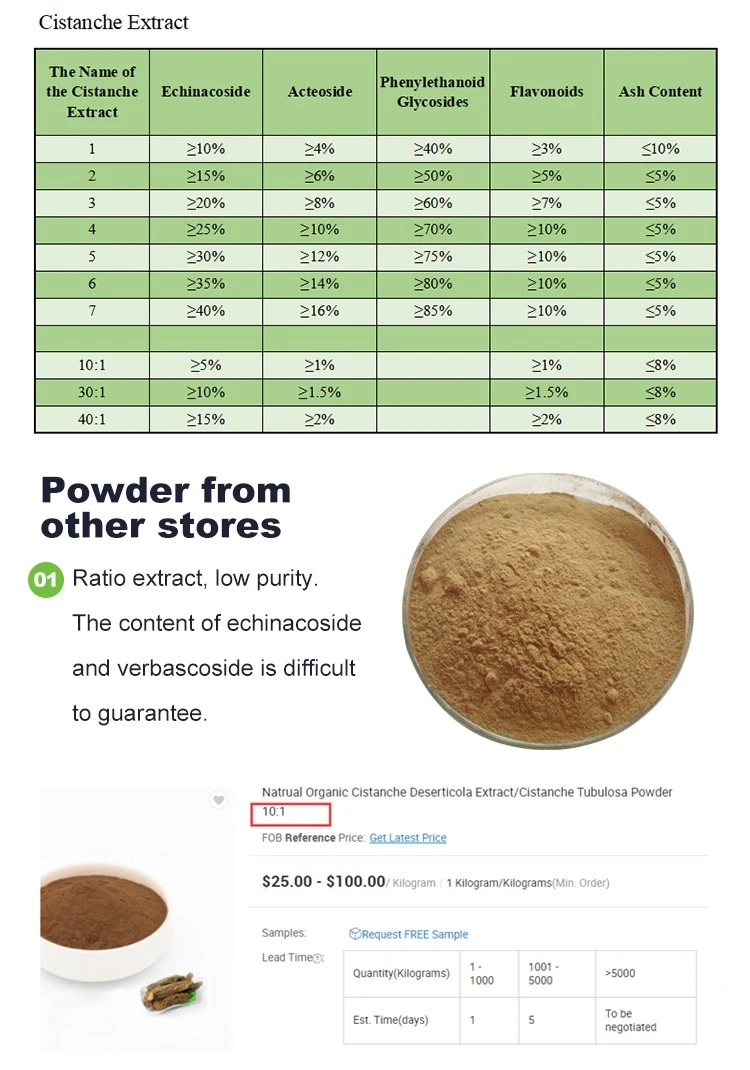
Industry focus (SEO): Cistanche extract / botanical extract / herbal extract / ethanol–water extraction / vacuum extraction / low‑temperature extraction / hydrothermal pretreatment / steam explosion (air‑blast) / phenylethanoid glycosides (echinacoside, acteoside/verbascoside) / polysaccharides / functional beverage base / liqueur (herbal wine) ingredient / GMP‑ready scale‑up.
Invention Title (54)
A Hydrothermal Preparation Method for Cistanche (Rou Cong Rong) Alcoholic Extract Solution
Abstract (57)
This invention discloses a hydrothermal preparation method for producing Cistanche alcoholic extract solution, belonging to the field of herbal liqueurs (medicated/functional infused wines). In this method, dried Cistanche slices are first subjected to flash steam explosion (instant air/steam‑blast) pretreatment, followed by dual‑system vacuum maceration extraction using an ethanol–water solvent system, thereby obtaining a Cistanche extract solution.
The method innovatively combines steam‑explosion pretreatment with vacuum, low‑temperature extraction, effectively improving the extraction efficiency of active constituents in Cistanche. Under optimal steam‑explosion conditions, compared with extraction without pretreatment, the extraction yield of phenylethanoid glycosides (marker components echinacoside and acteoside/verbascoside) increased by 93.5%, and the extraction yield of polysaccharides increased by 92.6%. These results demonstrate that the method can be applied to preparing Cistanche extract solutions for liqueur production, greatly improving raw‑material utilization efficiency and providing potential commercial value.
1. Claims
Claim 1
A hydrothermal preparation method for Cistanche alcoholic extract solution, characterized by:
subjecting dried Cistanche slices to steam‑explosion pretreatment, and then performing dual‑system vacuum maceration extraction using ethanol and water, to obtain a Cistanche extract solution.
Claim 2
The method according to Claim 1, comprising the following steps:
Step 1: Washing
After slicing Cistanche, rinse with cold water to remove bottom residues, then dry.
Step 2: Steam‑Explosion Pretreatment
Weigh and transfer the dried Cistanche slices into an instant steam‑explosion unit; add a certain amount of water; seal and set operating parameters; after completion, rapidly transfer the treated material out of the unit.
Step 3: Maceration Extraction
Perform dual‑system vacuum maceration extraction using ethanol and water: add the steam‑exploded Cistanche material into extraction solvent and conduct continuous low‑temperature extraction under vacuum to obtain a Cistanche extract solution.
Claim 3
The method according to Claim 2, wherein in Step 2, for steam‑explosion operation, 100 g of Cistanche slices are used and the added water amount is 25–80 wt%.
Claim 4
The method according to Claim 2, wherein in Step 2, the steam‑explosion temperature is 110–150 °C, held for 5–30 min.
Claim 5
The method according to Claim 4, wherein in Step 2, the steam‑explosion temperature is 120–135 °C, and the holding (temperature/pressure) time is 10–15 min.
Claim 6
The method according to Claim 2, wherein in Step 3, the extraction solvent is 50–70% (v/v) ethanol–water prepared from food‑grade ethanol, and the solvent addition ratio is 0.03–0.1 kg/L.
Claim 7
The method according to Claim 6, wherein in Step 3, the extraction temperature is 50–70 °C, the vacuum range is −0.03 to −0.05 MPa, and continuous extraction lasts 3 h.
2. Technical Field
This invention belongs to the field of herbal liqueurs (medicated/functional infused wines) and specifically relates to a hydrothermal preparation method for producing Cistanche alcoholic extract solution.
3. Background (From Traditional Extraction to Scalable Botanical Extract Manufacturing)
With the rapid growth of the global health and wellness industry, medicinal–edible herbs are increasingly used in functional liqueurs and botanical beverages. Cistanche (Rou Cong Rong) is a traditional premium tonic herb, with functions including supporting kidney‑yang, nourishing essence and blood, and moistening the intestines. It is often referred to as "desert ginseng".
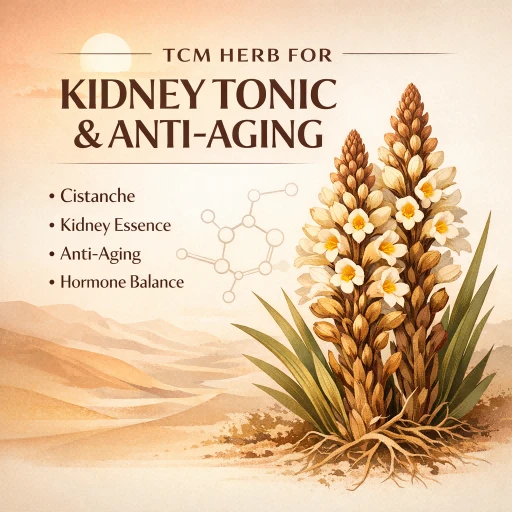
Modern pharmacological studies indicate that Cistanche's key functional constituents include:
Phenylethanoid glycosides (PhGs) - marker compounds echinacoside and acteoside (verbascoside)
Iridoids, lignans, polysaccharides, flavonoids, and alkaloids
Cistanche API IN HEALTH FOOD APPILICATION
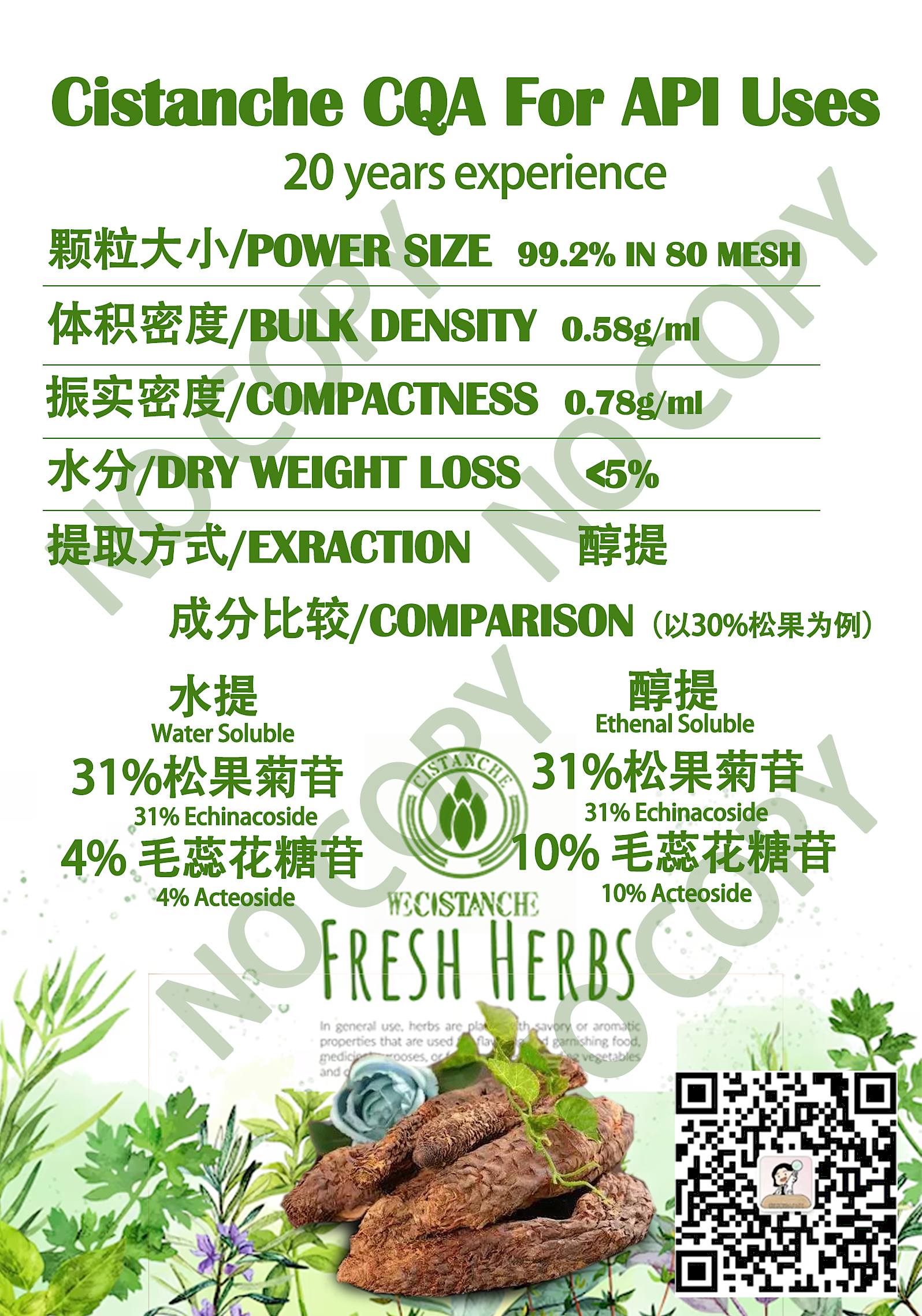
These compounds have reported activities such as anti‑fatigue, antioxidant, neuroprotective, immunomodulatory, and hepato‑renal protective effects, making Cistanche a strong candidate ingredient for functional botanical extract solutions and liqueur base concentrates.
Limitations of conventional extraction methods in industrial production
Maceration (soaking): simple and retains flavor, but slow, low mass transfer, and often yields <40% extraction efficiency for key PhGs because Cistanche tissue has a dense cell wall matrix.
Percolation: higher efficiency but high solvent consumption, long cycle time, complex operation, and difficult continuous scale‑up.
Decoction / hot reflux: higher temperature accelerates extraction but PhGs are thermally sensitive, and prolonged heating can cause degradation; polysaccharides can gelatinize and reduce clarity-undesirable for high‑quality extract solutions.
Various assisted extraction technologies (supercritical CO₂, Soxhlet, ultrasound, microwave, pulsed electric fields, enzymes, flash extraction, HSCCC, aqueous two‑phase, resin adsorption, etc.) can be effective but often face constraints in cost, throughput, consumables, and industrial scale‑up.
4. Invention Summary (Core Process Logic)
This invention solves the "dense cell wall + low mass transfer" bottleneck by:
Hydrothermal flash steam explosion (physical cell disruption)
Followed by vacuum, low‑temperature ethanol–water extraction (higher PhGs retention + polysaccharide compatibility)
Under optimized steam‑explosion conditions, compared to non‑treated extraction, the method improves:
Echinacoside + Acteoside/Verbascoside extraction by 93.5%
Crude polysaccharides extraction by 92.6%
Additionally, it is designed for process compatibility with common food/pharma equipment, enabling easier integration into existing lines for botanical extract or herbal liqueur production.
5. Detailed Method (Process Steps)
Step 1 - Washing
Slice Cistanche material.
Rinse with cold water to remove bottom residues.
Dry the material.
Step 2 - Steam‑Explosion Pretreatment (Hydrothermal "Air‑Blast")
Weigh dried slices and load into an instant steam‑explosion unit.
Add water (typically 25–80 wt%, based on 100 g slices).
Seal and run with controlled parameters:
Temperature: 110–150 °C
Holding time: 5–30 min
Recommended: 120–135 °C, 10–15 min
After holding, shut down and release pressure instantly to complete the explosion, then quickly unload material.
Additional operating notes:
Total fill (material + water) should not exceed 60–80% of reactor volume.
Peak pressure during operation is typically monitored within 0.35–1.0 MPa.
Step 3 - Vacuum Ethanol–Water Extraction (Dual‑System Maceration)
Prepare solvent: 50–70% (v/v) ethanol–water, made from food‑grade ethanol.
Solvent addition ratio: 0.03–0.1 kg/L.
Extract under:
Temperature: 50–70 °C
Vacuum: −0.03 to −0.05 MPa
Continuous extraction time: 3 h
Collect extract solution for further use (e.g., blending into liqueur base).
Step 4 - Active Constituent Testing
Analyze the extract solution for:
Phenylethanoid glycosides (echinacoside + acteoside/verbascoside)
Total flavonoids
Crude polysaccharides
Compare extraction efficiency with extract made from non‑steam‑exploded Cistanche.
6. Formulas (from the original specification)
6.1 Phenylethanoid Glycosides Content Calculation (HPLC)
The total target content WWW (mg/L) is calculated as:
W=(C−C0)×V×NmW = \frac{(C - C_{0}) \times V \times N}{m}W=m(C−C0)×V×N
Where:
WWW: total amount of target analyte in the sample (mg/L)
CCC: concentration of target analyte in the test solution (mg/L)
C0C_{0}C0: concentration of target analyte in the blank control (mg/L)
VVV: final volume after volumetric dilution (mL)
NNN: dilution factor
mmm: sample volume taken for analysis (mL)
6.2 Crude Polysaccharides Calculation
The crude polysaccharide content XXX is calculated as:
X=m1×V1×0.9m×V2×1000×100X = \frac{m_{1} \times V_{1} \times 0.9}{m \times V_{2} \times 1000}\times 100X=m×V2×1000m1×V1×0.9×100
Where:
m1m_{1}m1: mass of crude polysaccharides in the aliquot (converted from absorbance)
V1V_{1}V1: total volume of the processed solution (mL)
mmm: sample mass (g)
V2V_{2}V2: volume of solution used for colorimetric measurement (mL)
Note: The factor 0.9 and the 1000 unit conversion are kept exactly as in your provided text for specification fidelity.
7. Experimental Examples (Industrial‑Friendly Parameter Windows)
Example 1 (QBRC‑1)
Cistanche slices: 100 g (dried)
Add water: 75 mL
Steam explosion: 110 °C, 10 min
Combine 3 repetitions
Extraction: place material in nonwoven bag → into 100 L explosion‑proof basket extractor
Solvent: 10 L of 60% (v/v) ethanol–water
Conditions: 65 °C, reduced pressure to boiling, continuous extraction 3 h
Product name: QBRC‑1
Example 2 (QBRC‑2)
Same as Example 1, except:
Steam explosion: 120 °C, 10 min
Product name: QBRC‑2
Example 3 (QBRC‑3)
Same as Example 1, except:
Steam explosion: 130 °C, 10 min
Product name: QBRC‑3
Example 4 (QBRC‑4)
Same as Example 1, except:
Steam explosion: 140 °C, 10 min
Product name: QBRC‑4
Example 5 (QBRC‑5)
Same as Example 1, except:
Steam explosion: 150 °C, 10 min
Product name: QBRC‑5
Comparative Example 1 (DZ, No Pretreatment)
Cistanche slices: 300 g (dried), no steam explosion
Extraction: 10 L of 60% (v/v) ethanol–water
Conditions: 65 °C, reduced pressure to boiling, continuous extraction 3 h
Product name: DZ
8. Analytical Methods (Quality Control for Cistanche Extract)
8.1 Phenylethanoid Glycosides (HPLC)
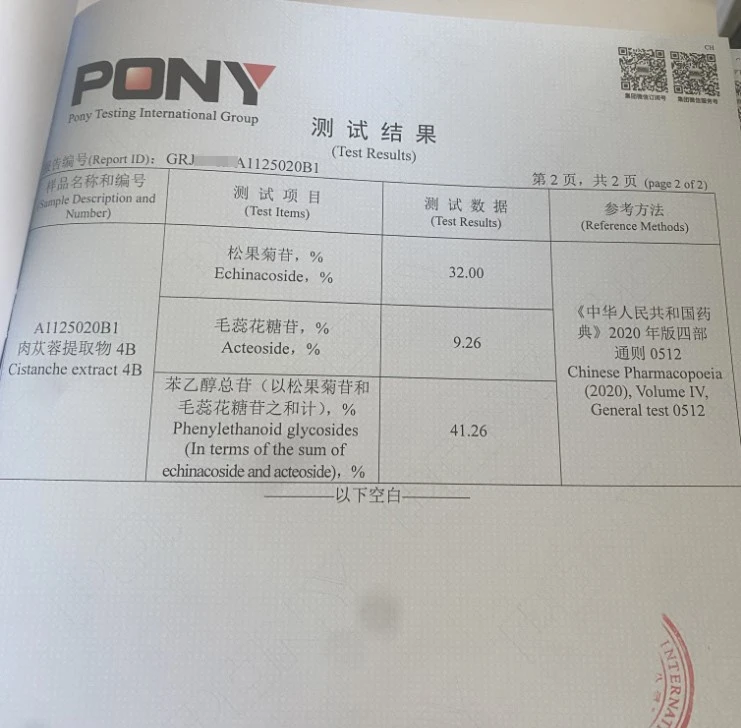
Referring to Chinese Pharmacopoeia (2025 edition), determine PhGs via HPLC. Prepare sample, filter through membrane, and inject for analysis. Calculate content using the formula provided above.
CISTANCHE EXTRACT TESTING BASED ON Chinese Pharmacopoeia (2025 edition)
8.2 Crude Polysaccharides (Phenol–Sulfuric Acid Method)
Weigh 5 g sample.
Add 5 mL water, vortex, then add 20 mL absolute ethanol; ultrasonically wash 30 min; centrifuge.
Wash precipitate with 80% ethanol for 30 min; centrifuge.
Add water to the precipitate and ultrasonicate for 90 min; bring to 50 mL.
Take aliquot, adjust to 1 mL; add 1 mL phenol solution; add 5 mL sulfuric acid.
Stand 10 min, mix well; water bath at 30 °C for 20 min.
Measure absorbance at 490 nm; convert absorbance to m1m_{1}m1 and compute crude polysaccharides with the formula above.
9. Reported Results (Mechanism‑Driven Interpretation)
When steam‑explosion temperature does not exceed 140 °C, PhGs (echinacoside + acteoside/verbascoside) are significantly higher than the non‑treated group (DZ).
At 130 °C (QBRC‑3), PhGs reached 68.1 mg/L vs 35.2 mg/L in DZ, i.e., +93.5% improvement.
Crude polysaccharides peak at 130 °C: 148.9 mg/L vs 77.3 mg/L in DZ, i.e., +92.6% improvement.
At higher temperatures, polysaccharides drop sharply, likely due to carbonization and structural damage under high temperature and pressure.
Microscopy observations indicate that steam‑exploded Cistanche exhibits heavily disrupted cell walls and dispersed block‑like structures, which improves release and mass transfer of intracellular constituents during extraction.
10. Why This Matters for a Cistanche Extract Factory (Scale‑Up + Productization)
Key advantages for industrial botanical extract production
High cell‑wall disruption efficiency (physical, no enzymes/chemicals): improves mass transfer and raw‑material utilization.
Production‑line compatibility: uses common food/pharma equipment (steam‑explosion unit + vacuum extractor), reducing CAPEX compared with high‑cost "new tech" solutions.
Extract solution ready for liqueur blending: ethanol–water solvent matches the liqueur base system, reducing downstream solvent removal and minimizing losses of actives and flavor.
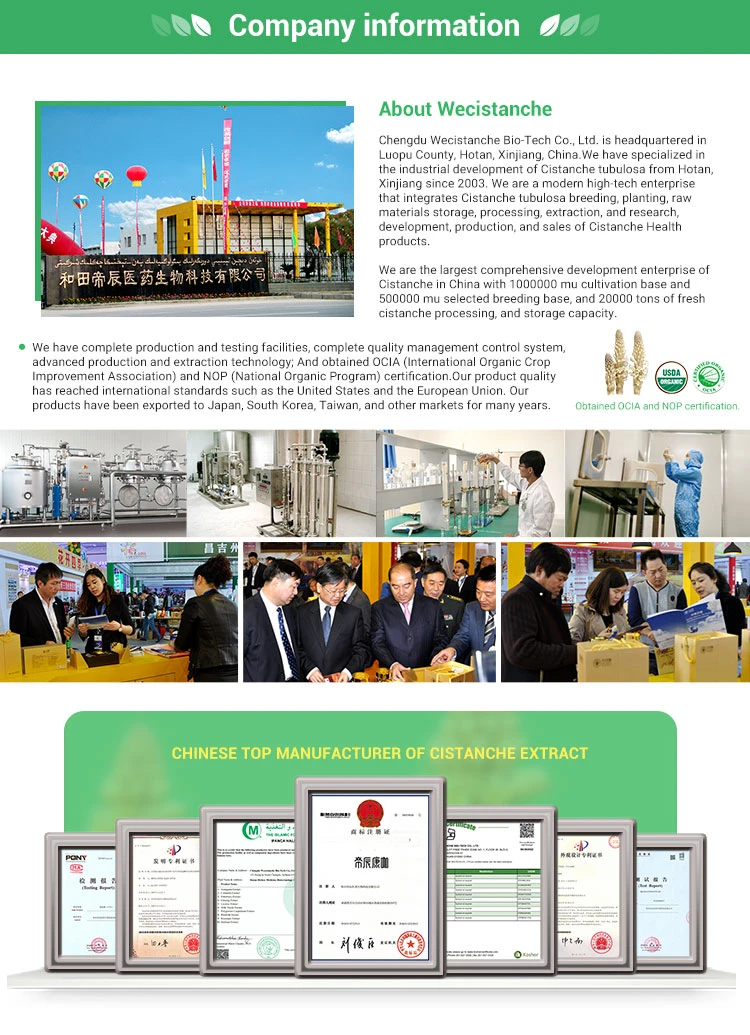
Wecistanche Factory
click the picture to get more details about cistanceh extract factory
11. SEO Keyword Bank (Plant Extract Industry Keywords You Can Reuse)
Primary keywords:
Cistanche extract, Rou Cong Rong extract, Cistanche tubulosa extract
herbal extract solution, botanical extract manufacturer, plant extract factory
ethanol–water extraction, hydroalcoholic extraction, vacuum extraction, low‑temperature extraction
steam explosion pretreatment, hydrothermal pretreatment, cell wall disruption
Active compounds & QC keywords:
phenylethanoid glycosides (PhGs)
echinacoside, acteoside, verbascoside
polysaccharides, crude polysaccharides
HPLC assay, Chinese Pharmacopoeia, quality control, marker compounds
Application keywords:
herbal liqueur ingredient, functional beverage base
nutraceutical ingredient, functional food additive
12. Suggested Blog URL (Slug)
/blog/cistanche-alcoholic-extract-hydrothermal-steam-explosion-vacuum-extraction