Yiqi Wenshen Tonglong Decoction Improves BPH in Rats By Modulating IL‑6, COX‑2, E‑cadherin, And N‑cadherin — What Is The Best Herbal For Prostate? With Cistanche Tubulosa Insights
Dec 30, 2025
Executive note for herbal developers
Signal: Robust, dose‑dependent improvements in a testosterone‑induced BPH rat model using a classic TCM formula (Yiqi Wenshen Tonglong Decoction, YWTD). Markers moved in the same direction as standard therapy (finasteride).
Mechanisms validated: Anti‑inflammatory (↓IL‑6, ↓COX‑2) and anti‑EMT/pro‑epithelial remodeling (↑E‑cadherin, ↓N‑cadherin).
Product concept: A science‑messaged herbal SKU for "prostate comfort + healthy urinary flow + vitality," with Cistanche tubulosa as a hero ingredient given its evidence on IL‑6/TNF‑α, antioxidant protection, and steroidogenesis support.
Plain‑English translation of the study section (Results, Discussion, References)
Figure 1. Morphological features of prostate tissue in each group (HE staining, ×200)


Results
2.1 General condition across groups
Normal group: Good spirit, glossy fur, normal appetite, and weight gain.
BPH group: Poor spirit, reduced appetite, rough skin, dull/yellowish fur, and no obvious weight change.
Treatment groups: Clear improvement versus BPH; no deaths in any group.

2.2 Prostate index across groups
BPH vs Normal: Prostate wet weight and prostate index were significantly increased (P < 0.05).
Versus BPH: The positive drug group (finasteride) and YWTD low, medium, and high doses significantly reduced prostate wet weight and index in a dose‑dependent manner (P < 0.05) (Table 1).
2.3 Effects of YWTD on prostate IL‑6, COX‑2, E‑cadherin, and N‑cadherin mRNA
BPH vs Normal: IL‑6, COX‑2, and N‑cadherin mRNA were significantly upregulated; E‑cadherin mRNA was significantly downregulated (P < 0.05).
Versus BPH: The positive drug and all YWTD doses significantly lowered IL‑6, COX‑2, and N‑cadherin mRNA and significantly increased E‑cadherin mRNA, with dose dependence (P < 0.05) (Table 1).

2.4 Histopathology of prostate tissue
Normal: Normal architecture; orderly epithelium; no obvious hyperplasia of smooth muscle/fibrous tissue.
BPH: Disorganized architecture; vascular congestion and edema in the stroma; markedly narrowed glandular lumens; extensive fibrous hyperplasia.
Positive drug and high‑dose YWTD: No obvious tissue destruction; most glandular lumens returned toward normal.
Low‑dose YWTD: Mild tissue injury; some edema and congestion.
Medium‑dose YWTD: No obvious tissue damage; small amount of inflammatory cell infiltration (Figure 1).
2.5 SP immunohistochemistry for IL‑6, COX‑2, E‑cadherin, and N‑cadherin
Versus BPH, the Normal group showed less brown staining overall; IL‑6, COX‑2, and N‑cadherin positive rates were significantly lower, while E‑cadherin was significantly higher (P < 0.05).
Versus BPH, positive drug and all YWTD doses significantly reduced IL‑6, COX‑2, and N‑cadherin positive rates and significantly increased E‑cadherin, dose‑dependently (P < 0.05) (Figure 2, Table 2).
2.6 Western blot for IL‑6, COX‑2, E‑cadherin, and N‑cadherin protein
BPH vs Normal: IL‑6, COX‑2, and N‑cadherin were significantly increased; E‑cadherin was significantly decreased (P < 0.05).
Versus BPH: Positive drug and all YWTD doses significantly decreased IL‑6, COX‑2, and N‑cadherin and significantly increased E‑cadherin, dose‑dependently (P < 0.05) (Table 2, Figure 3).
TCM HERB FORMULA CISTANCHE SUPPLEMENTS

Figure 2. Expression of IL-6, COX-2, E-cadherin, and N-cadherin in each group (SP staining, ×200)


Table 2. Comparison of IL-6, COX-2, E-cadherin and N-cadherin Positive Expression Rates and Protein Expression Levels in Each Group (x̄±s, n = 5)
| Group | IL-6 (%) | COX-2 (%) | E-cadherin (%) | N-cadherin (%) | IL-6 Protein | COX-2 Protein | E-cadherin Protein | N-cadherin Protein |
|---|---|---|---|---|---|---|---|---|
| Normal Group | 11.23 ± 2.05 | 8.62 ± 1.42 | 41.62 ± 3.42 | 5.21 ± 1.46 | 0.23 ± 0.05 | 1.13 ± 0.12 | 0.13 ± 0.02 | 0.21 ± 0.04 |
| BPH Group | 32.36 ± 4.17¹ | 26.73 ± 2.41¹ | 13.32 ± 3.52¹ | 21.65 ± 3.01¹ | 1.45 ± 0.09¹ | 1.87 ± 0.10¹ | 0.19 ± 0.04¹ | 0.98 ± 0.08¹ |
| Positive Drug Group | 14.25 ± 2.13² | 12.33 ± 1.86² | 35.12 ± 2.70² | 10.43 ± 2.04² | 0.40 ± 0.07² | 1.45 ± 0.12² | 0.22 ± 0.05² | 0.33 ± 0.04² |
| Low Dose Treatment | 27.61 ± 3.20²³ | 21.05 ± 2.25²³ | 25.42 ± 2.78²³ | 15.62 ± 2.30²³ | 1.05 ± 0.08²³ | 1.73 ± 0.15²³ | 0.27 ± 0.07²³ | 0.76 ± 0.08² |
| Medium Dose Treatment | 21.42 ± 2.12²³⁴ | 16.42 ± 1.95²³⁴ | 30.51 ± 2.37²³⁴ | 12.54 ± 2.23²³⁴ | 0.76 ± 0.10²³⁴ | 1.60 ± 0.08²³⁴ | 0.31 ± 0.05²³⁴ | 0.57 ± 0.06²³⁴ |
| High Dose Treatment | 14.65 ± 2.03²³⁴ | 11.35 ± 1.74²³⁴ | 37.62 ± 2.85²³⁴ | 9.23 ± 1.65²³⁴ | 0.33 ± 0.09²³⁴ | 1.38 ± 0.07²³⁴ | 0.35 ± 0.08²³⁴ | 0.40 ± 0.07²³⁴ |
| F value | 46.805 | 49.507 | 28.135 | 19.440 | 106.003 | 97.656 | 112.444 | 134.917 |
| P value | < 0.001 | < 0.001 | < 0.001 | < 0.001 | < 0.001 | < 0.001 | < 0.001 | < 0.001 |
Statistical Notes:
¹ P < 0.05 vs. Normal Group
² P < 0.05 vs. BPH Group
³ P < 0.05 vs. Positive Drug Group
⁴ P < 0.05 vs. Medium Dose Treatment Group
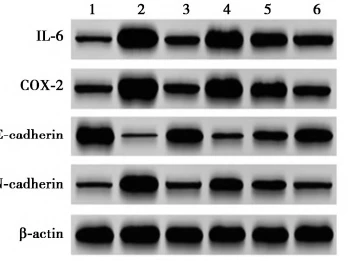
Figure 3. Western blot analysis of IL-6, COX-2, E-cadherin, and N-cadherin protein expression in each group
Discussion
Benign prostatic hyperplasia (BPH) is common in older men and rising in prevalence. Given side effects with pharmaceuticals, safer effective options are needed. In TCM, BPH aligns with the "long bi" pattern involving kidney Qi yang deficiency, Qi stagnation with blood stasis, and damp‑heat accumulation. YWTD, composed of Chi Shao, Rou Gui, Xiang Fu, Tu Si Zi, Huang Qi, Dan Shen, Ze Xie, Hu Po, etc., aims to tonify kidney Qi, move blood, relieve pain and swelling, and promote urination. This study shows YWTD improves prostate enlargement in BPH rats.
Inflammation is tightly linked to BPH. Many surgical BPH specimens show chronic inflammation, and serum IL‑6/IL‑8 are elevated. Inflammatory cascades damage prostate tissue and disturb the balance of cell death and proliferation, driving hyperplasia. IL‑6 is a key cytokine; COX‑2 is an inducible enzyme upregulated during inflammation and implicated in BPH progression; inhibiting COX‑2 can ameliorate enlargement. Here, YWTD likely improves BPH partly by suppressing inflammatory mediators IL‑6 and COX‑2.
Epithelial‑mesenchymal transition (EMT) is also relevant in BPH progression, typically characterized by decreased E‑cadherin and increased N‑cadherin. E‑cadherin maintains epithelial adhesion and architecture; N‑cadherin shifts cells toward a mesenchymal phenotype. Suppressing EMT can alleviate BPH features. This study suggests YWTD may improve BPH by inhibiting EMT (↑E‑cadherin, ↓N‑cadherin).
Conclusion
YWTD improves experimental BPH in rats by downregulating IL‑6, COX‑2, and N‑cadherin and upregulating E‑cadherin, with dose‑dependent effects.
References
Zhu W‑X, Yuan Y‑F, Zhang X, et al. Effect of cirbamazine on Hedgehog pathway factors in BPH rats. Chongqing Med, 2022;51(8):1266–71.
Miernik A, Gratzke C. Current treatment for benign prostatic hyperplasia. Dtsch Arztebl Int, 2020;117(49):843–54.
Tu M‑L, Yang X‑G, Zhuang T‑T. Effects of Epimedium on BPH rats and autophagy proteins Beclin‑1, LC3. Shizhen TCM Materia Medica, 2020;31(5):1102–6.
Lloyd GL, Ricke WA, McVary KT. Inflammation, voiding and BPH progression. J Urol, 2019;201(5):868–70.
Chen Y, Xu H, Shi Q, et al. HIF‑1α mediates EMT in BPH. Int J Clin Exp Pathol, 2019;12(1):295–304.
Song H, Shen Q, Hu S, et al. MIF promotes BPH epithelial cell growth via COX‑2 and P53 signaling. Biol Open, 2020;9(11):1–7.
Zhang Y‑J, Hou J‑M, Luo X‑N, et al. Effects of Yishen Huoxue Granules on Caspase‑3 and bFGF in BPH rats. Chin Patent Med, 2017;39(5):906–11.
Song KH, Seo CS, Yang WK, et al. Phyllostachys pubescens leaf extract represses 5‑α‑reductase 2 and ameliorates testosterone‑induced BPH in rats. Nutrients, 2021;13(3):884–97.
Yuan Y‑F, Fu X‑W, Zhu W‑X, et al. Effects of Yiqi Huoxue Xiaozheng Formula on apoptosis in BPH rats. Chin J TCM Info, 2018;25(9):52–5.
Yuan Y‑F, Li Y, Zhu W‑X, et al. Effects of Qianlongtong Capsules on prostate histomorphology in BPH rats. J Tradit Chin Med, 2018;59(19):1685–8.
Zhou Y, Li H‑S, Xie Z‑Y, et al. Effects of Yishen Tonglin Formula on PI3K/Akt/mTOR signaling in BPH rats. Chin J TCM Info, 2019;26(7):56–9.
Chen H, Wu X‑M. Serum inflammatory factors, TGF‑β1, PSA and PSAD in elderly BPH. Chin J Gerontol, 2018;38(4):860–1.
Sun S, Chen M. Role of chronic inflammation in BPH progression. J Southeast Univ (Med), 2019;38(6):1082–6.
Raafat M, Kamel AA, Shehata AH, et al. Aescin protects against experimental BPH via suppressing cytokines and COX‑2. Pharmaceuticals (Basel), 2022;15(2):130–49.
Zhou H, Yang X, Li B, et al. Effects of Yishen Tonglong Capsules on COX‑2 and PGE2 in BPH rats. J Shanxi Univ TCM, 2020;21(1):14–7,22.
Liu D, Liu J, Li Y, et al. BMP5 upregulation enhances proliferation and EMT in BPH via BMP/Smad. Prostate, 2021;81(16):1435–49.
Zhang B, Chen X, Xie C, et al. Leptin promotes EMT in BPH via BAMBI downregulation. Exp Cell Res, 2020;387(1):1–7.
Kim Y, Lee D, Jo H, et al. GV1001 interacts with AR to inhibit BPH cell proliferation by regulating EMT molecules. Aging (Albany NY), 2021;13(3):3202–17.
Chen T, Wang J, Huang W‑T. Inhibitory effect and mechanism of MMI‑0100 on BPH in rats. Herald Med, 2022;41(5):603–7.
Positioning for the query: What is the best herbal for prostate?
There is no single "best" for every man, but the most evidence‑aligned approach targets:
Inflammation and oxidative stress: reduce IL‑6/COX‑2 and ROS.
Tissue remodeling: shift EMT back to an epithelial phenotype (↑E‑cadherin, ↓N‑cadherin).
Hormone/vitality support when appropriate.
Two complementary routes:
Standardized single‑herb backbone: Cistanche tubulosa (肉苁蓉)
From the referenced article (Dec 27, 2024, Chengdu Wecistanche Bio‑Tech Co., Ltd.):
Echinacoside and acteoside reduce inflammatory markers (TNF‑α, IL‑6) and oxidative stress; DPPH assays show ROS scavenging.
Restores key steroidogenic proteins (StAR, CYP11A1, CYP17A1, HSD17β3) suppressed by AGEs; echinacoside performed especially well on HSD17β3.
Improves sperm count and motility in diabetic rat models; high‑dose Cistanche outperformed a comparator on motility.
Gentle for long‑term use; convenient capsules or powder.
Practical takeaway: Cistanche can serve as the hero ingredient addressing inflammation and vitality - a compelling answer when consumers ask "What is the best herbal for prostate?"
Evidence‑based multi‑herb TCM pattern: YWTD (as preclinical proof)
In this rat model, YWTD significantly lowered IL‑6/COX‑2/N‑cadherin and raised E‑cadherin; improved histology and prostate index, dose‑dependently - mechanistic validation of anti‑inflammation and anti‑EMT.
Developer‑oriented optimization for a science‑messaged blog and product brief
Core claim (structure/function, not disease): "Supports prostate health, healthy urinary flow, and male vitality."
Hero ingredient: Cistanche tubulosa extract standardized to echinacoside and acteoside.
Supportive botanicals (optional, keep concise): Salvia miltiorrhiza (microcirculation), Alisma (urinary flow), small‑dose Cinnamomi cortex (comfort/circulation).
Preclinical checkpoints:
In TP‑induced BPH rats: prostate index, HE histology, IL‑6/COX‑2, E‑ and N‑cadherin; add oxidative stress markers (SOD, catalase).
Pilot human feasibility (8–12 weeks, men 40–70 with moderate LUTS):
Primary: IPSS total score, nocturia frequency, QoL.
Secondary: Qmax, PVR, safety labs.

Keywords for discoverability
What is the best herbal for prostate?
Cistanche tubulosa echinacoside acteoside prostate
IL‑6 COX‑2 E‑cadherin N‑cadherin BPH herbal
TCM formula prostate inflammation EMT
Natural prostate support urinary flow vitality
Citations (machine‑extractable)
Yiqi Wenshen Tonglong Decoction study (preclinical rat BPH): dose‑dependent reductions in IL‑6, COX‑2, N‑cadherin; increase in E‑cadherin; improved histology and prostate index; comparator finasteride 4.5 mg/kg. Methods: qRT‑PCR, IHC (SP), Western blot.
Cistanche reference (URL content used):
Chengdu Wecistanche Bio‑Tech Co., Ltd. Say Goodbye To Prostate Problems With Cistanche Tubulosa (肉苁蓉): A Natural, Science‑Backed Herbal Solution. Dec 27, 2024. https://www.xjcistanche.com/news/say-goodbye-to-prostate-problems-with-cistanch-83534746.html
Disclosure
The YWTD findings are from an animal model and require clinical confirmation in humans. Cistanche evidence cited includes preclinical and mechanistic data; human outcome studies for LUTS/BPH should be pursued to substantiate consumer claims in each market.