Identification And Authenticity Of Herbal Cistanche Deserticola
Jun 11, 2024
There are differences in the composition and efficacy of different medicinal materials and their adulterants of the genus Cistanche. To better evaluate the quality of Cistanche and ensure the efficacy of the medicinal materials and their products, it is necessary to distinguish them. At present, the evaluation of the quality of Cistanche deserticola mainly relies on the determination of the content of the indicator components of piloside and quercetin specified in the pharmacopeia. However, the chemical composition of traditional Chinese medicine is very complex, and the efficacy is not determined by any single active ingredient, but by the combined use of multiple active ingredients. Therefore, there are obvious shortcomings in evaluating the quality of Cistanche deserticola medicinal materials solely based on the content of two components. In addition, due to different growth environments, harvesting seasons, and processing methods, the quality and even clinical efficacy of Cistanche deserticola vary greatly. Therefore, it is necessary to establish a comprehensive and effective method for evaluating the quality of Cistanche deserticola.
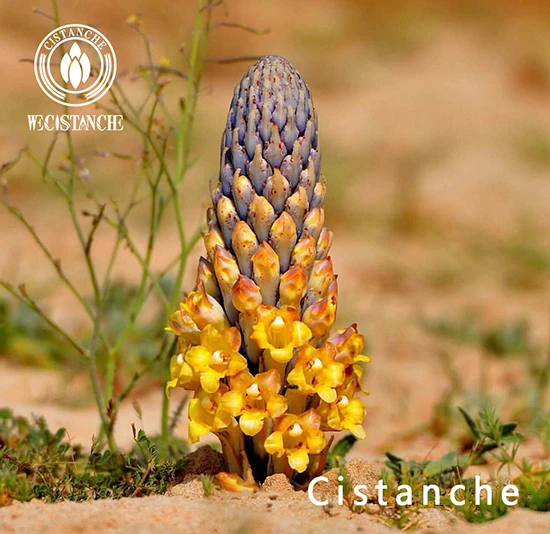
Cistanche deserticola Y.C.Ma
1, Identification and Authenticity of Herbal Cistanche deserticola
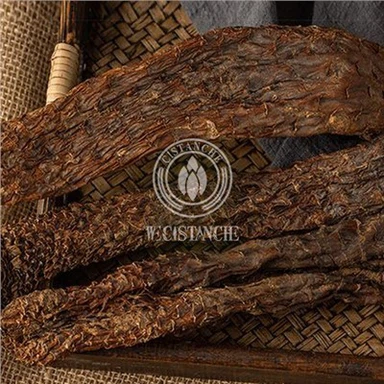
The identification research of Cistanche deserticola mainly involves distinguishing Cistanche deserticola from other medicinal herbs of the same genus, such as Salted Cistanche deserticola, White Flower Salt Cistanche deserticola, Sand Cistanche deserticola, and Tubular Cistanche deserticola, as well as common confusion products such as Suoyang and Grass Congrong. According to the Pharmacopoeia, it is a flat cylindrical shape, slightly curved, 5-20cm long or more, with a diameter of 2-8cm. The surface is brownish or grayish brown, densely covered with fleshy scales arranged in a tile-like pattern, usually with the tip of the scales broken. Weight, hard texture, slightly flexible, not easily broken, with a brownish cross-section and light brown dotted vascular bundles arranged in a wavy ring pattern. Mild breath, sweet taste, and slightly bitter. However, this description is difficult to distinguish from plants of the same genus and their confusions, so identification and identification research need to be carried out using microscopic, thin-layer, and other methods.

benefits of cistanche tubulosa
1. Microscopic identification
The epidermis of Cistanche deserticola is a layer of flat cells, covered by a thin stratum corneum. The vascular bundles of the central column in the transverse section of the stem are arranged in a wavy band; The stem vascular sheath does not have phloem fibers; Scaly leaf vascular bundles 5 bundles, unbranched; Starch granules are spherical, quasi-spherical, or irregularly long oval shaped, with larger starch granules. The navel points are mostly in the form of dots, cracks, and tridents, and the larger starch grain layers have obvious and very few complex grains, which are composed of 2-part grains. Zhang Mian et al. [4] used trait identification and microscopic digital imaging technology to conduct digital microscopic identification of commercial medicinal materials such as Cistanche deserticola (including Cistanche deserticola, Saline Cistanche deserticola, and Tubular Cistanche deserticola) from 10 regions across the country. The characteristics of epidermal cells, stratum corneum, vascular bundles, vascular bundle sheaths, and the ratio of phloem to xylem in digital photos can truly and intuitively reflect the differences in the microstructure of different medicinal materials.

Cistanche deserticola Y.C.Ma
2. Thin layer chromatography identification
The thin-layer chromatography conditions in the Pharmacopoeia are as follows: using quercetin and piloside as reference substances, methanol acetic acid water (2:1:7) as the developing agent, point on the same polyamine thin-layer plate, and examine under ultraviolet light (365 nm). It is found that fluorescent spots of the same color appear in the chromatogram of the test substance at the corresponding positions of the control substance. The content of betaine in Cistanche deserticola is relatively high, so some studies have selected betaine as a reference substance for identification. Take the standard sample of betaine hydrochloride, use methanol acetic acid (8:2) as the developing agent, and use the improved potassium bismuth iodide test solution as the chromogenic agent. The results show that only Cistanche deserticola contains spots in the same position as betaine.

Cistanche deserticola
Click here to view Cistanche deserticola tea products
【Ask for more】 Email:cindy.xue@wecistanche.com / Whats App: 0086 18599088692 / Wechat: 18599088692
3. Spectral method
Spectral methods have the advantages of being intuitive, simple, and fast, and play an important role in identifying traditional Chinese medicinal materials. Zhong Shijie et al. used infrared spectroscopy to identify and analyze four types of Cistanche deserticola (Cistanche deserticola, Cistanche tubulosa, Cistanche salina, and Cistanche confusa) produced in Xinjiang. Three distinct bands were selected for comparative identification based on peak position and number. In addition, the difference in absorption peaks between the 60% ethanol extract of Cistanche deserticola and Saline Cistanche deserticola in the UV absorption spectrum wavelength range of 200-500nm can also distinguish the two.
4. Protein SDS-PAGE gel electrophoresis
Protein molecules controlled by genetic genes are commonly present in plant cells, and soluble proteins have strong heterogeneity and relative stability during plant development. Therefore, protein fingerprinting technology can be used for inter-species identification and classification. Chen Pei et al. used soluble protein SDS-PAGE gel electrophoresis to identify four species of Cistanche. The results showed that there were significant differences in the SDS-PAGE maps of four species of Cistanche, and the polymorphic bands were 81.82%. The SDS-PAGE spectrum of soluble proteins in the genus Cistanche can be used as a protein fingerprint for inter-species identification. This provides a new biochemical indicator and a new identification method for the inter-species identification of Cistanche deserticola. Using this method, the identification of different species of Cistanche deserticola has the advantages of simplicity, speed, accuracy, and trace amounts.
5. Fingerprint method
The fingerprint is a comprehensive and quantifiable identification model that effectively detects and controls the authenticity, consistency, and stability of traditional Chinese medicine products. Internationally, countries such as the US Food and Drug Administration (FDA) and the European Community also advocate the use of fingerprint technology for the quality evaluation of traditional Chinese medicine products. Jiang et al. applied the fingerprint method of high-performance liquid chromatography diode array detector mass spectrometry to identify medicinal materials of the genus Cistanche. Principal component analysis was used to compare Cistanche with other medicinal materials of the genus Cistanche. Additionally, based on the comparison of their retention time, UV spectra, and data from electrode array detector mass spectrometry, 18 main peaks were identified on the fingerprint. Xia Pengxiao et al. used ergosterol as a reference and Shim pack VP ODS chromatography column (4.6 × 150mm, 5 μ m), with methanol acetonitrile 0.05mol/L sodium acetate buffer (pH adjusted with glacial acetic acid) (12:11:77) as the mobile phase. The flow rate was 1.0 mL/min, and the detection wavelength was 334 nm. A total of 12 common peaks of Cistanche deserticola were detected. A good fingerprint was established for the methanol extract of the medicinal herb Cistanche genus. Xie Jiena et al. used the HPLC gradient elution method and conducted data processing using the "computer-aided similarity evaluation system" software to establish an HPLC fingerprint method for Cistanche deserticola. Based on this, they compared and analyzed medicinal materials from different geographical sources and evaluated their intrinsic quality differences. The results indicate that the method has good precision, stability, and reproducibility.
6. Research on Chemical Pattern Recognition
Su Weiwei et al. used the macro and trace element data of authentic Cistanche deserticola from different regions as classification features, and through cluster analysis, identified their inherent patterns. They classified authentic Cistanche deserticola from other regions, providing a scientific basis for the identification and authentic research of Cistanche deserticola.

Main Chemical Constituents of Cistanche deserticola