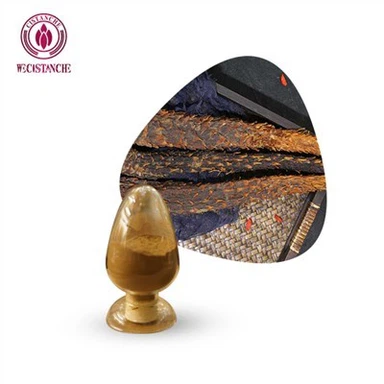
Extraction And Content Determination Of Active Ingredients in Cistanche Deserticola
Jun 11, 2024
The main chemical components of Cistanche deserticola include phenylethanol glycosides, polysaccharides, cyclohexene ether, betaine, and galactose. At present, phenylethanol glycosides are the most extensively studied, with a total of 17 phenylethanol glycoside substances discovered. This is the first natural product reported to have neuroprotective effects and plays a role in preventing lipid peroxidation, exerting liver protection, and clearing NO free radicals to demonstrate anti-inflammatory activity. Polysaccharides are a major component of Cistanche deserticola and an important pharmacological active ingredient. They have antioxidant and anti-aging effects and have unique effects on immunity and anti-lipid peroxidation. Gong Lidong et al. found that there were significant differences in the monosaccharide composition of the crude polysaccharides of Cistanche deserticola between natural and artificially cultivated samples from different species and regions. In addition, Cistanche deserticola contains a certain amount of betaine and galactose, which respectively have the functions of promoting fat metabolism, anti-fatty liver, protecting the kidneys, lowering blood pressure, moistening the intestines, and promoting bowel movements.

Main Chemical Constituents of Cistanche deserticola
1. Polysaccharides
Early research on polysaccharides from Cistanche deserticola mostly focused on the extraction, separation, content determination, and physicochemical properties of polysaccharides. In methodology, ethanol is mostly used as the solvent to extract polysaccharides using the reflux extraction method, and the content of polysaccharides is determined by the phenol sulfuric acid method. Li Yan and others used ultrasound technology for the first time to extract polysaccharides from Cistanche deserticola and measure their content, greatly reducing the extraction time. Sun Ping et al. used microwave technology to extract polysaccharides from Cistanche deserticola and measured their content. The results showed that the reaction time was shortened and the extraction efficiency was improved, indicating that microwave technology has great potential in polysaccharide extraction. Xuan Guodong et al. selected three reaction factors, namely extraction time, temperature, and solid-liquid ratio, as the research objects. The extraction rate of polysaccharides was used as the evaluation index, and the extraction process conditions of polysaccharides from Cistanche deserticola were optimized using the response surface analysis method. The results showed that with an extraction time of 193.0 minutes, a temperature of 94.59 ℃, and a solid-liquid ratio of 10.89, the theoretical value of the polysaccharide extraction rate was 85.5%. Wu Xiangmei et al. used chemical and spectroscopic methods to study the chemical structural characteristics of neutral polysaccharide CDP-4 isolated from the fleshy stems of Cistanche deserticola. They not only determined the average relative molecular weight and monosaccharide composition of CDP-4 but also determined its spatial structure as straight chain glucan, consisting of l, 4-linkage glcp and l, 6-linkage glcp connected in a 3:l ratio. Unlike straight-chain starch, it is a new type of glucan. Zhao Wei et al. [25] extracted water-soluble polysaccharides from wild Cistanche deserticola stems, which were deproteinized by Seveg and enzymatic methods, graded by ultrafiltration, and prepared by Sephadex G-75 column to obtain a uniform composition of SPA. Methylation, GC/MS, and C-NMR analysis showed that SPA consisted of (1-6) Glc as the main chain, and the GIc residue had a branch at 3-O. The side chains were composed of (1-4) Gal, (1-4) Man, (1-3) Gal, and (1-2) Rha, with (1-) Ara as the end of the side chain. Wu Bo et al. used 95% ethanol for defatting, water extraction, and alcohol precipitation to obtain crude polysaccharides, and Sephadex column chromatography to refine polysaccharides; Using thin-layer chromatography to identify its monosaccharide composition, measuring its specific rotation and UV spectroscopy to identify the purity of the polysaccharide, it was found that the UV spectrum of the polysaccharide only has a single peak, and the specific rotation of the precipitates of different concentrations of ethanol is consistent, indicating that the polysaccharide separated and purified by this method is a homogeneous component.
2. Phenylethanol glycosides

Phenylethanol glycoside is the main active component of Cistanche deserticola
Phenylethanol glycosides are the main active ingredients in Cistanche deserticola and are also the main detection indicators for quality control of Cistanche deserticola. At present, 17 types of ethanol glycosides have been isolated from Cistanche deserticola, among which piloside and quercetin are representative. The early determination of glycoside substances was mostly based on the content of total phenylethanol glycosides, often using colorimetric methods. For example, Cheng Jie and others extracted Cistanche deserticola with ethanol reflux, concentrated the extract, defatted it with ethyl acetate, and extracted the active ingredients with n-butanol. The content was then determined by macroporous resin, AB-8 adsorption, methanol elution, and UV spectrophotometry. The results showed that the range of determination was 3.20-32.0 mg · L-1, with an average recovery rate of 100.6% and an RSD of 3.5%. Li et al. used the principle that phenolic groups in phenylethanolamine glycosides and diazonium salts can generate colored substances and conducted the determination at 486 nm, with a recovery rate of 101.3% and an RSD of 3.70%. However, colorimetric methods have drawbacks such as poor stability, poor repeatability, and large errors, as well as complex pre-treatment, making them unsuitable for the quantitative determination of phenylethanolamine glycosides.

Echinoside, the main chemical component of Cistanche deserticola
High-performance liquid chromatography is the most widely used method for the determination of phenylethanolamine glycosides in Cistanche deserticola due to its high sensitivity and wide linear range. The Chinese Pharmacopoeia stipulates the conditions for using HPLC to determine the content of quercetin and anthocyanins in Cistanche deserticola: using mobile phase (acetonitrile methanol 0.1% acetic acid solution 10:15:75) as solvent, ultrasonic extraction for 40 minutes, preparing the test solution, and chromatographic conditions using octadecylsilane bonded silica gel as filler; Using acetonitrile methanol 0.1% acetic acid solution (10:15:75) as the mobile phase, the detection wavelength is 334 nm. The theoretical number of plates should not be less than 4000 based on the peak calculation of quercetin, and the content of quercetin should not be less than 0.3%. Zhang Siju et al. used the method described in the Chinese Pharmacopoeia to simultaneously determine the content of quercetin and anthocyanins in Cistanche deserticola using RP-HPLC. The results indicate that this method is simple, has good precision and reproducibility, and the results are accurate and reliable. Zhang Ju et al. used improved conditions to determine the content of quercetin and ergosterol in medicinal herbs of the genus Cistanche and found that the content of phenylethanolamine glycosides in Cistanche from different hosts and regions varied.
In addition, studies have shown that different processing methods can have a certain impact on the content of phenylethanolamine glycosides in Cistanche deserticola. Zhang Siju et al. used high-performance liquid chromatography to study the differences in ergosterol content between different processed and raw products. The results showed that the content of raw products was higher than that of processed products, and the content of high-pressure wine stewed products was the lowest. The higher the processing temperature and time, the lower the content of processed products. Reminder: Cistanche deserticola medicinal herbs should not be processed at high temperatures, high pressure, or for a long time. At the same time, studies have found that the content of betaine in processed Cistanche deserticola significantly increases, indicating that processed Cistanche deserticola has a certain effect. Further proving the necessity and scientificity of traditional Chinese medicine's processing (heat treatment) of Cistanche deserticola for thousands of years. In addition, processing also has a certain impact on the trace elements in it. Wang Linan et al. [33] investigated the effect of different initial processing temperatures on the content of main active ingredients in Cistanche deserticola, using the total amount and polysaccharide content of total phenylethanol glycosides, quercetin, and anthocyanins as indicators. The results showed that the content of active ingredients in samples treated with different initial processing temperatures varied. For example, the content of phenylethanol glycosides was higher when dried naturally or in a drying oven at 40 ℃; With the increase of initial processing temperature, the content of phenylethanol glycoside mostly shows a decreasing trend, which provides a scientific basis for the initial processing method of Cistanche deserticola.

Acteoside, the main chemical component of Cistanche deserticola
The combination of liquid chromatography and tandem mass spectrometry (LC/ESI-MS/MS) has the advantages of high sensitivity and strong specificity. It can simultaneously qualitatively and quantitatively analyze multiple complex components in traditional Chinese medicine without the need for complex sample preparation processes, making it superior to general HPLC and GC/MS methods. Wang Yiming et al. used this method to identify seven phenylethanol glycoside residues in Cistanche deserticola, including sea urchin, ergosterol, cis ergosterol, isoergosterol, 2 '- acetylergosterol, Cistanche deserticola glycoside A and Cistanche deserticola glycoside B. At the same time, they found that there were differences in the types and contents of phenylethanol glycoside residues among different species of Cistanche deserticola. Cao Zhenjie et al. [35] used LC-MS to detect four phenylethanolamine compounds in the spring and autumn Cistanche deserticola, respectively. Except for ergosterol, the content of the other three compounds showed significant differences, indicating that the content of phenylethanolamine compounds varies with the harvesting season of Cistanche deserticola.
3.8-Epi Strychnoside
8-Eleganoside is a major iridoid glycoside component in the genus Cistanche. Yang Jianhua et al. established a high-performance liquid chromatography method for determining the content of 8-Eleganoside in Cistanche by using a Hypersil ODS-2 column (4.6 mm x 250 mm, 5 μ m) with acetonitrile 0.4% phosphoric acid (9:91) as the mobile phase, a flow rate of 1.0 mL · min-1, a column temperature of 25 ℃, and a detection wavelength of 235 nm. This method is simple, fast, sensitive, and accurate.
4. Volatile oil
Hui Ruihua et al. reported the extraction of volatile compounds from Cistanche deserticola using simultaneous distillation and extraction. 24 chemical components, including eugenol, benzaldehyde, and caryophyllene, were separated and confirmed using GC/MS method. The content of the volatile oil in Cistanche deserticola was measured to be 3.5%, with the main component eugenol accounting for 83.60% of the total volatile oil.
5. Galactol
Bao Zhong et al. used high-performance liquid chromatography to separate, and evaporative light scattering detector (ELSD) to detect the content of galactose alcohol, the active ingredient for defecation in Cistanche deserticola. They used Prevail Carbohydrate ES polymerized gel column (250 mm x 4.6 mm, 5 μ m), the mobile phase was acetonitrile-water (77:23), and the flow rate was 0.7 mL · min-1; The column temperature is 25 ℃, the drift tube temperature of the detector is 40 ℃, and the gas pressure is 240 kPa to determine the content of galactose alcohol. The maximum content can reach 10%. This method is simple and accurate and can be used as a common method for detecting galactose in Cistanche deserticola.
6. Betaine
Betaine is a quaternary ammonium water-soluble alkaloid and commonly used content determination methods include a colorimetric method, thin-layer chromatography scanning method, and gravimetric method. However, with the popularization of high-performance liquid chromatography technology, high-performance liquid chromatography has gradually become the preferred method for its content determination. Gong Lidong et al. successfully established a method for determining the content of betaine in Cistanche deserticola using high-performance liquid chromatography with evaporative light scattering. The method used a Waters Spherorb S5 NH2 chromatography column (250mm x 4.6 mm, 5 μ m) with a column temperature of 25 ℃ and a mobile phase of 0.1% (volume fraction) trifluoroacetic acid aqueous solution methanol (volume ratio 15:85) at a flow rate of 0.6 mL/min. The parameters of the evaporative light scattering detector are drift tube temperature of 90 ℃, spray temperature of 45 ℃, and carrier gas (nitrogen) pressure of 110 kPa (16 psi). This method has a good linear relationship and can be used as a method for determining the content of betaine. At the same time, research has found that Cistanche deserticola does not contain betaine, so betaine can be used as a marker to distinguish between genuine Cistanche deserticola and Cistanche deserticola deserticola.

Main Chemical Constituents of Cistanche deserticola
7. Inorganic elements
The effective ingredients of traditional Chinese medicine include not only organic compounds such as glycosides, alkaloids, and flavonoids but also many inorganic components, namely many trace and macro elements. With a comprehensive understanding of the effective ingredients of traditional Chinese medicine, inorganic elements have been increasingly valued, especially in recent years. The efficacy of certain Chinese medicinal materials that cannot be explained by traditional Chinese medicine theory can now be explained through the physiological effects of trace elements. Therefore, studying the calibration and standardized detection methods of trace and macro elements in Cistanche deserticola is of great significance for establishing and improving the quality control and safety evaluation system of traditional Chinese medicine Cistanche deserticola. Atomic absorption spectrophotometry has gradually become the main method for detecting inorganic elements due to its low detection limit, high precision, wide application range, small sample size, and simple operation. Qi Yu et al. used flame atomic absorption spectrophotometry to determine the content of trace elements manganese and copper in Cistanche deserticola in Xinjiang. Chi Wenjun et al. used an atomic absorption spectrophotometer to determine the content of calcium, magnesium, copper, zinc, cobalt, and nickel in Cistanche deserticola. Su Weiwei and others found that in addition to macro elements such as K, Ca, and Mg, Cistanche deserticola also contains various essential trace elements for the human body. Among them, Fe, Mn, Zn, and other elements are relatively high, but the content of Cu is low, and harmful elements such as Pb, As, and Hg are also present. The element Cd was not detected, and it was found that the trace elements in Cistanche deserticola are closely related to the origin, medicinal parts, and harvesting time of the medicinal herbs.

Benefits of cistanche tubulosa-Immprove immunity
Click here to view Cistanche Enhance Immunity products
【Ask for more】 Email:cindy.xue@wecistanche.com / Whats App: 0086 18599088692 / Wechat: 18599088692
8. Amino acids
Rena et al. measured that the amino acid content in Cistanche deserticola reached 0.74%, and a total of 17 amino acids were detected, of which 7 were essential amino acids for the human body. Li Yuxia et al. [43] found that Xinjiang Cistanche also contains 17 amino acids, including valine, lysine, methionine, and arginine, with a protein content of 16.38%. Among them, the 7 essential amino acids for the human body have a reasonable ratio, which is close to the reference standards proposed by WHO/FAO, indicating that Cistanche has high nutritional and health value, and is a natural green food that is conducive to the balance of amino acid nutrition in the human body.
Cistanche deserticola has extremely high medicinal value and is a precious nourishing traditional Chinese medicine. Due to the scarcity of Cistanche deserticola resources and long-term unreasonable excavation, it is on the brink of depletion and has been listed as a national second-level protected plant. At the same time, plants of the same family and genus are commonly used in the traditional Chinese medicine market to replace Cistanche deserticola. Therefore, quality control of Cistanche deserticola plants is necessary to scientifically utilize and develop this precious resource.