Individual Recognition And Long‑term Memory Of Inanimate Interactive Agents And Humans in Dogs(1)
May 29, 2023
Abstract Investigation of individual recognition (IR) is difficult due to the lack of proper control of cues and previous experiences of subjects. The utilization of artificial agents (Unidentified Moving Objects: UMOs) may offer a better approach than using conspecifics or humans as partners. In Experiment 1, we investigated whether dogs can develop IR of UMOs (that is stable for at least 24 h) or that they only retain a more generalized memory about them. The UMO helped dogs to obtain an unreachable ball and played with them. One day, one week, or one month later, we tested whether dogs display specific behavior toward the familiar UMO over unfamiliar ones (four-way choice test). Dogs were also re-tested in the same helping context and playing interaction. Subjects did not approach the familiar UMO sooner than the others; however, they gazed at the familiar UMO earlier during re-testing of the problem-solving task, irrespectively of the delay. In Experiment 2, we repeated the same procedure with human partners, applying a two-way choice test after a week delay, to study whether the lack of IR was specific to the UMO. Dogs did not approach the familiar human sooner than the unfamiliar, but they gazed at the familiar partner earlier during re-testing. Thus, dogs do not seem to recognize an individual UMO or human after a short experience, but they remember the interaction with the novel partner in general, even after a long delay. We suggest that dogs need more experience with a specific social partner for the development of long-term memory.
Keywords Individual recognition · Memory · Animal-robot interaction · Robot · Dog ·Cistanche deserticola

Chinese herb cistanche
Introduction
The ability to recognize others individually is advantageous for social animals. Individual recognition (IR) involves (1) individually distinctive cues displayed by the subject that can be (2) learned by the observer. These cues (3) allow matching current sensory input with the previously learned features in future interactions, and (4) form the basis of showing specific behavior toward others based on their identity (e.g. Gherardi et al. 2010; Proops et al. 2009; Tibbetts and Dale 2007; see also the review by Gherardi et al. 2012). IR is thought to be widespread among animals due to its advantages in several social contexts, such as mate or kin recognition, or dominance hierarchies (Dale et al. 2001). IR can be based on unique visual, acoustic, or olfactory features that allow distinction between individuals. Potentially, IR could have evolved in any species where repeated interaction among group members is likely to occur frequently or the cost of competition can be reduced by showing individual-specific behavior toward rivals (e.g. Aubin et al. 2000; Carazo et al. 2008; Madeira and Oliveira 2017; Sheehan and Tibbetts 2009).
In contrast to IR, class-level recognition (CLR) is based on characteristics shared by many individuals in the group, who may represent certain subgroups of sex, age, or hierarchical rank (Gheusi et al. 1994; Madeira and Oliveira 2017). CLR and IR diverge in important ways, but many studies do not aim to discriminate between the two or are missing the required controls to disentangle these mental skills (see Gábor et al. 2019). It is difficult to properly control for all cues displayed or emitted by the partners and to limit the role of subjects’ previous experience, both of which are important to distinguish IR from CLR. The application of robots may facilitate the investigation of IR because this allows researchers to gradually change the morphological and behavioral features of the partner, and depending on its embodiment (similarity to known social partners) the infoence of previous experiences can be limited as well (Abdai et al. 2018; Frohnwieser et al. 2016). Further advantages of deploying robots are that both the quality and the quantity of the (direct or third-party) experience with the social partner can be controlled, allowing researchers to study how these aspects contribute to IR.

Desert living cistanche
Individual variability in vocalization is widespread in the Canidae family. For example, it has been shown in the howling of wolves (Canis lupus) (Palacios et al. 2007; RootGutteridge et al. 2014a, b; Tooze et al. 1990), and researchers also found individual-specific variation in dogs (Canis familiaris) barks (Molnár et al. 2008; Yin and McCowan 2004). Although these acoustic differences might be used to identify others, the presence of individually distinctive cues does not necessarily indicate the functioning of IR (see Schibler and Manser 2007; Yorzinski 2017). Further, unique visual and olfactory cues may also contribute to the IR of conspecifics in dogs (and wolves). Hepper (1994) found that dogs show preference toward their mother/offspring (vs unfamiliar, unrelated individuals), but not toward their siblings after a two-year separation, relying solely on olfactory cues. Hamilton and Vonk (2015) found that dogs can recognize kin without familiarity (although in females discrimination was not clear), and the study of Lisberg and Snowdon (2011) further showed that female dogs can discriminate between familiar and unfamiliar individuals based on olfactory cues alone. These findings show that dogs can rely on olfactory cues to discriminate among conspecifics; however, dogs might show CLR and not IR.
Identifying humans individually can be important for domestic dogs. Intraspecific IR in their ancestors might have favored the emergence of heterospecific IR, but domestiction and developmental experience could also contribute to the occurrence of this cognitive skill. The advantages of being able to discriminate between humans individually, and their social environment during development support the notion that dogs have the cognitive skill to identify humans based on individually distinctive cues.
In previous studies, dogs were able to find the owner based on olfactory cues alone when they were close to him/her; however, not when the owner and the two unfamiliar humans were three meters away from the dog (Polgár et al. 2015). Dogs could also locate their owner based on his/her voice alone when the other choice was an unfamiliar person (Gábor et al. 2019). Although these studies show that dogs discriminate their owner from Enfamiliar people based solely on olfactory and vocal cues, in both cases subjects could rely on the degree of familiarity (CLR). Regarding visual cues, dogs can discriminate between pictures of humans and dogs that they have seen before vs novel ones; however, discrimination could be the result of familiar vs unfamiliar cues here as well (Racca et al. 2010). Huber et al. (2013) found that dogs can discriminate between their owners and a familiar human relying solely on their heads (live presentation and picture). Although subjects had difficulties choosing their owner when only the inner part of their faces was displayed (picture). Furthermore, Adachi et al. (2007) reported that dogs can recall their owner’s face upon hearing their voice, thereby demonstrating a cross-modal representation of their owner. Thus, it seems dogs can individually discriminate against their owner.
Despite only having empirical data on the recognition of owners, who represent a specific category within humans, it is also assumed that dogs can discriminate against other humans individually. However, we do not know the quality and quantity of (direct or third-party) social interaction that is required for dogs to be able to identify humans individually. We also do not know the type of cues dogs rely on in doing so, and the duration for which dogs can remember to a specific individual.
Dogs display social behavior toward an unfamiliar, self-propelled object (UMO—Unidentified Moving Object) (e.g. Abdai et al. 2015). Across studies, researchers manipulated whether the UMO was merely a moving object (moving around the room without engaging in interaction with the dog) or the UMO interacted shortly with the dog in a problem-solving task, helping the dog to obtain an unreachable reward. Right after the short interaction, dogs learned to follow the communicative signals of the UMO, but they failed to learn the indication of the UMO when it was presented as a moving object (Gergely et al. 2015). Interactive UMOs were also able to elicit social bias in dogs (Abdai et al. 2015; Gergely et al. 2016). When presenting dogs with a free choice between larger and smaller food quantities, the UMO indicated the option opposite to the dogs’ initial preference. We found that the interactive UMO was able to revert dogs’ choice for a small amount; however, the UMO’s indication had no effect on dogs’ choice when it did not show interactive behavior before (Abdai et al. 2015). Gergely et al. (2016) also found that dogs commit the A-not-B error when the interactive UMO was hiding the ball, but the error did not occur when the partner was the non-interactive UMO. Based on these results, UMOs could be applied as partners to investigate IR in dogs, providing better control over the characteristics of the potential social partners.
Here we aimed to test the UMO’s utility to study IR and memory in dogs. In Experiment 1, we investigated whether dogs can recognize a UMO that they previously interacted with in two situations. Considering that this method has never been used before, for comparison, in Experiment 2 we applied a similar procedure to test dogs’ behavior when human partners were presented.

Main Chemical Constituents of Cistanche deserticola
Experiment 1
We used UMOs as interactive partners in a problem-solving and playful situation, and retested subjects one day, one week, or one month after the short social interaction. We hypothesized that dogs would remember the individual UMO because it had helped them to solve a problem, and it had shown playful behavior. Thus, dogs would be motivated to engage in interaction with this partner again. We predicted that dogs would show specific behavior toward the familiar UMO after a day or a week, but they would be less likely to remember it after a month due to the short duration of the initial interaction. Considering that the UMOs were a novel social partner, we expected that even if dogs would not recognize the specific individual, they would remember the helping and playful behavior of the UMO in general. In previous studies, dogs’ behavior toward the UMO had been tested right after familiarization (Abdai et al. 2015; Gergely et al. 2015, 2016), but in the present experimental setup, we aimed to investigate dogs’ memory after a long delay.
During the first occasion, the UMO was helping subjects to obtain a ball from an unreachable location. The UMO reacted to the gazing behavior of the dog, that is, it started to move during the problem-solving task when the dog looked at it. After obtaining the ball, the UMO also attempted to engage in a playing interaction with the dog. One day, one week, or one month later (between-subject design), we tested whether dogs remembered the individual UMO, i.e. whether they showed preference toward the familiar UMO in a four-way choice test. Following this, dogs faced the same problem-solving task and playful interaction as during their first encounter with the UMO. Here we applied a playing interaction instead of using food as motivation (cf. Abdai et al. 2015; Gergely et al. 2015) because we aimed to investigate whether dogs can remember the UMO based on the social experience, and not because it provided food to them.
Methods
Subjects
We included dogs above one year of age that could be motivated to participate with a tennis ball based on the owner’s opinion. Out of 74 dogs, 27 had to be excluded for various reasons. We excluded eight dogs because they showed distress either in the room or in the presence of the UMO, three dogs because they continuously attacked the UMO, four dogs because they did not come to the retest, seven dogs because they were not motivated by the ball, and one dog because it did not give the ball back either to the expertmentors or to the owner. We further excluded four dogs due to procedural issues (e.g. the UMO failed to retrieve the ball from the cage repeatedly or the owner did not follow the instructions properly). Thus, 47 dogs remained in the final analyses (different breeds, 20 females; mean±SD age: 4.5±3.0 years). We assigned dogs to three groups based on the time passing between the first occasion and the retest, which depended on the availability of the owner: Day group (N=15; 8 females, mean±SD age: 4.4±3.6 years), Week group (N=16; 8 females; mean±SD age: 5.2±2.8 years), and Month group (N = 16; 4 females; mean ± SD age: 4.0±2.5 years) (for more details see Online Resource 2).

Main Chemical Constituents of Cistanche deserticola
Click here to view Cistanche products
【Ask for more】 Email:cindy.xue@wecistanche.com / Whats App: 0086 18599088692 / Wechat: 18599088692
Test partner and apparatus
We used a remote-controlled car (#32710 RTR Switch Abarth 500, basis: 28 cm×16 cm×13 cm) as an interactive partner (UMO) which could be covered with four different embodiments differing in color and shape (Fig. 1). Three embodiments of the UMO were handcrafted from cardboard boxes and self-adhesive wallpapers, and the fourth was the original plastic cover of the remote controlled car. We counterbalanced within groups, which UMO was presented as familiar. The UMO was controlled by Experimenter (E) 1 from outside through two fish-eye optic cameras.
Dogs were tested in a 6.27 m × 5.40 m room at the Department of Ethology, Eötvös Loránd University, Budapest, Hungary. All tests were recorded with two fish-eye optic cameras (Mobius ActionCam) attached to the ceiling. We used a tennis ball to motivate the dogs. During the problem solving task, we put the ball inside a wire-mesh cage (L×W×H: 61 cm×47 cm×54.5 cm) with a front opening (W× H: 20 cm×18 cm). The ball was placed on a plastic plate (8 cm×8 cm) with metal sheets on its sides, and the plate was attached to magnets on the bottom of the cage to prevent dogs from getting the ball by moving the cage. All embodiments of the UMO had magnets on their front to be able to attach to the plate and thus bring it out of the cage.
In the Test phase of the Recognition Session (see below), we used an occluder (125 cm×100 cm with two bent sides of 125 cm × 70 cm) to cover the dog’s view of the room while E1 placed the four UMOs and the balls inside the room. For more details about the apparatus, see Online Resource 1.
Procedure
All dogs were tested in two sessions: we introduced dogs to the UMO during the Familiarization session, and the Recognition session took place one day, one week, or one month after the Familiarization session (Fig. 2). For a video about the procedure, see Online Resource 4.

Fig. 1 Embodiments of the UMOs
Familiarization session Observation phase: Before the dog entered the room, the experimenters already placed a chair, the UMO, the cage, and the plate in the room (Fig. 3a). The owner and the dog entered the room along with E1 and E2; the dog was allowed to explore the room while one of the experimenters gave the instructions to the owner. The owner sat on the chair and held the dog in front of him/her by the collar. E1 gave a tennis ball from outside of the room to E2 and then left the room. E2 played with the UMO shortly, to demonstrate to the dog that the UMO can move and push the ball, and to test in an indirect context whether the dog showed behavioral indications of stress in the presence of the UMO (e.g. hiding behind the owner, excessive barking at the UMO). During the playful interaction, E2 placed the ball in front of the UMO that pushed the ball to E2. This was repeated overall four times.
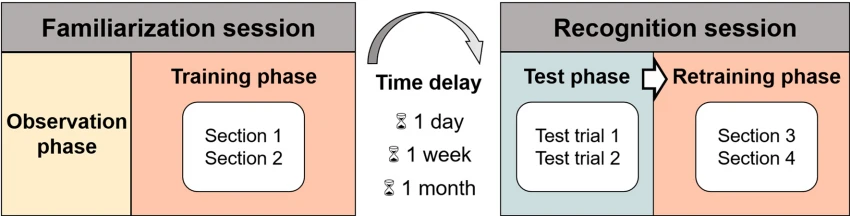
Fig. 2 Scheme of the procedure; in Experiment 2 only one week delay was applied. The dog interacts with one UMO/human during the Training and Retraining phases (same UMO/human in both sessions). In the Test phase, four UMOs/two humans are presented in the room

Fig. 3 Experimental setup. Training and Retraining phases of Experiment 1 and c Experiment 2; X marks the other starting position of the partner. Test phase of b Experiment 1 and d Experiment 2; note that in Test Trial 1 there were no balls in front of the partners
Following this, E1 entered the room and E2 gave him/her the ball. E2 stood on the left side of the chair. The owner released the dog and E1 played with the dog by throwing the ball 3–5 times to assess the way the ball could be retrieved from the dog. After this, E1 asked the owner to call the dog back and hold it in front of him/her.
Training phase: E1 called the dog’s attention by saying “Dog’s name! Look!” and bounced the ball on the ground. E1 placed the ball on the plate and put it inside the cage, attaching it to the magnet. E1 showed his/her empty hands to the dog and left the room. The owner released the dog on the signal of E2. The dog was allowed to move freely in the room and to try to obtain the ball. E2 avoided eye contact with the dog, and neither E2 nor the owner reacted to the dog’s behavior. In the first trial of the Familiarizain session, the UMO only started to move after 20 s. In all following trials, the UMO started to move either after 20 s or immediately when the dog looked at it. The UMO went inside the cage and retrieved the plate with the ball. The dog was allowed to retrieve the ball as soon as it could reach it.
After ball retrieval, a playing interaction started between the dog and the UMO facilitated by E2 if necessary. In case the dog placed the ball on the ground by itself, the UMO pushed the ball, and let the dog catch it. If the dog did not place the ball on the ground, E2 took the ball away from the dog and placed it in front of the UMO. Neither the owner nor E2 threw the ball or engaged in other playful interactions with the dog. During the playing interaction, the UMO pushed the ball 2–7 times (in the case of one dog the UMO pushed it more often, a maximum of eleven times; mean pushes±SD =3.26±1.24). The frequency of pushing the ball depended on the behavior of the dog: if the dog placed the ball on the floor by itself, the UMO pushed it more often, but if the ball had to be taken away, the UMO pushed it less often to avoid inducing distress in the dog by repeatedly taking away the toy.
The playing interaction ended with the UMO moving back to its starting position, to the opposite side of the room from which it had started before the problem-solving task (see Fig. 3a). E2 went back to her starting position. E1 entered the room and took the ball from the dog/ E2. The above procedure was repeated at least five and a maximum of ten times (trials). After five trials, we stopped the experiment when the dog lost motivation or seemed to be stressed because the ball was continuously taken away (e.g. not grabbing the ball after the UMO pushed it or not willing to give the ball to E2 or its owner). We carried out 10 trials with eighteen dogs, 9 trials with two dogs, 8 trials with six dogs, 7 trials with seven dogs, 6 trials with eight, and 5 trials with six dogs.
Recognition session Test phase: Before the owner and the dog entered the room, the experimenters placed the chair, the occluder, and a stopwatch in the room. The owner and the dog entered the room along with E1 and E2; the dog was allowed to explore the room while one of the experimenters explained the procedure to the owner. The owner sat on the chair and held the dog. E2 placed the occluder in front of the dog. E1 placed the four UMOs in their predetermined places (Fig. 3b). We counterbalanced the position of the familiar UMO within groups, and within subjects for which the familiar UMO had the same type of embodiment. The order of the other three, unfamiliar UMOs was also counbalanced.
E1 left the room and E2 removed the occluder. Then the owner stood up and walked to the right corner with the dog on a leash. Starting from here, the owner led the dog in front of or behind the UMOs slowly. The owner did not stop at any of the UMOs, the dog had 2–3 s to assess each UMO. After this, the owner sat back on the chair and held the dog in front of him/her. The owner released the dog to the indication of E2; the dog was allowed to move freely in the room (Test trial 1). After 30 s, E2 asked the owner to call the dog back and placed the occluder in front of the dog again. E1 entered the room, placed one ball in front of each UMO, and then left the room. E2 asked the owner to hold the dog in front of him/her, and she took the occluder away. The owner released the dog on the signal of E2; the dog was allowed to move freely in the room and could take away any of the balls (Test trial 2). Neither E2 nor the owner engaged in any interaction with the dog in either of the trials. After 30 s, E2 asked the owner to put the dog on the leash and leave the room. After the owner left, the experimenters rearranged the room for the Retraining phase.
Retraining phase: We repeated the procedure of the Training phase to assess whether dogs’ behavior changed after a delay, that is, irrespectively of remembering the familiar UMO, whether they remembered the behavior of the UMO in general. This phase corresponded to the Training phase of the Familiarization session, except that (1) before the first trial, E1 played with the dog by throwing the ball 3–5 times to the dog (as in the Observation phase); (2) the UMO started to move within 20 s if the dog looked at it, even in the first trial; and (3) we carried out a maximum of eight trials.
Questionnaire After the Recognition session, we sent a questionnaire to owners via email, which contained questions regarding the general playing habits of dogs (see Online Resource 1). For example, whether the dog prefers to play alone (chewing on the ball) or in interaction.

Cistanche supplement near me-Improving Memory
Behavior and data analyses
Behavior coding was carried out with Solomon Coder on 19.08.02. (©András Péter: http://solomoncoder.com). Data were analyzed using R software version 4.1.2 (R Core Team 2021) in RStudio version 1.4.1717 (RStudio Team 2021). We carried out backward model selection by using the drop1 function (except for mixed-effects Cox regression, for which this function is not available thus we used ANOVA for model comparison). The selection was based on the likelihood ratio test (LRT). Non-significant variables were excluded from the model, and we report the result of LRT before exclusion. In the case of pairwise comparisons (“means” package; Tukey correction), we report contrast estimates (β±SE). Intercoder reliabilities were carried out on a random subsample (20% of dogs). Inter-coder reliabilities were acceptable for all variables; for details see Online Resource 1.
Test phase We coded the latency to first approach the UMO (s): from the moment the owner released the dog until the dog approached the first UMO (within 0.5 m) (in case the dog did not approach any of the UMOs, we used the 30 s maximum time and indicated that the event did not happen). We used Cox regression (“survival” package) to analyse whether dogs approached the familiar UMO faster than the non-familiar UMOs (familiarity); and whether the time delay between the Familiarization and Recognition sessions (group), the type of UMO used as familiar (familiar UMO), placement of the UMOs (place), or the number of trials carried out during the Familiarization session (trial number; categorized as ten trials vs five-to-nine trials due to the differences in the subject number) had an effect on the latency of the dog’s first approach; and whether dogs showed a preference for any of the UMOs (UMO-type). We also analyzed whether dogs’ general preference to play alone vs in interaction with a human as reported by the owner, affected the dog’s behavior (playing style). We used separate models for Test trials 1 and 2. In both Test trials, some dogs did not approach any of the UMOs, thus familyarity, place, and UMO type could not be defined in these cases. In Test Trial 1, eighteen dogs did not approach any of the UMOs (Day group, N=6; Week group, N=7; Month group, N=5). Considering the large number of subjects that would be missing from the analysis, in Test Trial 1 we did not include familiarity, place, and UMO type in the model. In Test Trial 2, only four dogs did not approach any of the UMOs. Considering that testing whether there is an interaction between group and familiarity was an important aspect, the latter of which cannot be defined in these cases, we left the data of these dogs out from the model (Day group, N=2; Week group, N=1; Month group, N=1).
We also analyzed whether dogs chose first the familiar UMO above the chance level (binomial test; chance level 0.25). For this analysis, we included only subjects that approached at least one of the UMOs.
We also investigated the within-trial dynamics of looking at the UMOs in the two-Test trials separately by constructing looking-time curves (Python 3.7.6 in Jupyter Notebook 6.0.3). We determined for every 0.2 s the proportion of dogs looking at any of the UMOs. To capture overall trends, we applied linear regression to the data and provide the slope of the regression line (β±SE). Considering that in Test Trial 2 it could not be determined whether the dog looks at the partner or the ball, here looking at the partner included looking at the ball as well.