Know A Plant Every Day - Cistanche
Jan 15, 2025
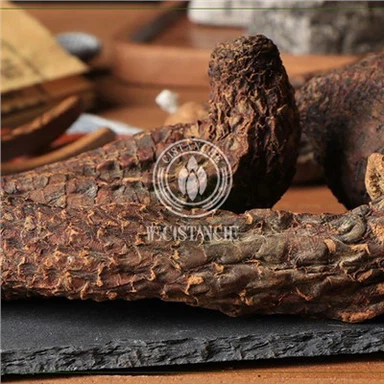
Cistanche is a tall herbaceous plant of the genus Cistanche in the Orobanchaceae family. It is a parasitic perennial herb that parasitizes on the roots of the desert tree Haloxylon ammodendron. It is known as the "Desert Ginseng" and is an endangered species with a national protection level of second class. Cistanche is a succulent plant, and its medicinal properties are calm and gentle, so it is named Cistanche.
1. Aliases
Hei Silin, Zongrong, Dijing, Mazhu, Mazhi, Dayun, Cunyun
2. Morphological Characteristics

Cistanche is 40 - 160 cm high. Most of Cistanche grows underground, and the stem gradually becomes thinner from bottom to top. The leaves are broad-ovate, and those on the upper part of the stem are relatively sparse and narrow, usually lanceolate. The inflorescence is spike-shaped, and the edges of the petals are often rolled outward, yellowish-white or lilac, and often turn brown after drying. The fruit is ovoid. The seeds are elliptical or nearly ovoid, reticulated on the outside and shiny. The flowering period is from May to June, and the fruiting period is from June to August.
3. Growth Environment
It reproduces by seeds. Cistanche is mainly distributed in Inner Mongolia, Ningxia, Gansu, and Xinjiang regions of China. Cistanche likes slightly saline and soft sandy land and generally grows in sandy land or semi-fixed sand dunes, dried-up old riverbeds, lake basin lowlands, etc. The climate in the growth area is arid, with little rainfall, large evaporation, long sunshine hours, large temperature differences between day and night, and poor habitat conditions. The seeds of Cistanche are very small, with a diameter of less than 1 mm. After falling to the ground, they move downward in the gaps between sand grains. If lucky, they may encounter the roots of host plants and then germinate under the induction of their secretions. The germinated seeds directly fuse with the roots of the host to form a small nodule. When enough nutrients are absorbed, the Cistanche plant grows from these nodules. Most of Cistanche's life is spent under the sandy soil. It usually takes 2 - 3 years for the plant to grow after the seeds germinate. The newly born plant is wrapped in scale-like reduced leaves and looks a bit like a pine cone. Dozens of them can grow on one parasite, but only a few can finally develop normally and break through the ground. From April to May every year, Cistanche emerges from the sandy soil and quickly blooms when exposed to light, growing taller while blooming. Including the part under the sandy soil, the whole plant can be up to 1 meter long, and the above-ground part is completely an inflorescence. The whole flowering and fruiting period lasts until August. Often, the flowers at the top of the inflorescence are still blooming while the fruits at the base are already ripe. After releasing the seeds, the plant body withers and decays, and the parasite will continue to grow inflorescences in the following years.
4. Functions and Effects
4.1 Medicinal Value
Medicinal Material Source: Fleshy stem
Functions and Indications: Tonify the kidney, nourish essence, moisten dryness, and relieve constipation. It is used to treat impotence in men, infertility in women, leucorrhea, uterine bleeding, cold and painful lower back and knees, and dry constipation. It is contraindicated for those with weak stomach and loose stools and excessive fire in the life-gate. Avoid copper and iron. It is also prohibited for those with excessive fire and constipation, and those with heart deficiency and qi distension.

4.2 Edible Value
It can be added to make porridge and soak in wine.
5. Chinese Medicine Prescriptions
For treating a man's five kinds of overstrain and seven kinds of impairment, impotence that has persisted for ten years, itching and dampness, dribbling urination, and urine that is sometimes red and sometimes yellow: Take Cistanche, Dodder seed, Cnidium monnieri, Schisandra chinensis, Polygala tenuifolia, Dipsacus asper, and Eucommia ulmoides, four parts each. Grind and sieve these seven substances, mix them with honey to form pills the size of Chinese parasol tree seeds. Take five pills in the morning and another five in the evening. (Cistanche Pills in "Medical Secrets of the Orient")
For replenishing depleted essence and treating facial blackening due to overstrain: Take four liang of Cistanche (boil it until it is soft, cut it thinly and grind it finely), and divide the lean mutton into four portions. Add seasonings and cook porridge with rice. Take it on an empty stomach. (From "Treatise on the Properties of Medicinal Herbs")
For strengthening the tendons and enriching the marrow: Take Cistanche and Monopterus albus. Grind them into powder and make pills with Polygonatum sibiricum wine. (From "Supplements to the Compendium of Materia Medica")
For treating deficiency, warming the lower yuan, enriching the essence and marrow, and benefiting the lower back and knees: Take Cistanche (soaked in wine overnight, scrape off the wrinkled skin, and dry by roasting), Cnidium monnieri, Polygala tenuifolia (remove the core), Schisandra chinensis, Saposhnikovia divaricata (remove the reed head), Aconitum carmichaelii (roasted and peeled), Dodder seed (soaked in wine for three days, dried in the sun, and ground into powder separately), Morinda officinalis, Eucommia ulmoides (remove the thick skin, roast until slightly yellow, and file), one liang each. Grind these substances into powder, mix them with honey to form pills the size of Chinese parasol tree seeds. Take twenty pills on an empty stomach every day, or with salt soup. Gradually increase the dosage to forty pills. (Cistanche Pills in "Holy Benevolent Prescriptions")
For treating kidney deficiency and turbid urine: Take Cistanche, Cervus elaphus antler, Dioscorea opposita, and Poria cocos in equal parts. Grind them into powder, make pills with rice paste the size of Chinese parasol tree seeds. Take thirty pills with jujube soup each time. (From "General Records for Holy Relief")

For treating the elderly with blood depletion, dry stools, and chest tightness: Take three liang of large Cistanche, soak it in white wine, wash off the scales, slice it, decoct it with three bowls of clear soup to get one bowl, and take it all at once. (From "Medical Notes")
For treating overstrain, depleted essence, and facial blackening: Take four liang of Cistanche, boil it until it is soft, cut it thinly and grind it finely, and stew it with mutton.
For treating excessive sweating and constipation (in elderly or physically weak patients): Take two liang of Cistanche (soaked in wine and roasted), and one liang of Aquilaria sinensis powder. Grind them into powder together. Make pills with Cannabis sativa seed juice. Take seven or eight pills each time with plain boiled water.
For treating spermatorrhea: Take Cistanche, Ootheca mantidis, Euryale ferox, and Nelumbo nucifera seed 15g each, and 30g of black sesame. Grind them into powder together, make pills with honey. Take 9g each time in the morning and evening with boiled water. (From Zhang Jishu's "Selected Prescriptions")
Internal Use: Decoct in water, 10 - 15g; or make into pills or powders; or soak in wine.
6. Dietary Therapy Recipes
Cistanche Porridge
Method: Take 30 grams of Cistanche and 30 grams of japonica rice to make porridge together. Take it once a day for a week.
Efficacy: It can tonify the kidney, moisten the intestines, and relieve constipation. It can also treat senile polyuria, kidney deficiency, and constipation.
Morinda officinalis and Cistanche Chicken Intestine Soup
Method: Take 12 grams of Morinda officinalis, 12 grams of Cistanche, and 1 chicken intestine. Cut open the chicken intestine, clean the inner and outer walls, scrub with salt, cut it into sections after washing; wrap Morinda officinalis and Cistanche in a gauze bag, tie the bag mouth tightly, put them together with the chicken intestine into a casserole, add water, add refined salt and ginger slices. Boil it over high heat first, and then simmer for 60 minutes. Drink the soup and eat the intestine.
Efficacy: Warm and tonify the lung and kidney, and consolidate essence and stop leakage. It is used to treat weakness of lung and kidney yang qi, impotence, premature ejaculation, spermatorrhea, seminal emission, enuresis, frequent urination at night, shortness of breath, and asthma.
Cistanche Stew
Method: Take 30 grams of Cistanche, 50 grams of sweet potato, and 100 grams of mutton. Add appropriate amounts of scallion, ginger, and refined salt. Scrape off the scales of Cistanche, wash it with wine, remove the black juice, cut it into thin slices, cut the sweet potato and mutton into thin slices after washing, put them into a pot together, add ginger slices and an appropriate amount of water, boil it over high heat first, and then simmer for 35 minutes, add scallion and salt.
Efficacy: Warm and tonify the liver and kidney. It is mainly used to treat impotence, low back pain, dizziness, blurred vision, and tinnitus caused by decline of kidney yang and deficiency of liver blood.
Cistanche and Sheep Kidney Stew
Method: Take 1 pair of sheep kidneys and 30 grams of Cistanche. Cut open the sheep kidneys, remove the white fascia and adrenal glands, and clean them; wash Cistanche and cut it into slices. Put the sheep kidneys and Cistanche together in a casserole, add water, boil it over high heat first, and then simmer for 20 - 30 minutes until the sheep kidneys are cooked through. Remove the Cistanche slices, add an appropriate amount of pepper powder, monosodium glutamate, and refined salt. Eat it as a dish or snack.
Efficacy: Tonify the kidney and assist yang, nourish essence and moisten the intestines. It is used to treat kidney deficiency and overstrain, impotence, weakness and soreness in the lower back and knees, deafness, frequent urination at night, and constipation caused by weakness of yang qi.
Achyranthes bidentata, Cistanche, and Angelica Honey Paste
Method: Take 50 grams of Achyranthes bidentata, 500 grams of Cistanche, and 50 grams of Angelica sinensis, and an appropriate amount of honey. Soak Achyranthes bidentata, Cistanche, and Angelica sinensis in an appropriate amount of water until they are fully soaked, then heat and decoct them. Take the decoction every 20 minutes, add water and decoct again. Take the decoction three times in total, combine the decoctions, and then simmer and concentrate them into a thick paste. Add twice the amount of honey, bring to a boil and stop heating. Let it cool and bottle it for later use.
Efficacy: Warm yang and relieve constipation.
Cistanche Soup
Method: Take 12 grams of Cistanche, 100 grams of carrot, and appropriate amounts of tofu, dried shrimps, scallion, pepper powder, and other seasonings. Cut the carrot into shreds, cut the tofu into pieces, decoct Cistanche twice with water, take the juice for later use, then pour the Cistanche juice into the pot, add an appropriate amount of water, bring to a boil, add carrot shreds, tofu pieces, dried shrimps, etc., and when the tofu floats on the soup surface, remove from the heat, add scallion, pepper powder, and other seasonings and serve.
Efficacy: Eliminate fatigue, strengthen the internal organs, and enhance male sexual function. It is mainly used to treat fatigue, premature aging, and decreased sexual function.
Chicken and Cistanche Stew
Method: Take 1 small rooster, 30 grams of Cistanche. Slaughter the small rooster, remove the feathers and internal organs, wash it, cut it into pieces; wash Cistanche, drain it, put it in a gauze bag, tie the bag mouth tightly, put it together with the chicken in a casserole, add cooking wine and an appropriate amount of water, boil it over high heat first, and then simmer slowly until the chicken is cooked through. Add refined salt for seasoning and eat it as a dish or snack.
Efficacy: Tonify the kidney and assist yang and replenish qi. It is used to treat decline of kidney yang, impotence, premature ejaculation, seminal emission, frequent urination or enuresis.
Recovery Soup
Method: Take 50 grams of Dioscorea opposita, 20 grams of Cistanche, 10 grams of Dodder seed, 2 walnut kernels, 500 grams of lean mutton, 1 sheep spine, 100 grams of japonica rice, 3 scallions, and appropriate amounts of ginger, Chinese prickly ash, cooking wine, pepper powder, star anise, and salt. Cut the sheep spine into several sections, wash it with clean water, wash the mutton, blanch it to remove the blood, wash it again, cut it into 5 cm thick strips, put Dioscorea opposita, Cistanche, Dodder seed, and walnut kernels in a gauze bag and tie it tightly, smash the ginger, cut the scallion into sections. Put the Chinese medicine and food in a casserole at the same time, add an appropriate amount of clear water, bring to a boil, remove the foam, add Chinese prickly ash and star anise, cooking wine, and move to low heat to continue cooking until the meat is cooked through. Serve in a bowl, add pepper powder and salt for seasoning and serve.
Efficacy: Warm and tonify kidney yang. It is suitable for tinnitus, blurred vision, weakness in the lower back and knees, impotence, and premature ejaculation caused by insufficient kidney yang and deficiency of kidney essence.
Cistanche and Mutton Porridge
Method: Take 15 grams of Cistanche, 100 grams of mutton, and 100 grams of japonica rice. Wash Cistanche, wash the mutton and cut it into slices, cut the scallion and ginger into grains and set aside. Put Cistanche in a casserole, add an appropriate amount of water, boil it for 30 minutes, remove the residue and keep the juice. Add japonica rice, salt, scallion, and ginger, bring to a boil over high heat, and then simmer for 35 minutes until the japonica rice is cooked through. It can be eaten for breakfast and dinner.
Efficacy: Warm kidney yang, nourish essence and blood. It is used to treat decline of kidney yang, impotence, premature ejaculation, spermatorrhea, cold and painful lower back and knees, weakness of tendons and bones, and constipation.
Cassia obtusifolia, Cistanche, and Honey Tea
Method: Take 10g each of stir-fried Cassia obtusifolia and Cistanche, and an appropriate amount of honey. Put Cassia obtusifolia and Cistanche in a teacup, brew with boiling water, cover and steep for 10 minutes, add an appropriate amount of honey and serve. Drink it frequently as tea.
Efficacy: Moisten the intestines and relieve constipation. It is mainly used to treat habitual constipation and senile constipation.
It should be noted that the above suggestions are for reference only.
Cistanche and Constipation: A Natural Solution
One of the common concerns among patients is constipation. It can cause a great deal of discomfort, including abdominal pain, bloating, and a general feeling of sluggishness. In modern medicine, constipation can be caused by a variety of factors such as an unbalanced diet, lack of physical activity, and stress.
Cistanche offers a natural and effective way to address constipation. The substances in Cistanche can have a positive impact on the digestive system. It can help to increase the water content in the feces, making it softer and easier to pass. This is especially important for those who struggle with hard and dry stools. Additionally, Cistanche can stimulate the peristalsis of the intestines, promoting the regular movement of feces through the digestive tract. This gentle yet effective action can provide relief for constipation without the harsh side effects that some chemical laxatives may have.
Beyond Constipation: Other Potential Benefits and Considerations

In addition to its constipation-relieving properties, Cistanche holds great potential in other aspects of health. Its ability to tonify the kidney and nourish essence may have implications for overall energy levels and vitality. By improving kidney function, it may also help with other issues related to kidney health, such as maintaining proper fluid balance in the body.
The fact that it has been used in traditional medicine for centuries adds to its allure. In a world where people are increasingly looking for natural alternatives to synthetic medications, Cistanche represents a connection to ancient healing traditions. Its long history of use suggests that it may have a holistic approach to health that goes beyond just treating symptoms.
However, it is important to note that like any herbal remedy, Cistanche should be used with caution. While it has many potential benefits, it may interact with certain medications or have different effects on different individuals. For example, it is always advisable to consult with a healthcare professional before using Cistanche, especially if you have underlying health conditions or are taking other medications.
In conclusion, Cistanche is a remarkable herb with a rich history and a promising future in modern health. Its unique properties