Part 2:Echinacoside Protects Against MPP+-Induced Neuronal Apoptosis Via ROS/ATF3/CHOP Pathway Regulation
Mar 04, 2022
Echinacoside Protects Against MPP+-Induced Neuronal Apoptosis via ROS/ATF3/CHOP Pathway Regulation
Qing Zhao1 • Xiaoyan Yang2 • Dingfang Cai3,4 • Ling Ye5,6 • Yuqing Hou1 •
Lijun Zhang1 • Jiwei Cheng1 • Yuan Shen1 • Kaizhe Wang5 • Yu Bai1
Contact: joanna.jia@wecistanche.com
Pls click here to Part 1
Pls click here to Part 3

Cistanche echinacoside has antioxidant properties
Immunofluorescence Staining
1 mmol/L MPP?, 40 LG/mL ECH, or a combination of MPP? and ECH. The cells were then incubated in a blocking buffer (3% BSA in PBS) at room temperature (RT) for 30 min. Then, anti-ATF3, anti-CHOP, or anti-cleaved caspase 3 antibodies were diluted to 1:100 in blocking buffer (1% BSA in PBS with 0.3% Triton X-100) and incubated overnight at 4C. After washing three times with PBS, the cells were incubated with Alexa 488-goat anti-rabbit IgG (Life Technologies, Carlsbad, CA) at RT for
1 h. Nuclei were stained with Hoechst 33342. Images were captured with a confocal microscope (Leica SP8, Wetzlar, Germany).


Terminal Deoxynucleotidyl Transferase-Mediated dUTP Nick-End Labeling (TUNEL) Assay
We stained every 10th coronal section (total 14–15) through the SNc from bregma -2.92 nm to -3.64 mm.
Four typical sections through the SNc at the same level in each group were used for TH and TUNEL counts [10]. TUNEL assays were performed to analyze apoptosis in tissue sections with an in situ cell death detection kit (Roche, Rotkreuz, Switzerland), following the manufacturer’s instructions. After DNA labeling, sections were used for immunofluorescence staining with anti-TH antibody, and images were captured with a confocal microscope (Leica SP8, Wetzlar, Germany). After delineation of the SNc at low magnification (10 9 objectives) according to the mouse brain atlas [20], the TH- positive cells and TH/TUNEL double-positive cells were counted at a higher magnification (20 9 objectives) by two observers blind to the treatment. The ratio of TH/TUNEL double-positive cells to TH-positive cells was calculated.

Cistanche echinacoside has anti-inflammatory properties
Statistical Analysis
All data are presented as mean ± SD. One-way ANOVA followed by post hoc analysis with Tukey’s HSD and the Student–Newman–Keuls multiple comparisons test were performed for statistical purposes. A value of P \ 0.05 was considered statistically significant.
Results
ECH Decreases ROS Products and Attenuates
MPP1-Induced Apoptosis
ECH has been shown to protect neurons from apoptosis in animal models, as well as reduce the levels of pro- inflammatory cytokines in neuroblastoma cells [12]. How- ever, it remains unclear whether ECH directly modulates the neuronal apoptosis induced by MPP?. Our data showed that ECH did not affect the proliferation or death of SH-SY5Y cells (Fig. 1B), and their morphology remained unchanged (Fig. 1C). Interestingly, following exposure of SH-SY5Y cells to MPP?, survival increased in a dose-dependent manner after ECH treatment (10–40 lg/mL) (Fig. 1B, C).
Previous studies have shown that MPP? specifically inhibits the electron transport chain in mitochondria and is also associated with ROS generation [6, 21]. Using DCFH-DA as a fluorescent probe to assess changes in ROS levels, we found that ECH markedly suppressed the MPP?-induced ROS generation (Fig. 2A). Confocal microscopy revealed that the decreased ROS products were associated with ECH levels (Fig. 2C). ECH was also shown to protect the cell membrane against ROS and decrease MDA levels, the end product of lipid peroxidation (Fig. 2B). Taken together,
ECH promotes cell survival by decreasing MPP?-induced ROS products in neurons.
ECH Suppresses ROS Stress-Related/MPP1-Induced Gene Expression and Increases GDNF
Expression in MPP1-Treated Cells
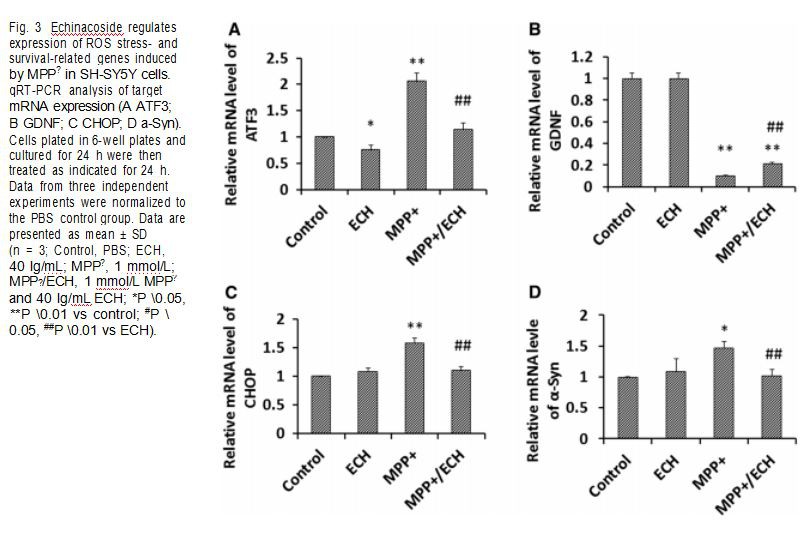
ROS products have been shown to stimulate the unfolded protein response and induce the expression of stress-related genes, including ATF3, ATF4, and CHOP [22]. ATF3 and CHOP play an especially important role in stress-induced neuronal apoptosis [9, 23]. Abnormal a-synuclein expression is also one of the critical markers in PD pathology [2]. Using qRT-PCR, we analyzed the expression of ATF3, CHOP, SNCA, and glial cell line-derived neurotrophic factor (GDNF) in the MPP? cell model and found that MPP? significantly enhanced the expression of ATF3, CHOP, and SNCA compared with the PBS control group. ECH did not affect the expression of these genes in SH-SY5Y cells that were not treated with MPP?. However, ECH abrogated their MPP?-induced expression (Fig. 3). In addition, MPP? significantly suppressed the expression of GDNF in SH-SY5Y cells, but ECH partially reversed this phenomenon (Fig. 3B).
ECH Inhibits MPP1-Induced Caspase-3 Activation in SH-SY5Y Cells
High levels of ATF3 and CHOP directly promote neuronal apoptosis [9, 23]. Our data showed that ECH inhibited ATF3 and CHOP expression in a dose-dependent manner (Fig. 4A). ECH also blocked MPP?-induced caspase-3


activity (Fig. 4A, B). Immunofluorescence analysis of the cleaved form of caspase-3 further showed that ECH markedly decreased the cleaved caspase-3 protein expression in MPP?-treated cells (Fig. 4C).
ECH Reverses MPP1-Induced ATF3 and CHOP Accumulation in SH-SY5Y Cells
Following exposure to environmental toxins, ATF3 and CHOP proteins localize in the cytoplasm and nucleus [24, 25], and this leads to apoptosis. Our results suggested that MPP? treatment increased ATF3 and CHOP expression in the nucleus, and ECH effectively attenuated this process (Fig. 5A, B). Western blotting analysis showed that MPP? markedly increased levels of both proteins in the cytoplasm and nucleus. Interestingly, ECH abrogated the MPP? effects and suppressed ATF3 and CHOP accumulation in the nucleus (Fig. 5C–E).
ATF3 Plays a Critical Role in MPP1-Induced Apoptosis in SH-SY5Y Cells
ATF3 has been shown to induce apoptosis in SH-SY5Y cells [23], and the results from the present study indicate that ECH significantly suppresses ATF3 mRNA and protein expression induced by MPP? in these cells. However, the role of ATF3 in apoptosis and ECH protection of cell survival remained unclear. So we used small hairpin RNA (shRNA) specific for ATF3 to investigate this and found no difference in viability between the ATF3-knockdown group and the control group under normal conditions (Fig. 6A). However, ATF3 suppression or ECH treatment significantly rescued the morphological changes induced by MPP? (Fig. 6B). The ATF3-knockdown cells had higher viability than the control group following exposure to MPP? (Fig. 6C). The protein levels of CHOP and activated caspase-3 were lower in ATF3-knockdown cells than


in control cells with non-specific shRNA (Fig. 6C, D). These data indicated that ATF3 plays a critical role in the MPP?-induced apoptosis of neuroblastoma cells. So, these results support the hypothesis that ECH protects SH-SY5Y cells against MPP?-induced effects via downregulation of the ROS/ATF3/CHOP pathway. Interestingly, our data showed that ECH also inhibited the MPP?-induced increase of p53 and PUMA (p53-upregulated modulator of apoptosis) levels in SH-SY5Y cells (Fig. 7).

Cistanche echinacoside has the effect of enhancing immunity
ECH Protects DA Neurons Against Apoptosis
Induced by MPP1 in Vitro or by MPTP in Vivo
To confirm the action of ECH in PD, primary DA neurons were treated with MPP? or MPP? and ECH. The in vitro experiments revealed that MPP? significantly reduced the viability of DA neurons and this was prevented by ECH
(Fig. 8). We further assessed apoptosis in DA neurons in the SNc after different treatments in mice with MPTP- induced PD and controls. More TH-positive neurons were found in this area in the control than in the MPTP group (Fig. 9A). TUNEL assays showed that NS and ECH did not induce apoptosis in DA neurons in the SNc, but MPTP did and ECH protected the neurons against it (Figs. 9B, S2). Interestingly, western blotting of lysates of the SNc from the mouse model of PD showed that the ATF3 and CHOP protein levels were also decreased by ECH (Fig. 10).

Cistanche echinacoside has an anti-apoptotic effect