Part Ⅰ:East To West: Research Progress in Traditional Chinese Medicine For Antiaging Strategies
Mar 03, 2022
For more information:ali.ma@wecistanche.com
Jing-Ning Yan, Cong Hu, Xiang-Long Meng
1 Clinical College of Traditional Chinese Medicine, Shanxi University of Chinese Medicine, Jinzhong 030619, China;
2 School of Pharmacy, Jiangxi Science and Technology Normal University, Nanchang 330013, China;
3 College of Chinese Materia Medica, Shanxi University of Chinese Medicine, Jinzhong 030619, China;
4 College of Korean Medicine, Dongguk University, Gyeongju 38066, Rep. of Korea.
Highlights
This study summarizes the current progress in antiaging research with respect to both modern medicine and traditional Chinese medicine and demonstrates that the antiaging properties of these medicines are effective based on pharmacological experiments and clinical applications.

Click to anti-aging Cistanhce tubulosa powder
Traditionality
The earliest Chinese medicine book, Huangdi Neijing (Yellow Emperor's Canon of Internal Classic; 221 B.C.E.–220 C.E.), recorded the process of human aging approximately 2,000 years ago. More than 1,700 years ago, the oldest traditional Chinese materia medica, Shennong Bencaojing (Shennong’s Classic of Materia Medica; 25–220 C.E.), clarified the use of traditional Chinese medicines such as Cistanche tubulosa and Huangqi (Astragali radix) in improving health and prolonging the lifespan. In addition, certain physical activities and therapies based on the theory of traditional Chinese medicine have been developed to maintain health, and most of these activities and therapies have been proved to be effective through thousands of years of clinical practice and are being used to date.

Abstract
Delaying the onset of aging is considered an important tool for dealing with the global crisis of the aging population. Accordingly, several antiaging studies have been conducted using strategies of modern medicine and traditional Chinese medicine (TCM). In this review, we summarize the current state of antiaging research related to both modern medicine and TCM and provide suggestions for further research. Various theories related to the aging process have been proposed, including the free radical theory, mitochondrial DNA damage theory, telomere theory, cross-linking theory, and intestinal flora theory, and a number of antiaging chemical treatments have been developed using modern medicine. These theories and achievements have resulted in major advancements in antiaging research. TCM is based on practical experience and has a long history with unique advantages in antiaging research. Some antiaging practices such as moderate diet consumption, acupuncture, Tai Chi (a traditional Chinese martial art that can relax the nerves to slow down the aging process), and Wuqin Xi (a traditional Chinese exercise to strengthen the body) have been adopted to maintain health. Several TCMs and prescriptions, particularly those related to medicine food homology, have been used in antiaging treatment, and their antiaging properties have been demonstrated to be effective based on pharmacological experiments and clinical applications.

Keywords: Antiaging, Modern medicine, Traditional Chinese medicine, Medicine food homology, Pharmacological experiments, Clinical applications.
Background
Currently, population aging is a serious global concern. According to World Health Organization, 617 million people worldwide were aged ≥ 65 years in 2015. A press conference held by the China Aging Office highlighted that 241 million elderly people in China were aged ≥ 60 years, accounting for 17.3% of the total population by the end of 2017 [1]. Population aging is more prevalent in developed countries, and the proportion of adults aged ≥ 60 years in Japan, Italy, and Germany was 32.79%, 28.59%, and 27.35%, respectively, in 2015 according to population data from the United Nations [2]. Moreover, there is an increasing trend of population aging worldwide. Therefore, the number of studies focused on antiaging has drastically increased in recent years, with results indicating that people should pay more attention to their health and longevity.
Although modern medicine has made important achievements in antiaging research and a number of aging theories have been proposed with the development of several promising antiaging drugs, to the best of our knowledge, there is no primary effective strategy for antiaging [3]. However, traditional Chinese medicine (TCM), which is based on practical experience, has a history of more than 2,000 years in antiaging research; it is considered to have a substantial advantage in antiaging treatments. The earliest Chinese medicine book, Huangdi Neijing (Yellow Emperor's Canon of Internal Classic; 221 B.C.E.–220 C.E.), recorded the process of human aging approximately 2,000 years ago [4]. More than 1,700 years ago, medica of the oldest traditional Chinese material, Shennong Bencaojing (Shennong’s Classic of Materia Medica; 25–220 C.E.), clarified the use of TCMs in improving health and prolonging lifespan using treatments such as Renshen (Ginseng radix et rhizoma) and Huangqi (Astragali radix). Moreover, certain activities and physical therapies based on the theory of TCMs have been developed to maintain health, and most of these interventions have been shown to be effective through thousands of years of clinical practice and are being used to date. This review summarizes and analyzes the research findings and measures of antiaging related to both modern medicine and TCMs, with the goal of providing guidance for future antiaging research.

Modern aging theories
The aging mechanism, an essential subject in modern geriatric medicine, is a complex, extensive, and challenging concept. With rapid development in modern cell biology, molecular biology, and other disciplines, significant advances have been made in determining the mechanisms of aging, and several theories of aging with scientific value have been proposed [5].
Free radical theory
The free radical theory was proposed by Harman D in 1956 [6]. This theory states that free radicals are produced in the body at all times and that the number of free radicals is regulated by free radical scavengers such as superoxide dismutase (SOD) to maintain a balance [5]. However, this balance is gradually disrupted with aging owing to a reduction in free radical scavenger activity. Consequently, excess free radicals adversely affect cellular function, leading to aging and death [7].
Mitochondrial DNA damage theory
The second theory of aging states that mitochondrial DNA (mtDNA) is closely related to aging; this theory was proposed by Linnane AW in 1989 [8]. Since then, several experiments have been conducted by scholars, with results indicating that the hypothesis is convincing. The main argument of this theory is that mtDNA damage is the molecular basis of cell senescence and death, with mitochondrial degeneration, leakage, and rupture being essential causes of cell senescence. Therefore, lifespan can be prolonged by inhibiting mtDNA degradation [9].

Telomere theory
Harley, an American antiaging expert, proposed the telomere theory of cell senescence in 1990 [10]. This theory suggests that the chromatid located at the tip of the chromosome, which is also called the telomere, is closely associated with aging and longevity and that telomeres gradually shorten with cell division, which leads to cell aging [11]. Modern medical studies have demonstrated that telomeres can preserve the integrity and stability of chromosomes and protect chromosomes from enzymatic digestion, fusion, loss, or rearrangement [12].
Cross-linking theory
The cross-linking theory was proposed by Bjorksten J in 1963 [13]. This theory states that macromolecules (e.g., proteins and nucleic acids) present in organisms can be combined to create giant molecules via a process called cross-linking [14]. However, this cross-linking can affect the normal functions of cells and disturb organ homeostasis, which becomes more serious with aging [15].
Intestinal flora theory
The relationship between gut microbiota and aging was proposed by Carmen Garcia-Peña in 2017 [16]. This theory argues that the balance of the intestinal micro ecological system is gradually disrupted with aging, with the resulting imbalance allowing bacteria, viruses, and/or other pathogens to invade the body, further endangering human health [17]. Therefore, maintaining the equilibrium of the intestinal microbial system has been hypothesized to prolong cell life and extend the organism’s lifespan [18].

Antiaging chemical medicines
In recent years, antiaging research has garnered increased attention, resulting in the development of several antiaging chemical medicines. According to their formulations, these medicines can be divided into three categories, namely, tablets, capsules, and liquids. These formulations have been designed to delay aging by improving immunity and protecting organs and cells from oxidative damage (Table 1).

The development stage of TCM in antiaging research
TCM-related antiaging research initiated with the introduction of the Jin Dan theory, which is based on the fact that ancient Chinese people believed that they could live forever if they consumed Jin Dan, a mineral product made by ancient Chinese alchemists. Subsequently, some researchers supplemented and modified various antiaging methods by performing clinical trials at different time periods, thus forming an antiaging system with Chinese characteristics. In Chinese history, TCM-related antiaging research has primarily been described in four stages, namely, infancy, formation, wander, and development [19].
Infancy stage: before the Eastern Han Dynasty (before 25 C.E.)
Before the Eastern Han Dynasty (25–220 C.E.), scientific knowledge was very poor. However, a campaign searching for measures that would confer immortality had spread throughout the country during this period because the emperors of the Qin Dynasty (221–207 B.C.E.) and the Western Han Dynasty (202 B.C.E.–8 C.E.) desired to be immortal. Under these conditions, Huangdi Neijing (Yellow Emperor's Canon of Internal Classic; 221 B.C.E.–220 C.E.) and WuShiEr BingFang (Prescription for Fifty-Two Diseases; 475 B.C.E. –221 B.C.E.) were issued, which provided not only information on antiaging but also a foundation of evidence for modern antiaging research.
Formation stage: from the Eastern Han Dynasty to the Southern and Northern Dynasties of China (25–589 C.E.)
In Chinese history, certain famous experts of TCM, including Zhang Zhongjing, Hua Tuo, and Tao Hongjing, belonged to the period involving the Eastern Han (25–220 C.E.), Three Kingdoms (220–280 C.E.), Jin (280–420 C.E.), and Southern and Northern Dynasties (420–589 C.E.). Some classic works of TCM, such as Shennong Bencaojing (Shennong’s Classic of Materia Medica; 25–220 C.E.), Mingyi BieLu (Miscellaneous Records of Famous Physicians; 184–220 C.E.), and Bencaojing Jizhu (Variorum the Classic of Materia Medica; 480–498 C.E.), were produced during this period.
Wander stage: the Sui Dynasty to the Ming Dynasty (581–1644 C.E.)
The Sui Dynasty (581–619 C.E.), Tang Dynasty (618–907 C.E.), Song Dynasty (960–1279 C.E.), and Yuan Dynasty (1271–1368 C.E.) marked the heydays of the Chinese feudal society. Some classic works, including Sun Jing's Xinxiu Bencao (New Revision of Herbs; 659 C.E.), Sun Simiao’s Beiji Qianjin Yao Fang (Essential Recipes for Emergent Use Worth A Thousand Gold; 652 C.E.), and Li Shizhen's Bencao Gangmu (Compendium of Materia Medica; 1518 C.E.–1593 C.E.), were produced during this period. However, because of the ruling class's superstition regarding Taoism (one of China's native religions) and the Jin Dan theory advocated by alchemists and literary officials during this period, further development of antiaging studies were hindered.
Development stage: from the Qing Dynasty to Date (1636 C.E.–To Date)
From the last years of the Qing dynasty until the founding of the Republic of China, the feudal autocratic system declined and capitalism gradually grew (1840–1911 C.E.). In this period, the development of natural science, the introduction of Western medicine, and the old government's policy of abandoning TCM therapies had a positive or negative impact on antiaging research. However, some works, including Wang Ang's Yifang Jijie (Collected Exegesis of Recipes; 1682 C.E.) and Qing Pu's Shoushi Bian (The Organized of Prolonging Life; 1667 C.E.), were produced. With economic development and social stability, antiaging TCMs and prescriptions have been strongly supported by the government after the founding of the People’s Republic of China (1949 C.E.–To Date). Meanwhile, the China Scientific Research Center on Aging was established, and Chinese Pharmacopoeia was published. Both these works had positive impacts on TCM-related antiaging research.
Antiaging methods in TCM
The law and practices for preventing aging were established as early as the production of Shanggu Tianzhen Lun, article 1 of Suwen (Plain Questions; 770 B.C.E.–221 B.C.E.), which stated that all things are divided into Yin and Yang. Indeed, Yin and Yang are two opposing principles in nature, with the former being feminine and negative and the latter being masculine and positive. Accordingly, correct health care methods based on these principles involve appropriate diet and exercise and avoiding being overworked, which can help people to live in harmony and die at the age of ≥ 100 years. In this case, TCM not only gives importance to TCM therapies but also emphasizes the critical roles of dietary habits, emotional factors, health campaigns, and alchemy for antiaging purposes [20].
Moderate diet consumption
A moderate diet is the cornerstone of health; it can not only improve the immunity of the body but also treat some diseases. First, meals need to be regular. In China, the traditional schedule for eating includes three meals a day, the benefit of which has been demonstrated both scientifically and in practice. This ensures that digestive organs regularly digest food and absorb nutrients and provides digestive organs with a proper balance between work and rest. Second, the dietary intake should be balanced. Accordingly, a variety of foods can meet energy and nutritional needs only when they are properly matched. In addition, dietary intake should not be too little or too much, and the food should not be too cold or too hot. These requirements can protect body organs and make the body strong and healthy [21]. Hence, the theory of medicine and food homology was gradually discovered and developed into a unique Chinese medical practice [22, 23].
Emotional reconciliation and peace
Yinyang Yingxiang Dalun, article 5 of Suwen (Plain Questions; 770 B.C.E.–221 B.C.E.), states that emotions such as joy, anger, sorrow, fear, love, hate, desire, and external emotional stimulation exceed the normal tolerance limits of the human body can generate certain factors that disrupt the functions of organs and reduce Qi (Qi is considered the most basic material basis of the human body according to the TCM theory), and reductions in Qi lead to accelerated body aging [24].
Acupuncture
Acupuncture has long been used as an antiaging strategy. As early as the Huangdi Neijing (Yellow Emperor's Canon of Internal Classic; 221 B.C.E.–220 C.E.), more than 30 types of acupuncture measures have been recorded in detail for disease syndromes. These included several acupuncture prescriptions and tests for aging-related diseases, which served to establish the foundation for use of clinical acupuncture as part of an antiaging strategy [25]. In recent years, World Health Organization has paid increasing attention to acupuncture and its benefits. In addition, a number of experts worldwide have studied acupuncture and found that it can activate brain cells, improve brain blood circulation and brain cell nutrition, and delay brain cell aging. Moreover, it has been found that acupuncture slows down the aging process through various mechanisms, such as eliminating free radical damage, regulating immunity and neuroendocrine function, adjusting lipid metabolism, improving blood rheology, and regulating the levels of trace elements. Some studies have also demonstrated that acupuncture has far-reaching antiaging effects, with Zusanli (ST 36), Quchi (LI 11), and Sanyinjiao (SP 6) (3 acupoints) being most closely associated with antiaging [26].
Traditional health care movement
Tai Chi. Elimination of diseases and prolongation of lifespan are essential factors for Tai Chi (a traditional Chinese martial art that can relax the nerves to slow down the aging process), which has won the favor of people worldwide. The ultimate goal of practicing Tai Chi is to provide health and a long lifespan to its practitioners. In addition, Tai Chi has been stated to provide a life as vigorous and beautiful as spring, which was recorded in the ancient Tai Chi classic—Taiji Shisanshi Xinggong Gejue (Tai Chi 13 Essential Technique Drills; 1525–1606 C.E.). This recording demonstrates that one of the ultimate aims of the ancient Chinese practice of Tai Chi is to prolong lifespan [27]. The fundamental reason why practicing Tai Chi has been reported to expel diseases and prolong lifespan is that practicing Tai Chi can balance the Yin and Yang and the smooth Qi and the blood as well as increase overall vitality. Thus, sick and sub-healthy individuals can recover, and the elderly can be rejuvenated by practicing Tai Chi [28].
Wuqin Xi. Hua Tuo, a famous doctor of the Eastern Han Dynasty (25–220 C.E.), studied activities of the tiger, crane, leopard, snake, and dragon and combined the functions of human viscera, the meridians, and Qi and blood to create “Wuqin Xi” (a traditional Chinese exercise to strengthen the body) [29]. In Wuqin Xi, all the major muscles and joints of the body participate in various activities, thus improving blood circulation and promoting viscera metabolism. Taken together, this can, directly and indirectly, prevent lipid peroxidation in the body [30, 31]. Indeed, some studies have demonstrated that long-term exercise (e.g., Wuqin Xi) can increase SOD activity in the peripheral blood of the elderly and delay-free radical damage to delay aging [32, 33].
Baduanjin. Baduanjin (a traditional Chinese exercise to strengthen the body) can improve the balancing ability of the elderly [34, 35]. Achieving good balance is of great significance to the elderly because it provides a fundamental guarantee for the maintenance of independent life. Many movements in Baduanjin require the fingers to grasp hard and involve the full exercise of the forearm and hand muscles [54]. Some studies have demonstrated that the long-term practice of Baduanjin can enhance blood supply and improve blood circulation speed [55]. It can also promote functions of the human respiratory system and increase vital capacity [56, 57].
Antiaging TCMs
There is a long history of using drugs to delay aging in China, which has been recorded in many ancient books. Shennong Bencaojing (Shennong’s Classic of Materia Medica; 25–220 C.E.) comprises 365 TCMs, of which 133 are associated with prolonging life, immortality, aging tolerance, longevity, etc. [58]. Bencao Gangmu (Compendium of Materia Medica; 1518 C.E.–1593 C.E.) includes 1,539 TCMs, of which 197 are associated with prolonging lifespan and replenishing the body [59]. Other books, such as Yaoxing Bencao (Materia Medica of Medicinal Properties; 1520 C.E.), Shiliao Bencao (Materia Medica for Dietary Therapy; 713–741 C.E.), and Shiwu Bencao (Food as Materia Medica; 1506–1521 C.E.), have recorded additional antiaging TCMs. With the development of TCMs, some researchers have combined traditional antiaging TCMs with modern science to perform a series of experimental studies for delaying aging.

Antiaging TCM's represented by “medicine food homology”
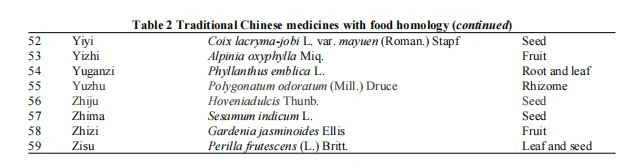
In recent years, people have become more interested in food therapy based on the theory of “medicinal and food homology.” Modern medical studies have demonstrated that antiaging TCMs can reverse aging and prolong longevity because they activate the adenosine monophosphate-activated protein kinase pathway [60], scavenge free radicals [61], and improve body immunity [62]. In 2002, the Ministry of Health issued the “List of Traditional Goods that Are Both Food and Medicine”. This list comprised 87 TCMs. In recent years, the National Health and Family Planning Commission have updated this list to include 110 TCMs. In addition, Sun QS [63] researched ancient books and TCM documents and summarized that 226 TCMs have antiaging properties. On the basis of this study, 59 antiaging medicine food homologous drugs were identified by further analysis (Table 2, Chinese Pinyin (Chinese phonetic alphabets) names in alphabetical order). The main components of their antiaging properties and the antiaging mechanisms are shown in Figure 1.

Pharmacological studies of TCMs
Some TCMs are considered to have excellent effects on antiaging, and many effects have been confirmed by experimental studies. Below, we summarize the main experimental studies related to antiaging TCMs.
Renshen (Ginseng radix et rhizoma). Renshen (Ginseng radix et rhizoma), a traditional antiaging medicine, is the dry root of Panax ginseng C.A. Mey. With rapid development in modern science and technology, increasing research has focused on mechanisms underlying the antiaging properties of Renshen (Ginseng radix et rhizoma). A study used D-galactose-induced aging male Sprague–Dawley rats to investigate the antiaging properties of ginsenoside Rg1, and after 42 days of comparative testing, this study concluded that ginsenosides Rg1 had potent antioxidant activity and that it regulated the senescence of hematopoietic stem cells, promoted the activity of SOD, and decreased levels of reactive oxygen species and content of malondialdehyde (MDA) in aging rats [64]. In addition, the administration of ginsenoside Rg1 was shown to increase telomerase activity, inhibit telomere shortening, and delay aging in D-galactose-induced aging rats [65]. In addition, the aqueous extract of Renshen (Ginseng radix et rhizoma) has been shown to increase SOD and catalase (CAT) activities and decrease MDA content in drosophila melanogaster. Simultaneously, quantitative real-time quantitative reverse transcription-polymerase chain reaction results demonstrated that the aqueous extract of Renshen (Ginseng radix et rhizoma) could significantly upregulate the expressions of SOD and CAT in drosophila melanogasters. Thus, it is concluded that the antiaging properties of Renshen (Ginseng radix et rhizoma) are primarily associated with increased activities of relevant antioxidant enzymes and enhanced free radical scavenging ability in vivo [66].
Huangqi (Astragali radix). Huangqi (Astragali radix) is the dried root of Astragalus membranaceus (Fisch.) Bge. and has shown to have unique curative effects in terms of antiaging and antioxidation. A previous study investigated the antiaging properties of the aqueous extract of Huangqi (Astragali radix) in mice with cardiac dysfunction and found that Huangqi (Astragali radix) was able to prolong the lifespan of the mice through varied mechanisms, including maintaining SOD activity in mice with cerebral ischemia, reducing MDA content and free radical levels, decreasing apoptosis and exerting antioxidant effects [67]. In addition, relevant physiological changes due to aging were simulated in naturally aging rats, and the antiaging mechanisms of Huangqi (Astragali radix) were discussed in Van’s research. The study showed that the aqueous extract of Huangqi (Astragali radix) could reduce mtDNA damage caused by free radicals, thus preventing the loss of mtDNA fragments and exhibiting good antiaging properties. The effects of Huangqi (Astragali Radix) are reportedly similar to those of vitamin E [68]. Moreover, the regulation of intestinal flora by Huangqi (Astragali radix) was studied in aging mice, and the results indicated that the amount of bifidobacteria, which is closely associated with health, returned to normal levels after administration of the aqueous extract of Huangqi (Astragali radix) [69].