Preparation Technology For Wenyang Tongbian Granules 2
Sep 20, 2024
Tab 3 Variance analysis of the orthogonal test
| Source of Variation | SS | f | S | F | P |
|---|---|---|---|---|---|
| A | 55.86 | 2 | 27.93 | 1.29 | > 0.05 |
| B | 193.94 | 2 | 96.97 | 4.49 | > 0.05 |
| C | 43.18 | 2 | 21.59 | 1.00 | > 0.05 |
| D | 1361.61 | 2 | 680.80 | 31.53 | < 0.05 |
| Error | 21.59 |
Note: F0.05(2,2)=19.00,F0.01(2,2)=99.00.
2.2.2 Verification experiment
Weigh 3 portions of the prescription medicinal materials and extract them according to the optimal process. The results show that the echinacoside content is 3.0397, 2.6835, and 3.7308 mg·g-1 respectively; the paste yield is 46.56%, 48.53%, and 47.39% respectively. The results show that the water extraction process selected by this experimental method is relatively stable and has good repeatability.

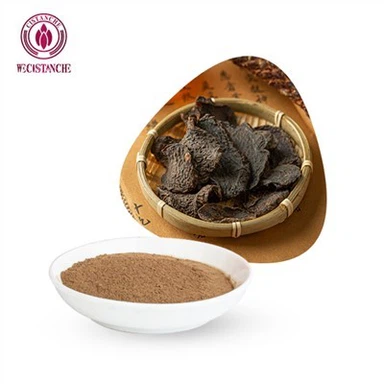
HERBAL CISTANCHE FOR
2.3 Preparation molding process research
2.3.1 Screening of excipient types
Dextrin, corn starch, microcrystalline cellulose, sucrose and lactose were selected as excipients for the preliminary experiment. They were mixed with dry paste powder at a ratio of 1:1, and then 80% ethanol was added to prepare soft materials. The materials were squeezed through a No. 2 sieve, dried at 60℃, and granulated through a No. 1 and No. 5 sieves. The dried granules were placed at the bottom of a weighing bottle with constant weight, accurately weighed, and placed in a dryer with a supersaturated NaCl solution. The granules were placed at a constant temperature of 25℃ and weighed at 6, 12, 24, 36, 48 and 60 h, respectively. The moisture absorption rate was calculated [moisture absorption percentage (%) = (weight of granules after moisture absorption - weight of granules before moisture absorption) / weight of granules before moisture absorption × 100%), and the change in moisture absorption percentage was observed. The results are shown in Table 4. . Considering the cost, process and other factors comprehensively, dextrin was finally selected as the excipient for preparation molding.
Tab 4 Effect of different excipients moisture absorption on graules (%)
| Additive | 6 | 12 | 24 | 36 | 48 | 60 |
|---|---|---|---|---|---|---|
| Agar | 2.29 | 3.81 | 5.60 | 6.93 | 7.94 | 8.83 |
| Corn Starch | 3.42 | 5.25 | 7.28 | 8.25 | 9.59 | 10.03 |
| Microcrystalline Cellulose | 2.39 | 4.11 | 6.03 | 7.22 | 8.46 | 9.08 |
| Glucose | 2.04 | 3.00 | 4.50 | 5.32 | 6.07 | 6.79 |
| Lactose | 1.75 | 2.81 | 4.18 | 5.07 | 5.77 | 6.30 |
2.3.2 Examination of wetting agent
The dry paste powder was mixed with a certain amount of dextrin (1:1), and different concentrations of ethanol (70%, 75%, 80%, 85%, 90%) were used to prepare soft materials, which were squeezed through a No. 2 sieve, dried at 60°C, and granulated through a No. 1 sieve and a No. 5 sieve. The granulation difficulty, granule properties and granule yield were used as evaluation indicators to select the appropriate ethanol concentration [11]. The results are shown in Table 5. When 85% ethanol was used for granulation, the granule yield was the highest and granulation was the easiest, so 85% ethanol was finally selected as the wetting agent.
Tab 5 Effect of adhesives with different ethanol on granules
| Ethanol Concentration/% | Granulation Difficulty | Granule Characteristics | Granule Yield/% |
|---|---|---|---|
| 70 | Large viscosity, difficult to sieve | Uneven granules, clumping | 92.39 |
| 75 | Viscous, not easy to sieve | Granules form, slightly clumped | 90.01 |
| 80 | Moderate viscosity, easy to sieve | Granules form, moderately clumped | 93.87 |
| 85 | Moderate viscosity, slightly difficult to sieve | Even granules, moderately loose | 95.63 |
| 90 | Slight viscosity difference, easy to sieve | Granules break easily, more fine powder | 90.96 |
Tab 6 Effect of different proportions of dextrin on granules
| Binder Ratio: Agar | Granulation Difficulty | Granule Characteristics | Granule Yield/% |
|---|---|---|---|
| 1:0.7 | Large viscosity, difficult to sieve | Large granules, easy to break | 67.98 |
| 1:0.8 | Large viscosity, difficult to sieve | Large granules, slightly clumped | 90.59 |
| 1:0.9 | Moderate viscosity, slightly difficult to sieve | Even granules, moderately loose | 93.38 |
| 1:1.0 | Moderate viscosity, easy to sieve | Even granules, moderately loose | 91.06 |
| 1:1.1 | Slight viscosity difference, easy to sieve | Loose granules, not well-formed | 86.22 |
| 1:1.2 | Slight viscosity difference, easy to sieve | Loose granules, not well-formed | 82.15 |
2.3.3 Ratio of dry paste and excipients
Different proportions of excipients were selected for evaluation. The dry paste powder was mixed with a certain amount of dextrin, granulated with 85%
ethanol, and dried at 60℃. The difficulty of granulation and the yield of granules were used as evaluation indicators. The single factor method was used to optimize the appropriate amount of dextrin. The results are shown in Table 6. When the ratio of dry paste to excipients was 1:0.9, granulation was easiest and the granule yield was the highest.

2.3.4 Granule verification test
Three batches of Wenyang Tongbian granules were prepared according to the optimal process. According to the provisions of the preparation process under the relevant items of the 2020 edition of the "Chinese Pharmacopoeia", the appearance, moisture, solubility, and echinacoside content of the granules were evaluated and measured. The results showed that the size and particle size of the three batches of Wenyang Tongbian granules were uniform, the appearance was yellow-brown, the smell was slightly fragrant, and the moisture and solubility were in line with the relevant provisions of the pharmacopoeia. The results are shown in Table 7. It shows that the preparation process of Wenyang Tongbian Granules is stable, controllable, reasonable and feasible.
3 Discussion
3.1 Selection of indicator components
The indicator component for the content determination of Cistanche deserticola in the 2020 edition of the Chinese Pharmacopoeia is the total content of echinacoside and verbascoside. However, in the specific test of content determination in this experiment, it was found that the chromatographic peak of verbascoside in Wenyang Tongbian Granules was very low and had negative interference. The contents of echinacoside and verbascoside in more than ten batches of Cistanche deserticola slices were determined. The results showed that the content of verbascoside in each batch of Cistanche deserticola slices was much lower than that of echinacoside, but the total content of both was in line with the pharmacopoeia requirement of more than 0.3%. Echinacoside is the main active ingredient of Cistanche deserticola, which has antioxidant, anti-inflammatory, mucosal repair and immunomodulatory activities [3]. There are literature reports: Direct intragastric administration of echinacoside to constipation model mice has a laxative effect, and its mechanism may be related to reducing intestinal oxidative stress and inflammatory response, improving intestinal neurotransmitter abnormalities and increasing AQP3 expression in colon tissue [12-13]. Therefore, after comprehensive consideration, this experiment finally selected only echinacoside as the indicator for content determination.

3.2 Selection of excipients
Dextrin, corn starch, lactose, sucrose, etc. are commonly used excipients for granules. Because lactose is expensive and for lactose-intolerant patients, taking granules prepared with this excipient will cause diarrhea, vomiting, distension and pain and other adverse reactions. Sucrose is hygroscopic and has moisture absorption during the granulation process, which makes granulation difficult. It is also easy to absorb moisture and soften during drug storage, affecting drug stability. In addition, excessive intake of sucrose can induce or cause diseases such as diabetes, obesity, and dental caries.
Microcrystalline cellulose is expensive and has a higher hygroscopicity than dextrin. Corn starch has the highest hygroscopicity, so this process ultimately selected dextrin as the excipient for granulation. Studies have found that granulation is easiest when the drug-excipient ratio is 1:0.9, the granules are more uniform, the operability is strong, and the granule yield is the highest.

References
[1] Xiao Wenjie, Lin Aizhen. Lin Aizhen's experience in treating functional constipation in the elderly with the warming Yang method [J]. Journal of Integrated Traditional Chinese and Western Medicine, 2019, 11 (1): 43-44.
[2] Guo Yuanheng. Comprehensive utilization of desert Cistanche deserticola resources [D]. Beijing: University of Chinese Academy of Sciences (Institute of Process Engineering, Chinese Academy of Sciences), 2017: 3.
[3] Liu Xianhong, Zheng Anmin. Clinical study on 31 cases of constipation treated with Cistanche deserticola decoction [J]. Chinese Community Physician, 2020, 36 (4): 126-127.
[4] Chen Xu, Liu Chang, Ma Ninghui, et al. Research progress on chemical composition, pharmacological effects and comprehensive application of cinnamon [J]. Chinese Pharmacy, 2018, 29 (18): 2581-2584.
[5] Zhang Tuoyan, Liu Hailong, Wang Rui, et al. Chemical components and pharmacological effects of Astragalus and Q-marker prediction analysis [J]. Chinese Journal of New Drugs, 2023, 32 (4): 410-419.
[6] Han KH, Park JM, Jeong M, et al. Heme oxygenase-1 induction and anti-inflammatory actions of atractylodes macrocephala and taraxacum herba extracts prevented colitis and was more effective than sulfasalazine in preventing relapse [J]. Gut and Liver, 2017, 11 (5): 655-666.
[7] Pei Xiangping, Liang Huizhen, Jin Beibei, et al. Optimization of extraction and molding process of Men's Yangrong Granules by orthogonal experimental method [J]. Northwest Journal of Pharmacy, 2020, 35 (2): 183-186.
[8] Li Guoyu, Liang Haodu, Guan Tong, et al. Study on the preparation process of Gushen Zhiyi Shuangzi Granules [J]. Zhongnan Pharmacy, 2023, 21(3): 700-705.
[9] Chinese Pharmacopoeia 2020 Edition. Volume 1 [S]. 2020: 257.
[10] Wang Jingxia, Chen Lin. Study on the extraction process of pediatric Qingre suppository optimized by multi-index comprehensive scoring method [J]. Chinese Journal of Traditional Chinese Medicine, 2014, 32(10): 2396-2399.