Quercetin Application For Common Carp (Cyprinus Carpio): I. Effects On Growth Performance, Humoral Immunity, Antioxidant Status, Immune-Related Genes, And Resistance Against Heat Stress
Jul 26, 2023
This study was done to evaluate the effect of different quercetin levels on growth performance, immune responses, antioxidant status, serum biochemical factors, and high-temperature stress responses in common carp (Cyprinus carpio). A total number of 216 common carp with an average weight of 27:21 ± 53 g were divided into 12 tanks (four treatments × three replications) and fed 0 mg/kg quercetin (T0), 200 mg/kg quercetin (T1), 400 mg/kg quercetin (T2), and 600 mg/kg quercetin (T3) for 60 days. There were significant differences in growth performance, and the highest final body weight (FBW), weight gain (WG), specific growth rate (SGR), and feed intake (FI) were observed in T2 and T3 (P < 0:05).
There is a close relationship between serum biochemical factors and immunity. Serum biochemical factors are the main metabolites in the human body, and the increase or decrease of their levels will affect the immunity of the human body.
Serum biochemical factors include proteins, carbohydrates, fats, and other substances, which form a complex metabolic network in the human body. When the human body is in a healthy state, the levels of serum biochemical factors will be in a balanced state, which helps to maintain the healthy state of the human body.
When the human body suffers from disease or stress, the levels of serum biochemical factors will change, which will reduce immunity. For example, when the levels of protein and amylase in the serum decrease, the body's immunity will be significantly weakened, resulting in increased susceptibility to disease.
Therefore, it is very important to maintain the balance of serum biochemical factors, which can be achieved through lifestyle changes. For example, exercising more, eating less high-fat, high-salt, and high-sugar foods, and eating more fresh fruits and vegetables can help the body maintain healthy serum biochemical factor levels, thereby improving immunity.
In short, serum biochemical factors are closely related to human immunity, and together they constitute the body's metabolic network. We should maintain a healthy lifestyle and keep serum biochemical factors in balance to protect our health. From this point of view, we need to improve our immunity. Cistanche can significantly improve immunity because Cistanche also has anti-virus and anti-cancer effects, which can strengthen the immune system’s ability to fight and improve the body’s immunity.

Click health benefits of cistanche
Different quercetin levels significantly increased complement pathway activity (ACH50) and lysozyme activity both before and after heat stress (P < 0:05). Catalase (CAT), glutathione peroxidase (GPx), and malondialdehyde (MDA) were significantly increased in fish exposed to heat stress, but fish fed with a supplemented diet with quercetin showed the lowest levels both before and after heat stress (P < 0:05). Superoxide dismutase (SOD) levels were significantly enhanced in fish fed diets supplemented with quercetin in both phases (P < 0:05). Different quercetin levels led to a significant decrease in alanine aminotransferase (ALT) and aspartate aminotransferase (AST) before and after the challenging test (P < 0:05).
Glucose and cortisol levels were significantly higher in
the control group compared to the other treatments in both phases (P < 0:05). The expression of glutathione peroxidase (GPx)
and lysozyme was markedly upregulated in fish fed with quercetin-supplemented diets (P < 0:05). No marked effects were
observed for growth hormone (GR) and interleukin-8 (IL8) (P > 0:05). In conclusion, dietary quercetin supplementations (400-
600 mg/kg quercetin) improved growth performance, immunity, and antioxidant status and increased tolerance to heat stress.
1. Introduction
Aquaculture is developing incrementally in parallel with global population growth. Nevertheless, intensive production activities, sudden temperature changes, abnormal climate, and other environmental conditions as such cause stress to fish and hamper production quality and yield by triggering immune depression and increased infectious epidemics. One of the most important environmental items in the aquaculture industry is temperature because it can affect the metabolism, feeding behavior, growth performance, survival, and disease resistance of aquatic animals [1–3]. Temperature changes decreased the growth, feed efficiency, physiological function, immune response, and oxidative status in the organs of aquatic animals ([3–5].
To combat such challenges, the involvement of functional feed additives in the fish diet is environment-friendly and efficient. These additives can potentially increase the growth and reproductive performance of fish, fillet quality, and resistance to diseases and environmental conditions.
Polyphenols and polyphenol-rich additives are added to aquatic animal feed to increase growth performance, immune response, antioxidant status, and disease resistance [6, 7]. Being considered the main class of flavonoids (flavonols), a family of polyphenolic compounds, quercetin is abundant in many fruits and vegetables, including tea, onions, apples, strawberries, cabbage, nuts, and cauliflower.
It is widely acknowledged that quercetin inhibits biofilm production of many pathogenic bacteria such as Enterococcus faecalis, Staphylococcus aureus, Streptococcus mutants, Escherichia coli, and Pseudomonas aeruginosa with its features such as suppression of quorum-sensing pathways, inhibition of efflux pumps, disruption or alteration of the plasma membrane, and blocking nucleic acid synthesis [8]. Moreover, quercetin has many beneficial properties such as being an anticancer [9], antioxidant, and anti-inflammatory [10].
Previous findings indicated that dietary quercetin had a positive effect on the antioxidant status [11, 12], growth performance [13, 14], flesh quality [15], hematological and immune parameters [16], disease resistance [17, 18], and grouper iridovirus defense properties [19–21]. Some research showed that dietary quercetin enhanced the growth performance of chicken [22] and boosted sensory scores such as color, texture, and overall acceptability of goat loin [23]. In aquatic animals, quercetin above 400 mg/kg improved the growth performance of tilapia (Oreochromis spp.) [24].
Previous studies have reported that dietary herbal supplementations reduce stress markers in some fish and/or shellfish species like Macrobrachium rosenbergii [25], Megalobrama amblycephala [26], and Oncorhynchus mykiss [27] subjected to high-temperature. However, no information is available as to the effect of dietary quercetin on aquatic animals exposed to high-temperature stress. Therefore, the present study was carried out to compare the effect of dietary quercetin supplementations on growth performance, some immune parameters, antioxidant status, some serum biochemical variables, and high-temperature stress responses in fish.
2. Material and Methods
2.1. Experimental Diets. Four experimental diets with different quercetin (>95% purity, Sigma Chemical Co., USA) levels were formulated (Table 1). Briefly, the dry ingredients were mixed thoroughly. After the liquid ingredients were diffused into the mixture, deionized water was added (250 ml per kg of diet). The prepared mixture was extruded in an electric meat grinder (MG1400R, Pars Khazar, Tehran, Iran), and feeds were passed off based on the fish’s mouth size (1 mm in diameter). Finally, four experimental diets were prepared including 0 mg/kg quercetin (T0), 200 mg/kg quercetin (T1), 400 mg/kg quercetin (T2), and 600 mg/kg quercetin (T3). The pellets were dried in a drying cabinet and then stored at 4° C until use. The chemical composition, moisture, crude protein, lipids, and ash contents were confirmed by following standard methods [28].
2.2. Fish and Experimental Condition. A total number of 216 common carp with an average weight of 27:21 ± 53 g were obtained from a private fish farm and moved to the research hall of the University of Gonbad (Gonbad, Iran). They were stored in 12 tanks with a density of 18 fish per tank and acclimated to experimental conditions for 10 days. During the acclimation period, common carp were fed a basal diet twice a day. At the end of adaptation time, these tanks were randomly nominated to 4 treatments with 3 replicates, and fish were fed at a rate of 2.5% of body weight twice a day for 60 days. Fish waste and half of the aquarium water were siphoned daily and replaced with well-aerated water. Water quality parameters such as temperature, dissolved oxygen, and pH were regularly measured and kept at standard levels for common carp (temperature 24:1±0:5C, dissolved oxygen 6:8±0:2mg/l, pH7:36 ± 0:1, and photoperiod 12D: 12L) [29].
2.3. Biometry and Blood Sample Collection. After a 24 h fasting period, all fish in each tank were anesthetized using 200 mg l-1 clove powder, and the weight of each fish was recorded [30]. The growth performance and survival rate were calculated using a common formula [7]. Three fish per tank (9 fish per treatment) were randomly selected to collect the blood sample. Blood samples were collected via the caudal vein of each fish using a sterile syringe and introduced into tubes. The tubes were centrifuged (5000 rpm for 10 min at 4° C) [29], and then, the supernatant was separated and stored at -20° C.
2.4. Heat Challenge. After 60 days of feeding, a heat stress challenge was administered according to the Dawood et al. [30] study in triplicate. First, feeding was stopped during the test, and seven starved fish per tank (21 fish per treatment) were held at a similar condition with a high temperature (32° C) for 48 hours for heat stress. Aquarium heaters were used to increase the temperature up to 32° C, and the water temperature was checked frequently by portable multiparameter meters (YSI, China).
2.5. Blood and Tissue Sampling. After the challenging test, all fish in each tank were anesthetized using 200 mg l-1 clove powder, and three fish per tank (9 fish per treatment) were selected to collect blood samples. Blood samples were collected via the caudal vein of each fish using a sterile syringe and introduced into tubes. The tubes were centrifuged (5000 rpm for 10 min at 4° C) [29], and then, the supernatant was separated and stored at -20° C.

2.6. Biochemistry Assay. Before and after challenging tests, glucose, alanine aminotransferase (ALT), aspartate aminotransferase (AST), catalase (CAT), glutathione peroxidase (GPx), malondialdehyde (MDA), and superoxide dismutase (SOD) were assayed using commercial kits (Pars Azmoon, Iran). Serum lysozyme activity was assayed using the method of Saurabh and Sahoo [31] with turbidimetry. First, a suspension of Micrococcus lysodeikticus was prepared by dissolving 0.2 mg ml-1 in a 0.05 M sodium phosphate buffer (pH 6.2). Then, 50 μl serum was added to a 2 ml suspension of Micrococcus lysodeikticus, and the reaction mixture was divided into a 96-well microtitre plate (Hyperion, Germany), and initial OD was measured spectrophotometrically at 450 nm immediately. The final OD was measured after incubation of the reaction mixture at 24° C for 1 h. A unit of lysozyme activity was defined as the sample amount causing a decrease in absorbance of 0.001/min lysozyme of the sample calibrated using a standard curve determined with hen’s egg white lysozyme (Sigma) in PBS. Serum alternative complement (ACH50) activity was measured based on Yano et al. [32], in which rabbit red blood cells (RBCs) were used as a target. Serum cortisol levels were measured by the competitive ELISA method using a commercial kit (IBL Co., Gesellschaft für Immunchemie und Immunbiologie).
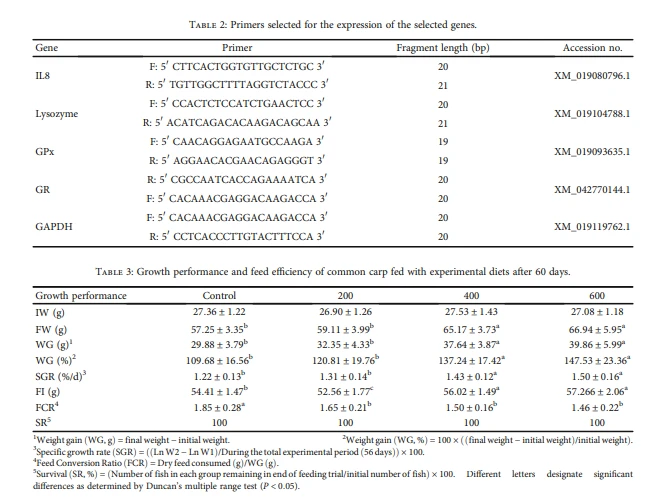
2.7. Gene Expression. The total RNA of fish livers collected after a challenging test was isolated using the GeneAll Kit (GeneAll Biotechnology, Seoul, Korea). After evaluating RNA quality by electrophoresis agarose gels, 2 μg of total RNA was treated with DNase I and used for first-strand cDNA synthesis using oligo (dT) primers, 10 mM dNTPs, and reverse transcriptase according to the manufacturer’s instructions (Thermo Scientific, Germany). Gene-specific primers were mentioned for RT-PCR analysis in Table 2. The beta-actin gene was used as an internal control. qPCR was carried out using RealQ Plus Master Mix Green (AMPLIQONIII) following the manufacturer’s instructions. The reaction consisting of 10 μl SYBR green mix, 1 μl of diluted cDNA, 0.5 μl of each primer, and Millipore water was added to a final volume of 20 μl. The following program was used for the reaction: 10 min at 95° C, denaturation at 95° C for 10 s, annealing at 60° C for 40 s, and extension at 72° C for 35 s for 40 cycles. The RNA level was calculated based on the 2-ΔΔCT method [33]. Three biological repeats were done for each experiment.
2.8. Statistical Analysis. Data (mean ± SD) were analyzed by one-way analysis of variance (ANOVA) followed by Duncan’s multiple range test to compare the means between groups. Before analyses, data were assessed for normality and homogeneity of variance with the Shapiro-Wilk test and Levene’s test, respectively. Two-way ANOVA was also used to test the effects of the diet, heat stress, and their interactions. Statistical analyses were conducted using SPSS software version 23, and P < 0:05 was the accepted significance level.
3. Results
3.1. Growth Performance. There were significant differences in growth performance, and the highest FBW, WG, SGR, and FI were seen in T2 and T3 (Table 3, P < 0:05). FCR was significantly decreased in fish-fed quercetin (Table 3, P < 0:05).
3.2. Serum Immune Response. Lysozyme and ACH50 activity was remarkably decreased when common carps were exposed to heat stress, and the lowest activity was observed in fish fed a control diet and fish fed with supplemented diets, representing the highest levels (Table 4, P < 0:05). Before and after heat stress, different quercetin levels significantly increased ACH50 and lysozyme activity, and the highest activities were seen in fish fed 400 (T2) and 600 (T3) mg/kg quercetin (Table 4, P < 0:05).

3.3. Antioxidant Enzymes. Catalase, MDA, and GPx were significantly raised in fish exposed to heat stress, with the highest level in fish fed with a control diet and fish fed with a supplemented diet with quercetin showing the lowest levels (Table 4, P < 0:05). SOD levels decreased significantly in fish exposed to heat stress (when all treatments were combined); also, there was a significant difference in the levels of SOD amongst the treatments before and after heat challenge, and the highest level was recorded in T2 in both phases (Table 5, P < 0:05).
3.4. Stress Parameters. Before and after heat stress, glucose, and cortisol levels were significantly higher in the control group compared to quercetin supplementation treatments (Table 6, P < 0:05). Exposure of common carp to high temperatures led to a significant increase in AST and ALT in all treatments, but fish fed with 600 mg/kg quercetin had the lowest levels (Table 6, P < 0:05). Moreover, before and after the challenge, the highest and lowest activities of ALT and AST were seen in the control group and T3, respectively (Table 6, P < 0:05).

3.5. Gene Expression. After heat stress exposure, the expression of GPx (Figure 1(a)) was markedly upregulated, and the highest RNA levels were observed in fish fed 400 mg/kg quercetin (P < 0:05). No marked effects were observed for GR (Figure 1(b)) and IL8 (Figure 1(c)), but they were higher in fish fed with quercetin-supplemented feeds (P > 0:05).
The lysozyme gene expression was markedly higher in common carp fed with quercetin-supplemented feeds than in the control group (Figure 1(d)).
4. Discussion
In this study, the dietary incorporation of quercetin significantly improved growth and feed efficiency in common carp. Accordingly, the best WG, SGR, FI, and FCR were obtained in the fish fed with 400 and 600 mg/kg quercetin-supplemented diets. Previous findings indicated that dietary quercetin had a positive effect on the WG, SGR, and FCR in Nile tilapia (Oreochromis niloticus) [34], grass carp (Ctenopharyngodon idella) (), and common carp [13]. The promoting effect of quercetin on fish growth performance may be related to their better efficacy in stimulating the secretion of digestive enzymes like protease, amylase, and lipase [13, 34], decreasing the abundance of harmful bacteria of the intestine and promoting the populations of beneficial bacteria [35], ameliorating the intestinal barrier function, and improving the surface area of intestinal villi and goblet cells [36].

ACH50 activity is a significant parameter that benefitted in the evaluation of humoral nonspecific immune response in fish. A decrease in serum ACH50 levels is reported in different stress situations that fish are exposed to. In the present study, serum ACH50 activity significantly increased in the group supplemented with the doses of 400 and 600 mg/kg quercetin before the stress and after the stress compared to the control group. In conclusion, as the liver is the main source of complement proteins, the increase in ACH50 levels can be explained by improving the health and function of the liver. Our results in terms of increasing ACH50 activity are in full agreement with findings of earlier studies in common carp-fed diets incorporated with 200 or 800 mg/ kg quercetin [16]. Moreover, the results are in line with previous studies showing exogenous feed additives successful to prevent post-stress complement activity reduction [37, 38].
Lysozyme is an important antimicrobial peptide of the innate immune system invading pathogens. A significant decrease in serum lysozyme activity was found in the control group of fish exposed at 32° C for 48 hours. A similar decrease in serum lysozyme activity at higher temperatures was observed in Nile tilapia, Oreochromis niloticus [39]. In the present study, serum lysozyme activity was significantly increased in all quercetin-supplemented groups before the stress and after the stress compared to the control group. This suggests that quercetin supplementation inhibits post-high-temperature stress immunosuppression.
Parallel with our study, lysozyme levels have also been increased in some fish species fed with quercetin-containing feeds. For instance, C. carpio fed with a diet containing 200 or 800 mg kg−1 quercetin showed an increase in lysozyme levels in serum, intestine, and mucus [16]. Wang et al. [18] added 0.01, 0.1, 1, 10, 100, and 1000 μg/l quercetin to the rearing water of zebrafish (Danio rerio) and reported that serum lysozyme activity was significantly higher in the 1 μg/l quercetin group than in the control group.
It is well known that serum glucose is used as a nonspecific stress index in fish studies [40, 41]. In this study, quercetin supplementations decreased serum glucose content significantly in the prestress group. Some reports are available on the hypoglycaemic effects of quercetin [42, 43]. This was supported in a recent study, where quercetin decreases serum glucose levels in common carp [16]. However, unlike our study, serum glucose levels in silver catfish, Rhamdia queen [12], and blunt snout bream, Megalobrama amblycephala [44], fed with feed containing quercetin remained unchanged.
Superoxide dismutase (SOD), catalase (CAT), and glutathione peroxidase (GPx) are the main enzymes that scavenge reactive oxygen species (ROS) and detoxification of H2O2 and hydroperoxides, respectively. In addition, malondialdehyde (MDA) is frequently used as a biomarker of lipid peroxidation. Our results in terms of increasing SOD and decreasing MDA activity are in full agreement with findings of earlier studies in common carp, C. carpio, fed diets incorporated with 800 mg/kg quercetin. Similarly, Ibrahim et al. [45] reported the increased SOD and GPx and decreased MDA effect of quercetin in Nile tilapia, Oreochromis niloticus.
Moreover, SOD mRNA expression [46] and brain, gill, liver, and/or muscle SOD and CAT activity levels [12] were higher in fish fed with quercetin diets. SOD, CAT, MDA, and GPx parameters play a significant role in antioxidant response in different stress conditions like pesticides [47], metals [48], high temperatures [49, 50], hypoxia [50], and cold temperatures [51]. However, no study is available on the effects of quercetin on antioxidant capacity in fish under high-temperature stress conditions. In the present study, decreased CAT, MDA, and GPx levels and increased SOD levels observed in post-high-temperature stress conditions indicate a significant antioxidant effect of quercetin. Similarly, the dietary anthraquinone extract especially at 0.1- 0.2% levels significantly increased SOD and decreasing MDA levels in the liver was reported in M. rosenbergii under high-temperature stress [25].
Serum enzyme activities are accepted as important indicators of tissue damage; for example, AST and ALT are indicators of liver damage, and lactate dehydrogenase (LDH) for liver or muscle damage in fish [52]. Therefore, increases in these enzymes in blood could be attributed to liver and muscle tissue damage. Previous studies showed that the serum ALT and AST activities provided decreased when fish were fed with quercetin [13, 16]. No study on the effects of quercetin under high-temperature stress on fish serum enzyme levels has been found in the literature so far. However, [25] reported that AST and ALT activities in freshwater prawn (M. rosenbergii) fed a diet containing anthraquinone extract from R. officinale Bail under high-temperature stress were significantly lower than those of the control fish. In this study, serum AST and ALT (except for 200 mg/kg) decreased in fish fed with quercetin-supplemented feeds before high-temperature stress. This trend was sustained after high-temperature stress as well.
The low serum glucose levels in the high-temperature stressed fish may be the result of undernourished conditions, liver disorders, and inflammation [25, 50, 53]. This can be related to the increases in glucose use in peripheral tissues, probably related to the enhancement of energy demand generated by the stress response [54]. A similar reduction in the serum glucose level at a higher temperature (21° C) was observed in rainbow trout, Oncorhynchus mykiss [50]. In contrast to our findings, however, increased levels of glucose in the blood were reported in Wuchang bream, M. amblycephala, under high-temperature stress [26]. These different results might be associated with differences in rearing conditions, exposure time, fish species, fish size, and/or age.
Blood cortisol is one of the most important indexes of the response to heat stress in fish [55]. In this study, cortisol levels were significantly lower in fish fed different quercetin levels before heat stress. Also, fish fed with diets supplemented with quercetin displayed significantly lower levels of cortisol after heat stress, highlighting the protective potential of quercetin supplementation on the metabolism of common carp. Similarly, Nile tilapia fed with dietary sodium butyrate showed a decrease in cortisol levels when exposed to heat stress [30]. In this study, cortisol was significantly lower during heat stress in fish-fed quercetin as compared to the control group. These results may be related to the antistress effects of quercetin that inhibited the domain of raised cortisol.
In line with these findings, it can be suggested that quercetin (400-600 mg/kg) may be a useful substance in the treatment and protection of cells against possible oxidative stress.

Data Availability
The datasets generated during and/or analyzed during the current study are available from the corresponding authors upon reasonable request.
Conflicts of Interest
The authors declare that they have no conflicts of interest
Acknowledgments
This study was supported by the University of Zabol (Iran) with a grant code (IR-UOZ-GR-6313). This work was partially supported by Chiang Mai University.
References
[1] F. Wu, C. Yang, H. Wen, et al., “Improving low-temperature stress tolerance of tilapia, Oreochromis niloticus: a functional analysis of Astragalus membranaceus,” Journal of the World Aquaculture Society, vol. 50, no. 4, pp. 749–762, 2019.
[2] M. E. Abd El-Hack, S. A. Abdelnour, A. E. Taha, et al., “Herbs as thermoregulatory agents in poultry: an overview,” Science of the Total Environment, vol. 703, article 134399, 2020.
[3] C. Liu, W. Shen, C. Hou et al., “Low temperature-induced variation in plasma biochemical indices and aquaglyceroporin gene expression in the large yellow croaker Larimichthys crocea,” Scientific Reports, vol. 9, no. 1, pp. 1–10, 2019.
[4] J. Qiang, H. Yang, H. Wang, P. Xu, Z. Qi, and J. He, “Studies on blood biochemical indices and expression of hepatic HSP70 mRNA of different tilapia strains artificially challenged with streptococcus iniae,” Journal of Fisheries of China, vol. 36, no. 6, pp. 958–968, 2012.
[5] I. S. Vicente, L. F. Fleuri, P. L. Carvalho, et al., “Orange peel fragment improves antioxidant capacity and hematological profile of Nile tilapia subjected to heat/dissolved oxygen-induced stress,” Aquaculture Research, vol. 50, no. 1, pp. 80– 92, 2019.
[6] E. Ahmadifar, M. Yousefi, M. Karimi, et al., “Benefits of dietary polyphenols and polyphenol-rich additives to aquatic animal health: an overview,” Reviews in Fisheries Science & Aquaculture, vol. 29, no. 4, pp. 478–511, 2021.
[7] E. Ahmadifar, M. Eslami, N. Kalhor, et al., “Effect of a diet enriched with sodium propionate on growth performance, antioxidant property, innate-adaptive immune response, and growth-related genes expression in critically endangered beluga sturgeon (Huso huso),” Fish & Shellfish Immunology, vol. 125, pp. 101–108, 2022.
[8] H. Memariani, M. Memariani, and A. Ghasemian, “An overview on anti-biofilm properties of quercetin against bacterial pathogens,” World Journal of Microbiology and Biotechnology, vol. 35, no. 9, 2019.
[9] S. S. Baghel, N. Shrivastava, R. S. Baghel, P. Agrawal, and S. Rajput, “A review of quercetin: antioxidant and anticancer properties,” World Journal of Pharmacy and Pharmaceutical Sciences, vol. 1, no. 1, pp. 146–160, 2012.
[10] M. Lesjak, I. Beara, N. Simin, et al., “Antioxidant and antiinflammatory activities of quercetin and its derivatives,” Journal of Functional Foods, vol. 40, pp. 68–75, 2018.
[11] T. S. Pês, E. M. Saccol, É. P. Londero et al., “Protective effect of quercetin against oxidative stress induced by oxytetracycline in the muscle of silver catfish,” Aquaculture, vol. 484, pp. 120–125, 2018.
[12] T. S. Pês, E. M. Saccol, G. M. Ourique, et al., “Quercetin in the diet of silver catfish: effects on antioxidant status, blood parameters, and pituitary hormone expression,” Aquaculture, vol. 458, pp. 100–106, 2016.
[13] H. Ghafarifarsani, S. H. Hoseinifar, S. Javahery, M. Yazici, and H. Van Doan, “Growth performance, biochemical parameters, and digestive enzymes in common carp (Cyprinus carpio) fed experimental diets supplemented with vitamin C, thyme essential oil, and quercetin,” Italian Journal of Animal Science, vol. 21, no. 1, pp. 291–302, 2022.
[14] S. W. Zhai and S. L. Liu, “Effects of dietary quercetin on growth performance, serum lipids level and body composition of tilapia (Oreochromis niloticus),” Italian Journal of Animal Science, vol. 12, no. 4, article e85, 2013.
[15] Z. Xu, X. Li, H. Yang, G. Liang, B. Gao, and X. Leng, “Dietary quercetin improved the growth, antioxidation, and flesh quality of grass carp (Ctenopharyngodon idella),” Journal of the World Aquaculture Society, vol. 50, no. 6, pp. 1182–1195, 2019.
For more information:1950477648nn@gmail.com