Research On The Medicinal History Of Cistanche Deserticola And Selection Of The Best Production Areas
Sep 03, 2024
Cistanche deserticola was first recorded in the Shennong Bencao Jing. It is a fleshy plant with calm and gentle medicinal properties, hence the name Cistanche deserticola. On November 9, 2023, Cistanche deserticola was listed as a substance that is both a food and a traditional Chinese medicinal herb according to tradition.
chinese herb cistanche
Materia Medica Verification
The production areas of Cistanche deserticola plants in ancient Chinese herbal books are widely distributed, mainly concentrated in Qinghai, Gansu, Shaanxi, Shanxi, Hebei, and Inner Mongolia provinces, with Inner Mongolia and Gansu being the best production areas, similar to the current Cistanche deserticola production areas.
The medicinal history of ancient Cistanche deserticola is relatively chaotic, with some cases of mixing it with Liedang and Jinlian roots and using them as substitutes when Cistanche deserticola is lacking. However, the efficacy is relatively low, so Cistanche deserticola is preferred in terms of quality.
The main contraindications for the use of Cistanche deserticola in ancient Chinese herbal books are based on syndrome contraindications, which can be summarized into the following six points:
① Diarrhea is prohibited;
② Insufficient kidney yin and strong yang, as well as insufficient consolidation of essence, should be avoided; ③ Do not use for people with stomach deficiency;
④ Heart deficiency and bloating are prohibited;
⑤ Prohibited for constipation caused by excessive heat;
⑥ Avoid copper and iron. Many contents related to the indications and effects of Cistanche deserticola have not been included in the Pharmacopoeia of the People's Republic of China. The Pharmacopoeia of the People's Republic of China has made deletions to its medicinal properties and taste and does not specify any contraindications for its use.
morphological character

Harvest of Cistanche deserticola
Click here to view Cistanche deserticola tea products
【Ask for more】 Email:cindy.xue@wecistanche.com / Whats App: 0086 18599088692 / Wechat: 18599088692
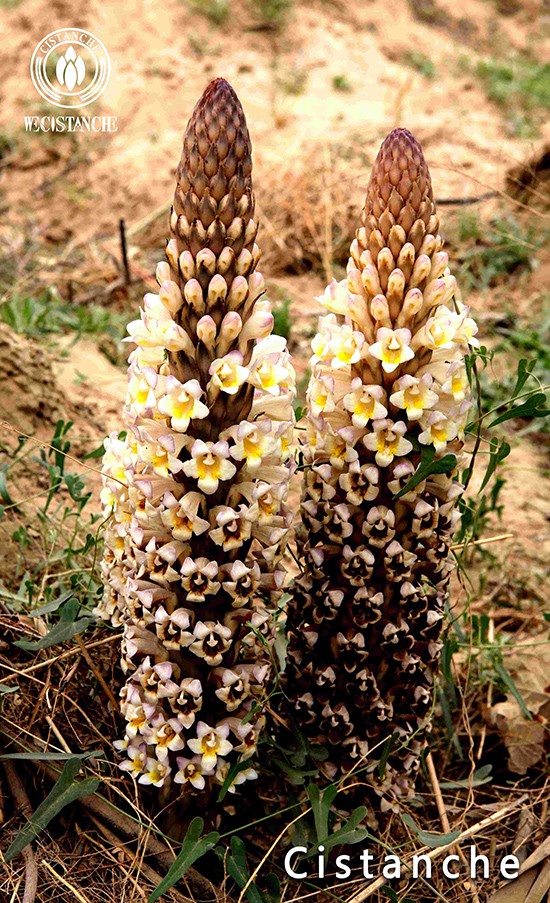
Perennial herb; 40-160 centimeters high, mostly underground; The lower leaves of the stem are tightly packed, broadly ovate or triangular ovate, measuring 0.5-1.5 cm in length and 1-2 cm in width; The upper leaves are sparse, lanceolate or narrowly lanceolate, and hairless; The inflorescence is 15-50 centimeters long and 1-2 centimeters wide; The upper leaves are sparse, lanceolate or narrowly lanceolate, and hairless; Spike inflorescence is 15-50 centimeters long; Bracts are lanceolate or lanceolate in shape, often longer than the corolla; The small bracteoles are ovate lanceolate or lanceolate in shape, nearly equal in length to the sepals; Calyx bell shaped, 5-lobed; Corolla cylindrical bell shaped, 3-4 cm long, 5 lobes, nearly semi-circular; The corolla is light yellow, the lobes are light yellow, light purple or light purple at the edges, and brown when dried; The base of the filaments is wrinkled and covered with long soft hairs; The base of the anthers has a pointed tip and is wrinkled with long soft hairs; The base of the ovary has nectaries; Fold inward at the top of the style; Capsule ovoid, 1.5-2.7 cm long, with a persistent style at the top; The seed is 0.6-1 millimeters long.
Distribution range
Xinjiang: Urumqi, Toutunhe, Urhe, Changji, Qitai, Jinghe, Wuqia, Shawan, Tori, Hebusier, Fuyun, Fuhai, Shihezi; Inner Mongolia: Alxa Right Banner; Gansu: Gaolan; Ningxia.
environment
Born on dunes in the Red Willow Desert, at an altitude of 225-1150 meters; The main hosts are red willow and white red willow. The type specimen was collected from Alxa Banner, Bayannur League, Inner Mongolia.
Red Willow - Growth Habits
It prefers to grow on soft sandy land with mild salinization, generally on sandy or semi-fixed dunes, dry old riverbeds, lowlands of lake basins, etc., with poor habitat conditions. The climate suitable for growth is arid, with low rainfall, high evaporation, long sunshine hours, and large temperature differences between day and night. The soil is mainly composed of gray-brown desert soil and brown desert soil. The host red willow is a strongly drought-tolerant plant. Cistanche deserticola often parasitizes its lateral roots at a depth of 30-100 centimeters. Born in the desert at an altitude of 225-1150 meters, it parasitizes the roots of plants such as red willows and white willows in the Chenopodiaceae family.

Cistanche deserticola flower
Breeding methods
The reproduction method of Cistanche deserticola is seed propagation. Dig seedbeds on the east or southeast side of wild red willows, 50-80 centimeters away from the host. The size of the seedbeds varies, with a length of 1-2 meters, a width of about 1 meter, and a depth of 50-80 centimeters; In areas with high host density, dig a large seedling bed ditch, surrounding many host plants, sprinkle seeds on the seedbed, apply camel manure, cow and sheep manure, etc., and cover with 30-40 centimeters of soil. Leave a ditch or seedbed pit on top for watering. Artificial red willow forests grow neatly and in rows, and can be used as seedbeds by digging trenches on both sides of the plants. After sowing, keep the seedbed moist and induce the host roots to extend onto the seedbed. Sow in spring or autumn, and in the second year, some seedbeds are parasitized by Cistanche deserticola. A few are unearthed and grow, while most are unearthed, flowering, and fruiting within 2-4 years after sowing.
cultivation techniques
Choose a place
Cistanche deserticola is a sand plant and should be planted in desert hills with abundant sunlight, low rainfall, good drainage, and large temperature differences between day and night.
Cistanche deserticola is a perennial parasitic seed plant that has certain selectivity for host, soil, and climate conditions. Suitable hosts include Salix, Salix, and Eucommia ulmoides. The host can utilize natural red willows, red willows, etc., or artificially plant red willows and red willows and inoculate them with Cistanche deserticola 2-3 years later.
Vaccination method
Combining afforestation with inoculation of Cistanche deserticola: During afforestation, place the seed paper horizontally at one end of the afforestation pit, with the absorbent paper facing upwards, then backfill with an appropriate amount of soil, plant the host on the other end of the afforestation pit, and compact the backfill with soil.
Inoculate on the original host: Dig a pit with a length of 40 centimeters, a width of 30 centimeters, and a depth of 40-80 centimeters in the root dense area outside the wild host, place seed paper, raise the suction surface upwards, and backfill soil to about 10 centimeters along the edge of the pit to facilitate the storage of snow or rainwater.
Artificial host inoculation: Artificially cultivated red willows have a plant spacing of 1.5 meters, a row spacing of 3 meters, and a density of 140 plants/667 square meters or more. Ditches can be made on both sides of the plant as seedbeds, and after inoculation, the seedbeds can be kept moist to induce the host to extend onto the seedbeds.
Cistanche deserticola is usually inoculated in spring and autumn and begins to grow after inoculation. A few are unearthed in the second year, while most are unearthed and bloom within 2-4 years.

Cistanche deserticola florescence
Field management
Management of artificial afforestation area: During the initial stage of host afforestation, appropriate watering can be applied, not too much, to ensure the normal growth of the host; From now on, irrigate 1-2 times a year according to the appropriate amount of rainfall. Fertilization should mainly use manure, and chemical fertilizers are prohibited to ensure the wild quality of Cistanche deserticola.
Wild host area management: In desert areas with strong winds, the host roots are often exposed after being blown by the wind. Attention should be paid to soil cultivation or using branches to surround the host roots to prevent wind. The seedbed should be kept moist, and other plants should be manually removed. When Cistanche deserticola blooms, artificial pollination should be carried out to improve the fruiting rate.
recovery
From April to June every year, when Cistanche deserticola is unearthed, it should be excavated promptly, and the integrity of Cistanche deserticola should be ensured as much as possible during excavation. To reduce damage to host plants, during excavation, pits should be dug from the outer periphery of the Cistanche deserticola connected to the host to the bottom of the Cistanche deserticola. Without opening the connection point between the Cistanche deserticola and the host, the upper part should be cut 5-8 centimeters upwards from the connection point and then backfilled with soil and lightly compacted. This can ensure that the Cistanche deserticola is inoculated once and has a stable production period of 5-7 years.
Air drying
Heat the top of the discolored Cistanche deserticola with boiling water or cut off the discolored head, then place the Cistanche deserticola on a clean cement floor or other non-metallic utensils to dry. Flip it 2-3 times a day to prevent mold growth, and dry it completely (with a moisture content of less than 10%) before collecting and packaging.
Disease and pest control
Red willow powdery mildew
Red willow powdery mildew is a common disease. From July to September, white powder appears on the green branches of diseased plants, causing them to turn light yellow, which is detrimental to the growth of seedlings, reduces their vitality, and even leads to death.
Prevention and control measures: timely watering to improve the growth ability of seedlings, reduce the damage of pests and diseases, control with 25% rust powder 4000 times solution, once a week, for 2-3 consecutive times.
Red Willow Root Rot Disease
Red willow root rot disease is more common in the seedling stage. Due to the damp and rainy nursery environment and poor ventilation, pathogenic bacteria can invade and cause root rot. When Clostridium dies, it is necessary to sow on sandy soil with good drainage and no standing water and increase tillage and weeding during the growth period.
Prevention and control measures: In the early stage of the disease, immediately remove the dead plants, water the roots thoroughly with 1%~3% sulfuric acid iron, and then spray with 50% Bacillus subtilis wettable powder at 800 times dilution.
Poaceae pests
Rice planthoppers, also known as green-striped moths, mainly feed on the tender branches of silkworms and cause great damage to the growth and development of red willows. The Dalat Banner area suffered from severe pest infestations in 2008, with the vast majority of red willows suffering losses,
Prevention and control measures: During the peak period of adult insects, 50% phoxim emulsion at 800 times dilution or organic phosphorus pesticides can be used for control.
a plague of rats
The Great Sandrats caused the greatest damage to the Red Willow. They will gnaw on the branches of the Red Willow, and in severe cases, they will eat all the branches, causing the Red Willow to die quickly. During their activities, there are many mouse nests on the trunk of the Red Willow, and they will gnaw on the carnivorous Cistanche deserticola.
Prevention and control methods: Cut C-type botulinum white radish, a non-toxic biological agent, into square shapes of about 1 centimeter to prevent birds from eating it, or lure zinc phosphide into the cave.

Professor Cistanche Research on the Growth of Cistanche deserticola
Grubs
Grubs are an underground pest that mainly damages the body of Cistanche deserticola, and in severe cases, they can devour all of the Cistanche deserticola, causing it to lose its economic value. At present, some regions have adopted high toxicity and high residue chemical pesticides to control Cistanche deserticola, as it grows in a pollution-free environment and is a green organic product. The use of highly residual chemical reagents can have a certain impact on underground Cistanche deserticola, therefore biological control measures should be adopted.
Prevention and control method: In areas where Cistanche deserticola is planted, first cut the cowheart grass into 2cm thick slices. When planting Cistanche deserticola, mix the cowheart grass with sand, and then apply wine to the soil of Cistanche deserticola for prevention and control.