Revealing The Distribution Map And Production Advantages Of Cistanche Deserticola
Jan 23, 2025
Cistanche deserticola: a rare treasure in the desert
Cistanche deserticola, a precious traditional Chinese medicine known as the "desert ginseng", plays a crucial role in both traditional medicine and modern health preservation. It is warm, sweet, and salty, and belongs to the kidney and large intestine meridians. It has multiple effects such as tonifying kidney yang, nourishing essence and blood, moistening the intestines, and promoting bowel movements. It is a commonly used medicinal herb in traditional Chinese medicine for treating kidney deficiency, impotence, soreness and weakness of the waist and knees, intestinal dryness, and constipation. At the same time, as people pay more attention to health care, Cistanche deserticola has become a good health care product with its excellent nourishing properties and is widely used in various health care products and Tonic Diets. So, where does this magical Cistanche grow? What are the unique features of planting in different regions? Let's uncover its mysterious distribution veil together and explore the mysteries of planting in various places.

dragon herbs cistanche
Exploring the distribution footprint of Cistanche deserticola
(1) Main regions of domestic distribution
In China, Cistanche deserticola is mainly distributed in the vast northwest region, with Xinjiang, Inner Mongolia, Gansu, Ningxia, Qinghai, and other places becoming its main habitats. These regions have vast deserts and semi-desert areas, with dry and rainy climates, long sunshine hours, and significant temperature differences between day and night, providing unique natural conditions for the growth of Cistanche deserticola.
Inner Mongolia, as one of the important production areas of Cistanche deserticola, the desert areas of its Alashan League, such as Badain Jaran Desert and Tengger Desert, have bred high-quality Cistanche deserticola through its unique desert ecological environment. The Cistanche deserticola here parasitizes at the roots of the red willow tree, which has strong drought and salt alkali tolerance, providing stable host support for the Cistanche deserticola.
Xinjiang is also fertile soil for the growth of Cistanche deserticola. In the desert area around the Tarim Basin and the Junggar Basin, Cistanche deserticola thrives on this land. The climate conditions in Xinjiang have enabled Cistanche deserticola to accumulate abundant nutrients here, and its medicinal value is highly recognized.

Cistanche deserticola
The Hexi Corridor region of Gansu Province, nourished by the melting water of ice and snow from the Qilian Mountains, also has a certain amount of Cistanche deserticola distributed in the transitional zone between oases and sandy areas on the edge of the desert. In Zhongwei and other areas of Ningxia, the desert ecosystem is intertwined with the irrigation water source of the Yellow River, providing a unique environment for the growth of Cistanche deserticola. Around the Qaidam Basin in Qinghai, Cistanche deserticola grows tenaciously in this high-altitude desert area, adapting to the unique plateau climate and soil conditions.
(2) Brief overview of overseas distribution
Abroad, Cistanche deserticola is mainly distributed in countries such as Mongolia. The climate conditions in the Gobi Desert region of Mongolia are similar to those in some parts of northwest China, with drought, less rainfall, and greater sandstorms, but it has created a suitable living space for Cistanche deserticola. In these areas, Cistanche deserticola parasitizes host plants such as red willows and is interdependent with the local ecological environment. However, compared to the abundant resources and diverse ecological environment of Cistanche deserticola in China, its distribution in foreign countries is relatively limited, and its yield and species are also relatively few.
Advantages and highlights of planting Cistanche deserticola in various regions
(1) Inner Mongolia: a production area where quality is king
Inner Mongolia, especially the Alxa region, can be regarded as an outstanding representative of the quality of Cistanche deserticola. The unique climate conditions here, with dry and cold winters, hot summers, and scarce precipitation, but with ample sunshine and a large temperature difference between day and night, create an ideal environment for the growth of Cistanche deserticola. The vast sandy land, such as the Badain Jaran Desert and the surrounding area of Tengger Desert, provides fertile soil for the red willow and cistanche to take root.
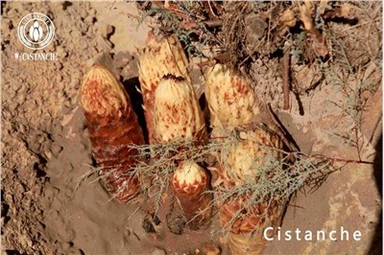
Alashan Cistanche is renowned for its thick flesh, abundant oil content, and high content of active ingredients. Its appearance is mostly flat cylindrical, slightly curved, with a tile-shaped arrangement of fleshy scales and leaves on the surface. It is hard in weight and texture but also has toughness. After incision, light brown point-like vascular bundles can be seen on the section, arranged in a unique wavy ring pattern. These features are not only symbols of its quality but also make it highly sought after in the market and relatively expensive. Local growers, relying on their experience passed down from generation to generation and deep understanding of the land, carefully care for every plant of Cistanche deserticola. From the planting of red willow trees to the inoculation and management of Cistanche deserticola, every step is strictly controlled to ensure that Alashan Cistanche deserticola always maintains top quality.
(2) Xinjiang: Responsibility for Scale and Production

cistanche male benefits
Xinjiang, with its vast land resources, has become the dual champion in terms of planting area and yield of Cistanche deserticola in China. The desert area around the Tarim Basin and the Junggar Basin has a large area of land suitable for the growth of Cistanche deserticola. The climate here is arid, with long sunshine hours and a large temperature difference between day and night, which perfectly matches the growth habits of Cistanche deserticola.
Xinjiang is also at the forefront of research and promotion in the cultivation technology of Cistanche deserticola. Through continuous scientific research investment and practical exploration, Xinjiang has successfully achieved large-scale artificial planting of Cistanche deserticola, forming three concentrated contiguous production areas around the Tarim Basin, Turpan Basin, and the Junggar Basin. According to statistics, the current artificial inoculation area of Cistanche deserticola in Xinjiang is about 1 million mu, with an annual output of more than 6000 tons of dried Cistanche deserticola medicinal materials, accounting for about 80% of the national output of Cistanche deserticola medicinal materials. Such a huge output not only meets the demand of the domestic market but also occupies an important share of the international market. Numerous planting enterprises and cooperatives have adopted modern planting management models, forming a complete industrial system from seed selection, planting technology, and field management to harvesting and processing, effectively promoting the large-scale development of Xinjiang's Cistanche deserticola industry.
(3) Gansu: a rising star with unlimited potential
Gansu, as a rising star in the Cistanche deserticola industry, is showing great potential for development. The Hexi Corridor region has abundant sandy resources and relatively convenient irrigation conditions, providing a basic guarantee for the cultivation of Cistanche deserticola. In recent years, Gansu has increased its research investment in the field of Cistanche deserticola cultivation and cooperated with multiple research institutions to carry out research and innovation in Cistanche deserticola cultivation technology.
Gansu also has sufficient labor resources, and the local people are hardworking and simple, providing manpower support for the planting, management, and harvesting of Cistanche deserticola. At the same time, Gansu has a strong foundation in the traditional Chinese medicine industry, with a group of well-known pharmaceutical companies and a complete pharmaceutical industry chain, which provides strong support for the deep processing and product research and development of Cistanche deserticola. With the continuous growth of demand in the Cistanche deserticola market, Gansu is expected to leverage its advantages in scientific research, labor force, and industrial foundation to achieve the rapid rise of the Cistanche deserticola industry and become an important force in the domestic Cistanche deserticola industry.

Professor Cistanche Research on the Growth of Cistanche deserticola
Grand Prize for Characteristics of Cistanche in Different Regions
Due to different production areas, Cistanche deserticola has unique characteristics in appearance, medicinal ingredients, taste, and flavor. Alxa Cistanche deserticola in Inner Mongolia is mostly slender in shape, covered with scales on the surface, and has a unique chrysanthemum pattern on the cut surface. Its texture is soft and resilient. It is rich in nutrients, containing 17 types of amino acids, with a total amino acid content of over 4.8% and crude sugar content of over 2% per 100 grams of dry sample. After soaking in water, the taste is slightly bitter and then sweet, just like the charm of tea water, with an excellent drinking effect.
Xinjiang Cistanche deserticola, especially the Guanhua Cistanche deserticola in the Hotan area, has a short and thick shape, a smooth surface, and a hard texture. After drying, it is called "hard big cloud" by medicinal merchants. The active ingredients of its fresh wood are echinacoside and verbascoside, with a general content ranging from 1.5g to 4g in 100g. The higher the age, the higher the content, but it will decrease with the loss of water. Guanhua Cistanche has a bitter taste with a hint of saltiness and is more effective in nourishing yang.
Gansu Cistanche deserticola, due to differences in planting areas and methods, may appear slender or short in appearance, with a relatively solid texture. Although its active ingredient content is slightly lower than that of high-quality Cistanche deserticola in Inner Mongolia and Xinjiang, it also has a certain amount of polysaccharides, alkaloids, and other components, and plays a positive role in tonifying kidney yang, moistening intestines and promoting bowel movements. In terms of taste, Gansu Cistanche deserticola soaked in water has a relatively light taste and a mild bitterness, making it suitable for those who cannot tolerate strong medicinal flavors.
Prospects of the Cistanche deserticola industry
Looking ahead to the future, the prospects of the Cistanche deserticola industry are bright. From the perspective of market demand, with the continuous improvement of people's health awareness, the demand for natural and nourishing Chinese medicinal materials is becoming increasingly strong. As the "desert ginseng", Cistanche deserticola will have a broader application prospect in the fields of health products, drugs, food, etc. The awareness and demand for Cistanche deserticola in the international market are gradually increasing, bringing new opportunities for China's Cistanche deserticola industry to export and generate foreign exchange.
In terms of ecological protection, various regions are increasingly emphasizing the protection of the ecological environment and sustainable development in the process of developing the Cistanche deserticola industry. By promoting the combination of red willow tree planting and Cistanche deserticola inoculation, not only have economic benefits increased, but the desert ecological environment has also been improved to a certain extent, reducing the harm of sandstorms. In the future, this eco-friendly industrial development model will be widely promoted and applied, achieving a win-win situation for both the economy and ecology.
Technological innovation will also become an important driving force for the development of the Cistanche deserticola industry. Researchers will continuously explore innovative planting techniques for Cistanche deserticola to improve its yield and quality; In terms of processing technology, we will develop more advanced extraction and processing techniques to enhance the added value of Cistanche deserticola products. Meanwhile, with in-depth research on the medicinal ingredients and efficacy of Cistanche deserticola, more novel and efficient Cistanche deserticola products will emerge to meet the needs of different consumers.

desert ginseng
Click here to view Cistanche powder products
【Ask for more】 Email:cindy.xue@wecistanche.com / Whats App: 0086 18599088692 / Wechat: 18599088692
Cistanche deserticola, a treasure in the desert, is shining brightly on various lands with its unique value and charm. From the high-quality production areas in Inner Mongolia to the scale and responsibility in Xinjiang, and the potential new star in Gansu, the Cistanche deserticola industry is showing a thriving development trend. Let us look forward to the future where the Cistanche deserticola industry can achieve even more brilliant development driven by market demand, ecological protection, and technological innovation, and contribute more to people's health and the improvement of the ecological environment.