Study On The Differences Of Cistanche Tubulosa Inoculated Tubes Of Different Tamarix Inoculated Tubes
Mar 13, 2024
Abstract: By studying and comparing the growth conditions of Tamarix and Cistanche tubulosa during the period when 9 species of Tamarix were inoculated with Cistanche tubulosa, the results showed that: 7 of the 9 species of Tamarix introduced from the psoma botanical gardens of Xinjiang and Minqin counties could be successfully inoculated with Cistanche tubulosa. The parasitic number of Cistanche tubulosa on a single Tamarix tube flower in that year, from high to low, is Tamarix alba, Tamarix ganmeng, Tamarix slender, Tamarix multi-branched, Tamarix densely flowered, Tamarix long-spike and Tamarix multi-flowered. Among them, Tamarix multi-branched and Tamarix white-flowered The maximum transverse diameters of the inoculated Cistanche tubulosa reached 4. 5cm and 4. 3cm respectively that year. By observing the microstructure, it can be concluded that compared with the unparasitized Tamarix roots, the roots of Tamarix parasitized by Cistanches tubulosa are thicker, and their phloem and xylem cells contain a large amount of enriched substances (saccharides and lipids); 7 species The parasitic modes of Cistanche tubulosa are terminal parasitism, in which they invade host cells by destroying cortical cells, and eventually connect with the vascular tissue of the host cells, absorbing water and nutrients from the host for their own growth and development needs.
Keywords: Cistanche tubulosa; enrichment; terminal parasitism

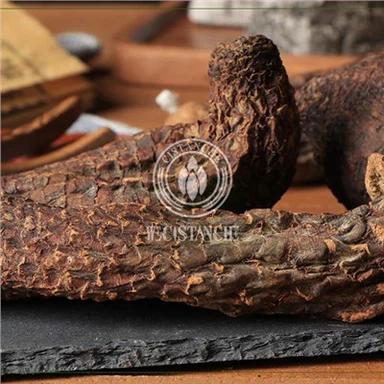
CISTANCHE TUBULOSA
Cistanche tubulosa is a herbaceous plant that is an obligate perennial parasitic plant, and its host is Tamarix plants [1]. The germination of Cistanche tubulosa seeds has specific requirements for environmental conditions. Without pretreatment, the germination rate will be extremely low. Therefore, a germination-stimulating substance is needed to break the dormant state of seeds to promote their germination. Studies have shown that adding a certain concentration of GA3 plus NAA plus KT mixed solution and controlling the temperature at about 23°C can significantly increase the germination rate of Cistanche tubulosa seeds [2, 3]. Fluridone solution of 1 to 100 mg·L-1 has a significant promoting effect on Cistanche tubulosa seeds [4]. Cistanche tubulosa was treated with 10 mg·L-1 mass concentration of fluridone plus gibberellin for 36 hours.
The seed germination rate reached 60% [5].
Soak Cistanche tubulosa seeds in distilled water for 24 hours, then treat with 1 mg·L-1 gibberellin for 72 hours and culture them in a 100 mg·L-1 fluridone solution at 25°C for 21 days under dark conditions, which can effectively improve the germination of Cistanche tubulosa seeds. rate[6]. Some studies have also shown that the inducing substances for the germination of Cistanche tubulosa seeds are reducing hydroquinones [7]. Therefore, the hydroquinones extracted from the roots of Tamarix willow can be used as inducing factors to study their effects on the germination of Cistanche tubulosa seeds.

CISTANCHE TUBULOSA
In recent years, research on Tamarix inoculated with Cistanches tubulosa has mainly focused on the infection of host cells and its development process, the relationship between Cistanche tubulose and the host Tamarix tubulosa, and the study of cultivation techniques.
Miao Zhongqin observed the development process of Cistanche tubulosa from infection to seedlings through a transmission electron microscope and optical microscope and found that Cistanche tubulosa formed haustoria before contact with Tamarix roots, and the haustoria invaded Tamarix roots from the epidermis, cortex, phloem, and xylem in turn, and Cistanches tubulosa was observed for the first time
The single-stage growth phenomenon of Cistanche tubulosa [8]; Ma Dongming et al. established an in vitro inoculation system using peeled Cistanche tubulosa seeds and Tamarix willow [9], which laid a research foundation for studying the germination and parasitism processes of Cistanche tubulosa seeds. Chen Qiming studied the inoculation of Tamarix tubulosa and Cistanche tubulosa growing naturally in Moyu County, Xinjiang, and showed that a higher inoculation rate near water sources and surface coverage can improve the survival rate of Cistanche tubulosa [10]; Tu Pengfei et al. systematically elaborated on the artificial afforestation technology of Tamarix tubulosa. The cultivation, harvesting, processing, packaging, and storage technologies of Cistanche tubulosa and Cistanche tubulosa provide technical reference for technicians and farmers [11]; Wang Hongguo et al. conducted research on Cistanche tubulosa in greenhouse facility cultivation in Dongying City, Shandong Province.
It shows that facility cultivation can effectively promote the growth of Tamarix tamarisk and Cistanches tubulosa, increase the inoculation rate, and solve the problems of rot disease and winter frost damage caused by excessive precipitation [12]. However, facility cultivation is not widely used in production, mainly because Large-area planting will increase production costs and reduce profits; it is recommended that this method be used for scientific research activities. Yang Taixin studied 8 species of Tamarix introduced in the North China Plain and the inoculated tube flower Cistanche tubulosa. He concluded that there are significant differences in the adaptability of different Tamarix species to the North China Plain, and screened out Tamarix Gansu and Tamarix Gansu as suitable hosts for local introduction. Cultivation[13].
In areas such as southern Xinjiang, Alxa League in Inner Mongolia, the saline-alkali land of the North China Plain, and the Yellow River Delta in Shandong Province, the technology of Tamarix inoculated tube flowers with Cistanche tubulosa has gradually matured [14-18]. The main types of Tamarix that have been successfully inoculated include Tamarix chinensis, Tamarix Gansu, Tamarix gaming, and Tamarix multibranch [19]. Up to now, due to drought, lack of rain low temperature, and freezing damage, the technology of inoculating Tamarix tube flowers with Cistanche tubulosa has not been widely promoted in the Hexi region of Gansu Province. This area is rich in tamarisk resources. If the tamarisk resources are developed, the value of the tamarisk itself will be greatly increased. This study took 9 species of Tamarix introduced from Xinjiang and Minqin County and Cistanche tubulosa seeds purchased from Xinjiang and Inner Mongolia as the research objects. By comparing the growth conditions of Tamarix seedlings and Cistanche tubulosa during the inoculation period of 9 species of Tamarix, to Provide technical reference for inoculating Tamarix tube flower Cistanche tubulosa in the Hexi region of Gansu Province.

ACTIVE INGREDIENT OF CISTANCHE
Click to get more info
1 material
Cistanche tubulosa seeds were sourced from Yutian County in southern Xinjiang Uygur Autonomous Region and Inner Mongolia Agricultural University. The nine species of tamarisk introduced from Xinjiang and Minqin County are Tamarix elongata Ledeb., Tamarix hohenackeri Bunge, Tamarix androssowii Litw., and Tamarix ramosissima.
Lcdcb), Tamarix arceuthoides Bunge, Tamarix laxa Willd., Tamarix leptostachys Bunge, Tamarix hispida Willd., Tamarix austromongolica Nakai. Introduced 9 species of Tamarix that grow in desert saline-alkali lands. The introduction materials are fresh branches and branches.
The length is 30cm and the thickness is 1. 0 ~ 1. 2cm. Each tamarisk tree has 200 branches. From 2018 to 2022, experimental research on cutting seedlings, tissue culture, and inoculation of tube flowers of Cistanche tubulosa of different Tamarix were carried out. The soil of the experimental field was sandy.
2 methods
2. 1 Screening of Cistanches tubulosa seeds
Seeds of Cistanche tubulosa were graded and screened using 30-mesh, 35-mesh, 40-mesh, and 45-mesh sieves respectively, and seeds with a diameter greater than 0.5 mm were selected for this test.

CISTANCHE TUBULOSA
2. 2 Pre-inoculation treatment of Cistanche tubulosa seeds
Soak Cistanche tubulosa seeds in a mixed solution of 1 mg·L-1 gibberellin and 10 mg·L-1 fluridone for 30 to 36 hours, then filter out the excess mixed solution with gauze and set aside.
2.3 Tamarix cutting substrate treatment
Mix the nutrient matrix and clean sand at a ratio of 1:1 evenly, and disinfect with 0.1% potassium permanganate before use.
2.4 Inoculation of Tamarix cuttings
Mix the pre-processed Cistanches tubulosa seeds in step 2.2 with the nutrient soil 1:5 processed in step 2.3 and mix them for seed dressing. Sprinkle the seeds evenly into the prepared transparent plastic flowerpot, and keep the seeding site away from the flowerpot. The depth of the bottom is about 5cm, the diameter of the flower pot is 17cm, and then 9 different tamarisk cuttings are placed
Soak with 200 mg·L-1 rooting powder for 20 minutes and then cut the cuttings into flower pots, 5 plants per pot. When cutting, be careful to keep the lower end of the Tamarix cuttings in the middle of the inoculated Cistanche tubulosa seeds to improve the success of later inoculation. Rate. After numbering each flowerpot, place it in a culture room with a temperature of 23-25°C, a humidity of 30%, a light/dark cycle of 12/12h, and a light intensity of about 2000lx. Observe the vaccination status after 180 days.

CISTANCHE TUBULOSA
2.5 Preparation of paraffin sections
The obtained Tamarix tamarisk and Cistanches tubulosa systems were sectioned using the ordinary paraffin sectioning method, stained with the safranin fast green staining method, and scanned with a Panoramic 250FLASH (Hungary 3DHISTECH) scanner.