Unleashing The Furr-Recovery Method: Interacting With Pets in Teleworking Replenishes The Self’s Regulatory Resources: Evidence From A Daily-Diary Study Part 1
Oct 18, 2023
Why we will be tired? How can we solve the fatigue problems?
【Contact】Email: george.deng@wecistanche.com / WhatsApp:008613632399501/Wechat:13632399501
Abstract: This study is based on the conservation of resources theory and the recovery step model to further explore the furr-recovery method—a mechanism through which workers break their routine by taking micro-moments to interact with their “furry co-workers,” thus relieving their fatigue and tension or other negative affective states. Based on this, we argue that this method not only serves the purpose of restoring self-regulatory resources but also ameliorates mental health. Accordingly, this study aims to analyze how daily human–animal interactions during teleworking positively influence teleworkers' mental health, via recovering their self-regulatory resources, at the within-person level. Full-time teleworkers completed multiple online surveys for 5 consecutive workdays (N = 211 × 5 = 1055 daily observations). Multilevel path analysis results showed that on days on which employees had more micro-moments to interact with their “furry co-workers” during the day, they experienced a higher self-regulatory capacity and felt better while working. In sum, the findings give support for the theoretical resource perspective of interacting with pets as an effective energy management strategy while at work. This research extends the theoretical understanding of regulatory resources as a cognitive mechanism that links HAIs to employee mental health. Moreover, the findings outlined here offer practical implications by highlighting the furr-recovery method, a method that teleworkers who own pets may use as a strategy during the working day to restore resources needed to be healthier.
Cistanche can act as an anti-fatigue and stamina enhancer, and experimental studies have shown that the decoction of Cistanche tubulosa could effectively protect the liver hepatocytes and endothelial cells damaged in weight-bearing swimming mice, upregulate the expression of NOS3, and promote hepatic glycogen synthesis, thus exerting anti-fatigue efficacy. Phenylethanoid glycoside-rich Cistanche tubulosa extract could significantly reduce the serum creatine kinase, lactate dehydrogenase, and lactate levels, and increase the hemoglobin (HB) and glucose levels in ICR mice, and this could play an anti-fatigue role by decreasing the muscle damage and delaying the lactic acid enrichment for energy storage in mice. Compound Cistanche Tubulosa Tablets significantly prolonged the weight-bearing swimming time, increased the hepatic glycogen reserve, and decreased the serum urea level after exercise in mice, showing its anti-fatigue effect. The decoction of Cistanchis can improve endurance and accelerate the elimination of fatigue in exercising mice, and can also reduce the elevation of serum creatine kinase after load exercise and keep the ultrastructure of skeletal muscle of mice normal after exercise, which indicates that it has the effects of enhancing physical strength and anti-fatigue. Cistanchis also significantly prolonged the survival time of nitrite-poisoned mice and enhanced the tolerance against hypoxia and fatigue.

Click on tired
Keywords: recovery; micro-breaks; mental health; pets; human–animal interactions; furr-recovery method
1. Introduction
The recent COVID-19 crisis imposed the adoption of telework to reduce the widespread distribution of the virus, at the same time ensuring its maintenance. Telework is a flexible work arrangement that allows workers to do their jobs from other locations (e.g., home) through information and communication technologies [1]. Even though the virus is more contained, it seems that the flexibility afforded by teleworking likely sustains workers’ performance as with face-to-face work [2,3].
While teleworking, pet owners get an opportunity to work near their pets, or their “furry co-workers.” Indeed, pet owners appear to be at the top of the list of those who prefer to work from home [2,3], and they often describe their pets as important and cherished family members who offer solace in times of stress [3] and company in moments of loneliness [4]. When working from home, pet owners can reduce their concerns regarding their pets being home alone for too many hours, and thus reduce their worries, anxiety, or other negative states, allowing them to better concentrate on the tasks at hand [5] and making them feel better during the day [6]. Additionally, pets (especially dogs) tended to develop strong attachments to their owners during the COVID-19 crisis, as they were together for more time due to the national confinements and mandatory teleworking [2,7]; however, now, they may experience anxiety or distress if their owners are working fully in face-to-face mode, which in turn may intensify their owners’ concerns about their dogs’ welfare [7]. Indeed, the welfare issues are not just those of the owners but of the dogs, too, who may be facing more anxiety if they are now home alone due to the return of their owners to face-to-face work. When working from home, pet owners may work near their pets, interact with them (e.g., head petting, observing the pet playing, or taking the pet for a walk), and thus feel happier and contribute to the welfare of their pets as well.
The relevance of human–animal interactions (HAIs)—the interaction between humans and pets—has been acknowledged; however, few studies have explored them in the context of telework. For instance, HAIs have been demonstrated to have positive effects on health and well-being [7,8]. For instance, a great amount of HAI research has focused on the role of animals in mitigating mental health disorders, such as relieving depression/anxiety symptoms [9]. Other studies have demonstrated that HAIs reduce stress and the feeling of loneliness, provide emotional support, improve emotional regulation and executive functioning, and are a natural booster of happiness [10,11]. Indeed, despite these pieces of evidence, only recently has this attracted organizational scholars to explore how these benefits could transpose the personal/familiar domains to the work one. This has been triggered by the call for studies of Kelemen et al. [12], who emphasized the need to understand the intersection of pets in organizational daily routines and thus transpose what is already known from other scientific areas.
HAIs may include physical (e.g., head petting), affective (e.g., observing the pet), or cognitive (e.g., perceived emotional support) interactions [5,13]. By interacting with their pets, during work, individuals break their routine and create moments of respite—a micro-break similar to that which involves interactions with co-workers.
Micro-breaks have been explored in the recovery literature and have been demonstrated as crucial moments for the individual’s rest and recovery from daily job demands and hassles [14,15]. Indeed, individuals during their working day often experience several challenges or unexpected events that make them spend resources. When this occurs, there is a period in which they have to stop and take a break to recover those lost resources. Micro-breaks are short, informal, and voluntary breaks. They are flexible in timing, duration, and frequency because they depend on how much the individual needs them [16,17]. Some examples of micro-breaks include coffee breaks and just getting up and stretching.
For instance, Chan et al. [15] recently developed a model of recovery—the recovery step model—outlining the role of micro-breaks in diverse recovery processes, among them being self-regulatory resources [16]. Self-regulatory resources are cognitive resources that are relevant for the working day because they are related to the individual’s ability to self-control their behaviors, emotions, and impulses (e.g., focus attention on the tasks even when physically or emotionally exhausted or suppress some emotion that is not supposed to be expressed) [16,18,19]. By engaging in micro-breaks, individuals restore their capacity to fully function [17] and reach fullness [20]. Despite the relevance of micro-breaks for health outcomes [10], no study has explored HAIs as a micro-break at work (see [5] as an exception).
Relying on the recovery step model, and the furr-recovery method—the recovery process through interacting with furry co-workers, that is, pets [15]—we argued that HAIs during the day are micro-breaks that can help individuals recover their regulatory resources by making them experience relaxation and calmness, and control (i.e., contributing to a self-perceived sense of control what one wants and need to do) and distracting them from work (i.e., psychological distancing from work) [5]. Additionally, based on the conservation of resources theory [21,22], we expect that these regulatory resources’ recovery will make individuals feel better and relaxed, thereby contributing to their improved mental health. We delineate arguments to show that when regulatory resources are recovered, individuals feel resourceful, which may attenuate negative affective states, such as tension or stress, thus improving their mental health.

This study has three major contributions. First, it contributes to extending the recovery literature by unleashing the role of HAIs at work. Exploring how teleworkers’ interactions with their “furry co-workers” influence their mental health will develop a better understanding of how they may have access to unique resources while working from home—that they would not be able to have if they were working at the office. Second, HAIs—as micro-breaks—may provide the needed support for workers to preserve and develop their regulatory resources that may support how HAIs may improve mental health. Moreover, this indirect path highlights two resources that may support managers and employees in better coping with negative and uncertain conditions: telework and interacting with pets as moments to respite. Third, due to the COVID-19 pandemic crisis, many organizations across the world adopted telework as an organizational strategy; however, some resist it. From a practical standpoint, it will be helpful to clarify the role of telework in workers’ mental health, in particular for those who own pets.
2. Theoretical Framework
2.1. The Importance of Pets
Pets are increasingly present in modern families. Plus, how families treat and see their pets has also changed as they have been often described as cherished family members who accompany the family in their daily routine [23].
These changes might be supported by the great number of empirical demonstrations of the pets’ benefits for all ages [6]. For instance, some studies have consistently demonstrated that pets help individuals feel calm, mindful, and present in their daily lives [23]. They also reduce loneliness and improve the quality of life of elderly people [24]; make kids more active, confident, and responsible [25]; and reduce blood pressure and heart rate, raise survival chances after a heart attack, and facilitate social contact [6] and at the same time improve oxytocin levels—the known “love and attachment hormone” [26], among other benefits. In addition, pets have also benefitted an individual’s mental health as it has been demonstrated that pets reduce psychological impairment states, such as anxiety, depression [27], and psychological distress [6]. In addition, there is plenty of evidence showing that by interacting with their pets, individuals tend to feel emotionally supported and abstracted from their problems [28].
Human–animal interactions (HAIs) are not a new research topic for psychology or medicine areas, as there is plenty of evidence of their beneficial effects on an individual’s health [29], mental health [30], well-being [31], and plenitude [13]. HAIs have been often defined as all the interactions between humans and non-human beings [28] and may include physical (e.g., going to take a walk with the pet), affective (e.g., observing the furry friend playing with a bone), or cognitive (e.g., perceived support by having the furry friend nearby) interactions [2,5,9].
As we outlined before, HAIs appear to have diverse benefits for individuals and include, for instance, well-being [6]. One benefit that has been highlighted consistently across studies is the health benefit of HAIs, as there are diverse studies that have shown that interacting (physically, cognitively, or effectively) with pets typically reduces depression symptoms, stress triggered by negative events, and loneliness [28]. Moreover, HAIs, such as taking a walk with the pet, act like an “ice-breaker” as this catalyzes communication and enhances opportunities for social exchange, which in turn enhances social interaction or social skills and promotes the feeling of social integration [4,10,32–34]. Research has also shown that the simple act of looking at the pet decreases anxiety and exerts a calming or dearousing influence [33]. Indeed, the mere observation of a pet can attenuate physiological and psychological responses to negative and stressful situations, attenuating those stressful and anxious responses: for instance, it has been observed that the presence of a companion dog as well as interactions with friendly but unknown dogs momentary decrease the blood pressure and heart rate in individuals of different ages [8,12] (for an exhaustive review, see [9]). Moreover, other studies have shown that HAIs produce oxytocin, which impacts the central nervous system and in turn diminishes behavioral and neuroendocrine responses to distress (e.g., [35,36]). Indeed, there is increasing evidence suggesting that interacting with a pet appears to be as calming as reading a book in silence (by lowering cortisol levels) [11,37].
2.2. Human-Animal Interactions as a Micro-Break during Work
As we can see, HAIs appear to be beneficial in several ways for an individual’s daily life. The impact of HAIs on the organizational domain only recently started to attract scholars who have recognized the importance of pets, not only for the personal or familiar domain but also for the work-related one [38]. This might be related to the fact that many organizations worldwide have started to adopt organizational strategies (e.g., Amazon, Google) that include pet-friendly policies (e.g., teleworking) as a way to motivate and engage their workers in their work [2,14,38,39] and have identified diverse benefits in doing it, such as higher performance levels, increased organizational commitment and identification, and lower turnover intentions [26,40].
Among the different pet-friendly policies, teleworking is the most frequent one [5], in part because not all organizational spaces are prepared to receive their worker’s furry co-workers and also because workers with pets tend to prefer working from home, even in a hybrid regime—working from home some days and working at the office on other days—than working at the office in a full-time regime [2]. Indeed, pet owners tend to choose to telework instead of going to the office, because when working from home, they do not need to feel worried about their pets, who are alone at home for so many hours, which on the one hand allows them to be more focused on the tasks they have to do and on the other hand makes them feel better. Additionally, when working from home, pet owners get an opportunity to spend more time with their “furry co-workers” as they can work near them, which on the one hand makes them feel emotionally supported and, even if physically lonely, feel accompanied; on the other hand, they can interact with their pets frequently during the working day. Hence, interacting with pets during the working day means that HAIs transpose the personal domain to the working one.
Despite the scarcity of studies exploring HAIs in the working context (for an exception, see [5]), we argue that daily HAIs are micro-breaks like those that encompass interpersonal interactions (e.g., taking a break to call someone or text someone) or similar to micro-breaks that include coffee breaks. Accordingly, we also assume that daily HAIs, as micro-breaks from work, serve the function of helping the individual to recover resources, such as self-regulatory resources, lost while performing the job and facing daily demands and challenges. By taking micro-breaks that involve interacting with their furry co-workers, teleworkers can regain their resources, such as energy—a resource linked to self-regulatory resources (the regulatory ability to self-control diverse behaviors, emotions, and impulses) [20].

Self-regulatory resources are relevant for individuals as they need them to do their jobs and deal with the diverse hassles or challenges that appear throughout the day and thereby demand a strong regulation of affect and cognition [16,41]. In addition, self-regulatory resources are limited in nature because while working, there is a natural use of such resources for different self-control tasks (e.g., stopping to procrastinate or stopping to chat, allocating and redirecting cognitive attention to the tasks) [42,43]. When this happens, individuals must engage in recovery behaviors as a strategy to stop such regulatory efforts and thus take micro-breaks to recover the depleted resources before going to the next set of self-regulation activities [16,17].
Micro-breaks have been explored in the literature on recovery from work. This is divided into two main streams of research: recovery after work, which includes experiences of relaxation, control, mastery, and psychological detachment from work, and recovery during work, which is mainly focused on micro-breaks aimed at recovering resources needed for the working day.
Recently, Chan et al. [15] developed the recovery step model. Accordingly, microbreaks are important for individuals to recover resources spent while working. Self-regulatory resources are among the most relevant recovered cognitive resources [15] and may be restored through recovery experiences (i.e., control, relatedness, mastery, enjoyment, detachment, and relaxation) [17]. Hence, micro-breaks are “short and informal breaks/respite activities taken voluntarily between tasks” [16], (p. 773) that are generally considered more flexible in timing, duration, and frequency and are typically self-initiated [15]. In addition, such pauses are a way to stop resource spending and renew other ones [15], serving as a resource-replenishing strategy that is relevant between different task episodes [16,17]. Micro-breaks are relevant because they may include experiences that (1) bring relaxation and calmness to the individual (e.g., calling a friend in search of emotional support), (2) improve the sensation of control (e.g., taking a coffee break), (3) create psychological detachment from some task or problem at work (e.g., taking a walk, interacting with colleagues about off-job activities), or (4) create a sense of mastery (e.g., through pleasurable micro-activities, such as looking to improve knowledge through reading).
Empirically, some studies have shown that micro-breaks decrease tiredness and improve resources needed for daily activities (see [18,44]). This happens because while working, individuals exert efforts, which leads to a loss of resources [45], either by performing their tasks or by having to make efforts to deal with daily work demands. This is why they need to take some breaks during the working day—to recover what is lost. This is supported by the conservation of resources theory [46]. Accordingly, individuals when perceiving a loss of resources engage in behaviors to recover them—for instance, taking a micro-break from work—as they are impelled to maintain, acquire, or develop resources [46,47]. For them, resources are needed to face daily challenges that may be stressful or harmful to their mental health. Hence, the act of preserving or searching for resources is an ongoing daily behavior whose objective is to avoid entering the spiral of resource losses. These acts are often relied on when taking micro-breaks that help them to enlarge and preserve the resource reservoir. When micro-breaks are positive and help to recover lost resources, individuals turn into a state of resourcefulness that improves their ability to focus on what they have to accomplish and makes them feel better.
2.3. The Mediating Role of Regulatory Resources
Diverse micro-breaks have been explored in the literature, (e.g., coffee or tea breaks, micro-interactions with co-workers) [15,16]; however, HAIs in the work context have been less studied. Relying on the step recovery model, we argue that HAIs may help teleworkers recover self-regulatory resources, and in turn, this may promote their mental health.
First, physical HAIs, such as touching or petting the head of a furry friend, are physiologically and emotionally pleasurable for the individual. Concerning this, Olmert [48] suggested that the urge to touch an animal is biological, and this occurs even for unknown pets. For instance, neuroscience studies have shown that simply looking at a dog or stroking or talking to a dog can release oxytocin. It has been consistently demonstrated in the literature that oxytocin decreases the production of stress hormones and diminishes the experiences of fear and danger [11,12,48]. As such, oxytocin not only is responsible for the individual to feel pleasure but also helps them to broaden and restore other resources, such as cognitive resources needed to self-regulate actions, emotions, or impulses.
Second, another stream of research has evidenced that a simple eye exchange between humans and pets leaves them with the feeling of being supported and makes them experience positive emotions, such as calm and relaxation [23]. There is theoretical and empirical evidence for the influences of positive emotions on an individual’s behaviors [47]. Accordingly, positive emotions are personal resources with their value; they serve to broaden an individual’s cognitive and behavioral repertoire, which, in turn, improves their ability to acquire and develop other resources that are enduring in nature [47].
Third, as mentioned earlier, although some pets with behavioral issues may be a nuisance to their owners, ongoing pet ownership generally suggests that pets are not only cherished family members but also unique resources due to their attachment role. This has been demonstrated in interviews with pet owners who described their relationship with their pets as caring and nurturing and to whom they are emotionally tied [6]. Theoretically, the attachment experiences give support to these studies [49]. Accordingly, emotional bonds are processed and stored in the right hemisphere of the brain, influencing affective (e.g., mental health) and cognitive (e.g., self-regulation) functioning [49]. Such benefits have been described in the popular media, particularly in the recent event of the death of Queen Elizabeth II. Although this is not a scientific example, it is relevant to consider. For instance, close friends and familiars of the queen reported that in stressful and tense moments, her refuge was in her furry friends—the corgis—as she saw in them a unique way to relieve her anguish. Her family called it the dog mechanism: “[ . . . ] If the situation becomes too difficult, she will sometimes literally walk away from it and take the dogs out” [50].
Hence, relying on the recovery step model, we argue that interacting with their “furry co-workers” may help individuals replenish their self-regulatory resources, which will contribute to improving teleworkers’ mental health [51]. Based on the conservation of resources theory (COR), we hypothesized that for the within-person level, individuals tend to have more self-regulatory resources on days in which they engage in more interactions with their furry co-workers (H1a) and that this will serve as a mechanism explaining why HAIs enhance their mental health (H2a). Moreover, at the between-person level, we expect that individuals with higher average levels of HAIs tend to have more self-regulatory resources than individuals with lower average levels of daily HAIs (H1b). In addition, these average levels of self-regulatory resources will serve as a potential mechanism for the relationship between daily HAIs and daily mental health at the between-person level (H2b); see Figure 1.
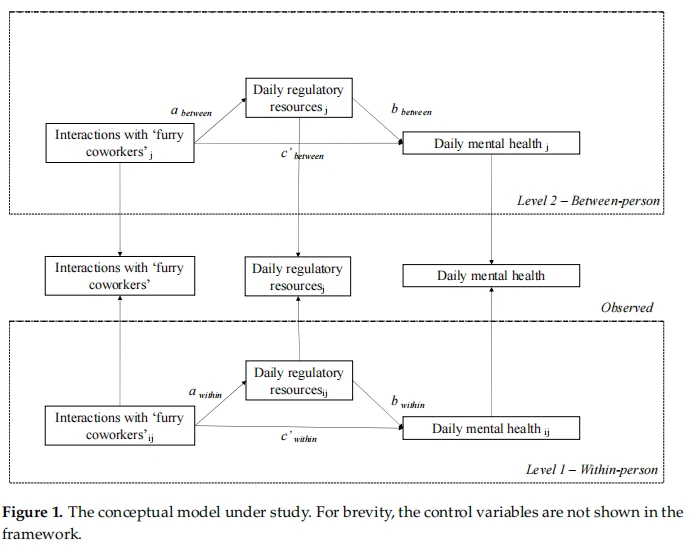
Hypothesis 1 (H1). Daily HAIS will be positively related to daily regulatory resources at the (a) within- and (b) between-person level.
Hypothesis 2 (H2). The relationship between daily HAIs and daily mental health will be mediated by daily regulatory resources at the (a) within- and (b) between-person level.
3. Methods
3.1. Participants and Procedure
In total, 211 individuals who were teleworking participated in the study. They included human resources managers (37%), advertisers (33%), trainers (22%), and researchers (8%). Overall, 64% were female, the mean age was 38.50 years (SD = 10.32), and the mean tenure was 16 years (SD = 6.78). On average, they worked about 41 hours per week (SD = 6.13). All participants had pets (M = 3.2, SD = 3.70) living with them. Dogs were the most reported pets (92%), followed by cats (21%). Overall, 28% had both dogs and cats. On average, the teleworkers reported having pets at 16 years (SD = 14.11).
The researcher asked the teleworkers from their professional network to participate in a study about telework attitudes. The ones who agreed to participate were explained the main goals and the data collection procedure. Moreover, in a second email, they were assured that their participation was completely voluntary and anonymous and that their responses would be confidential. Next, they signed an informed consent form before answering the general survey. After this, they received the hyperlink for the general survey, which assessed the participants' sociodemographics and their pets’ characteristics. In the following week, they started the daily questionnaires (collected once per day at the end of the working day) for 5 consecutive days (from Monday to Friday). Each participant received a daily email at 6:00 p.m. with the hyperlink for the daily survey. They had to answer it by 10:00 p.m. On average, they answered it at 7:30 p.m. Of the 255 teleworkers who agreed to participate, 211 provided valid responses across the 5 days (n = 1055; response rate = 83%).
3.2. Measures
3.2.1. Human-Animal Interactions
Human–animal interactions were measured with four items developed by JunçaSilva et al. [2]. An item example is “Today while teleworking I took breaks to interact with my pet.” Participants used a 5-point scale (1 = never; 5 = four times or more). Multilevel reliability performed through the Alpha and the Omega index suggested that the high values (αbetween = 0.93, ωbetween = 0.93; αwithin = 0.96, ωwithin = 0.96) may potentially suggest that some items are measuring the same thing.
3.2.2. Daily Self-Regulatory Resources
To assess daily self-regulatory resources, we used the 3-item Regulatory Resource Availability scale [52] (e.g., “Today, I have not been feeling mentally energetic.”). Responses were given on a 5-point Likert scale ranging from 1 for never to 5 for always. Multilevel reliability tests indicated acceptable reliability (αbetween = 0.84, ωbetween = 0.85; αwithin = 0.86, ωwithin = 0.86).

3.2.3. Mental Health
To measure the participants’ daily mental health, we used three items from the SF- 36v2 Health Survey [53]: “Today, how much of the time have you felt calm and peaceful?” Items were rated on a 5-point scale ranging from 1 (none of the time) to 5 (all of the time). Multilevel reliability indices were good (αbetween = 0.70, ωbetween = 0.71; αwithin = 0.66, ωwithin = 0.63).
3.2.4. Control Variables
The time of data collection (from Monday to Friday) was a daily-level control variable once it was found that while the study was ongoing, there was an influence on the criterion variables, known as the learning effect [54]. Sex and the number of pets were between-person-level control variables because the number of pets may influence daily HAIs and subsequent regulatory resources (as it may lead to a higher number of volatile actions to interact with them) and sex may influence both regulatory resources and performance-related outcomes.
【Contact】Email: george.deng@wecistanche.com / WhatsApp:008613632399501/Wechat:13632399501