What To Do About Chronic Constipation in The Elderly? These Tricks Are Easy To Deal With
Aug 10, 2023
Constipation is the most common gastrointestinal symptom clinically, mainly manifested as difficulty in defecation, dry stool, and decreased stool frequency.

Click to Cistanche for the best laxative
Among them, the incidence of chronic constipation (chronic constipation) is about 1%, and it is more common in middle-aged and elderly women. The ratio of male-to-female incidence is about 1:3, and the incidence increases with age. For long-term chronic functional constipation that occurs in the elderly, we also call it intractable constipation.
The etiology of constipation is very complex, mainly including impaired colonic transport function, anal sphincter dysfunction, structural changes of the fecal outlet, and abnormalities of the nervous and endocrine systems. According to different etiologies, chronic constipation is clinically divided into three types: slow transit constipation, outlet obstruction constipation, and mixed constipation.
Although chronic constipation is a benign disease, the course of the disease is long and the treatment effect is slow. Some patients will experience fear and anxiety before going to the toilet, which further aggravates the symptoms of constipation. Such "unspeakable secrets" have brought huge physical and mental torture to the patients. painfully.
In gastrointestinal surgery, patients with chronic constipation who have been ill for many years are often encountered. Due to the torment of the disease, they seek medicine from many sources and are in a state of mental anxiety. brought a heavy burden.
For the diagnosis and treatment of chronic constipation, gastrointestinal surgeons should pay close attention to it. In addition to targeted etiological treatment, attention should also be paid to counseling the patient's mental state, to achieve the purpose of comprehensive diagnosis and treatment and achieve more ideal results.
Constipation can be divided into mild, moderate, and severe according to the severity. Mild constipation refers to mild symptoms that do not affect life, and the symptoms can be improved after general treatment without medication or a little medication; severe constipation refers to persistent constipation symptoms, the patient is extremely painful, seriously affects work and life, and cannot be stopped or the treatment is ineffective; moderate constipation is between the two.

The treatment of chronic constipation should be handled according to the specific condition of the patient, mainly including the following treatment options:
1. General treatment
For early-onset or mild constipation, general treatment should be the main treatment, mainly to relieve constipation by changing living and eating habits, such as eating more foods rich in dietary fiber (coarse grains, vegetables, fruits, etc.), increasing drinking water, and exercising appropriately, develop the habit of regular defecation, and maintain a good and optimistic mental state.
2. Drug treatment
For moderate to severe constipation, based on changes in living and eating habits, drugs should be used to assist defecation. Common medications include general laxatives, rectal suppositories, and transanal enemas. Studies have shown that intestinal probiotics can improve the intestinal microenvironment and have a certain effect on relieving constipation.
3. Surgical treatment
For patients with intractable constipation or constipation with a clear etiology (such as excretory tract obstruction), if regular non-surgical treatment is ineffective, and the patient has a strong willingness to treat, surgical treatment should be adopted. The method of operation should be determined according to the specific conditions of the patient. Generally, a colonic transit test and a defecography examination are performed before the operation to determine whether the patient has colonic transit dysfunction or fecal outlet obstruction. If it is the cause of outlet obstruction, it is necessary to partially resect or repair the discharge tract according to the cause of the obstruction, such as rectocele repair, rectal mucosal resection, etc.

If it is slow transit constipation, the non-transporting colon needs to be resected. For slow transit constipation colectomy, the "reverse loop anastomosis" invented by the team of Professor Zhu Anlong, based on the subtotal colon resection, the terminal ileum is counterclockwise The direction is reversed 180° to perform side-to-side anastomosis with the preserved colorectum in the direction of reverse peristalsis to form an ileum-colorectal reverse peristaltic anastomosis. This anastomosis method can take into account both the treatment of constipation recurrence and postoperative diarrhea.
Natural Herbal Medicine For Relieving Constipation-Cistanche
Cistanche is a genus of parasitic plants that belongs to the family Orobanchaceae. These plants are known for their medicinal properties and have been used in Traditional Chinese Medicine (TCM) for centuries. Cistanche species are predominantly found in arid and desert regions of China, Mongolia, and other parts of Central Asia. Cistanche plants are characterized by their fleshy, yellowish stems and are highly valued for their potential health benefits. In TCM, Cistanche is believed to have tonic properties and is commonly used to nourish the kidney, enhance vitality, and support sexual function. It is also used to address issues related to aging, fatigue, and overall well-being. While Cistanche has a long history of use in traditional medicine, scientific research on its efficacy and safety is ongoing and limited. However, it is known to contain various bioactive compounds such as phenylethanoid glycosides, iridoids, lignans, and polysaccharides, which may contribute to its medicinal effects.

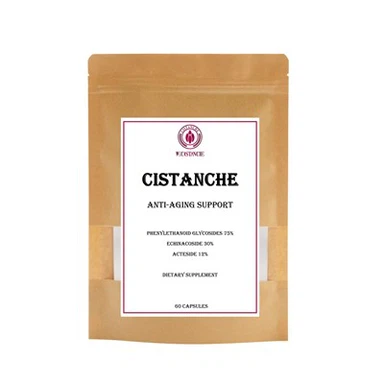
Wecistanche's cistanche powder, cistanche tablets, cistanche capsules, and other products are developed using desert cistanche as raw materials, all of which have a good effect on relieving constipation. The specific mechanism is as follows: Cistanche is believed to have potential benefits for relieving constipation based on its traditional use and certain compounds it contains. While scientific research specifically on Cistanche's effect on constipation is limited, it is thought to have multiple mechanisms that may contribute to its potential to relieve constipation. Laxative Effect: Cistanche has long been used in Traditional Chinese Medicine as a remedy for constipation. It is believed to have a mild laxative effect, which can help promote bowel movements and induce constipation. This effect may be attributed to various compounds found in Cistanche, such as phenylethanoid glycosides and polysaccharides. Moistening the Intestines: Based on traditional use, Cistanche is considered to have moisturizing properties, specifically targeting the Intestines. By promoting hydration and lubrication of the Intestines, it may help soften tools and facilitate easier passage, thereby relieving constipation. Anti-inflammatory Effect: Constipation can sometimes be associated with inflammation in the digestive tract. Cistanche contains certain compounds, including phenylethanoid glycosides and lignans, that are believed to have anti-inflammatory properties. By reducing inflammation in the intestines, it may help improve bowel movement regularity and relieve constipation.