Xinjiang Cistanche, A Golden Treasure in The Desert
Aug 20, 2025
Encountering Desert Treasures

Chinese herb cistanche
Stepping onto the vast and boundless desert of Xinjiang, scorching sand and gravel spread underfoot, and scorching sunlight poured out without reservation, outlining the unique contours of this mysterious land. The fierce wind howled past, raising layers of sand waves that made people truly feel the magnificence and grandeur of nature.
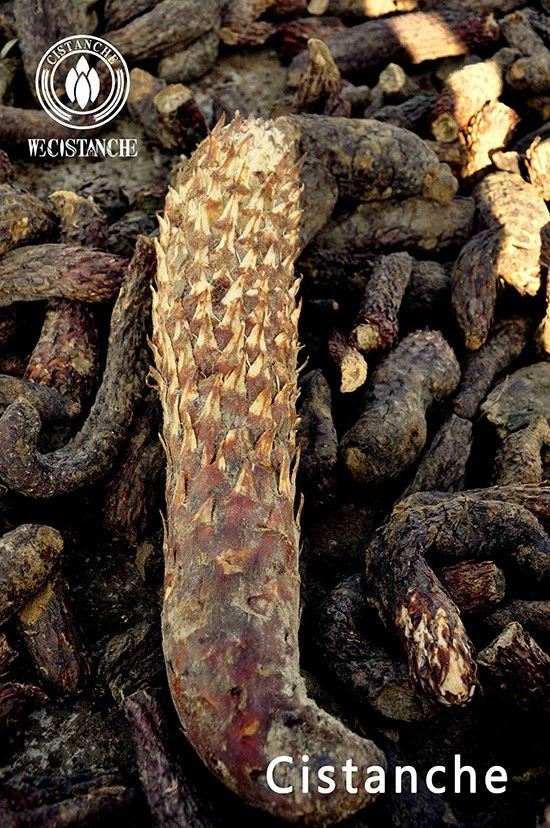
In this seemingly barren desert, I encountered a magical plant - Cistanche deserticola. It quietly roots deep in the desert, half-hidden under sandy soil, absorbing nutrients from the earth; half-exposed to the wind and sand, facing the harsh natural environment. When I first saw it, its thick stem, diamond-shaped scales all over its body, and spike-shaped flowers at the top bloomed with a unique vitality and beauty against the backdrop of the desert, bringing me a strong visual impact and instantly arousing my curiosity about it.
The Legend of Life in the Deep Sand Sea
(1) Unique growth environment
Xinjiang, on this vast land, deserts occupy a considerable area, such as the Taklamakan Desert and the Gurbantunggut Desert, which are like mysterious giant carpets of the earth, spreading out freely. The climate here is dry and rainy, with annual precipitation often less than 100 millimeters, while evaporation can reach as high as 2000-3000 millimeters. The strong evaporation quickly dissipates moisture, and the air seems to have been drained of humidity. The temperature difference between day and night is astonishingly large. During the day, under the scorching sun, the surface temperature of sandy land can reach 70-80 ℃, and the hot gravel can easily burn the skin. At night, the heat rapidly dissipates and the temperature drops sharply below 10 ℃, like two days of ice and fire.

desert ginseng
In such a harsh environment, most plants find it difficult to survive, but Cistanche deserticola has found its way of survival. It chooses to parasitize at the roots of the Haloxylon ammodendron, a pioneer tree species in the desert with extremely developed root systems that can penetrate more than ten meters underground to search for precious water sources. Cistanche deserticola is like a close companion of the Haloxylon ammodendron, relying on its strong water absorption ability to obtain the necessary water and nutrients for growth, and growing tenaciously under the protection of the sandy sea.
(2) Wonderful parasitic relationships
There is a wonderful and close parasitic relationship between Cistanche deserticola and Haloxylon ammodendron. The seeds of Cistanche deserticola are very small, like dust, floating around under the influence of the wind. When these seeds are lucky enough to fall near the roots of the shuttle tree and encounter suitable conditions such as temperature and humidity, they will begin to sprout. It will extend a special suction device, like tiny tentacles, tightly attached to the roots of the shuttle tree, and gradually penetrate the root tissue of the shuttle tree.
From this moment on, Cistanche deserticola established a life and death relationship with the Haloxylon ammodendron tree. The organic matter produced by the Haloxylon ammodendron through photosynthesis, as well as the water and minerals absorbed from underground, will be partially "shared" by the Cistanche deserticola. Cistanche deserticola has almost no chloroplasts on its own, making it unable to carry out photosynthesis and relying entirely on the nutrients provided by the Haloxylon ammodendron tree for growth and development. In this process, although the Haloxylon ammodendron tree "gave" some nutrients, the Cistanche deserticola is not a complete seeker. They jointly create a unique ecological environment, and the presence of Cistanche deserticola helps the Haloxylon ammodendron tree maintain soil stability to a certain extent, reducing the erosion of its roots by wind and sand. Moreover, when the desert encounters extreme drought conditions, Cistanche deserticola will also transport its stored water back to the Haloxylon ammodendron tree, helping it overcome difficulties.
This symbiotic relationship plays a crucial role in the stability and balance of desert ecosystems. The Haloxylon ammodendron and Cistanche deserticola are interdependent, rooting and reproducing together in the desert, bringing vitality and hope to this seemingly barren land, becoming an indispensable part of the desert ecological chain, and also showing us the magical creativity of nature and the subtle connection between life.

Cultivation of Cistanche deserticola
The legendary medicinal tale that has been passed down through the ages
(1) Treasures in Traditional Medicine
Cistanche deserticola has always held an important position in traditional medicine and is regarded as a precious nourishing medicine, with the reputation of "desert ginseng". As early as in the "Shennong Bencao Jing", there is a record about Cistanche deserticola, which is classified as a top-grade product and is called "sweet in taste, slightly warm. It is mainly used for five labor and seven injuries, tonifying the middle, removing cold and hot pain in the stem, nourishing the five organs, strengthening yin, nourishing essence and qi, having more children, and treating women's ailments. Long-term consumption can lighten the body." In just a few words, it accurately summarizes the main effects of Cistanche deserticola, such as tonifying kidney yang, nourishing essence and blood, moistening the intestines, and promoting bowel movements.
In traditional Chinese medicine theory, the kidney is the foundation of innate nature, mainly storing essence. Insufficient kidney yang and deficiency of essence and blood can lead to a series of physical problems, such as soreness and weakness of the waist and knees, cold limbs, impotence and premature ejaculation, infertility, etc. Cistanche deserticola is warm, sweet and salty in taste, and belongs to the kidney and large intestine meridians. Its warming and nourishing effects on kidney yang are mild and long-lasting, unlike some dry and hot kidney tonifying drugs that can easily cause adverse reactions such as excessive internal heat. Therefore, it has been widely used by medical practitioners throughout history in formulas for tonifying the kidney and strengthening yang. For example, the classic kidney tonifying formula "Yougui Wan" includes Cistanche deserticola as one of its important components. When combined with medicinal herbs such as Rehmannia glutinosa, Chinese yam, Cornus officinalis, and Goji berries, it plays a role in warming and tonifying kidney yang, filling essence, and stopping stagnation, helping countless patients with kidney yang deficiency to recover their health.
The moisturizing and laxative effects of Cistanche deserticola are also highly valued. For elderly people, pregnant women, or those with a weak constitution, the warm and moist characteristics of Cistanche deserticola can effectively lubricate the intestines and promote defecation, without damaging the normal qi like some laxatives, due to intestinal dryness and constipation caused by insufficient blood essence. Ancient doctors often cleverly used Cistanche deserticola to relieve the pain of patients when treating this type of constipation.
(2) Verification of Modern Science

Cistanche deserticola improves immunity
Click here to view Cistanche Enhance Immunity products
【Ask for more】 Email: Email:cindy.xue@wecistanche.com / WhatsApp: 0086 18599088692 / Wechat: 18599088692
With the rapid development of modern science and technology, research on Cistanche deserticola is becoming increasingly in-depth. Researchers have isolated and identified multiple active ingredients from Cistanche deserticola using advanced analytical techniques, among which polysaccharides, phenylethanoid glycosides, and other components have attracted much attention.
Cistanche polysaccharides are one of its important active ingredients. Research has shown that polysaccharides from Cistanche deserticola have significant immunomodulatory effects. It can promote the proliferation and differentiation of immune cells, enhance the phagocytic ability of macrophages, improve the immune function of the body, thereby helping the body resist the invasion of various pathogens and reducing the risk of disease. Experimental data show that after gavage of Cistanche deserticola polysaccharides in mice, the number of lymphocytes in the body significantly increases, and the content of immunoglobulin in the serum also increases, which fully proves the positive effect of Cistanche deserticola polysaccharides on the immune system.
Phenylethanoid glycosides exhibit excellent antioxidant and anti-aging properties. These ingredients have strong free radical scavenging ability, which can effectively reduce the damage of free radicals to cells in the body and delay the aging process of cells. Free radicals are harmful substances produced in the process of human metabolism. Excess free radicals will lead to oxidative stress in cells and cause a variety of chronic diseases, such as cardiovascular disease, diabetes, cancer, etc. The phenylethanoid glycosides in Cistanche deserticola act as the "scavenger" of the human body, capable of timely clearing these free radicals and protecting the normal structure and function of cells. Related studies have found that experimental animals taking extracts of Cistanche deserticola for a long time have significantly increased antioxidant enzyme activity and decreased lipid peroxidation product content in their bodies, indicating that Cistanche deserticola has significant effects in antioxidant and anti-aging.
Cistanche deserticola has also been found to have certain protective effects on the nervous system, cardiovascular system, etc. It can improve blood circulation in the brain, promote the growth and repair of nerve cells, and have a certain preventive and therapeutic effect on neurological diseases such as memory loss and Alzheimer's disease; In the cardiovascular system, Cistanche deserticola can regulate blood lipids, reduce blood pressure, inhibit platelet aggregation, prevent atherosclerosis, and protect cardiovascular health.
Cistanche
The diverse transformation from desert to life
(1) Nourishing delicacies on the dining table
Cistanche is not only a good medicine, but also a delicious dish on the dining table, adding a unique flavor and rich nutrition to our diet. It can be paired with various ingredients to create delicious and nourishing dishes one after another.
Cistanche lamb soup is a classic winter nourishing soup that is deeply loved by people. Prepare 15-20 grams of Cistanche deserticola, 200-300 grams of lamb, 3-5 slices of ginger, 5-8 red dates, and 10-15 goji berries. First, wash and cut the lamb into pieces, blanch it in boiling water to remove blood and impurities, and then remove it for later use. Wash and slice the Cistanche deserticola, put it in a clay pot with ginger slices and red dates, add an appropriate amount of water, bring it to a boil over high heat, then reduce the heat and simmer for 30-40 minutes to fully integrate the nutrients of Cistanche deserticola into the soup. Then add the blanched lamb and continue to stew for 1-1.5 hours until the lamb is cooked to perfection. Finally, add goji berries and cook for 5-10 minutes. Season with an appropriate amount of salt. This soup has a rich and mellow broth, with tender and smooth lamb and soft and delicious Cistanche deserticola. Drinking a sip of the soup can spread warmth from the tip of the tongue to the whole body, which can not only resist the cold of winter, but also nourish the kidneys, strengthen yang, warm the middle, and nourish qi.
Cistanche Congee is also a simple and nutritious way to eat. Wash 10-15 grams of Cistanche deserticola, cut into thin slices, and soak in clean water for 30-60 minutes. Prepare 100-150 grams of rice, wash it clean, put it in a pot, add an appropriate amount of water, bring to a boil over high heat, then turn the heat to low and cook slowly. When the rice is half-cooked, pour the soaked cistanche and the soaked water into the pot, and continue to cook for 20-30 minutes until the Congee becomes thick. If you like a sweet taste, you can add an appropriate amount of rock sugar for seasoning; If you like a salty taste, you can add a little salt and chopped scallions before serving. The cooked Congee with cistanche is full of rice grains, absorbs the essence of cistanche, emits a light fragrance, and tastes soft and glutinous. It can not only start a full day as breakfast, but also nourish the spleen and stomach at dinner.
(2) New choices for health and wellness
With the increasing emphasis on health, Cistanche deserticola has also been processed into various health products, entering thousands of households and providing more choices for people's health and wellness.
Cistanche wine is a common health supplement made from Cistanche deserticola. Wash and dry Cistanche deserticola, cut it into small pieces, put it into a clean glass bottle, and add an appropriate amount of high Baijiu. Generally, the ratio of Cistanche deserticola deserticola to Baijiu is 1:10-1:15. Seal the bottle mouth, place it in a cool and ventilated place for soaking, shake the bottle every 2-3 days to make Cistanche deserticola fully contact with Baijiu, and drink it after soaking for 1-3 months. Cistanche wine has the effects of tonifying the kidneys, nourishing essence, moistening the intestines, and promoting bowel movements. It has a certain relieving effect on symptoms such as waist and knee soreness, impotence, premature ejaculation, intestinal dryness, and constipation caused by kidney yang deficiency. However, it should be noted that alcohol consumption should be moderate. Excessive consumption may have adverse effects on the body, and it is not suitable for people with yin deficiency, excessive heat, and constipation.

Desert Cistanche
Cistanche Oral Liquid is more convenient for people with fast-paced modern lifestyles to take. It is scientifically extracted and concentrated, retaining the active ingredients in Cistanche deserticola, such as total phenylethanolic glycosides and polysaccharides. Cistanche Oral Liquid has various health benefits, such as regulating immunity, antioxidation, protecting cardiovascular health, moisturizing the intestines, and promoting bowel movements. It can enhance the body's immunity, improve the body's resistance, and reduce the occurrence of diseases; Eliminate free radicals in the body, delay aging, and maintain a youthful state of the body; Regulating blood lipids, lowering blood pressure, and protecting cardiovascular health; Increase intestinal peristalsis, promote bowel movements, and alleviate constipation problems. Generally speaking, take 1-2 times a day, 10-20 milliliters each time, half an hour before or after meals. However, pregnant women, breastfeeding women, and children are prohibited from using it. Those who are allergic to Cistanche deserticola and its components are prohibited from using it. Patients with colds and fever should not take it.
Guarding Desert Treasures
However, it is heartbreaking that due to the extremely high medicinal and economic value of Cistanche deserticola, it has been overexploited for a long time. Every time a wild Cistanche deserticola is harvested, it often causes serious damage to the surrounding desert vegetation, especially its host, the Haloxylon ammodendron. A large number of Haloxylon ammodendron trees are damaged or even killed due to the harvesting of Cistanche deserticola. According to statistics, in the past few decades, the number of wild Cistanche deserticola in Xinjiang has sharply decreased, and the population size has shrunk by more than 70%. It has now been listed as a second-class protected wild plant in China, and its survival situation is precarious.
In order to protect this precious desert species, Xinjiang actively carries out research and practice on the artificial cultivation of Cistanche deserticola. Researchers have worked closely with local governments, enterprises, and farmers and herdsmen, and after years of effort, have achieved significant results. In Shanshan County, Xinjiang, the existing artificial Haloxylon ammodendron forest and suitable barren land are being utilized to vigorously develop the industry of artificially planting Haloxylon ammodendron and inoculating Cistanche deserticola. Currently, the area of artificially planted Cistanche deserticola has reached more than 90000 acres. During the harvest season every year, workers are busy digging and harvesting Cistanche deserticola in the Haloxylon ammodendron forest, presenting a vibrant harvest scene. Qiemo County is also not willing to fall behind. Since the promotion of the Hedong Desert Prevention and Control Afforestation Project in 1998, 129000 acres of Haloxylon ammodendron forests have been artificially planted, and the Cistanche deserticola planting industry has been developed accordingly. Currently, more than 100000 acres of Cistanche deserticola have been inoculated, achieving a win-win situation of ecological and economic benefits.
Artificially planting Cistanche deserticola not only effectively meets the market demand for Cistanche deserticola, reduces dependence on wild resources but also opens up a new path for local farmers and herdsmen to increase income and become prosperous. These successful cases provide valuable experience for the protection and sustainable utilization of Cistanche deserticola.
Protecting Cistanche deserticola is not only about preserving a precious plant resource, but also about maintaining the stability and balance of the entire desert ecosystem. We should all enhance our awareness of protection and refuse to purchase illegally harvested wild Cistanche deserticola and its products. If you are interested in Cistanche deserticola, you can choose legally cultivated products. Let's work together to protect this treasure in the desert and let it continue to shine with the brilliance of life in the future, contributing to human health and the prosperity of desert ecology.