Analysis Of The Differences Between Xinjiang Cistanche Tubulosa And Cistanche Deserticola, With A Focus On The Kidney-Tonifying Effects Of Cistanche Tubulosa
Oct 14, 2026
Abstract: As a traditional and precious tonic in Chinese medicine, Cistanche is renowned as the "Ginseng of the Desert." The Pharmacopoeia of the People's Republic of China records two species of the genus Cistanche (Orobanchaceae) as official medicinal sources: Cistanche deserticola and Cistanche tubulosa. Although both share the traditional functions of tonifying kidney yang, replenishing essence and blood, and moistening the intestines to relieve constipation, they exhibit significant differences in botanical origin, morphology, chemical composition, and clinical emphasis. Specifically, Xinjiang C. tubulosa contains exceptionally high levels of phenylethanoid glycosides (especially echinacoside and acteoside), demonstrating superior efficacy in modern pharmacological studies related to kidney tonification, anti-aging, and neuroprotection. This article systematically reviews the core differences between the two and focuses on the unique advantages of C. tubulosa in the field of kidney tonification, providing a reference for precise clinical application and scientific daily supplementation.

Cistanche deserticola

Cistanche tubulosa
Keywords: Cistanche; Cistanche tubulosa; Cistanche deserticola; Kidney Yang Tonification; Phenylethanoid Glycosides; Echinacoside
1. Botanical Origin and Habitat: The Parasitic Distinction between Tamarix and Haloxylon
Plants of the genus Cistanche are perennial parasitic herbs whose growth is highly dependent on specific host plants and extremely arid desert environments.
Cistanche deserticola is endemic to China, mainly distributed in western Inner Mongolia, Ningxia, Gansu, and northern Xinjiang. Its primary hosts are plants of the genus Haloxylon (Chenopodiaceae), specifically Haloxylon ammodendron and H. persicum. Traditionally, the most authentic produce comes from Alxa League in Inner Mongolia. Due to historical over-exploitation, its wild resources were nearly depleted, leading to its classification as a National Class II Protected Plant and its listing in Appendix II of CITES.
Cistanche tubulosa (Xinjiang C. tubulosa) is primarily concentrated around the Taklamakan Desert in southern Xinjiang (e.g., Hotan, Kashgar), with distributions extending to Central and Western Asia. It specifically parasitizes the roots of plants in the genus Tamarix (Tamaricaceae), commonly known as red willow. Thanks to the large-scale artificial cultivation bases in southern Xinjiang, its industrialization level is high, making it a crucial source for the current medicinal material market .
2. Medicinal Properties and Identification: Visual Differences between "Soft" and "Hard" Cistanche
The differences in medicinal properties between the two are distinct and serve as vital bases for traditional experiential identification.
Cistanche deserticola (commonly known as "Soft Cistanche"): It appears as a flattened cylindrical shape, slightly curved, measuring 3~15 cm long and 2~8 cm in diameter. The surface is brown or grayish-brown, densely covered with imbricate fleshy scales. The texture is heavy, hard, but slightly flexible, and not easily broken. The cross-section is brown, with pale brown dotted vascular bundles arranged in wavy rings (commonly known as "chrysanthemum center") .

Cistanche deserticola
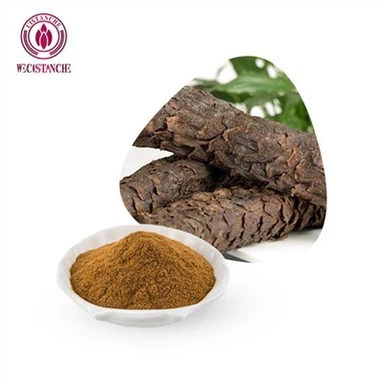
Cistanche tubulosa (commonly known as "Hard Cistanche"): It appears as a spindle-shaped, flattened spindle-shaped, or flattened columnar form, slightly curved, measuring 5~25 cm long and 2.5~9 cm in diameter. The surface is brown to dark brown. The texture is hard, and the fracture surface is granular, gray-brown to grayish-brown, with scattered dotted vascular bundles that do not form continuous wavy rings .

Cistanche tubulosa
3. Chemical Composition: The Content Disparity of Polysaccharides and Phenylethanoid Glycosides
The difference in chemical composition dictates the pharmacological偏向 of the two species. The Chinese Pharmacopoeia sets distinct quality control standards for the total content of echinacoside and acteoside: not less than 0.30% for C. deserticola and not less than 1.5% for C. tubulosa.
Cistanche deserticola: It contains higher proportions of oligosaccharides, mannitol, and betaine, while the content of phenylethanoid glycosides is relatively lower. This chemical profile determines its stronger effect in moistening the intestines and relieving constipation, making it a classic choice for treating constipation in the elderly or those with physical deficiency.
Cistanche tubulosa: It is characterized by significantly higher levels of phenylethanoid glycosides (such as echinacoside, acteoside, tubuloside A, and isoacteoside) compared to C. deserticola, and it lacks betaine. Modern research confirms that phenylethanoid glycosides are the core material basis for Cistanche's effects in kidney tonification, anti-aging, antioxidant, and neuroprotection .

Main Chemical Constituents of Cistanche tubulosa
4. Core Focus: The Kidney-Tonifying Mechanism and Advantages of C. tubulosa
Although ancient herbals generally attributed the function of "tonifying kidney essence" to Cistanche, modern pharmacological studies provide a scientific basis for the precise positioning of C. tubulosa in the field of "kidney tonification".
1. Explicit Kidney Yang Tonification and Reproductive Promotion
Studies have shown that C. tubulosa can significantly increase the weight of the seminal vesicles and prostate in castrated rats, prolong the weight, anoxia tolerance time, and loaded swimming time of normal mice, and improve symptoms of "kidney yang deficiency". Its decoction also positively regulates body temperature and physical strength. At the chemical level, echinacoside, acteoside, tubuloside A, and isoacteoside have been identified as the main active components responsible for its kidney yang-tonifying effects .
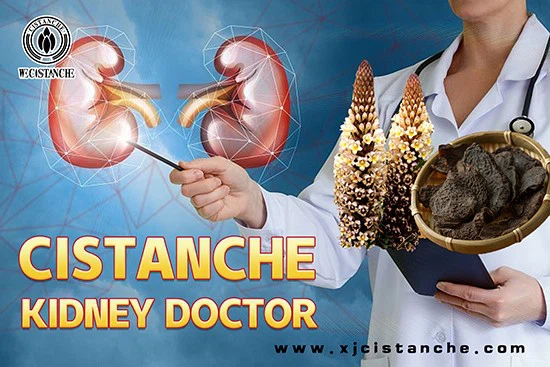
Effects of Cistanche: Improve Kidney Function
Click here to view Cistanche for Kidney disease products
【Ask for more】 Email:cindy.xue@wecistanche.com / WhatsApp: 0086 18599088692 / WeChat: 18599088692
2. Multi-Target Regulation and Sex Hormone-like Effects
Network pharmacology studies reveal that C. tubulosa improves kidney yang deficiency syndrome through multiple signaling pathways. Its active ingredients act on potential targets such as TNF, GSK3B, and MAPK1, exerting synergistic effects in promoting reproduction and enhancing immunity. Unlike simple hormone supplementation, C. tubulosa primarily enhances the function of the hypothalamic-pituitary-adrenal axis, promoting the normal release of related neurotransmitters and hormones, thereby increasing libido and combating fatigue without easily causing hormonal imbalances .
3. Neuroprotection and Anti-Aging
The phenylethanoid glycosides in C. tubulosa possess potent free radical scavenging and antioxidant capabilities. Research has led to the development of a Class II new drug using the total phenylethanoid glycosides extracted from C. tubulosa for the treatment of vascular dementia. It has also shown promising prospects in combating Alzheimer's and Parkinson's diseases and protecting the liver. This dual efficacy of "tonifying the kidney and replenishing essence" and "anti-aging" has secured its significant position in the modern men's health and middle-aged/elderly wellness markets .

Effects of Cistanche-Anti Alzheimers disease
5. Clinical Selection and Daily Application Recommendations
In clinical prescriptions and daily health care, differentiated choices should be made based on the characteristics of the two species.
For kidney tonification, essence replenishment, and anti-aging needs: Prioritize Xinjiang Cistanche tubulosa. Its high content of phenylethanoid glycosides offers superior advantages in improving kidney yang deficiency, soreness and weakness of the waist and knees, impotence, and enhancing overall physical function .
For intestinal dryness, constipation, and mild daily dietary supplementation: Prioritize Cistanche deserticola. Its rich oligosaccharides, polysaccharides, and betaine provide better effects in moistening the intestines, and its nature is milder, making it suitable for long-term soup and porridge preparation .
Contraindications: Cistanche is warm in nature and can assist yang and lubricate the intestines. Therefore, it is contraindicated for individuals with yin deficiency and excessive fire (characterized by tidal fever, night sweats, and a red tongue with little coating), spleen deficiency and diarrhea (loose stools, poor appetite), and excessive heat constipation. It is recommended to use it under the guidance of a professional TCM practitioner. The conventional decoction dosage is 6~10 grams; avoid excessive doses that may cause diarrhea or blood pressure fluctuations .

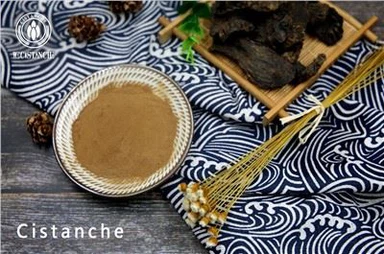
Cistanche tubulosa extract
6. Conclusion
Xinjiang Cistanche tubulosa and Cistanche deserticola are both precious medicinal materials included in the pharmacopoeia. They are not simply superior or inferior to each other but have their own strengths. C. deserticola excels in moistening the intestines, relieving constipation, and providing gentle nourishment. In contrast, Xinjiang C. tubulosa, with its extremely high phenylethanoid glycoside content, demonstrates more prominent modern pharmacological activities in tonifying kidney yang, replenishing essence and blood, and providing anti-aging and neuroprotective effects. With the maturation of the sand industry and artificial cultivation techniques in Xinjiang, C. tubulosa not only effectively alleviates the pressure on wild resource protection but also provides a high-quality raw material guarantee for the modernization of traditional Chinese medicine and the large health industry .