Association Between Renal Function And Cardiovascular Mortality
Mar 26, 2022
Contact: Audrey Hu Whatsapp/hp: 0086 13880143964 Email: audrey.hu@wecistanche.com
Association between renal function and cardiovascular mortality: a retrospective cohort study of elderly from health check-up
Ying-Jhen Huang,Yu-Lin Hsu
INTRODUCTION
Chronic kidney disease (CKD) is a common disease among the elderly and is defined as a structural or functional abnormality of the kidney (glomerular filtration rate (GFR)<60mL/min/1.73m², albuminuria or markers of kidney damage) for 3months or more in clinical diagnosis. With aging, the structure and physiology of the kidneys change, leading to declining in the functions of waste removal, maintenance of electrolyte balance, and regulation of blood pressure. Hypertension, diabetes, long-term inflammation, and urological diseases(such as prostate hypertrophy and urinary tract stones) are not only common chronic diseases in the elderly, but also common causes of deterioration of renal function, and contribute to CKD progression.23 In addition, the elderly are a population at high risk for acute kidney injury because of physiological age-related changes or polypharmacy and drug toxicity,24 and probably develop CKD in the context of incomplete repair of renal tubular epithelial cells, glomerulosclerosis, ischemia-reperfusion injury and fibrosis.56
Cardiovascular disease(CVD)is the leading cause of death worldwide, causing an estimated 17.8million deaths in 2017; approximately a 1.4million out of all CVD deaths are attributable to impaired renal function. Clarifying the relationship between renal function and cardiovascular mortality is vital, so as to enable early intervention to reduce the social and medical burden. Many studies have found evidence that CKD is an independent risk factor for CVDs and cardiovascular mortality and have suggested possible mechanisms for this.-1l A joint effect of estimated GFR(eGFR) and proteinuria on the adverse outcomes has been proposed, and it is suggested that combining the two indicators of renal function provides a better estimation for the risk of cardiovascular mortality,12-14 especially in the elderly over 70.12 However, there are still studies which do not support this hypothesis. Wang et alreported no significant association of the joint effect of eGFR and urinary albumin-to-creatinine ratio(ACR) with either all-cause or cardiovascular mortality among participants, non-institutionalized adults (18years or older), of the China National Survey of CKD in China.15 In addition to affecting the prognosis of renal function,16-18 the magnitude of renal function decline (eGFR slope)is also related to the increased risk of cardiovascular events'92and cardiovascular mortality.
However, to the best of our knowledge, such epidemiological studies are limited and have not yet included Asian elderly populations. The objective of this study was to clarify the independent relationship between the risk of CVD mortality among the elderly in Taiwan and their renal function and its decline. More specifically, the present study aimed to determine whether the eGFR, proteinuria, and eGFRslope are independent risk factors of cardiovascular mortality, and examine the joint effect of eGFR and urine protein to propose a combination more suitable for predicting the cardiovascular mortality risk of the elderly in Taiwan.

cistanche experience: treating chronic kidney diseases
METHOD
Study design and ethical statement
This research was designed as a retrospective longitudinal cohort study based on an elderly health examination database. Participants were enrolled, with informed consent signed and submitted to Taipei City Government, to record health examination data for research purposes. This database is linked to Taiwan's National Death Registry from 2005 to 2012 by using the participants' identification numbers and personal information encrypted by the data managers. Data were stored in the Taipei Geriatric Health Examination Database, and labels were deidentified before release.
Patient and public involvement
This study obtained secondhand data; participants did not receive feedback on the results and were not involved in the study. Cohort description
The government provides free annual elderly health examinations in Taipei City. On average, around 42000 elderly persons each year participate in the examinations, which accounts for 13% of the registered elderly population in Taipei City. All participants received a health examination once annually.

Figure 1 Flow chart for selection of participants. BMI, body mass index; CVD, cardiovascular disease; eGFR, estimated glomerular filtration rate.
Selection of participants
At the beginning, the database included 315045 health check-up visits of 97803 elderly persons aged 265 years old from 2005 to 2012. The selection process is shown in figure 1. The renal function assessed by the estimated GFR(eGFR) is one of our important explanatory variables. We used the Berlin Initiative Research calculation formula, which is more suitable for evaluating glomerular filtration in the elderly. The formula is eGFR(mL/min/1.73m²)=3736× serum creatinine-0.87×(age)-0.95 ×(0.82 if female). Thus, we excluded data for visits without serum creatinine test (visits=3844).Additionally, we excluded participants with abnormal eGFR (2200mL/min/1.73m)(visits=27) and those with missing values for explanatory variables, including body mass index(BMI)(visits=1639), urine protein(visits=3359), smoking status (visits=663) and drinking status (visits=188). Furthermore, we excluded participants who had taken the health examination only once(persons=31251)and those with erroneous data (with a date of death preceding the health check-up)(persons=8; visits=25). Finally,64732 elderly persons and 274049 visits were retained for further analyses. The endpoint outcome was defined as the cardiovascular deaths registered in the death registry encoded by the ninth or tenth revision(with death year
after 2009)of the International Classification of Diseases (ICD-9 or ICD-10). The ICD-9 codes are defined from 390 to 459, and the ICD-10 codes are defined in Chapter 9 (cardiovascular system)of ICD-10(https://icd.who.int/browsel0/2008/en#/IX).In this study, we found 1264 elderly persons died from CVDs(4055 visits),4002 died from non-CVD(13014 visits)and 59466 lived until the study's end (256980 visits).
Definition of explanatory variables
There are 10 explanatory variables used in the statistical analyses:(1)Age group: We coded participants aged older than 75 years old as 1, and those 65-74 years old as 0,(2)BMI: We classified BMI into six groups based on the suggestion from the Health Promotion Administration, Ministry of Health and Welfare, Taiwan (https://health99.hpa.gov.tw/OnlinkHealth/Onlink_BMI. px). We treated normal weight(18.5kg/m2² ≤BMI <24kg/m²) as the reference group. The remaining five groups are underweight (BMI<18.5kg/m),overweight (24 ≤BMI<27kg/m2),slightly obese(27 ≤BMI<30kg/m²),moderately obese(30 ≤BMI<35kg/m²),and severely obese (BMI ≥35kg/m²),(3)History of heart disease∶participants who fulilled one of three criteria, including medical history of heart disease, regularly taking medi-cine because of heart disease or reporting having heart disease,(4)History of hypertension: participants who fulfilled one of four criteria including high blood pres-sure (systolic pressure 2140mm Hg or diastolic blood pressure 290mm Hg),ahistory of hypertension, regularly taking medicine because of hypertension, or reporting having hypertension,(5)History of diabetes: participants who fulfilled one of four criteria including high fasting glucose(≥126mg/dL),a history of diabetes, regularly taking medicine because of diabetes, or reporting having diabetes, (6) Smoking status: We classified smoking status into three groups, including non-smoking (as a refer-ence), smoking occasionally and smoking every day,(7)Drinking status: We classified drinking status into two groups, including non-drinking (as a reference) and drinking, (8)eGFR class: We classified eGFR into four groups,including eGFR290mL/min/1.73m²(as a refer-ence),60mL/min/1.73m²≤eGFR<90mL/min/1.73m²,45mL/min/1.73m² ≤eGFR R <60mL/min/1.73m².(9)eGFR Decline∶ We defined this as the mean rate ofchange ineGFR from first (baseline) to last visit in the follow-up for each participant [eGFR slope=3736×serum creatinine-0.87×(age)-0.95×(0.82 if female)/years].Then,eGFR decline was classified into two groups, including slope>-5mL/min/1.73m2²/year (as a reference)and slope ≤-5mL/min/1.73m²/year and(10)Urine protein: We classified this into three groups, including-(as a reference),(+/-,+,++) and (+++ or ++++).
Statistical analyses
All analyses were performed with RStudio software V.1.2.5033(2009-2019 RStudio).In the survival analysis, to evaluate the effects of multiple variables on cardiovascular mortality (time to event), we applied the baseline, Cox, proportional hazards model. No participants in our data were lost or withdrawn, so censoring only occurs when the participants lived until the study ended (31 December 2012)or when the participants died from causes other than the outcomes of interest. The cause-specific relative hazard and the subdistribution relative hazard approaches were used in competing risks analysis.24 The results from competing risk analysis were used as the sensitivity analysis. Since the data show the dates of death in year-month format, we input the middle day of the month as the date of death. For those participants who died in the same month as the date of the health check-up visit, we input the last day of the month as the date of death.25 The analysis was conducted separately by gender.

what is cistanche used for?- treating cardiovascular and cerebrovascular diseases
RESULTS
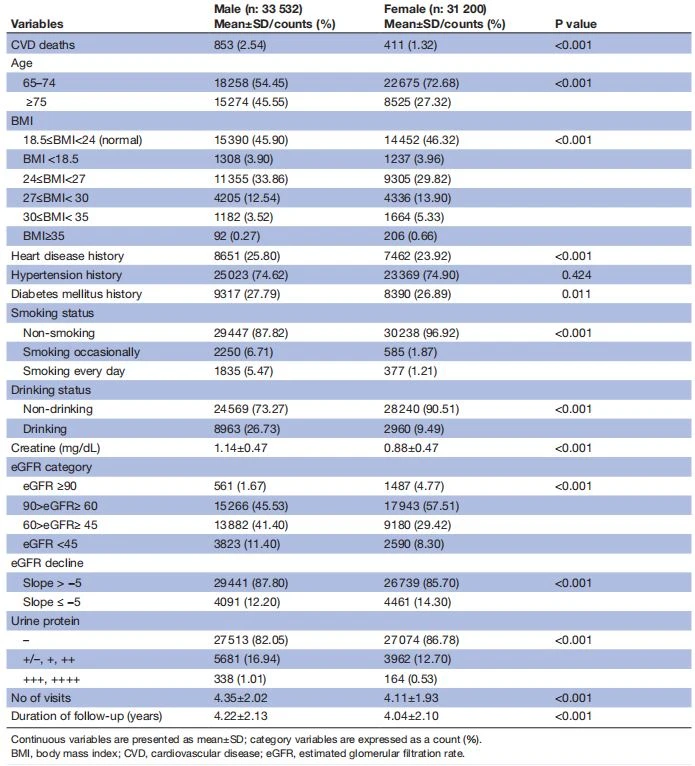
Among the included participants visits (table 1), the number of males (853) with cardiovascular deaths exceeded that of females (41l). In the younger elderly participants(age 65-74), the females(22,675)outnumbered males(18,258). Among included participants, a much higher proportion of females were in this younger elderly group(72.68%), whereas males showed the opposite pattern. In the underweight(<18.5), the females had proportions(3.96%)similar to that of the males (3.90%).The proportion of males(33.86%)was larger than females(29.82%)in the overweight(24BMI<27)group; on the other hand, the proportions of slightly obese(27≤BMI<30),moderately obese (30≤BMI<35) and severely obese (BMI ≥35) were much higher in females (13.90%,5.33%,0.66%)than in males(12.54%,3.52%, 0.27%).The proportions having heart diseases(25.80%)and diabetes history(27.79%)were slightly higher in males. The proportion having hypertension history in females(74.90%)was almost the same as in males (74.62%). The proportions of non-smoking (96.92%)and non-drinking(90.51%) behaviors were much higher in females. In normal eGFR(eGFR ≥90) and slightly mildly decreased eGFR groups (90>eGFR60),the proportion of females was higher(4.77%,57.51%)than males (1.67%,45.53%).However, in the mildly decreased eGFR group(60>eGFR≥45) and moderately decreased eGFR group(eGFR<45), the proportion of males was higher (41.40%,11.40%)than females(29.42%,8.30%).The females with eGFR decline(≤-5)had a slightly higher proportion(14.30%)than the males(12.20%).Last, a much higher proportion of females were in the normal urine protein group (-)(86.78%), whereas males showed the opposite pattern.
Table 1 Characteristics of included participants’ visits stratified by gender
The results of the adjusted Cox proportional hazards model are shown in table 2. Compared with the persons with eGFR>90mL/min/1.73m³,a significant higher risk of cardiovascular death was observed with eGFR 45-59 (male:HR:2.85,95%CI:1.33 to 6.09; female:HR:3.66, 95%CI∶1.32 to 10.15)and eGFR<45mL/min/1.73m² (male:HR:3.98,95%CI:1.84 to 8.61;female:HR:6.77, 95% CI:2.41 to 18.99).The eGFR decline slope≤-5 (male: HR:3.24,95%CI:2.73to 3.85; female: HR:2.83. 95%CI:2.20 to 3.64), urine protein(+/-,+,++,male:HR:1.51,95%CI:1.29to 1.78;female:HR:1.93,95%CI:1.54 to 2.42),and urine protein(+++,++++, male: HR:2.31,95%CI:1.51to 3.53;female:HR:4.23,95%CI:2.34 to 7.65)were associated with an increased risk of cardio-vascular death. Additionally, age ≥75 years and having heart disease history were independent risk factors for cardiovascular death in both genders. The association between a history of hypertension and the risk of cardio-vascular death was only significantin males.Furthermore, competing risk analysis determined that eGFR <90mL/min/1.73m²,positive proteinuria and rapid decline in eGFR were associated with an increased risk of cardiovas-cular mortality (online supplemental tables SI and S2).
Table 2 The estimated risks of cardiovascular deaths from explanatory variables by gender

We stratified our participants into 12 groups based on different levels of renal function (eGFR 290, 90>eGFR≥60,60>eGFR≥45, eGFR <45)and different levels of urine protein((-),(+/-,+, ++), and(+++ or ++++)).Table3 shows the joint effect of eGFR and urine protein with cardiovascular mortality different between genders. Compared with participants with normal renal function (eGFR ≥90+ urine protein (-)), those who met eGFR <60mL/min/1.73m² or tested positive in urine protein had a significant increase in cardiovascular mortality. When participants met both criteria, eGFR <60mL/min/1.73m², and having proteinuria, the risk of cardiovascular mortality in males and females was significantly increased by more than three and six times, respectively.
Table 3 The joint effect of eGFR and urine protein with cardiovascular mortality

Figure 2A-C shows that the survival curves estimated by the Cox proportional hazards model depend on different levels of renal function and different levels of urine protein. The worse urine protein and worse reduction in eGFR a participant had, the lower their probability of survival. Additionally, the survival probabilities among females were higher than those among males in all groups.

cistanche powder: anti-inflammation
DISCUSSION
In this cohort study, we observed significant and independent associations of a lower eGFR level, an elevated level of protein in the urine, and a rapid past decline in eGFR with a higher risk of cardiovascular mortality. The joint effect of increased concentration of urine protein and reduced eGFR was associated with a lower survival probability. Decreased GFR and persistent proteinuria are markers of kidney damage and are associated with an increase. Our findings indicate risk of cardiovascular mortality." that testing positive for proteinuria is an independent risk factor for cardiovascular mortality in our participants, and this is more evident in females than in males. The results of this study are consistent with previous studies, although the latter was not conducted in Asian populations.26 27 The eGFR<60mL/min/1.73m² is an independent risk factor for cardiovascular mortality in our participants and was more prominent in females than in males. However, the results are different from other studies. Zambon et al found that all participants (Italian population aged 65 years and older)with eGFR <60mL/min/1.73m² had an increased risk of cardiovascular mortality, although this was not significant in men(HR 2.13,95%CI 0.84 to 5.42)and women (HR 1.73,95%CI 0.92 to 3.27) separately.2 A longitudinal study showed the eGFR<45mL/min/1.73m² is an independent risk factor for cardiovascular mortality in the community-based elderly population(65-75 years old) in Japan, and analysis by gender showed that the HR of cardiovascular mortality is more evident in males (HR 3.14,95%CI 1.50 to 6.94)than in females(HR 1.48,95%CI 0.41 to 4.19).8 However, they did not include eGFR slope in their analysis. It is speculated that the difference in results is partially affected by the magnitude ofeGFR decline between men and women. In addition, obesity not only is a risk factor for CKD but is also associated with an increased risk of cardiovascular events and cardiovascular mortality, which may involve adipose tissue promoting several metabolic disorders and cardiac structure change caused by hemodynamic alterations.29-3i Females have a higher proportion of obesity than males in this study population(table 1), which may result in the risk of cardiovascular mortality being more significant in females than in males. In addition, the joint effect of impaired eGFR and proteinuria on a high risk of cardiovascular mortality has been reported in the elderly, but the difference in sex has not been analyzed yet.
Urinary protein excretion not only reflects localised subclinical renal disease but also a more generalized vascular endothelial dysfunction. Proteinuria is linked to higher high-sensitivity troponin T, avascular micronecrosis marker;" and Creative protein, an inflammation marker.?These results indicate that proteinuria is related to endothelial dysfunction. Oestrogen has vasodilatory effects and long-term actions that inhibit the response to vascular injury and prevent atherosclerosis."In an elderly population, without estrogen protection, females with proteinuria may have a higher risk of cardiovascular mortality than males.

cistanche health benefits: treating kidney diseases
As far as we know, only a study by Nerpin et al have shown that the combination of urinary albumin excretion rate and cystatin C-based eGFR is beneficial to improve the prediction of cardiovascular mortality in elderly men. In our study, the effect of a combination of increased urine protein concentration and reduced eGFR was associated with a lower survival probability. Participants with both eGFR<60mL/min/1.73m² and positive urine protein showed a higher risk of cardiovascular mortality compared with participants with normal renal function, and this was more prominent in females than in males.
The rapid decline in renal function is a risk factor for cardiovascular mortality. Rifkin et al found an association between the change of eGFR>3mL/min/1.73m²/yearand elevated risk for all-cause and cardiovascular mortality in older adults. Sumida et alalso showed that rapid decline of eGFR(slopes of <-5mL/min/1.73m²/year)is associated with higher all-cause and cardiovascular mortality in advanced CKD of veterans in the USA.37To the best of our knowledge, no study provides results on gender effects, but it has been proposed that males have a poor prognosis of kidney diseases.

Figure 2 Plots of survival curves which applied Cox proportional hazards model to estimate males’ and females’ survival depending on different levels of renal function and different levels of urine protein. (A) It shows the survival probability under different levels of renal function when the protein in urine is negative. (B) It shows the survival probability under different levels of renal function when the protein in urine is +/−, +, or ++. (C) It shows the survival probability under different levels of renal function when the protein in urine is +++ or ++++. eGFR estimated glomerular filtration rate.
Our results suggest that the risk of cardiovascular mortality in elderly men and women who had a rapid decline in renal function (eGFR decline<5 mL/min/1.73m²/year) was, respectively, 2.24 and 1.83 times more than their counterparts.
The advantage of our study is that this is a cohort study of elderly persons in Taipei, a major city in Taiwan, which is a large and representative population. In addition, there have been only limited studies discussing cardio-vascular mortality's relationship to both renal function and the magnitude of renal function decline in elderly Asians; we contribute to filling this gap and also analyzed the effect of gender. However, the limitations of our study should be noted. First, our results cannot extrapolate to the entire Asian elderly population, but the results can still be used as a reference for the generalized elderly population. Second, we were unable to obtain a better proteinuria index—ACR. ACR is calculated by dividing the concentration of urine albumin by the concentration of urine creatinine to eliminate the dilution or concentration effect caused by hydration, which is a more objective evaluation of the amount of albumin in the urine. The proteinuria test in the database used a (semiquantitative)urine test strip to estimate the amount of proteinuria by valence(-,+/-,+,2+,3 and 4+), which is not as accurate as of the(quantitative) microalbumin test, and there were no data available on urine creatinine to calculate ACR.
However, the urine test strip is the most common tool for preliminary screening of proteinuria. Our findings could provide an early warning to identify groups with a high risk of cardiovascular mortality.

cistanche salsa
CONCLUSIONS
With routine and simple indicators from health examinations, renal function and urine protein can be sensitive indicators for reducing the mortality risk of the elderly.
REFERENCES
1 Chen TK, Knicely DH, Grams ME. Chronic kidney disease diagnosis and management: a review.JAMA 2019;322:1294-304.
2 ski K, disease Kidney. (CKD) as an emerging risk factor in the elderly. In: Washio M, Kiyohara C, eds.Health issues and care system for the elderly. Singapore: Springer Singapore, 2019: 137-50.
3 Mallappallil M, Friedman EA, Delano BG, et al. Chronic kidney disease in the elderly: evaluation and management. Clin Pract 2014;11:525-35.
4 So S, Stevenson J, Lee V.Kidney diseases in the elderly. advanced age geriatric care. Springer, 2019: 131-44.
5 Liu BC, Tang TT, LLL.How tubular epithelial cell injury contributes to renal fibrosis.In: Liu BC, Lan HY, LL L, eds. Renal fibrosis: mechanisms and therapies. Singapore: Springer Singapore, 2019:233-52.
6 Chou Y-H, Huang T-M, Chu T-S. Novel insights into acute kidney injury-chronic kidney disease continuum and the role of the renin-angiotensin system. J Formos Med Assoc 2017;116:652-9.
7 GBD 2017 Causes of Death Collaborators.Global, regional, and national age-sex-specific mortality for 282 causes of death in 195 countries and territories, 1980-2017: a systematic analysis for the global burden of disease study 2017.Lancet 2018:392:1736-88.
8 GBD Chronic Kidney Disease Collaboration. Global, regional, and national burden of chronic kidney disease, 1990-2017:a systematic analysis for the global burden of disease study 2017.Lancet 2020;395:709-33.
9 Chronic Kidney Disease Prognosis Consortium, Matsushita K, van der Velde M, et al. Association of estimated glomerular filtration rate and albuminuria with all-cause and cardiovascular mortality in general population cohorts: a collaborative meta-analysis. Lancet 2010;375:2073-81.
10 Matsushita K, Coresh J, Sang Y, et al.Estimated glomerular filtration rate and albuminuria for prediction of cardiovascular outcomes: a collaborative meta-analysis of individual participant data.Lancet Diabetes Endocrinol 2015;3:514-25.
11 Gansevoort RT, Correa-Rotter R, Hemmelgarn BR, et al. Chronic kidney disease and cardiovascular risk: epidemiology, mechanisms, and prevention. Lancet 2013;382:339-52.
12 Hallan S, Astor B, Romundstad S, et al. Association of kidney function and albuminuria with cardiovascular mortality in older vs younger individuals: the HUNT Il study. Arch Intern Med 2007;167:2490-6.
13 Irie F, Iso H, Sairenchi T, et al. The relationships of proteinuria, serum creatinine, glomerular filtration rate with cardiovascular disease mortality in Japanese general population. Kidney Int 2006;69:1264-71.
14 van der Velde M, Matsushita K, Coresh J, et al. Lower estimated glomerular filtration rate and higher albuminuria are associated with all-cause and cardiovascular mortality. A collaborative meta-analysis of high-risk population cohorts. Kidney Int 2011;79:1341-52.
15 Wang J, Wang F, Liu S, et al. Reduced kidney function, albuminuria, and risks for all-cause and cardiovascular mortality in China: a population-based cohort study. BMC Nephrol 2017;18:188.
16 Turin TC, Coresh J, Tonelli M, et al.Short-Term change in kidney function and risk of end-stage renal disease. Nephrol Dial Transplant 2012;27:3835-43.
17 Tsai C-W, Ting l-W, Yeh H-C, et al.Longitudinal change in estimated GFR among CKD patients: a 10-year follow-up study of an integrated kidney disease care program in Taiwan. PLoS One 2017;12:e0173843.