Can A Desert Herb Soothe The Inflamed Brain? What Mouse Research Reveals About Cistanche And Depression
Oct 27, 2026
A gentle, science-based look at a laboratory study exploring whether Cistanche phenylethanol glycosides - the compounds behind the "desert ginseng" - might help with depression-like behavior, and why we must read these findings with careful eyes
Introduction: When a Desert Plant Meets a Modern Mental Health Challenge
For thousands of years, a plant called Cistanche deserticola - better known as the "desert ginseng" - has grown in some of the harshest environments on Earth, quietly storing an extraordinary chemistry in its fleshy stems. Traditional healers have long prized it for supporting vitality, energy, and overall well-being.
Today, that ancient reputation is meeting a very modern question. Could compounds from this desert plant hold promise for one of the most challenging health issues of our time - depression?
It's a question that has drawn serious attention from researchers, not because a plant can replace modern medicine, but because the search for gentler, more diverse treatment options is genuinely urgent. Depression affects hundreds of millions of people worldwide, and current treatments, while life-changing for many, do not work for everyone.
This article tells the story of a recent laboratory study that investigated whether phenylethanol glycosides (PhGs) - the signature active compounds found in Cistanche - could reduce depression-like behavior in mice, and how they might do it at the level of brain chemistry and brain inflammation.
Before we go further, one thing needs to be stated clearly and honestly: this is a study done in mice, not in humans. As we'll see, that distinction matters enormously. But understanding what the research found, and what it doesn't yet tell us, is exactly the kind of careful reading that separates good science from hype.
Let's begin with the problem itself.
1. Depression: A Quiet Global Epidemic
Depression is far more than "feeling sad." It is a complex and serious mood disorder that affects how a person thinks, feels, and functions. Its symptoms can include persistent low mood, loss of interest or pleasure in things once enjoyed, slowed thinking, changes in sleep and appetite, low energy, and difficulty concentrating. In its most severe forms, it can be life-threatening, and it is associated with an increased risk of self-harm and suicide.
The numbers are sobering. According to China's national report on nutrition and chronic disease (2020), the prevalence of depression in China was about 2.1% - and depression is consistently ranked by global health authorities among the leading causes of disability worldwide. It is not a niche issue; it is a global health challenge that touches individuals, families, and societies.
For decades, the standard approach to treating depression has centered on a class of medications that influence brain chemistry - drugs like fluoxetine (perhaps best known by its brand name Prozac), along with others such as venlafaxine and duloxetine. These drugs have helped countless people. But they have real limitations:
They don't work for everyone. A significant portion of people with depression do not respond adequately to first-line medications.
Residual symptoms are common. Even among those who improve, lingering symptoms often remain.
Relapse rates are high. Depression frequently returns.
Side effects can be challenging. Some people experience side effects that limit long-term use.
These gaps have driven researchers to look beyond the traditional "chemical imbalance" view of depression - and toward something called neuroinflammation. This is where our desert plant enters the story.
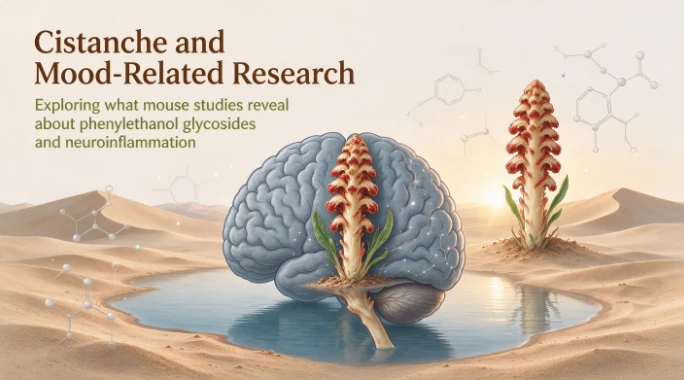
2. The "Inflamed Brain" Hypothesis: A New Way of Understanding Depression
For much of the past century, depression was largely understood through the lens of brain chemicals - specifically, low levels of neurotransmitters like serotonin, dopamine, and norepinephrine. This "monoamine hypothesis" led to the development of modern antidepressants and remains an important part of the picture.
But research has revealed that the story is more complex. A growing body of evidence points to the role of inflammation in the brain - a concept scientists call neuroinflammation - as a key player in depression.
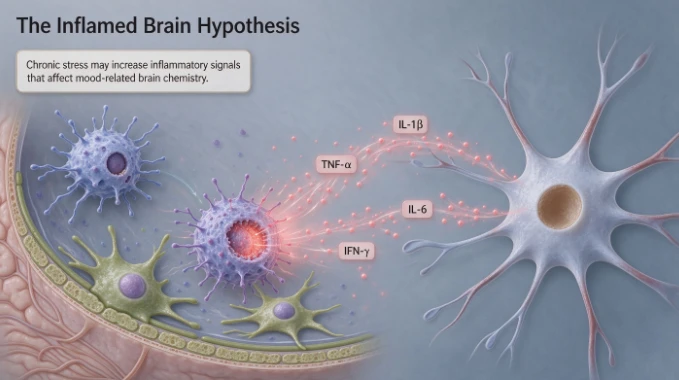
Here's the idea in plain terms. The brain has its own immune system, and central to that system are specialized cells called microglia and astrocytes. Normally, these cells help protect the brain, clear debris, and maintain healthy function. But when the brain experiences chronic stress or injury, these immune cells can become over-activated. When that happens, they release a flood of inflammatory molecules - signaling chemicals like TNF-α, IL-1β, IL-6, and others - that, in excess, can damage neurons and disrupt the delicate chemistry that underpins mood, motivation, and pleasure.
In people with depression, and in animal models of depression, researchers have observed signs of this neuroinflammatory state. Chronic stress appears to act like a slow-burning inflammatory fire in the brain, and that fire may help drive depressive symptoms.
This insight opens a new therapeutic avenue: if inflammation contributes to depression, then calming brain inflammation might be one way to help. And this is precisely where plant compounds with anti-inflammatory and neuroprotective properties - like the phenylethanol glycosides in Cistanche - become scientifically interesting.
3. Cistanche: The "Desert Ginseng" and Its Neurological Potential
Before we dive into the study, let's properly meet the protagonist.
Cistanche deserticola is a parasitic plant that lives by attaching to the roots of desert shrubs, drawing nutrients from hosts like saxaul trees. Despite its humble lifestyle, it has earned the nickname "desert ginseng" and a place among the most treasured herbs in traditional Chinese medicine, where it has been used to support kidney health, vitality, and digestive regularity.
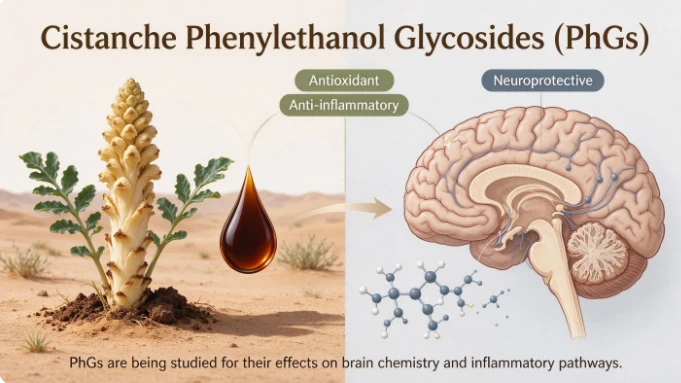
Modern chemistry has revealed why this plant is so special. Its stems are rich in a family of compounds called phenylethanol glycosides (PhGs) - complex molecules built from aromatic rings and sugar groups. These compounds are known for several biological activities:
Antioxidant activity - they can neutralize free radicals that damage cells.
Anti-inflammatory activity - they can help calm inflammatory responses.
Neuroprotective potential - earlier research has suggested possible protective effects relevant to conditions like Alzheimer's disease and Parkinson's disease.
The specific product studied here was a Cistanche PhGs extract standardized to contain at least 85% phenylethanol glycosides, including notable amounts of echinacoside and verbascoside - two well-studied compounds in this family.
Earlier studies had already hinted that Cistanche glycosides might influence mood-related pathways - for example, by supporting the levels of dopamine and other monoamine neurotransmitters in the brain. But whether they could help in a model of depression driven by chronic, unpredictable stress - and through what mechanism - had not been clearly established. That was the gap this study set out to fill.

4. How the Study Was Designed: Modeling Chronic Stress in Mice
To study depression, researchers cannot simply ask a mouse how it feels. Instead, they use carefully validated behavioral models that mimic the features of depression - and one of the most respected is the chronic unpredictable mild stress (CUMS) model.
The logic is simple but powerful. When mice are exposed to a series of unpredictable, mild stressors over several weeks - such as brief restraint, cage tilting, wet bedding, flashing lights, or brief cold-water swims - they begin to show behaviors that resemble the hallmarks of human depression: they lose interest in pleasures, they become more passive and hopeless, and they show signs of reduced motivation.
In this study, the researchers:
Divided the mice into six groups: a control group (no stress), a model group (stressed, no treatment), three groups receiving different doses of Cistanche PhGs (low, medium, and high), and a positive-control group receiving fluoxetine - a standard antidepressant - to serve as a benchmark for comparison.
Induced depression-like behavior in the stressed groups over four weeks.
Then administered the treatments daily for another four weeks.
Finally, ran a battery of behavioral tests to measure depression-like behavior, followed by laboratory analyses of brain chemistry and brain tissue.
The behavioral tests are worth explaining briefly, because they are the "how do we know" behind the study:
Sucrose preference test: Mice normally love sweet water. A depressed mouse loses interest in sweetness - a reflection of anhedonia, the loss of pleasure that is a core symptom of depression. A higher sucrose preference indicates better mood.
Open field test: Measures how much mice explore their environment and how comfortable they are in open, exposed areas - an indicator of anxiety-like behavior.
Tail suspension test & forced swim test: These measure "behavioral despair." When mice are placed in an inescapable, mildly stressful situation, they eventually stop struggling. A longer immobility time is interpreted as greater despair; treatments that reduce immobility are considered to have an antidepressant-like effect.
After the behavioral tests, the researchers examined the mice's brains - specifically the hippocampus, a region central to mood, memory, and stress regulation - to look at neurotransmitter levels, inflammatory markers, and the activity of immune cells.
5. Finding One: Real Behavioral Improvements
The first and most important question was: did Cistanche PhGs actually change the way the stressed mice behaved? The answer, according to the study, was yes - and in a dose-dependent manner.
Restored pleasure response. In the sucrose preference test, the stressed model mice showed a clear drop in their preference for sweet water - the hallmark of anhedonia. Treatment with Cistanche PhGs significantly restored this preference, with the highest dose producing the strongest effect. In practical terms, the treated mice regained interest in a rewarding experience.
Reduced despair. In the forced swim and tail suspension tests, the model mice spent more time immobile - a sign of giving up. Cistanche PhGs significantly reduced this immobility time, meaning the treated mice struggled more actively to escape, a sign interpreted as reduced behavioral despair. Again, the effect was stronger at higher doses.
Reduced anxiety-like behavior. In the open field test, the stressed mice moved less and avoided the open central area. Cistanche PhGs increased overall movement and time spent in the central zone, suggesting reduced anxiety-like behavior and greater willingness to explore.
Across all these measures, the effects of the highest dose of Cistanche PhGs were described as comparable to those of fluoxetine, the standard antidepressant used as a reference.
It's important to pause here and note what this does and doesn't mean. These are behavioral indicators in mice - not proof that the compound works in humans. But they are exactly the kind of results that justify further investigation.
6. Finding Two: Restoring Brain Chemistry
Behind the behavioral changes, the researchers found corresponding changes in brain chemistry - specifically in two key neurotransmitters: serotonin (5-HT) and dopamine.
These two molecules are intimately involved in mood and motivation. Serotonin is often linked to mood stability and well-being; dopamine is central to reward, motivation, and pleasure. Both are targets of many modern antidepressants.
In the stressed model mice, levels of both serotonin and dopamine - in the blood and in the hippocampus - were significantly reduced. This is consistent with the picture of depression as involving disrupted monoamine signaling.
Treatment with Cistanche PhGs significantly raised both serotonin and dopamine levels, again in a dose-dependent manner, with the highest dose approaching the levels seen with fluoxetine.
This finding suggests a plausible mechanism for the behavioral improvements: by helping restore the balance of these mood-related neurotransmitters, Cistanche PhGs may help the brain recover its capacity for pleasure and motivation. In plain terms, the treatment appeared to help the brain "reset" the chemistry that underpins feeling good and staying motivated.
7. Finding Three: Calming the "Inflamed Brain"
This brings us to the heart of the study and its most interesting contribution - the relationship between Cistanche PhGs and neuroinflammation.
Recall that the "inflamed brain" hypothesis links depression to chronic inflammation in the brain. This study directly tested whether Cistanche PhGs could calm that inflammation - and the results were striking.
In the stressed model mice, the researchers found significantly elevated levels of a suite of inflammatory molecules in the hippocampus, including:
TNF-α and IL-6 - pro-inflammatory cytokines that act as alarm signals.
IL-1β and IL-18 - inflammatory cytokines linked to the activation of a key immune complex.
IFN-γ - another pro-inflammatory signal.
iNOS, COX-2, and PGE2 - enzymes and mediators involved in the inflammatory cascade.
All of these were significantly increased by chronic stress. Treatment with Cistanche PhGs significantly reduced these inflammatory markers across the board, with the highest dose showing the strongest suppression.
This is a meaningful result. It suggests that Cistanche PhGs did more than just tweak a single neurotransmitter - they helped quiet the broader inflammatory environment in the brain, addressing a process increasingly recognized as central to depression.
8. Finding Four: Protecting the Brain's Cells
The study also looked directly at what was happening to the brain's cells - both the neurons themselves and the supportive immune cells around them.
Protecting neurons. Using special staining techniques, the researchers examined the health of neurons in the hippocampus. In the stressed mice, they found signs of neuronal damage - disorganized cell arrangement, shrunken nuclei, and loss of Nissl bodies (structures within neurons that reflect their metabolic health). Treatment with Cistanche PhGs, particularly at higher doses, visibly improved these signs, restoring a more normal, organized appearance and increasing the density of healthy, active neurons.
Supporting astrocyte health. Astrocytes are the most abundant supportive cells in the brain - they nourish neurons, maintain the blood-brain barrier, and help regulate neurotransmitter levels. In the stressed mice, markers of astrocyte health (a protein called GFAP) were significantly reduced, suggesting astrocyte damage. Cistanche PhGs significantly restored astrocyte density, with the highest dose even exceeding the effect of fluoxetine.
Calming overactive microglia. Microglia are the brain's resident immune cells. In depression, they are often found over-activated - stuck in a pro-inflammatory state that damages neurons. The stressed mice showed a significant increase in activated microglia (marked by a protein called Iba-1). Cistanche PhGs significantly reduced this over-activation, helping to bring these immune cells back toward a calmer, healthier state.
Taken together, these findings paint a picture of Cistanche PhGs as a neuroprotective agent: supporting the health of neurons, protecting supportive cells, and calming the brain's overactive immune response.
9. The Mechanism: A Molecular Chain of Command
The most scientifically valuable part of this study is that it didn't stop at "it seems to help." It dug into how - and identified a specific molecular pathway.
At the center of this story is a complex called the NLRP3 inflammasome. This is a key piece of the innate immune system - a kind of "fire alarm" inside cells that, when triggered, helps activate inflammatory responses. Normally useful, the NLRP3 inflammasome can become harmful when it's inappropriately activated, driving the excessive inflammation seen in depression.
The NLRP3 inflammasome doesn't activate on its own. It needs an upstream "start signal," and one of the most important is the TLR4/NF-κB signaling pathway:
TLR4 (toll-like receptor 4) sits on the surface of immune cells and acts like a sensor, detecting danger signals.
When TLR4 is activated, it switches on NF-κB, a master regulator of inflammation.
Activated NF-κB then boosts the production of NLRP3 and other inflammatory components, assembling the inflammasome.
The assembled inflammasome activates caspase-1, which in turn processes and releases the inflammatory cytokines IL-1β and IL-18.
These cytokines propagate the inflammatory response - and, in the context of chronic stress, contribute to neuroinflammation and depressive symptoms.
In the study, the stressed mice showed a dramatic upregulation of this entire chain - TLR4, p-NF-κB, NLRP3, and caspase-1 were all significantly elevated. Treatment with Cistanche PhGs significantly suppressed each step of this cascade, with the highest dose producing the strongest inhibition.
This is a coherent mechanism. By dialing down the TLR4/NF-κB signal, Cistanche PhGs appear to prevent the NLRP3 inflammasome from being switched on, which reduces the release of inflammatory cytokines, which calms neuroinflammation, which helps protect neurons and restore normal mood-related brain function.
Put simply: the study suggests Cistanche PhGs may act like a "circuit breaker" on one of the brain's key inflammatory pathways.
10. What This All Adds Up To
Let's bring the findings together. In a mouse model of depression induced by chronic unpredictable stress, Cistanche phenylethanol glycosides were found to:
Improve depression-like and anxiety-like behaviors - restoring pleasure response, reducing despair, and encouraging exploration, at a level comparable to a standard antidepressant.
Restore key neurotransmitters - raising serotonin and dopamine levels in the blood and brain.
Quiet brain inflammation - reducing a wide range of inflammatory molecules in the hippocampus.
Protect brain cells - supporting neuron health, restoring astrocyte density, and calming overactive microglia.
Act through a defined mechanism - suppressing the TLR4/NF-κB/NLRP3 inflammasome pathway, one of the key drivers of neuroinflammation.
When you connect these dots, a coherent picture emerges. Chronic stress triggers neuroinflammation through the TLR4/NF-κB/NLRP3 pathway. This inflammation damages neurons and disrupts the chemistry of mood and motivation. Cistanche PhGs appear to interrupt this chain - reducing inflammation at its source, protecting the brain's cells, and allowing normal mood-related chemistry to recover.
This is genuinely interesting science. But - and this is critical - it is still early-stage, animal-based research.
11. Reading This Honestly: What This Study Does and Doesn't Tell Us
This is the most important section of this article, and I want to be completely straightforward with you.
What this study tells us: It provides a well-designed, carefully measured piece of evidence that a standardized Cistanche PhGs extract has antidepressant-like effects in a validated mouse model of depression, and it identifies a plausible biological mechanism (reducing neuroinflammation via the TLR4/NF-κB/NLRP3 pathway).
What this study does not tell us: It does not tell us that Cistanche treats depression in humans. Here's why the distinction matters:
Mice are not humans. Mouse brains, while similar in many ways, are not the same as human brains. Depression in humans is complex, shaped by genetics, life experience, social context, and psychology - none of which a mouse model fully captures.
Doses don't translate directly. The doses used in mice (up to 700 mg/kg) do not simply scale to a supplement you'd buy online. A mouse study tells us a mechanism works in principle, not what dose would be safe or effective in a person.
Human clinical trials are the gold standard. None of this has yet been confirmed in rigorous human studies. Until that happens, any claim that Cistanche "treats depression" is premature.
Most importantly, I want to say this clearly and without ambiguity:
If you or someone you care about is experiencing depression, please seek professional help. Depression is a serious, treatable medical condition. Modern treatments - including psychotherapy, medication, and lifestyle support - can genuinely help, and you deserve that help. Do not stop, start, or change any psychiatric medication based on this article, and do not replace professional care with an herbal supplement. Natural compounds are not a substitute for evidence-based medical treatment, and their use alongside medication should always be discussed with a qualified healthcare provider.
The honest takeaway from this research is hopeful but modest: it suggests that compounds from this remarkable desert plant deserve further investigation as potential future contributors to a broader toolkit for mental health. That is a real and valuable scientific contribution - but it is a beginning, not an answer.
12. Conclusion: A Desert Plant, a Complex Brain, and a Careful Next Step
The story of Cistanche and depression is a story of genuine scientific curiosity meeting one of the most complex challenges in medicine.
On one hand, there is a plant with thousands of years of traditional use and a chemistry rich in neuroprotective and anti-inflammatory compounds. On the other, there is a modern understanding of depression that increasingly recognizes the role of a chronically inflamed brain.
This study builds a thoughtful bridge between the two. It shows that, in a carefully controlled mouse model, Cistanche phenylethanol glycosides can reduce depression-like behavior, restore mood-related brain chemistry, quiet brain inflammation, protect neurons, and do so through a defined molecular pathway. It is careful, rigorous, and genuinely promising work.
But it is also, by definition, an early chapter. The road from a mouse brain to a human brain is long, and it is paved not with enthusiasm but with evidence - with human clinical trials, careful dose-finding, and rigorous safety evaluation.
For now, the message is one of measured hope. The "desert ginseng" has shown, in the laboratory, that its compounds can touch the very mechanisms thought to underlie depression. Whether that promise will one day translate into a real, evidence-based addition to mental health care is a question that only more - and better - science can answer.
And that, perhaps, is the most honest and most hopeful thing we can say.

References & Further Reading
This article is an English popular-science adaptation of the peer-reviewed study: Hao Mei, Li Hongyan. "Research on the antidepressant effects and mechanisms of Cistanche phenylethanol glycosides in mice." Natural Product Research and Development (天然产物研究与开发), 2025, 37 (2): 204–215. All experimental data, behavioral results, and proposed mechanisms described above are drawn from that study.
Important disclaimer: This article is for general informational and educational purposes only. It is not medical advice, and it does not claim that Cistanche or any natural product treats, cures, or prevents depression or any other mental health condition. The research described was conducted in mice, not humans, and its results have not been confirmed in human clinical trials. If you or someone you know is struggling with depression or suicidal thoughts, please reach out to a qualified healthcare professional or a mental health crisis service immediately. Never start, stop, or alter any medication without consulting a licensed medical provider.