Cistanche Fresh Slices: Gas Jet Impingement Drying Technology (Part 1)
Aug 25, 2025
Introduction
Fresh Cistanche (Cistanche deserticola) has a high sugar content and loses water slowly. Traditional sun-drying typically requires 2–4 months. During prolonged drying, endogenous enzymes readily hydrolyze key phenylethanoid glycosides; if mold or insect damage occurs, these actives can drop dramatically or even become undetectable. Studies show that during natural drying, polyphenol oxidase activity degrades active components and turns the tissue from yellow‑white to brown, severely reducing commercial value. Therefore, improving on‑site drying technology to achieve rapid enzyme inactivation ("enzyme kill"), preserve original color, and maintain active‑ingredient content is an urgent technical need.

Fresh Cistanche
Prior approaches include anti-browning soaks (salt solutions, acids, sulfites) to inhibit polyphenol oxidase, and low‑temperature drying to better retain phenylethanoid glycosides. Some reports indicate that slicing fresh Cistanche, blanching in hot water to inactivate enzymes, then drying can raise active components 5–10×. However, hot‑water enzyme kill risks leaching valuable constituents into the water. An ideal process would dry quickly without solvent contact that extracts actives away from the plant matrix.
Gas jet impingement is an emerging drying technology that can save 20–30% energy compared with conventional hot air. Leveraging this, the Agri‑Product Processing Technology & Equipment Lab at China Agricultural University (CAU) developed a jet‑impingement platform for drying, roasting, and expansion, already applied to roast duck, sweet potatoes, chestnut de-shelling, and agricultural drying. For produce that benefits from blanching and color protection, the system can integrate a steam generator to deliver controlled‑temperature/humidity steam through nozzles for impact blanching; successful trials have been reported on carrot cubes and apricots. Compared with conventional hot air at the same temperature, jet impingement transfers energy more efficiently, accelerates internal heating and moisture vaporization, and increases moisture diffusivity-advantages well‑suited to Cistanche slices. To date, there has been little to no reporting on applying this method to Cistanche.
This study applies gas jet impingement drying to fresh Cistanche slices, systematically evaluating the effects of slice thickness, drying air temperature, and air velocity on color and active‑ingredient retention. The goal is to meet processing requirements for preserving original color and actives, and to provide a technical basis for a new, rapid, quality‑focused drying method at origin.
Materials and Methods
Materials
Raw material: Cistanche deserticola Y. C. Ma harvested from CAU's planted base in Wuhai, Inner Mongolia. To ensure uniformity, whole roots were longitudinally cut and divided into 11 portions, each treated as one sample and oven‑dried for baseline characterization.
Equipment and reagents:
Gas jet impingement drying unit developed by CAU's Agri‑Product Processing Technology & Equipment Lab
Hand‑crank slicer
DHG‑9140A electric thermostatic blast oven
FlatbedScanner_23 flatbed scanner
Agilent 1100 HPLC system: G1322A vacuum degasser, G1311A quaternary pump, G1313A autosampler, G1316A column oven, G1314A VWD UV detector
Reference standards: echinacoside and galactitol (≥98%, from Peking University Center for Modern Research on TCM); acteoside/verbascoside standard (batch 111530-200404, National Institutes for Food and Drug Control, China, ≥98%)
Solvents: HPLC‑grade acetonitrile (JT Baker, USA), HPLC‑grade methanol (Tianjin Xihua), analytical‑grade formic acid (Beijing Chemical), and distilled water

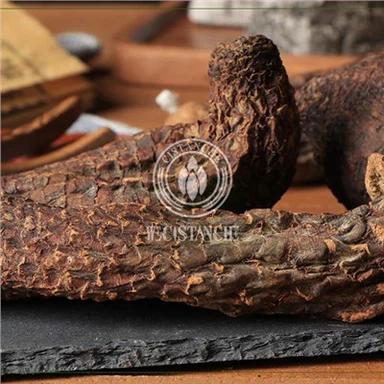
Dried Cistanche Root
Supportive Service Of Wecistanche-The largest cistanche exporter in China:
Email:wallence.suen@wecistanche.com
WhatsApp/Tel:+86 15292862950

Methods
Gas jet impingement drying design
Moisture baseline: Fresh Cistanche was sliced to 2 mm, single‑layer spread on white paper, then dried at 105°C for 24 h. Mass was recorded and drying continued with hourly weighing until the mass change between two measurements was ≤0.02 g, defining constant weight. The initial moisture content determined by this method was 72.1%.
Experimental factors: Slice thickness, air temperature, and air velocity-each at three levels-were arranged in an orthogonal design (see Part 2 for factor levels and table).
Procedure: Fresh Cistanche was sliced per design, weighed, and spread single‑layer on the jet‑impingement dryer tray. Mass was recorded at intervals. Drying ended when moisture content reached 10%.
Conventional controls: Natural sun‑dry and oven drying at 65°C, both at 2 mm slice thickness, randomized block design, n=3 per treatment.
Measurement indices
Color analysis by image processing

Each sample was scanned at 300 dpi, 50% scale, BMP format, placed at the same location on the scanner for consistency. Images were analyzed in Photoshop CS3 under the RGB color model. Three measurement points per sample were averaged.
HPLC quantification of echinacoside and acteoside
Chromatography: Agilent ZORBAX SB‑C18 (4.6 × 150 mm, 5 μm); mobile phase methanol–0.1% formic acid with gradient: start 26.5:73.5, hold 17 min; change to 29.5:70.5 within 3 min, hold 7 min; flow 1.0 mL/min; detection 330 nm; column 35°C; theoretical plates ≥3,000 (echinacoside peak).
Standards: Mixed standard of echinacoside + acteoside at 0.5 mg/mL in 60% methanol.
Sample prep: ~0.7 g Cistanche powder (80‑mesh) in a 100 mL brown volumetric flask; add 50 mL 60% MeOH, seal, shake, weigh, soak 0.5 h, ultrasound 40 min, cool, reweigh, replenish loss with 60% MeOH, mix, settle, filter through 0.45 μm membrane into brown vials.
Quantification: Inject 5 μL standards and samples, measure peak areas, external standard single‑point calibration.
HPLC quantification of galactitol (marker for polysaccharide hydrolysis/by‑products)
Chromatography: Prevail Carbohydrate ES column (250 × 4.6 mm, 5 μm); mobile phase acetonitrile:water 77:23; 0.7 mL/min; 25°C; ELSD detector with drift tube 40°C, gas pressure 2.4 × 10^5 Pa, sensitivity 8; theoretical plates ≥3,000 (galactitol).
Standard: Galactitol at 0.5 mg/mL in water.
Sample prep: From the 60% MeOH extract above, take 5 mL to 25 mL with 60% MeOH, mix, filter 0.2 μm.
Quantification: Inject 5 and 25 μL standard; 5 μL sample; calculate by external standard two‑point log equation.
Data analysis: Excel 2003 and SPSS 15.0.
Why this matters for processors and brands
Speed + quality: Jet impingement can rapidly inactivate enzymes without aqueous blanching, minimizing leaching while preserving color and key glycosides.
Energy savings: 20–30% lower than conventional hot air under comparable conditions.
Scalable: Purpose‑built equipment already validated on multiple food matrices.

Fresh Cistanche
What's next (Part 2)
In Part 2, we'll share:
The orthogonal design (factor levels for thickness, temperature, air velocity)
Drying kinetics and time‑to‑10% moisture
Colorimetric outcomes (RGB data) versus natural and 65°C oven drying
HPLC results for echinacoside, acteoside, and galactitol under each condition
Optimal parameter window and practical SOP for origin‑site processors
Want early access to Part 2 and the full SOP PDF? Leave your email and we'll send the data tables, HPLC methods, and a checklist for scaling gas jet impingement drying of Cistanche.