Cistanche Tubulosa: Echinacoside And Acteoside‑Natural Bioactive Compounds For Managing Hyperuricemia
Oct 16, 2026
Introduction to Hyperuricemia and Its Health Burden
Hyperuricemia (HUA) is a common metabolic disorder triggered by purine metabolism dysfunction inside the human body. Clinically, hyperuricemia is diagnosed when serum uric acid (SUA) exceeds 416.0 μmol/L (7.0 mg/dL) for men and 357.0 μmol/L (6.0 mg/dL) for women. Multiple contributing factors drive this condition: high‑purine eating patterns, excessive alcohol intake, certain pharmaceutical interventions, and underlying endocrine issues such as hypothyroidism.
Beyond elevated uric acid readings, persistent hyperuricemia raises long‑term health risks for cardiovascular disease, type‑2 diabetes and hypertension, significantly lowering patients' quality of life. The root causes fall into two primary categories: excessive endogenous uric acid production, and impaired renal excretion that prevents urate from leaving the body. Approximately two‑thirds of total daily uric acid is cleared via the kidneys, meaning kidney transport function largely determines an individual's urate balance.
Current mainstream pharmaceutical treatments for hyperuricemia separate into two major classes: agents that suppress uric acid biosynthesis, and substances that boost uric acid excretion. Nevertheless, these synthetic medications carry usage restrictions for people with compromised liver or kidney performance, creating demand for safe, natural alternative candidates derived from herbal sources. Traditional herbal remedies have long attracted research attention because many botanical metabolites demonstrate mild metabolic‑regulating properties with comparatively low toxic risk. Among these botanical resources, Cistanche tubulosa, a well‑known medicinal herb used in Asian traditional medicine, stands out for its abundant phenylethanoid glycoside constituents, especially echinacoside (ECH) and acteoside (AS).
Background of Cistanche Tubulosa and Its Key Active Ingredients
Cistanche tubulosa is a valued tonic herb recorded in traditional pharmacopeias. Historically practitioners applied this parasitic plant for supporting reproductive health, easing lower‑back weakness, replenishing essence‑blood, and alleviating intestinal dryness‑related constipation. Modern pharmacological investigations reveal multiple bioactivities of Cistanche tubulosa extracts, including neuroprotection, anti‑inflammatory responses, bone‑metabolism modulation, and adjuvant anti‑tumor potential when combined with chemotherapy regimens.
Phenylethanoid glycosides represent the dominant bioactive fraction within Cistanche tubulosa. Two representatives, echinacoside (ECH) and acteoside (AS), possess high purity and strong biological performance, making them leading research subjects for new natural health applications. Both molecules belong to the phenylethanoid glycoside family; their shared structural motifs include glycosyl groups and aromatic benzene‑ring frameworks. The sugar segments improve water solubility and bioavailability, while benzene‑ring substituent groups define their distinct biological behaviors. Early network pharmacology analysis plus preliminary animal screening hinted these two compounds might mitigate hyperuricemia, yet the concrete biological pathways remained unclarified before formal controlled animal research was carried out.

Animal Research Overview: How Scientists Evaluated Anti‑Hyperuricemia Effects
To verify whether acteoside and echinacoside can improve hyperuricemia, researchers built a stable rat hyperuricemia model. They combined potassium oxonate and adenine administration: potassium oxonate suppresses endogenous uricase activity to raise circulating urate, and adenine delivers extra purine substrate, jointly simulating the dual pathological features of human hyperuricemia‑over‑production plus defective renal urate removal.
Seventy male SPF‑grade SD rats took part in the trial. Animals were sorted into a normal control cohort, untreated HUA model group, allopurinol positive‑drug reference group, low‑dose and high‑dose acteoside groups (50 mg/kg/d, 100 mg/kg/d), as well as low‑dose and high‑dose echinacoside groups (50 mg/kg/d, 100 mg/kg/d). After successful model establishment, researchers maintained hyperuricemic status during the early treatment phase, then withdrew modeling agents and continued pure‑compound intervention for another 14 days, yielding a total four‑week intervention cycle.
At study endpoint, researchers collected serum and urine specimens to measure biochemical markers: serum uric acid (SUA), blood urea (UREA), serum creatinine (CREA), adenosine deaminase (ADA), urine uric acid (UUA). Serum xanthine oxidase (XOD) activity was quantified by enzyme‑based colorimetric assay. Kidneys were harvested for organ‑coefficient calculation, hematoxylin‑eosin (HE) histopathological observation. Immunohistochemistry (IHC) and real‑time quantitative PCR further detected both protein abundance and messenger‑RNA transcription level for four critical renal urate transporters: URAT1, GLUT9, OAT1, OAT3.

Core Observation 1: Acteoside and Echinacoside Improve Serum Biochemistry and Promote Urinary Uric Acid Discharge
Rats in the untreated hyperuricemia model group displayed significantly elevated serum uric acid, urea and creatinine relative to healthy controls. Meanwhile, urine uric acid concentration dropped sharply, reflecting typical kidney‑excretion failure of urate. Renal function markers UREA and CREA climbed, which indicated renal tissue damage caused by urate overload.
After continuous administration of acteoside or echinacoside, notable improvements appeared. Both low‑and‑high‑dose acteoside groups, alongside high‑dose echinacoside treatment, produced statistically meaningful reductions for SUA, UREA and CREA. Correspondingly, urine uric acid output increased markedly, which demonstrated enhanced uric acid excretion via urine channels. Even low‑dose echinacoside achieved observable reduction for blood urea levels.
These biochemical findings deliver a straightforward conclusion: purified acteoside and echinacoside from Cistanche tubulosa can lower circulating uric acid while alleviating abnormal serum kidney‑function indicators in hyperuricemic laboratory animals. Higher compound doses generally brought more pronounced benefits within the tested dosage scope.
Core Observation 2: Inhibition of Uric‑Acid‑Synthesizing Key Enzymes ADA and XOD
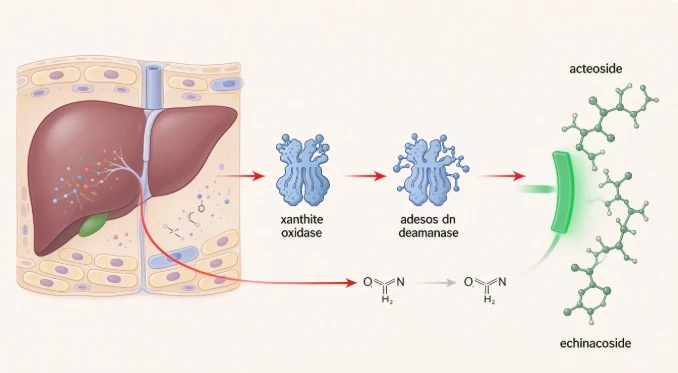
Inside the liver, two enzymes serve central roles for uric acid generation: xanthine oxidase (XOD) and adenosine deaminase (ADA). XOD directly catalyzes the oxidation process converting xanthine substrates to uric acid, representing a rate‑limiting enzyme for uric acid biosynthesis. ADA works in an indirect regulatory manner: it metabolizes adenosine, and downstream metabolites enter the purine transformation chain to ultimately generate uric acid. Elevated activity of either enzyme accelerates total‑body uric acid synthesis and worsens hyperuricemia conditions.
In model‑group animals without herbal intervention, serum ADA and XOD activity rose substantially. Compared against the untreated HUA model cohort, every acteoside and echinacoside receiving group showed significant suppression of ADA and XOD enzyme activity, comparable with the reference allopurinol group. This reveals one key working principle for these phenylethanoid glycosides: they restrain excessive uric acid formation by cutting down the activity of critical purine‑metabolizing enzymes in circulation.
Core Observation 3: Protection of Kidney Organ Morphology and Histopathological Structures
Hyperuricemia imposes heavy physical harm to renal tissue. In model‑group rat kidney slices processed for HE staining, scientists spotted obvious pathological injuries: shedding and necrosis of renal tubular epithelial cells, massive inflammatory‑cell infiltration inside renal tubules and interstitial space, plus renal swelling reflected by higher kidney‑to‑body‑weight coefficients and decreased animal body weight.
Following intervention by acteoside or echinacoside, physical status of experimental animals recovered partially: body weight rebounded, kidney weight and renal coefficient decreased toward normal‑control values. Histopathological damage was visibly relieved. Renal‑tubule epithelial shedding, cellular necrosis and interstitial inflammatory infiltration all became less severe. Portions of kidney tissue regained near‑normal glomerulus, renal tubule and interstitial architecture, confirming renal‑protective potency of these two compounds against hyperuricemia‑provoked organ harm.

Core Observation 4: Modulation of Renal Urate‑Transport Proteins (Key Molecular Mechanism)
Kidney urate balance hinges tightly on a set of specialized transporter proteins located on proximal renal‑tubule epithelial cells. They separate functionally into two opposing groups: re‑absorption transporters that pull urate back into bloodstream, and secretory transporters pumping urate fluid toward tubular lumen for final urine excretion.
Re‑absorption transporters: URAT1 and GLUT9
URAT1 and GLUT9 collaborate to mediate urate re‑uptake. When their expression level goes up, more urate gets re‑absorbed from primary urine back into blood circulation, aggravating hyperuricemia. In the untreated HUA model animals, both protein and mRNA transcription levels of URAT1 and GLUT9 were significantly up‑regulated. Acteoside and echinacoside treatment clearly down‑regulated both gene transcription and protein abundance of URAT1 and GLUT9, lowering excessive urate re‑absorption in nephrons.
Secretory‑excretion transporters: OAT1 and OAT3
OAT1 and OAT3 sit at the basolateral membrane of proximal renal tubule cells. They facilitate organic‑anion exchange reactions, importing urate substances from surrounding interstitial fluid into tubular epithelial cells, initiating the secretory route for uric‑acid elimination. In hyperuricemic model rats, expression of OAT1 and OAT3 was strongly suppressed. After AS or ECH supplementation, mRNA and protein levels for OAT1 and OAT3 were significantly elevated, strengthening renal secretory capacity for urate clearance.
Taken together, acteoside and echinacoside remodel the renal urate‑transport network: they turn down re‑absorption signals and amplify excretion‑related transporter expression, jointly promoting uric acid elimination from the body. Under experimental conditions, no large gap existed between acteoside and echinacoside regarding their regulatory effects for these four transporters, which may relate to their shared phenylethanoid‑glycoside chemical scaffold.
Consolidated Mechanism: Multi‑Pathway Action of Cistanche‑Derived Acteoside and Echinacoside Against Hyperuricemia
Based on above biochemical, histopathological and molecular‑biology results, we can summarize the complete working logic for these natural phenylethanoid glycosides in fighting hyperuricemia:
Reduce uric‑acid biosynthesis: Suppress activity of XOD and ADA, two core enzymes of purine metabolism, cutting down the rate of endogenous uric‑acid production.
Repair hyperuricemia‑induced kidney damage: Mitigate renal swelling, tubular necrosis and interstitial inflammation, restore overall renal physiological function disturbed by high urate burden.
Reset renal urate‑transport homeostasis: Down‑regulate re‑absorption transporters URAT1 and GLUT9; up‑regulate excretion‑promoting transporters OAT1 and OAT3. This dual adjustment diminishes urate re‑uptake and enhances secretory excretion, raising uric‑acid output into urine and lowering serum urate concentration.
Since acteoside and echinacoside share similar phenylethanoid‑glycoside backbone structures, they exhibit parallel pharmacological performance in this animal model. Slight distinctions between low‑dose and high‑dose groups suggest dose‑effect correlation: higher dosages generally deliver stronger biological responses within the tested experimental window.
Real‑World Implications, Limitations and Future Perspectives
Findings from this rat‑model study offer promising reference value for developing Cistanche tubulosa‑origin natural ingredients for hyperuricemia‑support applications, yet readers need to understand key boundaries when translating pre‑clinical data toward real‑human scenarios.
First, all results described originate from controlled laboratory rat experiments using chemically‑induced hyperuricemia animal models. Human hyperuricemia develops from far more complicated backgrounds: individual dietary habits, gut‑microbiome composition, genetic variance for urate‑transport genes, co‑existing metabolic syndromes all shape clinical outcomes. Animal‑model efficacy cannot be directly equated to definite therapeutic effect for human patients. No completed large‑scale human clinical trials are cited in this source material. This article serves purely as science‑popularization content explaining herbal compound pharmacology; it is not medical advice and cannot replace diagnosis or prescription services from qualified clinicians.
Second, dose conversion between rodent‑experiment dosages (50 mg/kg, 100 mg/kg for rats) and reasonable human supplementary intake still needs systematic pharmacokinetic calculation. Natural‑herb extracts' actual bioavailability inside human bodies differs greatly from purified compounds administered by gavage in lab settings. Whole‑herb powder, crude extracts and highly‑purified acteoside / echinacoside preparations differ dramatically in active‑ingredient concentration.
Third, modern‑market Cistanche tubulosa supplements vary widely across raw‑material origin, extraction workflows, purification standards, final product purity. Product quality inconsistency represents a practical barrier for real‑world application.
Looking forward, further research directions include:
Conducting pharmacokinetic assessments for oral acteoside and echinacoside;
Carrying out randomized controlled human clinical observation to evaluate safety and physiological impact for people with mildly elevated uric acid;
Exploring intestinal‑excretion pathways of urate (extra‑renal clearance route) affected by Cistanche tubulosa phenylethanoid glycosides;
Investigating synergistic potential when combining these glycosides with other plant‑derived metabolic‑support ingredients.

Conclusion
Hyperuricemia represents a growing global metabolic‑health concern. Constraints of conventional synthetic medicines fuel ongoing exploration for natural plant‑derived active components. As characteristic phenylethanoid‑glycoside bioactives extracted from traditional medicinal herb Cistanche tubulosa, acteoside and echinacoside demonstrate multi‑target anti‑hyperuricemia activity in pre‑clinical rat trials. Their mechanisms cover inhibiting uric‑acid‑synthesizing enzymes, protecting kidney tissue from hyperuricemic injuries, and readjusting expression profiles for renal urate‑transport proteins to facilitate uric‑acid urinary excretion.
These experimental outcomes illuminate the pharmacological foundation explaining historical traditional‑medicine application of Cistanche tubulosa. They also open new directions for developing plant‑based dietary‑supplement candidates targeting metabolic urate management. Even so, we emphasize repeatedly that data are pre‑clinical animal‑research outputs. More human‑focused investigations remain essential before confirming practical human‑use efficacy. Anyone living with high serum‑uric‑acid values ought to prioritize professional medical consultation rather than self‑medicating with herbal extracts.
Disclaimer: This article is science‑popularization content based on published pre‑clinical animal pharmacological research. It is for educational reference only, not medical guidance. It cannot substitute professional medical diagnosis, advice or treatment. Individuals with metabolic disease or persistent high uric acid should consult licensed healthcare practitioners.