Cistanche Tubulosa, Exploring The Millennium Old Kidney Nourishing Treasure Deep in The Desert
Jul 28, 2026
Parasitic Miracle in the Deep Desert
The growth environment of Cistanche tubulosa is itself a legend.
It is a perennial parasitic herbaceous plant in the family Liliaceae, which lives on the roots of the red willow or red willow (tamarisk) in the desert. Red willow is the toughest shrub in the northwest desert- cold-resistant, drought-resistant, high-temperature-resistant, salt-alkali-resistant, with a lifespan of up to thirty to forty years. It has a well-developed root system and is a loyal "desert guardian". Cistanche, on the other hand, plants its roots into the root system of the red willow, absorbs nutrients, and grows silently underground until the flowers bloom in the warm spring, at which point its inflorescence emerges from the sandy surface.

Cistanche tubulosa florescence
Its distribution area has an extremely arid climate, with an annual precipitation of less than 250 millimeters but a high evaporation rate of thousands of millimeters. It has strong sunlight, a significant temperature difference between day and night, strong winds, abundant sand, and poor soil development. It is in this place, which is considered a forbidden zone of life by ordinary people, that Cistanche tubulosa completes the entire process from seed germination to fleshy stem enlargement.
The seeds are abundant, small, and light, with a thousand-grain weight of only 0.086 to 0.091 grams. They scatter in the sand with the wind, and once they come into contact with specific chemical signals secreted by the roots of the red willow, they are "awakened" and germinate to invade the host roots, initiating a long parasitic life. This high dependence on the host has made the artificial cultivation of Cistanche tubulosa a world-class agricultural technology challenge - until it was gradually overcome by Chinese scientists in the past thirty years.
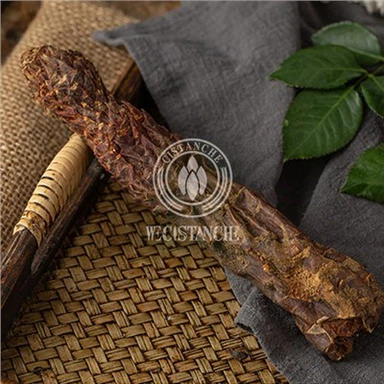
Every spring, when the seedlings have not yet been unearthed or have just broken through the soil, it is the golden season for harvesting Cistanche tubulosa. After digging out, remove the inflorescence and cut it into sections to air dry. After sunbathing on a clean beach or roof for over a month, the color gradually changes from yellow white to brown, which is called "Sweet Big Yun" (light Cistanche); If harvested in autumn, it is difficult to dry due to high water content, so it is put into salt lakes for one to three years to pickle, called "Yandayun" (Xiancong). The top grade is those with thick strips, dense scales, soft texture, and brown cross-section.

Harvest of Cistanche tubulosa
Authentic Medicinal Materials · Mountain and River Map
Cistanche tubulosa is an endangered medicinal herb unique to northwest China, mainly produced in Inner Mongolia, Xinjiang, Gansu, Ningxia, and other places, and is known as the "desert ginseng".
Alxa League in Inner Mongolia is a traditional, authentic land area, producing the best quality desert Cistanche tubulosa (commonly known as "Ruan Dayun") - thick, tender, and sweet in taste. It has been a precious tribute to the imperial court by various countries in the Western Regions in history. The southern part of Xinjiang (Hetian, Minfeng, Yutian, and Qiemo areas) is the main production area of Cistanche tubulosa (commonly known as "hard big Yun"), with large output and excellent efficacy. Since 2005, it has been included as one of the authentic sources of medicinal materials in the Chinese Pharmacopoeia.
The Tang Dynasty's "Daozang" listed Cistanche tubulosa as one of the "Nine Great Immortal Herbs of China", on par with Dendrobium officinale, Tianshan snow lotus, and ginseng, demonstrating its high status in the traditional Chinese medicine system.

Chinese herb cistanche
Thousand-year kidney tonifying effect with vertical and horizontal effects
Cistanche tubulosa has a sweet and salty taste, a warm nature, and belongs to the kidney and colon meridians. Its efficacy can be condensed into eight words: tonifying kidney yang, nourishing essence and blood, moistening intestines and promoting bowel movements.
1, Tonifying kidney yang and replenishing essence and blood
This is the core efficacy of Cistanche tubulosa. The "Shennong Bencao Jing" lists it as a top-grade product, stating that it "mainly deals with five types of labor and seven types of injuries, repairs the middle, removes cold, heat, and pain from the stem, nourishes the five organs, strengthens yin, benefits essence and qi, has many children, and can treat women's ailments. Long-term use can lighten the body. The "Japanese Herbal Medicine" bluntly states: "To treat male infertility caused by the cessation of yang, female infertility caused by the cessation of yin, moisten the five organs, build muscles, and warm the waist and knees.
Modern pharmacological research has uncovered the scientific veil of ancient experience: Cistanche tubulosa is rich in active ingredients such as phenylethanoid glycosides (represented by echinacroside and verbascoside), iridoids, lignans, polysaccharides, and alkaloids. Among them, phenylethanolic acid is widely recognized as a core substance for kidney tonifying and yang strengthening. On the one hand, it enhances the function of the hypothalamic pituitary adrenal axis, promotes the release of related hormones, and increases sexual desire; On the other hand, it can resist fatigue and enhance the body's exercise endurance.

Main Chemical Constituents of Cistanche
What is particularly rare is that the kidney tonifying effect of Cistanche tubulosa is suitable for both men and women. Male impotence, premature ejaculation, and oligospermia, as well as female uterine coldness, infertility, and menstrual disorders, can all be diagnosed and treated based on syndrome differentiation. Famous prescriptions throughout history, such as Cistanche Wan, Jingang Wan, Jisheng Shenqi Wan, etc., have all used it as a royal medicine or important auxiliary medicine.

The efficacy of Cistanche tubulosa in enhancing sexual function
Click here to view Improve Sexual Function Cistanche products
【Ask for more】 Email:cindy.xue@wecistanche.com / WhatsApp: 0086 18599088692 / WeChat: 18599088692
2, Moisturize the intestines and promote bowel movements
Another unique skill of Cistanche tubulosa is its ability to smooth the large intestine and promote internal circulation without damaging the body fluids. It has a soft and smooth texture, rich in gum and dietary fiber, which can soften feces without causing severe diarrhea and injury like rhubarb and saltpeter. For habitual constipation caused by elderly kidney deficiency, postpartum blood deficiency, and post-illness weakness, Cistanche tubulosa is one of the preferred drugs. Often used in combination with Angelica sinensis, Achyranthes bidentata, and Hemp Seed, it is warm and moisturizing, and can be used for both tonifying and nourishing purposes.
The "Jisheng Formula" contains a simple prescription: Two liang of Cistanche tubulosa is roasted and ground into powder, mixed with one liang of agarwood powder, and mashed with sesame seed juice to make pills. It is effective in treating elderly people with deficiency, excessive sweating, and constipation. Seventy pills are taken at a time and served in white soup.
3, Anti-aging and neuroprotection
In recent years, research has further expanded the "skill list" of Cistanche tubulosa: its phenylethanolic glycoside component can scavenge free radicals, enhance SOD activity, reduce MDA content, and has clear antioxidant and anti-aging effects; Pinecone chrysanthemum glycoside and verbascoside can protect nerve cells and improve learning and memory abilities by regulating signaling pathways such as Wnt/β - catenin, PI3K/Akt, and Nrf2/HO-1.

cistanche-Improve memory
Based on these findings, Professor Tu Pengfei's team at Peking University created a new drug called "Cistanche Total Glycosides Capsules" (launched in 2005), mainly composed of echinaceae glycosides, which is used to treat vascular dementia and provides a plant-based drug solution from the desert for elderly dementia.
Endangered and Protected: From Desert to Laboratory
Although Cistanche tubulosa is a precious herb, its fate was once precarious. Due to excessive excavation and destruction of the red willow forest, the wild desert Cistanche resources were almost depleted by the end of the last century, with an annual output of only over 50 tons. It was listed in the National Key Protected Wild Plant List (Level 2) and the International Union for Conservation of Nature Red List (Endangered).
The turning point began in the 1990s. Professor Tu Pengfei's team from Peking University, together with institutions such as China Agricultural University and Inner Mongolia Alxa League Forestry and Desertification Control Research Institute, conducted a systematic resource survey and artificial cultivation research on the Cistanche genus plants. After more than 30 years, the team has overcome a series of technical bottlenecks such as seed germination of parasitic plants, artificial inoculation, integrated seedling breeding of "Cistanche tubulosa host", prevention and control of pests, diseases and freezing damage, mechanized inoculation and harvesting processing, and pioneered a high-yield and stable production cultivation technology system for Cistanche tubulosa internationally.
Up to recent years, this technology has been widely planted in deserts of Xinjiang, Inner Mongolia, Gansu, Qinghai and other provinces and regions, with more than 6 million mu of red willow and tamarix, more than 2.3 million mu of Cistanche tubulosa, and an annual output of more than 7500 tons of medicinal materials, completely reversing the shortage of medicinal resources, and ensuring the supply of raw materials for clinical medicine and more than 200 traditional Chinese patent medicines and simple preparations and health products.

Abundant harvest of Cistanche tubulosa
What is even more commendable is that this industry has found a balance between desertification control and wealth creation. The large-scale planting of red willow forests has built a solid ecological barrier, effectively curbing land desertification and saving the country over 10 billion yuan in desertification control funds; Trained over 6300 farmers and herdsmen, helping more than 200000 people in the desert areas to lift themselves out of poverty and become prosperous. Medicinal herbs, ecology, and people's livelihood have achieved a rare unity here.
In 2025, the project "Key Technologies for the Development and Promotion of the Whole Industry Chain of Endangered Parasitic Chinese Medicine Cistanche tubulosa in the Desert" won the second prize of the National Science and Technology Progress Award, marking the highest level of recognition of this millennium-old herb in the contemporary scientific system.