Cistanche Tubulosa Vs Cistanche Deserticola: How To Choose The Right Extract
Sep 04, 2026
Within the industrial chain of Cistanche, the segment of extract procurement and formula selection is where confusion and concept‑swapping most frequently occur. Many brand owners, OEM manufacturers and even end‑consumers face the same problem: products are all labelled "Cistanche extract", yet some are derived from Cistanche tubulosa (Xinjiang origin) and others from Cistanche deserticola (Inner Mongolia origin). Their prices can differ by two to three times, while test‑report figures for echinacoside and acteoside vary drastically. Which one should you pick? The answer is not simply "higher content equals better performance". Instead, base species, regulatory boundaries, component profiles, formulation compatibility and end‑product positioning must all be evaluated together.

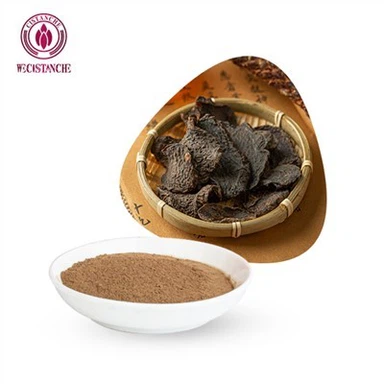
cistanche extract powder
Botanical Identity: Two Species, Two Host‑Parasite Relationships
The Chinese Pharmacopoeia includes both species as official medicinal materials.
Cistanche deserticola: Mainly produced in Alxa of Inner Mongolia, Gansu and Ningxia. It parasitizes the roots of Haloxylon ammodendron. Traditionally known as "soft Cistanche", it features an oily, pliable texture and high polysaccharide content.

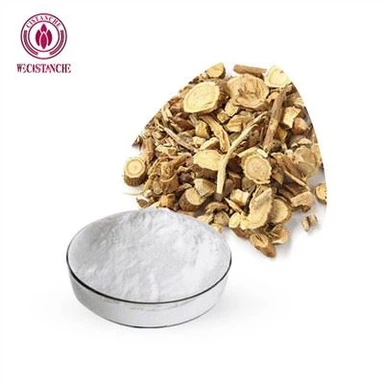
Cistanche deserticola
Cistanche tubulosa: Primarily grown in Hotan, Kashgar, and other regions of southern Xinjiang. It parasitizes the roots of tamarisk (Tamarix spp.). Officially admitted to the Pharmacopoeia in 2005, it is commonly called "hard Cistanche". Its texture is fibrous and firm, with exceptionally high phenylethanoid glycoside levels.

Cistanche tubulosa
Both are legal medicinal raw materials. However, "legitimate status" does not mean they are freely interchangeable - rules differ sharply between food and health‑product applications.
Pharmacopoeia Content Thresholds: The Most Intuitive Dividing Line
Pharmacopoeia specifications provide a clear benchmark. For crude medicinal material:
Total combined content of echinacoside plus acteoside for Cistanche deserticola shall be no less than 0.30%.
For Cistanche tubulosa, the combined threshold is no less than 1.5%, five times higher than that of C. deserticola.
At the extract level, C. tubulosa‑derived products are commonly standardized to specifications such as total phenylethanoid glycosides 40%‑355%, echinacoside 15%‑60%, and acteoside 3%‑25%. Owing to the inherently low marker content in raw C. deserticola, reaching 40 % total glycosides demands an extremely high material‑to‑extract ratio. Commercially available C. deserticola materials are mostly low‑standard liquid extracts, polysaccharide powders, or crude extracts barely meeting crude‑drug compositional levels.
Accordingly, if a "Cistanche extract" only states "equivalent crude‑material dosage" without reporting individual marker contents, it is most likely crude C. deserticola extract or blended material. Extracts labelled "echinacoside ≥25 %, total glycosides ≥60 %" can almost only originate from C. tubulosa.

Main Chemical Constituents of Cistanche tubulosa
Component Profiles: Distinct Chemical Fingerprints
High marker content does not automatically equate to superior tonic efficacy, as the two species possess fundamentally different component profiles.
Cistanche tubulosa: Dominated by phenylethanoid glycosides, chiefly echinacoside, acteoside, isoacteoside, tubuloside A and B. It contains relatively low polysaccharides and betaine, and carries a noticeable bitter taste.

Phenylethanol glycoside is the main active component of Cistanche tubulosa
Cistanche deserticola: A balanced profile of polysaccharides and glycosides. While phenylethanoid glycosides barely clear pharmacopoeia limits, it features abundant water‑soluble polysaccharides, oligosaccharides, mannitol, betaine and cistanoside A. It tastes sweet‑mild and exhibits strong oily characteristics.
Modern pharmacological studies demonstrate that high‑dose phenylethanoid glycosides (especially echinacoside) are repeatedly validated for antioxidant activity, neuroprotection against Alzheimer's and Parkinson's disease, anti‑fatigue effects, memory improvement and hepatoprotection. In contrast, the polysaccharide‑betaine complex from C. deserticola aligns more closely with the traditional therapeutic perceptions of "warming the kidney‑yang, replenishing essence‑blood, and relieving constipation in the aged and physically weak". It exerts gentler effects on intestinal barrier function and gut microbiota.
In short: C. tubulosa extract serves as a platform for targeted active constituents, whereas C. deserticola extract functions as a traditional tonic base. Before making your selection, clarify whether your product markets numerical echinacoside potency, or the holistic tonic experience of Cistanche.

Cistanche tubulosa extract
Click here to view Cistanche Tubulosa Extract Natural Supplement Powder
【Ask for more】 Email:cindy.xue@wecistanche.com / WhatsApp: 0086 18599088692 / WeChat: 18599088692
Regulatory Boundaries: Critical Compliance Risks
Regulatory compliance constitutes another non‑negotiable consideration. Cistanche deserticola appears on the Chinese list of medicinal‑and‑edible homologous materials. It may be used in ordinary foods including solid beverages, puree preparations, herbal pastes and candy compresses subject to local regulatory interpretations.
Cistanche tubulosa is classified solely as a medicinal herb. It cannot be deployed as a raw material for ordinary food. Its permitted applications include pharmaceuticals, blue‑hat certified health foods, special dietary foods and exported dietary supplements.
Many emerging consumer brands launch Cistanche‑infused coffee or beverages for e‑commerce under ordinary‑food classifications. Using undisclosed C. tubulosa extract while simply labelling it "Cistanche extract" without specifying the base species constitutes a regulatory violation. Conversely, developing a health food claiming memory improvement relying solely on C. deserticola extract fails to satisfy efficacy‑evidence and compositional requirements.
Practical guidance:
Ordinary‑food product lines: only Cistanche deserticola extract is allowed (or C. tubulosa may be used via health‑food filing).
Health foods and pharmaceuticals: standardized C. tubulosa extract is mainstream; C. deserticola may be used for complementary compound formulations.

cistanche powder
Selection by Application Scenario
Health‑focused products for middle‑aged and elderly consumers targeting memory enhancement, anti‑fatigue and neuroprotection: Prioritize standardized Cistanche tubulosa extracts. Recommended specifications: water‑soluble S‑1 grade powder with echinacoside ≥25 % and total phenylethanoid glycosides ≥60 %, or premium grade echinacoside ≥50 %. Formulate in combination with ginkgo, phosphatidylserine and coenzyme Q10. Test reports must present HPLC chromatograms showing both echinacoside and acteoside peaks, rather than merely UV‑determined total glycoside values.

cistanche supplement near me
Traditional herbal pastes and medicinal‑edible beverages for kidney‑yang support, intestinal dryness‑induced constipation and post‑partum debilitation: Cistanche deserticola extract better conforms to classical Chinese‑medicine formulation principles. Especially for elderly constipated patients concerned about potential dry‑heat tendencies associated with C. tubulosa, combinations of C. deserticola polysaccharide powder and crude‑material extract deliver more stable physiological responses.

Cistanche Oral Liquid
Antioxidant raw materials for cosmetics: Water‑soluble phenylethanoid glycoside powder from C. tubulosa represents the industry standard, offering superior colour properties, DPPH radical‑scavenging performance and metal‑chelating capacity. Extracts of C. deserticola yield highly viscous preparations with heavy pigmentation, leading to poor formulation compatibility.
Dietary‑supplement exports to Europe and North America: Overseas customers require quantifiable echinacoside values complying with USP or enterprise standards; C. deserticola‑sourced material generally cannot meet these specifications.