Millennia Of Imperial Cistanche: What Exactly Differs Between The Extract And The Raw Herb
Sep 07, 2026
Beneath the roots of saxaul and tamarisk in the deserts of Xinjiang, Inner Mongolia, and Gansu grows a root-parasitic herb the ancients called "ginseng of the desert" - Cistanche, or Roucongrong. First recorded in Shennong's Classic of Materia Medica as a top-grade tonic ("mends the five fatigues and seven injuries, nourishes the five viscera, strengthens yin, boosts essence-qi, and lightens the body upon long use"), it was offered by Western Regions kingdoms as a tribute to the Han, Tang, and later courts, earning the label "millennia of imperial use." The current Chinese Pharmacopoeia recognizes two botanical sources: Cistanche deserticola (desert cistanche, hosted by saxaul, mainly Alashan) and C. tubulosa (tubular-flowered cistanche, hosted by tamarisk, mainly Hotan, Xinjiang), both as dried fleshy stems with scale leaves.

Chinese herb cistanche
Modern buyers meet two forms: the sliced, whole, or powdered raw herb/decoction piece, and the brownish fine powder of Cistanche extract. Same origin, different stage - from natural crude drug to standardized active material. The breakdown below runs across history, chemistry, process, quality logic, efficacy, use cases, and buying myths.
1. Same root, different phase
Raw Cistanche is the sun-dried (or salt-cured) stem body after harvest in spring or before frost in autumn. It keeps the full plant architecture: scale leaves, vascular bundles, cell walls, fiber, soluble sugars, ash, pigments, volatiles, plus phenylethanoid glycosides, polysaccharides, iridoids, betaine, phenolic acids, amino acids, and trace elements. Pharmacopoeia dose: 6–10 g decocted, for "tonifying kidney-yang, replenishing essence-blood, moistening intestine."

Cistanche tubulosa slice
The extract starts from that raw herb, then goes through milling, water/ethanol extraction, filtration, concentration, macroporous resin enrichment, and spray drying. Cellulose and most inorganic ballast are removed; echinacoside, acteoside (verbascoside), total phenylethanoid glycosides (PhGs), and sometimes polysaccharides are concentrated. Commercial specs are labeled by total PhGs: 10%, 20%, 30%, 40%, up to 50%–85% high-purity. By contrast, the pharmacopoeia floor for raw herb is total echinacoside + acteoside ≥0.30% for desert type and ≥1.5% for tubular type. One kilogram of 40% extract equals dozens of kilograms of qualified raw herb in marker-glycoside mass - but "equivalent mass" is not "equivalent biology," because what is discarded is not only husk but part of the synergy spectrum.

Main Chemical Constituents of Cistanche tubulosa
2. Component map: complex balance vs marker concentration
Raw herb wins on wholeness. Desert Cistanche holds soluble sugars and mannitol around 30%, soft and sweet, hence its 2023 inclusion in the medicine-food homologous list for congee, tea, wine. Tubular type is harder, bitterer, lower sugar, higher PhGs, more drug-like. In raw material, PhG content swings with origin, host, age, and harvest season: tubular from Hotan vs Aksu can differ several-fold; spring harvest often beats autumn salted stock.
Extract flattens the swing. With HPLC batch release, a factory can promise total PhGs 30%±2%, echinacoside ≥15%, acteoside ≥3% - impossible for raw slices. But extraction is also subtraction: water-alcohol or resin steps primarily grab phenylethanoids; some polysaccharides are lost unless separately enriched; betaine, iridoids, certain oligosaccharides, and trace minerals fall into waste streams; the natural ratio of cistanosides A/B/C and isoacteoside shifts. So the extract is a "marker-concentrated fraction"; the raw herb is a "multi-component ecosystem."

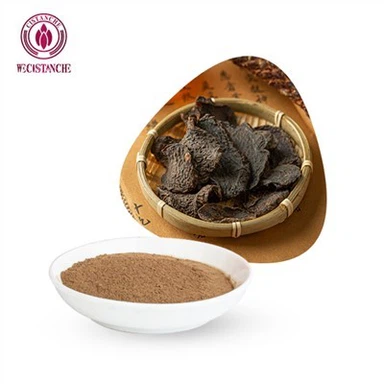
Cistanche tubulosa extract
Click here to view Cistanche Tubulosa Extract Natural Supplement Powder
【Ask for more】 Email:cindy.xue@wecistanche.com / WhatsApp: 0086 18599088692 / WeChat: 18599088692
3. Process chain: chemical restructuring behind a powder
A typical tubular-PhG line: coarse powder → 50%–70% ethanol reflux/ultrasound → concentrate → XAD macroporous resin → water wash (sugars/salts out) → 50% ethanol elution of PhGs → secondary polish → spray dry. Three irreversible changes follow.
First, heat and oxidation: echinacosides tolerate mild conditions but degrade under strong acid/base; spray drying retains most glycosides yet trims some labile phenolic acids.
Second, fraction reshuffle: resin binds echinacoside more strongly than acteoside, so elution changes their ratio versus nature.
Third, matrix loss: cell-wall slow-release and gut-fermentation of polysaccharides weaken; the extract now depends on capsule/tablet/liquid formulation to rebuild a release curve. That is why "higher extract content" does not automatically beat "one bowl of decoction" - the path differs.

Cistanche tubulosa experiment
4. Quality logic: macroscopic identity vs component quantification
Raw herb hangs on pharmacopoeia piece standards: morphology (flat-cylinder or spindle, imbricate scales, wavy vascular dots), moisture ≤10%, total ash ≤8%, ethanol-soluble extractive ≥35% (desert) or ≥25% (tubular), PhG floor 0.3%/1.5%. Veteran inspectors add: thick body, moist-soft texture, dense scales, sweet-bitter taste.
Extract quality rides enterprise specs and customer COA: total PhGs by HPLC, single-glycoside levels, heavy metals (Pb ≤5 ppm, As ≤3 ppm common), pesticide residues, microbes (TVB ≤1000 cfu/g), particle size, solubility, solvent residue. It answers "is this batch the same potency as last batch," not "does it look like Cistanche."
5. Efficacy expression: decoction holism vs formulation targeting
TCM uses raw herb as sweet-salty-warm, entering kidney and large intestine, "tonifying without harshness, warming without dryness." A 10 g slice decoction delivers PhGs, polysaccharides, betaine, and oligosaccharides together - polysaccharides moisten the bowel, glycosides act on oxidation/stress/neural protection, betaine supports liver - producing the combined "kidney-yang + essence-blood + laxative" output suited to yang-deficiency constipation, sore waist, elderly essence depletion.
Extracts feed modern products: anti-fatigue capsules, memory-support tablets, perimenopausal complexes, cosmetic serums (echinacoside scavenges radicals, inhibits photo-aging). Batch-stable dosing lets preclinical studies set ED50 on the extract. Yet single high-purity PhG fractions do not automatically outperform the crude decoction - evidence suggests PhGs synergize with polysaccharides and iridoids; over-purification may shed the "whole-herb effect."

cistanche supplement near me
6. Scene split: who takes which
Daily food therapy: desert Cistanche sliced into lamb stew, yellow wine, or goji-date tea - medicine-food compliant, choose raw herb.
TCM prescription: formula compatibility and processing (wine-fried Cistanche reduces greasiness) require decoction pieces; extract cannot substitute in boiling.
Health-product mass production: tablets/capsules must state mg PhGs per unit, so standardized extract is mandatory; tubular-source PhGs cannot enter ordinary food; only desert source may serve beverages.
Cosmetics/research: antioxidant or neuroprotection work uses 50%+ pure powder; raw herb cannot be emulsified.
Daodi collecting: whole Alashan sweet Da-yun or Hotan tubular sticks, judged by shape, smell, scales - a different value system.

cistanche supplement near me
7. Four myths
"80% total PhGs = 80× the raw herb's effect" - no. Chemical multiple is not physiological multiple; synergy loss offsets gain.
"Extract is always cleaner" - not necessarily; cheap water-extracted crude powder can fail ash, pesticide, or solvent tests worse than licensed pieces.
"Tubular is better than desert" - only if PhGs alone matter; for moistening intestine and food use, desert wins; imperial-era tributes were mostly Hexi desert type.
"Bitter powder means potent" - bitterness tracks tubular texture and process, correlates with but does not prove PhGs; trust HPLC.