Comparison Of The Control Effects Of Rhizosphere Soil Bacteria On Soil Borne Diseases Of Cistanche Deserticola
May 26, 2023
Abstract: To screen for rhizosphere bacteria that have control effects on soil-borne diseases of Cistanche deserticola, different planting years of Cistanche deserticola under broad-leaved forests in Tonghua County were used Using the rhizosphere soil of Cistanche deserticola as the material, bacteria were isolated using the gradient dilution method, and antagonistic bacteria were screened using the plate confrontation method. The results indicate that from the rhizosphere of Cistanche deserticola 37 bacterial strains were isolated from the soil, and 8 strains had inhibitory effects on Cistanche deserticola wilt disease. Among them, strains coded 5-2, 11-6, and 11-7 exhibited antibacterial activity The effect is most significant. 9 strains have inhibitory effects on the stem blight of Cistanche deserticola, and compared to CK, the inhibitory effects of two bacterial strains 15-6 and 11-1 at 0.01 level There is a highly significant difference in bacterial diameter, with three bacterial strains, 11-1, 15-6, and 15-5, showing significant differences at the 0.05 level. 9 strains It has a certain inhibitory effect on the root rot of Cistanche deserticola, but none of them are significant, with strains 11-7 having the largest antibacterial diameter. Bacteria 5-2, 11-1, 11-7Strains 15-5 and 15-6 can be further identified and further studied.

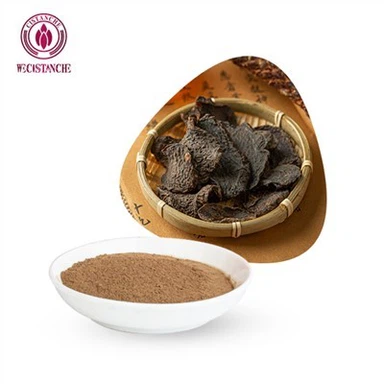
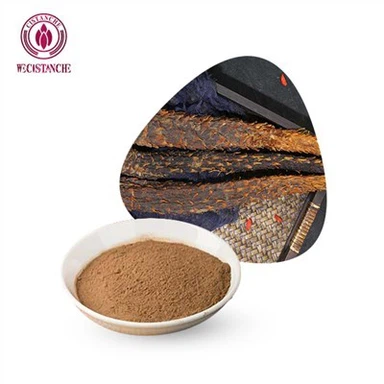
Cistanche deserticola
Click here to view Cistanche deserticola tea products
【Ask for more】 Email:cindy.xue@wecistanche.com / Whats App: 0086 18599088692 / Wechat: 18599088692
Keywords: Cistanche deserticola; Broad-leaved forest; Biological control; Plate confrontation method
Cistanche deserticola [1] is mainly cultivated in the Changbai Mountains region and is the main production area of Cistanche deserticola in China, accounting for 85% of the country's production and 52% of the world's production. Cistanche deserticola contains various bioactive components such as saponins and polysaccharides, which have been studied and have certain effects in fields such as anti-tumor, immunology, and nutrition. The quality and yield of Cistanche deserticola are limited by the soil-borne diseases of Cistanche deserticola [3], which means that pathogens in the soil can damage the roots and stems of crops and cause diseases. The soil-borne diseases of Cistanche deserticola include root rot, gray mold, stem rot, wilt, and sudden death. Cistanche wilt disease is caused by Fusarium oxysporum, which can cause disease spots on the stems and leaves, ultimately leading to the lodging and death of Cistanche. The pathogenic bacteria of Cistanche deserticola wilt disease are mostly Rhizoctonia solani [6]. The infected site produces disease spots, spreads to the surrounding area, and ultimately the entire plant will wither and die. The root rot disease of Cistanche deserticola is caused by Fusarium oxysporum [7], which can produce a large number of spores for diffusion and proliferation, leading to pathological changes in the roots of Cistanche deserticola, inability to absorb nutrients from the soil normally, and ultimately, the root of Cistanche deserticola rots and dies.

Cistanche deserticola florescence
The use of microorganisms for disease prevention and control is a green and pollution-free effective means of biological control. Although chemical control has significant effects and rapid effects, and can effectively control diseases in the short term, its harm to the environment and soil is often irreversible. This study aims to screen rhizosphere bacteria of Cistanche deserticola that have antibacterial effects on soil-borne diseases and provide a reference basis for the production of microbial agents.
1 Material and Methods
1.1 Materials
In July 2020, conventional methods were used to collect soil samples from the Cistanche deserticola base under the broad-leaved forest in Shihu Township, Tonghua County, with planting years of 2, 5, 8, 11, and 15 years, as well as soil from areas without planting Cistanche deserticola. The samples were refrigerated at 4 ℃ in the laboratory and numbered for future use. Use PDA medium to cultivate fungi, and beef extract peptone medium to cultivate bacteria.
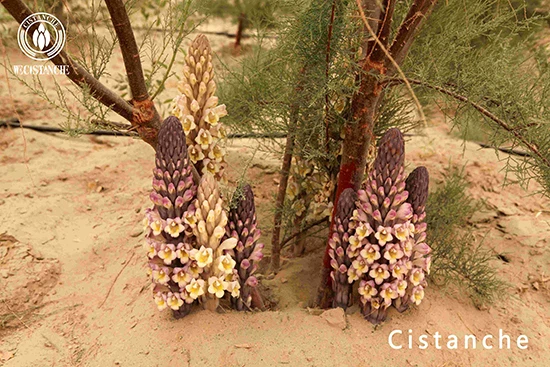
Desert living cistanche
Three pathogenic bacteria, Fusarium sp., Rhizoc tonia solani, and Fusarium solani, were all provided by the Microbiology Laboratory of Tonghua Normal University.
1.2 Experimental Methods
The gradient dilution method was used to isolate microbial strains in the rhizosphere soil of Cistanche deserticola [10], and the plate confrontation method was used to screen rhizosphere bacteria with antagonistic effects. Firstly, activate three types of pathogenic bacteria in the PDA medium [11], and then make a bacterial cake with the colony facing downwards. Inoculate it to the center of the PDA medium, and use an inoculation ring to inoculate rhizosphere bacteria to a distance of 23mm from the edge of the dish, with no bacteria inoculated as a blank control. Perform 3 replicates for each treatment, incubate at 30 ℃ for 4-7 days, observe for the presence of antibacterial circles [12], and measure the antibacterial diameter.
The data were analyzed using Excel 2016 software for data statistics and DPS software for data analysis.
2 Results and Analysis
Isolation and purification of bacteria in the rhizosphere soil of Panax ginseng under broad-leaved forests
37 bacterial strains were isolated from ginseng soil under broad-leaved forests and ginseng rhizosphere soil of different planting years, as shown in Table 1.
Table 1 Number and numbering of bacteria isolated from ginseng rhizosphere soil
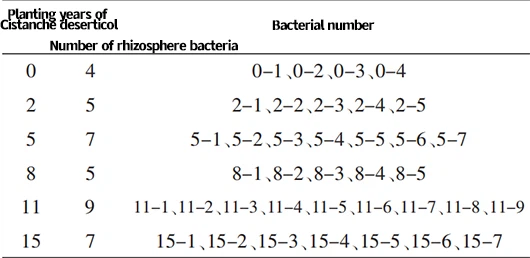
Note: In the table, the planting age of Cistanche deserticola is 0, which refers to the soil in the area where Cistanche deserticola is not planted. The first digit represents the planting age of Cistanche deserticola, and the last digit represents the strain number
2.2 Screening of biocontrol bacteria in the rhizosphere soil of Cistanche deserticola under broad-leaved forests
Through experiments, 8 strains of bacteria with antagonistic effects on Cistanche wilt disease were preliminarily screened, 9 strains of bacteria with antagonistic effects on Cistanche wilt disease, and 10 strains of bacteria with antagonistic effects on ginseng root rot disease.
2.2.1 Antagonistic effect of biocontrol bacteria on Cistanche wilt disease
Among the 37 strains of bacteria isolated from the rhizosphere soil of Cistanche deserticola, 8 strains had inhibitory effects on the Fusarium oxysporum, while 29 strains had no inhibitory effect. According to the flat panel confrontation experiment, the diameter of the inhibitory zone of each antibacterial bacterium against the pathogen of Cistanche deserticola wilt disease was measured [13]. The three repeated experimental data were entered into Excel, and the difference significance analysis was performed on the data using DPS software. The results are shown in Table 2.
Table 2 Determination of the control effect of different antibacterial bacteria on Cistanche deserticola wilt disease

The analysis results showed that only the inhibition diameters of 11-7 were significantly different from the control, while the inhibition diameters of 5-2, 11-6, and 11-7 were significantly different from the control. Among the treatments, there was no difference at the 0.01 level. At the 0.05 level, there was a significant difference between bacteria 11-7 and 11-1, 15-5, and 15-6, while there was no significant difference between bacteria 11-7 and 5-2, 11-4, 11-5, and 11-6. Bacteria 5-2, 11-6, and 11-7 can be considered for further research on their antibacterial effects in the field.
2.2.2 Antagonistic effect of biocontrol bacteria on stem blight of Cistanche deserticola
Out of 37 bacterial strains isolated from the rhizosphere of Cistanche deserticola soil, 9 strains had inhibitory effects on the Fusarium oxysporum, while 28 strains had no inhibitory effect. The statistical analysis results are shown in Table 3.
Table 3 Determination of the Control Effect of Different Antibacterial Bacteria on Cistanche deserticola Wilt Disease
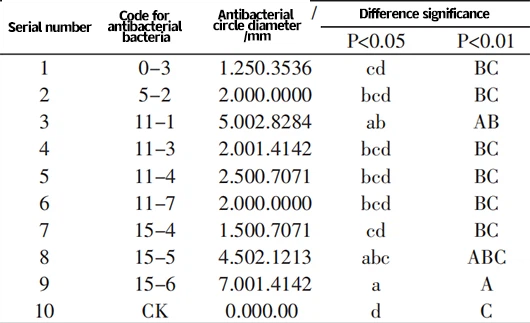
From the analysis results in Table 3, it can be seen that compared to CK, there is a very significant difference in the antibacterial diameter of the two bacterial strains 15-6 and 11-1 at the 0.01 level, and at the 0.05 level, there is a very significant difference in the antibacterial diameter of the three bacterial strains 15-6, 11-1, and 15-5. There was no significant difference between other factors and CK. There was no significant difference in the antibacterial diameter between the three bacterial strains of 11-1, 15-5, and 15-6 among different treatments. There was a significant difference in the antibacterial diameter between 15-6 and other bacteria, and there was no significant difference between 5-2, 11-1, 11-3, 11-4, 11-7, and 15-5, but it was significant compared to 0-3 and 15-4. 15-6, 11-4, and 15-5 have the best bacterial control effects and can be further tested for their effectiveness.
2.2.3 Antagonistic effect of biocontrol bacteria on root rot of Cistanche deserticola
Table 4 Determination of the control effect of different antibacterial bacteria on the root rot of Cistanche deserticola
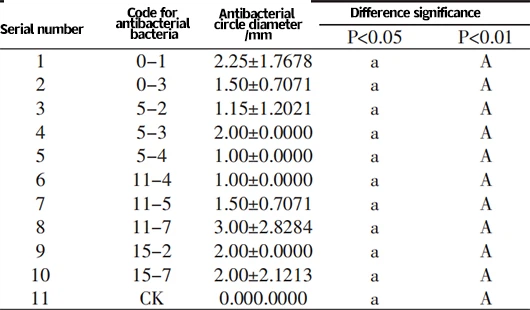
The results in Table 4 indicate that bacteria 11-7 have a certain inhibitory effect on ginseng wilt, but the effect is not significant. These 10 groups of bacteria have no significant inhibitory effect on pathogenic bacteria compared to the control group.
3 Summary and Discussion
In this experiment, a total of 37 bacterial strains were isolated from the rhizosphere soil of ginseng planted for 2, 5, 8, 11, and 15 years without ginseng under broad-leaved forests. Eight strains of bacteria with inhibitory effects on ginseng wilt disease were screened out, with strains 5-2, 11-6, and 11-7 having the most significant antibacterial effects. Nine strains have inhibitory effects on ginseng wilt disease. Compared to CK, there is a very significant difference in the antibacterial diameter of two bacterial strains, 15-6 and 11-1, at the 0.01 level. At the 0.05 level, there is a very significant difference in the antibacterial diameter of three bacterial strains, 11-1, 15-6, and 15-5. 9 strains have certain inhibitory effects on ginseng root rot, but none of them are significant, with strains 11-7 having the largest inhibitory diameter.
Superman herbs cistanche
Among them, bacterial strains 5-2, 11-1, 11-7, 15-5, and 15-6 can be used as excellent antibacterial bacteria for cultivation and propagation, further studying their antibacterial effects in the field. The inhibitory effect on other pathogenic bacteria of ginseng diseases needs further exploration.

Desert ginseng
The use of microorganisms to control plant disease has little impact on the environment and human beings, which reflects the concept of sustainable development [14], and has broad prospects for development. Putting biological agents into production and popularization will also improve people's awareness of environmental protection. The use of bacteriostatic agents suitable for the field will bring long-term benefits and sustainable ecological benefits.
reference
[1] Chen Hongyu, Cao Yang, Yang Huaping. Analysis of the Application Value of Lin Xiashan's Participation in Cultivating Ginseng [J]. Introduction to Traditional Chinese Medicine, 2019,25 (06): 67-68+81
[2] Zhang Lianxue, Chen Changbao, Wang Yingping, et al. Research on continuous cropping of ginseng and its solutions [J] Journal of Jilin Agricultural University, 2008,30 (4): 481-485491
[3] Park Jingpei, Dai Yueqiang, Zhou Xiaomei. Research progress in biological control of ginseng diseases [J]. Journal of Jilin Normal University (Natural Science Edition), 2021,42 (04): 103-107
[4] Preliminary Study on the Screening, Identification, and Antibacterial Efficacy Evaluation of 7 Antibacterial Strains of Ginseng Diseases by Shao Tianwei [D]. Beijing Union Medical College, 2017
[5] Deng Fang. Research on Ginseng Wilt Disease [J]. Journal of Plant Pathology, 1989, (02): 122
[6] Gao Wei. Comprehensive Prevention and Control Techniques for Ginseng Wilt Disease [J]. Friends of Farmers' Wealth, 2018, (19): 29
[7] Chen Dede. Analysis of Pathogens of Ginseng Root Rot and Rust Rot and Screening and Identification of Antagonists [D]. Jilin Agricultural University, 2019
[8] Li Haoyu. Isolation and identification of antagonistic microorganisms in potato rhizosphere soil and preliminary study on their antibacterial effects [D]. Inner Mongolia Agricultural University, 2020
[9] Shao Tianwei, Ding Wanlong, Li Yong. Screening and identification of antagonistic strains of ginseng pathogenic bacteria [J]. Modern Chinese Medicine, 2017,19 (05): 693-697
[10] Zhang Jiejing, Chen Dede, Gao Jixuan, et al. Screening and identification of antibacterial bacteria against ginseng rust rot disease and their impact on microbial diversity in rhizosphere soil [J]. Journal of Jilin Agricultural University, 2020,42 (05): 526-532
[11] Sun Wei. Method for Bacterial Activation [J]. Food Safety Guide, 2020, (35): 78
[12] Jiang Zhu. Biological control of soil borne fungal diseases in ginseng [D]. Heilongjiang University, 2010
[13] Wei Chuanhao, Wang Meiqin. The inhibitory effect of antibacterial bacterium GHt-q6 on cucumber wilt pathogen [J]. Shanxi Agricultural Science, 2021,49 (04): 494-498
[14] Song Jinqiu, Tian Canxi. Biological control of plant endophytes in plant disease [J]. Hubei Agricultural Mechanization, 2020, (04): 69-70