Current Situation, Popularization, And Application Of Planting Techniques Of Cistanche Deserticola in Xinjiang
Mar 13, 2023
Xinjiang Forestry Technology Extension Station Palhati Wutuk
Diriber Wutuk, Xinjiang Agricultural University
Dilimulati, Bazhou Environmental Protection Bureau
Cistanche deserticola ma has a high medicinal value and a wide range of uses. In recent years, new uses have been found, making the demand for drugs rise year after year and the price increase several times. The autonomous region listed the Cistanche deserticola planting technology demonstration project in the plan, and determined Qitai County and Minfeng County as the demonstration sites, to conduct an in-depth analysis of the current situation of the promotion and application of Cistanche deserticola technology in Xinjiang, and seek scientific ways of production and development.

Desert cistanche deserticola

Cistanche tubulosa
1. Analysis of the distribution of cistanche deserticola resources and the current situation of planting technology promotion
There are more than 20 species of the genus Cistanche (Brassica deserticola), of which two have become commercial medicinal materials: one is desert Cistanche deserticola (Haloxylon ammo dendron), whose main production areas are Alxa Banner in Inner Mongolia and Gurbantunggut Desert in Xinjiang. Xinjiang's "Research on the Artificial Cultivation Technology of Cistanche deserticola" passed the appraisal of the Science and Technology Department of the Autonomous Region in October 2001, and the achievements reached the domestic advanced level. The other is Cistanche deserticola, which is mainly produced in southern Xinjiang. In 1989, researcher Li Jiazheng of the Xinjiang Institute of Traditional Chinese Medicine for Nationalities and researcher Liu Mingting of the Xinjiang Institute of Desert Soil Biology of the Chinese Academy of Sciences experimented with artificial propagation of Cistanche deserticola, which was successful. In 1992, the Science and Technology Commission of the Xinjiang Autonomous Region organized relevant departments, experts, and scholars to carry out the project acceptance, and won the gold medal at the National Spark Program Exhibition in June of that year, This achievement is in the international leading level, which has not been achieved by other countries. Xinjiang is one of the regions with the largest species, the richest resources, the largest reserves, and the largest output and acquisition of Cistanche deserticola in the world. Southern Xinjiang is dominated by Cistanche deserticola, northern Xinjiang is dominated by Cistanche deserticola, followed by Cistanche salina, and Cistanche tubulicola is the main source plant of Chinese traditional medicine Cistanche deserticola, with a distribution ratio of 2:1 in the northern and southern Xinjiang. In recent years, with the continuous expansion of the planting area of Cistanche deserticola, there is a lack of unified planning for the promotion of Cistanche deserticola planting technology; The planting mode technology is not standardized, and the timely, appropriate, and appropriate variety inoculation technology is not well mastered; The source of artificial drugs has not been established, there are few pollution-free green products, lack of long-term resource utilization mechanism, lack of brand and international competitiveness. The planting scale and yield of Cistanche deserticola are far from meeting the market demand. Therefore, the promotion and application of Cistanche deserticola planting technology has practical significance for the adjustment of rural industrial structure, agricultural efficiency, and farmers' income, and has important ecological, economic, and scientific research values.

Cistanche deserticola - a bumper harvest for farmers
2. Popularization and application of planting technology of Cistanche deserticola in Xinjiang
2.1 Standardized planting technology of Cistanche deserticola
To meet the requirements of the international and domestic product markets for the safety, effectiveness, and stability of Cistanche deserticola drug quality, the quality of its raw material Cistanche deserticola must be guaranteed first. Therefore, the cultivation of domestic Cistanche deserticola and the collection technology of wild Cistanche deserticola must follow the standardized operating procedures (SOP, Standard Operational Practices), The cultivation and collection of Cistanche deserticola must have GAP certification (Good Agricultural Practices) and the drug manufacturing must have GMP certification (Good Made Practices). Only in this way can the quality of Cistanche deserticola be stable and effective, can it be used by large pharmaceutical companies, and can it further expand the international market. Xinjiang is also starting to run the promotion and application of GAP project technology. For example, Hotan Dichen Sasheng Pharmaceutical Development Co., Ltd. has established 333.33hm2 in Sawzek Township, Minfeng County, which has increased the market competitiveness of the products in and outside the region and at home and abroad. The planting base implements quality monitoring throughout the process according to the requirements of GAP to ensure the authenticity and quality of the medicinal materials and establish its brand for the medicinal materials to enter the international market. Gradually make the standardized production of plant raw materials a necessary condition for the preparation of high-quality products and the conscious behavior of producers. The current development trend is to gradually use advanced biotechnology such as bioengineering, cell culture, and fermentation to gradually replace traditional planting, harvesting, and processing methods and open up new ideas for the modernization research and promotion of Cistanche deserticola.
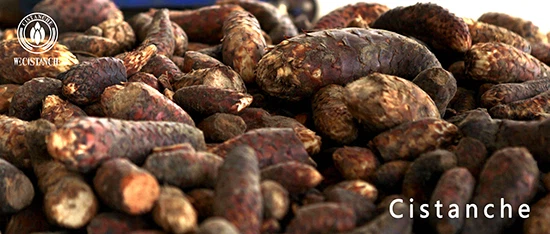
Desert living cistanche
2.2 Planting technology of non-polluting and green cistanche deserticola
When planting cistanche deserticola, it is necessary to use more decayed farmyard manure, control the use of chemical fertilizers, pesticides, and herbicides, and generally not use pesticides and herbicides. When it is really necessary to use it, try to choose low residual or biological pesticides or herbicides. Pay attention to the selection of planting environment and avoid polluted areas. During the processing and storage of Cistanche deserticola, sulfur, and toxic pesticide fumigation shall be avoided. Pay attention to protecting the natural cistanche resources and prevent the introduction of pollution sources. The content of heavy metals and pesticide residues in compliance with the standards are the necessary conditions for Chinese herb cistanche to enter the international market smoothly. Countries and regions such as South Korea, Japan, Southeast Asia, the United States, and Europe have strict restrictions in this regard.

Click here to view Cistanche deserticola products
【Ask for more】 Email: xue122522@foxmail.com / Whats App: 0086 18599088692 / Wechat: 18599088692
2.3 Artificial inoculation technology
2.3.1 Intensive field production
The core of this technology is to establish the parasitic seed source of wild cistanche deserticola by artificial inoculation, establish the seed collection garden of cistanche deserticola by artificial inoculation, and use biotechnology to prepare the seed guide agent of cistanche deserticola with the same species as the host, so as to improve the inoculation rate, reduce the number of seeds, and achieve the goal of increasing the yield per unit area and establishing the artificial drug source under the conditions of artificial inoculation. For example, on the basis of mastering the species, fruiting habits, flower color, seed maturity time, harvest and storage methods, and artificial inoculation of wild and domestic Cistanche deserticola, Minfeng County has adopted a wide and narrow row model, with a row spacing of (3+1) × 1m and (3+1) × 0.8m, 330 to 410 salix trees per 667 square meters were planted, and good results were achieved by using seed paper method and sowing method.
2.3.2 Inoculation on adult host
This technology is mainly to collect wild and domestic seeds of Cistanche deserticola and inoculate them on 2-3-year-old hosts in autumn and winter by seed paper method and sowing method. For example, Haloxylon ammo dendron (planted in March 2001, with a spacing of 1 × 3 m) The root is inoculated with Cistanche deserticola, with a demonstration area of 3 hm2. Because cistanche deserticola has low requirements on soil and water, it does not occupy arable land but also can restore desert vegetation. Artificial planting of cistanche deserticola does not need to compete with agriculture and animal husbandry for water and labor, which is conducive to promoting and developing the economy of the sand area, increasing income, and improving the environmental protection awareness of farmers and herdsmen.
2.4 Overall planning and reasonable layout
According to the different characteristics of the region, climate, soil, and technical promotion of Cistanche deserticola in the north and south of Xinjiang, the protection, restoration, and expansion of artificial planting of wild drug source areas should be combined, and a reasonable layout should be made. The demonstration should be taken as a guide, and the combination of points and areas should be gradually promoted. Northern Xinjiang can be divided into a gray-brown desert soil non-irrigated and snow-fallen Cistanche deserticola deserticola planting area along the southern edge of the Junggar Basin, namely, Mulei, Jimsar, Qitai County, and Wusu City, Focusing on the promotion of artificial inoculation technology of desert, saliferous deserticola, etc. and the promotion of supporting technologies of Haloxylon ammo dendron and alkaline boron cultivation, we summarized the experience of "inoculation technology of artificial deserticola", further explored the techniques and methods to improve the survival rate of the inoculation of deserticola, and formulated the technical specifications for the inoculation of deserticola. Seven counties and one city in the Hotan region on the southern edge of the Taklimakan Desert in the south of Xinjiang, and Yecheng, Zepu, and other counties in the Kashgar region are divided into the planting area of cistanche deserticola in the brown desert soil with irrigation and without snowfall, and the cultivation technology of cistanche deserticola and Tamarix is promoted. For example, the Hotan region plans to build a windbreak and sand-fixation forest with red willow as the main afforestation species in the west to Minfeng County and the east to Pishan County along the front desert area of the Taklimakan Desert oasis, The cultivation and product development of Cistanche deserticola will be supported and developed on a large scale as an emerging industry in the next 3-5 years. The main points are as follows: ① The existing area of natural red willow in the whole region is 150000 hm2, and it is strictly forbidden to collect and excavate the cistanche deserticola without permission to provide seed sources for artificial planting. ② The artificial red willow is planted in the whole region at an average annual rate of 13300 hm2. Yutian County should achieve the target of 10000 hm2 per year, and strive to plant more than 0.67 million hm2 of artificial red willow in the Hotan area in the near future, with an inoculation area of more than 2000 hm2 of big cloud and an annual output of 3000 tons of cistanche deserticola (dry products). Among them, the planting area of red willow in Yutian County is more than 33300 hm2, and the planting area of artificial barley is more than 1000 hm2. The annual output of dried barley in Yutian County is 2000 tons. In 2010, the annual output of Dayun dried products was 8000 tons, and Yutian County achieved the target of 5000 tons of Dayun dried products.

Cistanche deserticola - a bumper harvest for farmers
3. Protection technology of extremely degraded drug source
3.1 Enclose and protect by fencing to make it recover naturally
Strictly implement the measures of cutting ban by cutting and rotation in the drug source areas that still have the production capacity of Cistanche deserticola, that is, set aside a certain area every year to prohibit the collection of drugs. In such a year, the cistanche deserticola in these areas can be naturally renewed and grow normally, maintain the normal replenishment mechanism of the seed bank, ensure the normal existence of the species, and maintain the needs of the medicinal supply market for a certain period of time.
3.2 Artificial assistance, the introduction of seed sources
The sporadic plants of Cistanche deserticola should be regarded as a glimmer of hope for the reconstruction of the distribution area. They should be fully protected to make them bloom and bear fruit and naturally spread seeds, providing the last chance for the sustainable existence of this species. For severely degraded areas and newly built vegetation areas, the introduction of Cistanche deserticola provenance will increase the amount of desert vegetation and drug sources at the same time. The latter should be the main form to ensure the sustainable use of drugs.
3.3 Establish and improve the nature reserve dominated by Cistanche deserticola
For the key protected species of Cistanche deserticola, appropriate protection areas should be established throughout the region to ensure that the wild resources are not destroyed. For areas outside the reserve, the collection of wild and precious Chinese medicinal materials should also be carried out in a planned and scientific way according to their regeneration capacity. The relevant departments in the region can take the method of issuing collection certificates to conduct fixed and quantitative collection to ensure the sustainable use of the resources. For example, to establish the natural reserves of Haloxylon ammo dendron, Haloxylon ammo dendron, Cynanchum, etc., which grow naturally around the Junggar Basin, and the natural reserves of Cistanche and its host in southern Xinjiang, to protect the endangered species of Cistanche deserticola with laws and systems, and to expand the drug source area in combination with the restoration and protection of desert vegetation.
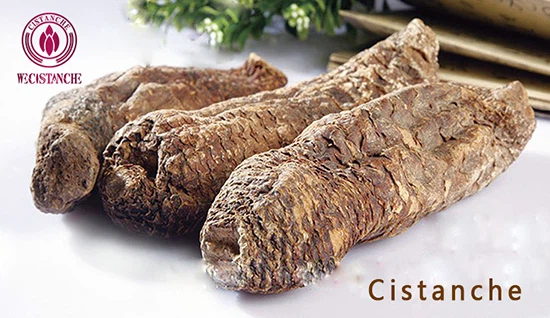
Superman herbs cistanche
With the continuous deepening of research, more and more people find that Cistanche deserticola has high medicinal value in addition to traditional medicinal parts. If comprehensive development and utilization are carried out, the economic value of the product can be greatly improved. The comprehensive development and utilization of Cistanche deserticola will develop in the direction of breadth, depth, and diversification.
【Ask for more】 Email: xue122522@foxmail.com / Whats App: 0086 18599088692 / Wechat: 18599088692