Effects Of Cistanche Deserticola Extract On Penis Erectile Response in Castrated Rats
Jun 22, 2022
Abstract: Cistanche deserticola (CD) has been considered as a tonic agent on reproductive function for thousands of years. The effects of CD extract on penis erectile response were investigated in present study. After castration surgery, rats were treated intragastrically with CD extract (0.45, 0.90 and 1.8 g/kg) daily for four weeks. Penis erectile response was measured and the serum hormones were assayed at the end of the experiment. It was evaluated that the erectile latency became longer and the erectile duration shorter significantly in castrated rats compared to sham-operated controls. However, CD extract shortened the erectile latency and prolonged the erectile duration to minimize the negative effects of castration. At the dosage of 0.9g/kg, CD extract regulated the serum luteinizing hormone concentration approach to normal level in castrated rats. These findings indicated that CD facilitated the penis erectile response and modulated the serum hormone level to some extent.
Keywords: Cistanche deserticola; erectile response; castration; hormone

For more details about cistanche improve sexual function
INTRODUCTION
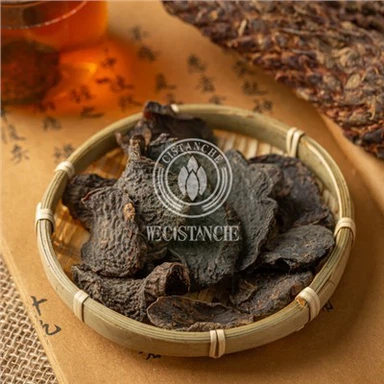
Cistanche Hoffmg. Et Link, one of the genera of the Orobanchaceae family, is mainly distributed in the arid lands and deserts in the northern hemisphere, such as Inner Mongolia, Xinjiang, Ningxia autonomous regions of China, and Iran, India, Mongolia, etc. The Cistanche species belong to the perennial parasite herbs, which commonly attach onto the roots of sand-fixing plants like Haloxylox ammodendron, H. persicum, Kalidium foliatum and Tamarix plants, etc. (Jiang and Tu 2009). Herba Cistanche, the stem of Cistanche species, has been considered as a superior tonic and earned the honor of “Ginseng of the deserts”. Among Cistanche species, Cistanche deserticola Y. C. MA has been indicated as the primary source material of Cistanche (Stefanova et al. 2011). However, due to over-harvesting in recent years, the natural resources of the wild C. deserticola (CD) is deficient which has been collected as one of the Class II plants needing protection in China, thus other species of this genus, such as C. salsa and C. sinensis, are also used as substitutes in some areas. From first recorded in Shen Nong’s Chinese Material Medica (an ancient pharmacological compendium), CD has been thought to tonify the kidney and invigorate the “Yang” in clinical practice under traditional Chinese medicine theory, which is alleged to be effective for reproduction, development and fertility function. Meanwhile, CD has also been boiled with mutton, potato or rice to produce a tonic food to treat overstrain-induced impairment for hundreds of years, suggesting that it is safe to take orally (Xiong et al. 2013). However, these anecdotal uses mainly exist in Chinese incunabula, with limited scientific information discussed in terms of modern pharmacological concepts. Erectile dysfunction (ED) is a condition characterized by either inadequate erection of the penis or erection that does not last sufficiently long in adult males (Cohan and Korenman 2000). In response to modern, sophisticated, chemical agents, there has been a renewed interest to search effective and safe medication from plants for the treatment of ED (Adimoelja 2000). A previous study (Liu et al. 2009) indicated that CD electuary accelerated the penis erection in normal rats, however, there were no data involved in the effect of CD on erectile dysfunction. In animal, surgical castration with bilateral orchiectomy has been regarded as the standard of castration for investigating ED (Tombal 2005). Therefore, the present study was undertaken to evaluate the potential effects of CD against ED by investigating the erectile latency and duration in castrated rats.
MATERIALS AND METHODS
Chemicals and materials Echinacoside (purity >98%) and acteoside (purity >98%) were purchased from the National Institutes for Food and Drug Control (Beijing, China). HPLC grade methanol was purchased from Sigma-Aldrich (St. Louis, MO, USA). Purified water was produced using a Millipore Milli-Q Integral 3 System and Q-POD Milli-Q System (Bedford, MA, USA). The stems of C. deserticola were purchased from Shenzhen GURU Biology Co., Ltd (GuangDong, China) and ground into fine powder with a pulverizer passed through a 60mesh sieve. HPLC analysis and plant material preparation Echinacoside and acteoside contents of CD powder were determined following our previous method (Zhao et al. 2011). Then, every 100 g dried powder was boiled in 1.5 L water for 1.5 h. Cooling down at room temperature, the mixed liquor was centrifuged at 2000 rpm for 10 min (Eppendorf 5810R, Germany) and the precipitate was reextracted twice under the same condition. The combined supernatants were concentrated by a vacuum rotary evaporator (Heidolph laborota 4001-efficient, Germany) at 60°C, and then lyophilized and yielded about 42% dried extract powder. When conducting the subsequent animal experiment, the dried extract was dissolved in purified water at room temperature.

Experimental animals
Adult male Sprague-Dawley rats (200-220g) were obtained from Medicine Experimental Animal
Center of Guangdong Province (Guangzhou, PR China), maintained in temperature-controlled quarters with 12-hr light/dark cycles at room temperature (22-24°C) and constant humidity (40-70%) in SPF (specific pathogen-free) laboratory and fed ad libitum. The experimental procedures were in compliance with the National Institutes of Health Guide for Care and Use of Laboratory Animals. Experimental procedure
One week before administration, fifty male SD rats were anesthetized with sodium pentobarbital intraperitoneally (40 mg/kg) (Jung et al. 1999) and randomly allocated to five groups: except rats in the sham-operated group (Sham), the rest were bilaterally castrated via the scrotal approach (Anderes 2003, Schlatt et al. 2002). Meanwhile, the CDtreated groups were administered intragastrically with 0.45g/kg (low dose of CD extract, LCD +Cas), 0.9g/kg (median dose of CD extract, MCD +Cas) and 1.8g/kg (high dose of CD extract, HCD +Cas) CD extract, respectively, while the sham and castrated groups were administered with the corresponding amount of water only. Body weight measurement was taken at the beginning of the procedure and then every week. All rats underwent laparotomy immediately after death for removal and posterior weighing of the following organs: preputial glands, seminal vesicle, prostate gland and levator ani muscle.
Penis erectile response measurement
Erectile function of rats in each group was assessed following the previous methods (Ji et al. 2009, Luo et al. 2006). Briefly, a stainless-steel bipolar electrode (BL420F Data Acquisition & Analysis System, Tme Technology Co., Ltd, Chengdu, P. R. China) was carefully positioned on the penis until it was erected with the pulse of the electric stimulation (5 V) 0.2 s. Time from stimulation to erection was recorded as the penis erectile latency. When the penis erectile response was observed, the electrode could be withdrawn from the penis, and the time length the penis kept erection was recorded as the erectile duration.
Blood sampling and serum hormone analysis
Rats were anesthetized with sodium pentobarbital intraperitoneally (40mg/kg) (Jung et al. 1999).
Blood samples were drawn and clotted at 4°C for 4h, from which the serum was collected by centrifugation at 4000 rpm for 5 min at 4°C (Eppendorf 5810 R, Germany) and immediately stored at -20°C freezer until further analysis. Total LH and FSH levels were measured using commercial radioimmunoassay (RIA) kits (Beijing North Institute of Biological Technology, Beijing, China) referring to the manufacturer’s instructions (Matsumoto et al. 1986). Based on the competitive radioactive immune technique, I125-labeled LH (or FSH) was used in the assay. Briefly, 100µl I125-labeled LH (or FSH) agent was added to a 100µl serum sample and incubated with 100µl purified rabbit antibody at 4°C (or 37°C) overnight. Then, a donkey-anti-rabbit immune separating agent was added into the antigen-antibody complex and centrifuged (3500 rpm, 15 min) to separate free and antibody-bound 125I- LH (or FSH). Afterward, the radioactivity of the precipitate was measured at radio immune assay γ counter (DMF-96, Zhongcheng electrical technology development Co., Ltd., Hefei, China). The sensitivity limits of the LH and FSH assay were both 1.0mIU/ml.

STATISTICAL ANALYSIS
Data analysis was performed using SPSS version 16.0 software.
Values were expressed as mean ± standard deviation (SD). Parametric data was analyzed using analyses one-way analysis of variance (ANOVA) followed by post hoc LSD tests. Nonparametric data were analyzed by the Kruskal-Wallis test. Differences were considered statistically significant if the probability for deviation was less than 0.05.
RESULTS
Quantitative determination of echinacoside and acetonide contents of CD powder
The contents of echinacoside and acetonide in CD powder were 1.27±0.01% and 0.52±0.003%, which conformed to the requirement of Chinese Pharmacopoeia. The HPLC chromatogram of CD powder was shown in fig. 1.

(4.6mm×250 mm, 5 µm, Waters, Milford, MA, USA); mobile phase: 0.5% (V/V) acetic acid aqueous solution (A) and methanol (B) ingradient (0min, A: B=25:75; 10- 30 min, A: B=40: 60; 30 min, A: B=0: 100); flow rate: 1ml/min; detective wavelength: 330 nm; temperature: 30.

Fig. 2: Penis erectile latency and duration in castrated rats. Data are expressed as the mean ± SD (n=10). ##p<0.01 relative to sham-operated group, **p<0.01 relative to castrated group. Abbreviation (below): Sham, sham-operated group; Cas, castration control group; LCD +Cas (0.45g/kg), MCD +Cas (0.9g/kg) and HCD +Cas (1.8g/kg), three groups of CD extract treated in castrated rats.
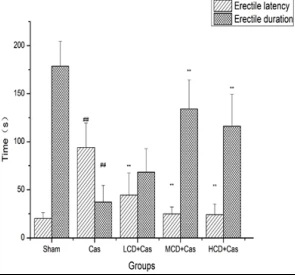
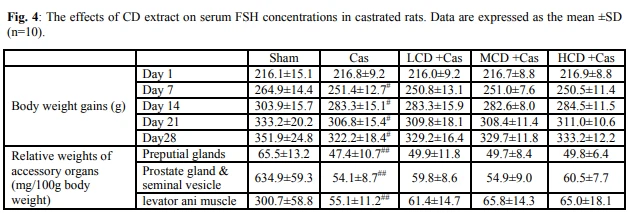
Fig. 3: The effects of CD extract on serum LH concentrations in castrated rats. Data are expressed as the mean ± SD (n=10). # p<0.05 relative to sham-operated group, * p<0.05 relative to castrated group. Body weights and relative accessory organs weights Shown in table 1, all rats were of similar initial body weights with an increase from day 1 to day 28. However, mean values in castrated group increased from 216.8±9.2 g to 251.4±12.7, 283.3±15.1, 306.8±15.4 and 322.2±18.4 g, gaining less weights compared to the sham operated counterparts (p<0.05). There were no statistical difference between sham group and CD treated group

Further, the mean relative weights of preputial gland, prostate gland & seminal vesicle and levator ani muscle in castrated rats were significantly lower (p<0.05) than those of normal controls, respectively. Compared with the rats castrated only, the relative values of these organs weight tended to be higher under the treatment of CD extract. Erectile response assessment In contrast to sham group, castration made the rats spend more time gaining penis erection under electric stimulation (p<0.01). However, the erectile latency was shortened by CD extract, exhibiting a significant decrease by 52.7% in LCD +Cas group (p<0.01), 73.5% in MCD +Cas group (p<0.01) and 74.5% in HCD +Cas group (p<0.01), respectively. Furthermore, castration shortened the erectile duration with the mean value of 37.2±17.3 s compared to sham operated group (p<0.01). However, the erectile duration in rats was significantly prolonged approximately by 2.6-fold in MCD +Cas group (p<0.01) and 2.1-fold in HCD +Cas group (p<0.01). It showed no strict dose-related correlation. (fig. 2).
Serum hormone levels
Analyzed by RIA assay, the average serum concentration of LH in castrated rats was 2.50±0.34mIU/ml, showing an increase compared to sham operated control (p<0.05). However, the value descended about 49.2% in MCD +Cas group relative to that in castrated control (p<0.05) (fig. 3). Shown in fig. 4, no statistical differences were observed among all groups on FSH concentration.
DISCUSSION
Our results demonstrated that castration significantly prolonged the penis erectile latency and shortened the erectile duration, with remarkable accessory organs atrophy. However, CD extract facilitated the penis erectile response and modulated the serum LH level to some extent in castrated rats. The spontaneous erection is mainly stimulated and maintained by androgen via cellular, molecular, and physiologic mechanisms, involving the relaxation of cavernosal smooth muscle (Traish et al. 2007, Talha et al. 2007). Insufficient testosterone levels lead to a decrease in its relaxation (McClure 1988), which accordingly results in impotence in male (Bivalacqua et al. 2000).
Specially in rats, it is maintained by a wide range of systemic testosterone concentrations as 10-12%, below which the erectile response is attenuated in a dose-dependent manner (Armagan et al. 2006). In present study, the testosterone concentration in circulation was too low to meet the sensitivity limit (0.02ng/ml) in all castrated rats (the data were not showed in the results). However, CD extract significantly shortened the penis erectile latency at three dosages and prolonged the erectile duration at 0.90 g/kg and 1.8 g/kg. It was probably the consequence of androgen-like effect of CD mentioned in some previous studies (He et al. 1996a, He et al. 1996b). Some accessory organs, such as the prostate and seminal vesicle, are androgen dependent, thus the weight changes may reflect the alterations in endocrine status (Trisomboon et al. 2007, Jang et al. 2011).
It existed a threshold level of testosterone, below which the metabolism of these organs was inhibited (Trachtenberg 1985). It was confirmed in our study that castration induced the accessory reproductive organs weight to decrease due to the testosterone deficiency. Testosterone is primarily secreted by testis Leydig cell and regulated by hypophysial hormones, such as luteinizing hormone (LH) and follicle-stimulating hormone (FSH), which play an important role in maintaining the penis function of the castrated animals (Robert et al. 2004). As the hypothalamus-pituitary-gonad (HPG) axis is a closed-loop feedback control mechanism, low gonadal hormone levels can regulate the secretion of LH and FSH in turn (Morales et al. 2004). Our study has investigated that the serum LH level was significantly increased in castrated rats and then descended to the normal levels by CD extract at 0.90 g/kg, which was agreed with the previous conclusion that increased LH level was associated with a higher risk of erectile dysfunction (Kupelian et al. 2006).
In testis, LH stimulates the synthesis and release of testosterone, the feedback control of which is relatively consistent, while FSH directly acts on the Sertoli cells for nourishment with the feedback control complex (Hellqvist et al. 2008). These findings offered more support for the surmise that CD expressed androgen-like effect, which might be mainly responsible for the reduction of serum LH more than FSH. In current observation, the influence of castration on body weight development in male rats was similar to the findings in previous study (Christoffersen et al. 2006), while contrary to the results in female rats (Pantaleão et al. 2010). CD extract was unable to significantly improve the body weight, which was probably due to the insufficient treatment duration or the complex impacts on overall health status. In conclusion, castration prolonged the penis erectile latency and shortened the duration significantly, with serum LH increase and accessory sex organs atrophy However, CD extract facilitated the penis erectile response by shortening the erectile latency and prolonging the erectile duration in castrated rats. These effects were probably due to the androgen-like effect, which was supported by observation that CD extract normalized the serum LH concentrations especially at the dosage of 0.90 g/kg.

However, additional evidences are needed to demonstrate the effect of CD extract against ED at hypothalamic and limbic levels and more attention could be gained to this valuable traditional medicine in modern world.