Evaluation On Main Biological Characters Of Host-plant Haloxylon Ammodendron And Haloxylon Persicum Of Cistanche Deserticola Ⅲ
Mar 12, 2024
2.4 Investigation on the parasitism rate of Cistanche deserticola and identification of host plants
In the inoculation test area of the Materia Medica Cistanche planting base in Yongning County, Ningxia, the parasitism rate of 20 Haloxylon ammodendron and 20 Haloxylon ammodendron strains and 20 Haloxylon ammodendron strains were randomly investigated. The results showed that the parasitism rates of Haloxylon ammodendron and Haloxylon ammodendron and Haloxylon ammodendron 1 year after inoculation were relatively high ( Figure 3), in which the parasitism rate of Haloxylon ammodendron is 90.00% and the parasitism rate of Haloxylon ammodendron is 95.00%. Both artificially cultivated Haloxylon ammodendron and Haloxylon ammodendron can parasitize Cistanche deserticola, but the difference in parasitism rate between the two is not statistically significant. However, the survey found that the Cistanche deserticola harvested in the Ningxia planting base comes from the Haloxylon ammodendron planting area, while the Haloxylon ammodendron growing area has always been The failure to collect Cistanche deserticola medicinal materials is related to the large difference in biological properties between the two. This study conducted an investigation into the Ganjia Lake Haloxylon ammodendron National Nature Reserve in Xinjiang where Haloxylon ammodendron and Haloxylon ammodendron are distributed. 28 Cistanche deserticola parasitic root samples were collected in areas where the two plants co-occurred, and ITS molecular identification was carried out ( Figure 4), the results show that the 27 sampling point samples are clustered with the Haloxylon ammodendron standard sample, and only sample No. 16 is clustered with the Haloxylon ammodendron standard sample, indicating that the host plants of Cistanche deserticola in this area are mainly Haloxylon ammodendron and Haloxylon ammodendron. Shuttlecock can also parasitize Cistanche deserticola.

NATURAL ORGANIC CISTANCHE TUBULOSA MATERIALS



Fig.3 Investigation on parasitism of host plant H. ammodendron and H. persicum of C. deserticola in field
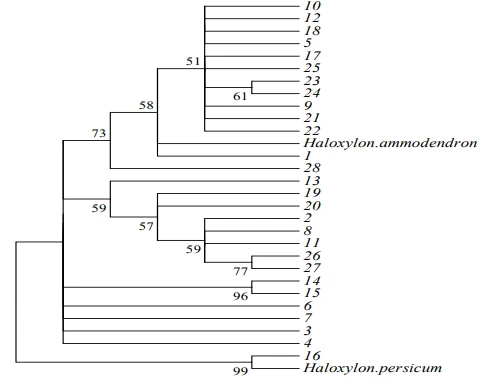
1~28 were the parasitic root samples of C. deserticola at different sampling points
Fig.4 ITS clustering analysis of roots parasitized by C. deserticola from different sampling points of Xinjiang

3 Discussion
Haloxylon ammodendron is widely distributed in the China, while Haloxylon ammodendron is mainly distributed in the Junggar Basin and its surrounding areas in Xinjiang. Different ecological ranges lead to large differences in biological traits between the two. This study shows that the top of the assimilation branch of Haloxylon ammodendron is blunt and rounded, while the top of Haloxylon ammodendron has a pointed tip, and the two can be effectively distinguished through the assimilation branch. Compared with other plant organs, pollen is less affected by environmental factors and can provide important basis for plant classification, species identification and variety selection [15]. This study shows that the pollen mesh of Haloxylon ammodendron is deeper, the number of surface granular structures is significantly less than that of Haloxylon ammodendron, and the pollen volume is smaller than that of Haloxylon ammodendron.
These pollen characteristics also provide an important basis for the classification and identification of the two. Correlation analysis shows that the agronomic indicators of Haloxylon ammodendron and Haloxylon ammodendron are significantly related to factors such as temperature and humidity. Haloxylon ammodendron has a strong adaptability to changes in factors such as moisture and light, while the growth of Haloxylon ammodendron is greatly restricted by factors such as temperature and moisture.
Previous studies have shown that two species of Haloxylon ammodendron will experience assimilation branch shedding and "growth dormancy" in the hot and droughty months of July and August, which is related to the self-protection mechanism of Haloxylon ammodendron and Haloxylon ammodendron in drought environments [16]. This study found that under the same field watering and other management measures, Ningxia planting base
The perennial Haloxylon ammodendron growing in the ground is relatively good, but Haloxylon ammodendron has become dormant in summer due to lack of water, indicating that atmospheric drought is a key factor restricting the growth and distribution of Haloxylon ammodendron. This is consistent with Shen Liang et al. [17] who carried out dehydration stress on Haloxylon ammodendron. The research results on the effects of photosynthesis of Haloxylon ammodendron and Haloxylon ammodendron are consistent. In addition, this
The study found that in Ningxia's high temperature and drought summer, the seedlings of Haloxylon ammodendron and Haloxylon ammodendron and Haloxylon ammodendron alba still have a large growth rate, and there is no "summer dormancy" phenomenon. This is due to the frequent watering of the nursery base and the fact that Haloxylon ammodendron and Haloxylon ammodendron and Haloxylon ammodendron are both C4 plants. It is related to stronger water use efficiency [18].

At present, there are many reports on Cistanche deserticola parasitized by Haloxylon ammodendron, but there are relatively few reports on Cistanche deserticola parasitized by Haloxylon ammodendron. In 1998, 80 acres of Haloxylon ammodendron alba was introduced to the Cistanche deserticola planting base in Yongning County, Ningxia. During this period, Haloxylon ammodendron alba was inoculated several times. Although Haloxylon ammodendron has survived to this day, the Cistanche deserticola medicinal materials have not been harvested. Planters have always doubted whether Haloxylon ammodendron can be harvested Parasitic Cistanche deserticola. For this reason, in the early stage of this study, Cistanche deserticola and host root materials were collected in the Ganjiahu Haloxylon ammodendron Forest National Nature Reserve in Xinjiang. Using ITS identification technology [9-10], it was concluded that Haloxylon ammodendron can parasitize Cistanche deserticola. At the same time, in Yongning County, Ningxia The field parasitism test carried out at the planting base also confirmed that Haloxylon ammodendron can parasitize Cistanche deserticola, and it was found that the parasitism rate of Cistanche deserticola in the Haloxylon ammodendron test area of the planting base was higher than that of Haloxylon ammodendron. Haloxylon ammodendron in the Ningxia planting base failed to harvest the parasitic Cistanche deserticola medicinal materials. This is related to the poor growth of Haloxylon ammodendron in the introduced area due to lack of water. Correlation analysis showed that the agronomic traits of Haloxylon ammodendron are significantly related to factors such as moisture, and moisture is an important factor limiting the growth of Haloxylon ammodendron. Wild Haloxylon ammodendron in the China is mainly distributed in the areas around Lake Aibi in Xinjiang where the groundwater level is high, and is rarely distributed in other areas. The growth of Haloxylon ammodendron in the water-saving mode of drip irrigation in Yongning County, Ningxia The main cause of death of parasitic Cistanche deserticola is lack of nutrients or water. This study provides scientific basis for the classification and identification of Haloxylon ammodendron, introduction and cultivation, and screening of excellent host germplasm of Cistanche deserticola.

[1] Jia Z Q, Lu Q, Guo B G. Progress in the study of Psammophyte Haloxylon. Forest Research, 2004, 17(1): 125-132.
[2] Zhang Dan, Ma Songmei, Wei Bo, Wang Chuncheng, Zhang Lin, Yan Han. Historical distribution pattern and driving mechanism of Haloxylon ammodendron in China. Biodiversity, 2022, 30(1): 42-51. Zhang D, Ma S M, Wei B, Wang C C, Zhang L, Yan H. Historical distribution pattern and driving mechanism of Haloxylon in China. Biodiversity Science, 2022, 30(1): 42-51.
[3] Yang F, Lv G H. Metabolomic Analysis of the response of Haloxylon ammodendron and Haloxylon persicum to drought. International Journal of MolecularSciences, 2023, 24(10): 9099.
[4] National Pharmacopoeia Committee. Pharmacopoeia of People's Republic of China, I. Beijing, The Medicine Science and Technology Press, 2020: 140-141. National Pharmacopoeia Committee. of China, 2020:140-141.
[5] Tang Lingling, Jiao Zhongyi. List of national key protected wild plants and analysis of their changes. Fujian Forestry Science and Technology, 2022, 49(4): 125-132.Tang L L, Jiao Z Y. Analysis and comparison of national key protected wild plants plants list. Journal of Fujian Forestry Science and technology. 2022, 49(4):125-132.
[6] Feng Xiaolong, Liu Ran, Ma Jian, Xu Zhu, Wang Yugang, Kong Lu. Photosynthesis of Haloxylon ammodendron branches and its influencing factors in the Gurbantunggut Desert. Acta Ecologica Sinica, 2021, 41(24): 9784-9795 .Feng X L, Liu R, Ma J, Xu Z, Wang Y G, Kong L. Photosynthetic characteristics and influencing factors of Haloxylon persicum stems (different diameter
classes) in Gurbantonggut desert. Acta Ecologica Sinica, 2021, 41(24): 9784-9795.
[7] Li Xue, Gao Guanglei, Sun Guili, Shi Haobo, Zhao Fangfang, Ma Long. Prediction of potential suitable areas for Haloxylon ammodendron and Haloxylon ammodendron in Xinjiang based on MaxEnt. Western Forestry Science, 2021, 50(1): 145-152.Li X, Gao G L, Sun G L, Shi H B, Zhao F F, Ma L. Potential suitable areas of Haloxylon ammodendron and Haloxylon persicum in Xinjiang based on MaxEnt. Journal of West China Forestry Science, 2021, 50(1): 145-152.
[8] Chen Yuchao, Li Miao, Wu Mingchao, Song Yuxia. Root structure and composition of two plants of the genus Haloxylon ammodendron. Acta Plant Physiologica Sinica, 2013, 49(11): 1273-1276.Chen Y C, Li M, Wu M Z , Song Y X. Structure and composition of roots in two species of Haloxylon Bunge. Plant Physiology Journal, 2013, 49(11):1273-1276.
Supportive Service Of Wecistanche-The largest cistanche exporter in the China:
Email:wallence.suen@wecistanche.com
Whatsapp/Tel:+86 15292862950
Shop For More Specifications Details:
https://www.xjcistanche.com/cistanche-shop