Identification Method Of Cistanche Deserticola - Traditional Chinese Medicine Identification
Oct 10, 2024
【 Identification of Traditional Chinese Medicine Material Name 】
Cistanche deserticola
【 Identification of Medicinal Material Source 】
This product is the dried fleshy stem with scaled leaves of Cistanche deserticola Y.C.Ma, a plant in the family Liliaceae. Cistanche, evolved from the word 'calm'. This medicinal herb has soft and smooth flesh, and its medicinal properties are not too strong, calm and gentle, hence the name Cistanche deserticola.
superman herbs cistanche
The earliest recorded herb of Cistanche deserticola is the "Shennong Bencao Jing". The "Record of Famous Doctors" states: "Cistanche deserticola grows in the Hexi Valley, Daijun, and Yanmen. It is harvested on May 5th and dried in the shade." Hexi refers to the present-day Hexi Corridor and Huangshui River Basin. The Commentary on the Compendium of Materia Medica states: "Daijun and Yanmen belong to Bingzhou, with the highest number in Henan province. The first one to emerge from Longxi now has a flat and wide shape, soft and smooth, with many flowers and a sweet taste; the second one to emerge from the northern country has a short and few flowers. There are also some in Jianping, Badong, but not as good." Bingzhou refers to most of present-day Shanxi province, Inner Mongolia, part of Hebei province, and northern Shaanxi province. Henan, located in the southwestern part of Gansu province south of the Yellow River. Longxi, now south of Lintao County, Gansu Province. The Shu Materia Medica quotes the "Newly Revised Materia Medica Sutra" as saying: "In March and April, dig roots in the sand of Suzhou and Lufu counties, cut out the best three or four inches in the center, thread the rope through the dry shade, and it will be good in August. The skin is like pine scales and armor." Suzhou, which is now east of the Shule River in Gansu and west of Gaotai. The Compendium of Materia Medica states: "There are many of them in Shaanxi provinces and counties today, but they are not as strong as those in the Western Qiang region. Their flesh is thick and their strength is tight... There is a thin flat root under the seedlings, which is over a foot long and harvested in March." The Western Qiang region, which includes present-day Shaanxi and Gansu provinces. According to the above herbal research, it is basically consistent with the current use of Cistanche deserticola.
[Plant Morphological Identification]
Perennial parasitic herb, 40-160cm tall. The stem is fleshy, flat, unbranched or branching 2-4 from the base, with a width of 5-10cm and a thickness of 2-5cm, gradually becoming thinner upwards; Leaves are fleshy, scaly, yellow, arranged in a tile like pattern, densely distributed in the lower part of the stem, broadly ovate or triangular ovate in shape, 0.5-1cm long and 1-2cm wide, sparse and narrowed in the upper part, triangular lanceolate in shape, and hairless on both sides. The spike shaped inflorescence grows at the top, with a length of 15-50cm and a diameter of 4-7cm. There is a large bract under the inflorescence, which is the same shape as the leaves and is equal or slightly longer than the corolla; 2 small bracteoles, hairy on the back; Calyx bell shaped, 1-1.5cm long, with 5 shallow lobes at the top, nearly circular lobes, and ciliated edges; The corolla is cylindrical and bell shaped, measuring 3-4cm in length, with 5 lobes at the top and nearly semi-circular lobes. The edges are often slightly curled outward, and the color varies from pale yellow white to light purple. After drying, it often turns brown; Stamen 4, filaments attached 5-6mm from the base of the tube, 15-25mm long, base covered with wrinkled long soft hairs, anthers long ovate, densely covered with long soft hairs, with a pointed tip at the top; Ovary elliptical, with nectaries at the base, style slightly longer than stamens, hairless, stigma nearly spherical. The capsule is ovoid in shape, 15-27mm in length and 13mm in diameter. It has two cracked petals and is brown in color. The seeds are mostly elliptical or nearly oval in shape. The flowering period is from May to June, and the fruiting period is from June to August.

Cistanche deserticola slice
【 Identification of Medicinal Material Characteristics 】
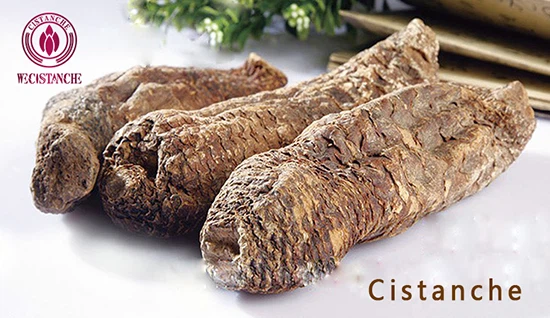
This product has a flattened cylindrical shape, slightly curved, measuring 3-15cm in length and 2-8cm in diameter. The surface is brown or gray brown, densely covered with fleshy scales arranged in a tile like pattern, and the tips of the scales are usually broken. Weight, hard texture, slightly flexible, not easily broken. The cross-section is brown in color, with light brown dotted vascular bundles arranged in wavy rings. Qi is subtle, with a sweet and slightly bitter taste.
Microscopic identification of medicinal herbs: Take 1g of this product powder, add 8ml of ethanol containing 0.5% hydrochloric acid, heat and reflux for 10 minutes, filter while hot, adjust the filtrate to neutral with ammonia test solution, evaporate, dissolve the residue in 3ml of 1% hydrochloric acid solution, and filter. Take 1ml of the filtrate and add 1-2 drops of bismuth potassium iodide test solution to form an orange red or reddish brown precipitate.
[Habitat distribution]
Born in sand dunes and deserts. It mainly parasitizes on the roots of Haloxylon ammodendron (C.A. Mey.) Bge. Distributed in Inner Mongolia, Shaanxi, Gansu, Qinghai, Ningxia, and Xinjiang.
[Collection and processing]
More than spring seedlings are harvested before or just after they are unearthed, and the inflorescence is removed, cut into sections, and dried in the sun.

Cistanche deserticola
【 Decoction Pieces Processing 】
1. Cistanche deserticola: Remove impurities, wash thoroughly, moisten thoroughly, cut into thick slices, and dry.
2. Cistanche deserticola: Take slices of Cistanche deserticola and stew or steam them with wine until the wine is completely absorbed.
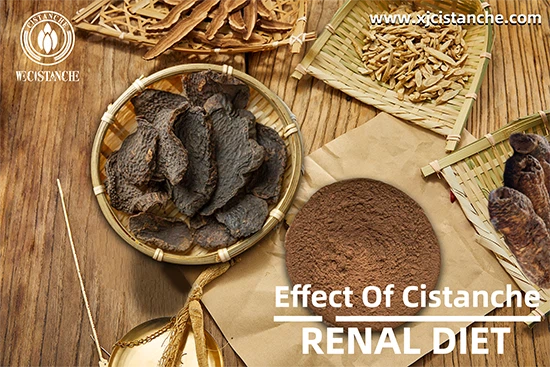
This product is an irregularly shaped slice with a thickness of about 3mm. The surface is brown or gray brown. Some can see fleshy scales and leaves. The cut surface is yellow brown, gray brown, or brown brown in color, with light brown or brown yellow point like vascular bundles arranged in irregular wavy rings, or arranged in strips and hashed. Qi is subtle, with a sweet and slightly bitter taste.
【 Performance and Function 】
Sweet, salty, warm. Returning to the Kidney Meridian and Large Intestine Meridian. Tonifying kidney yang, nourishing essence and blood, moistening intestines and promoting bowel movements. Used for impotence, infertility, soreness and weakness of the waist and knees, muscle and bone weakness, intestinal dryness and constipation. Oral administration: 6-9g. Boil it in water.

Cistanche supplement near me
Click here to view Cistanche products
【Ask for more】 Email:cindy.xue@wecistanche.com / Whats App: 0086 18599088692 / Wechat: 1859908869
[Note]
Store in a ventilated and dry place.