In Vivo Administration Of Gut Bacterial Consortia Replicates Urolithin Metabotypes A And B In A Non-Urolithin-Producing Rat ModelⅡ
Dec 25, 2023
Results
Analysis of the specificity and sensitivity of the designed primers and probe for Ellagibacter and Enterocloster
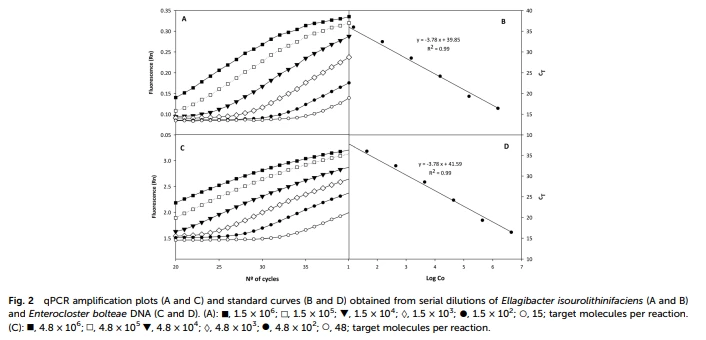
The specificity of the Ellagibacter and Enterocloster primers and probe was confirmed by uploading their sequences on the sequence alignment program ProbeMatch.31 Results are shown in Tables 1S and 2S.† Subsequently, the specificity of the primers and probe was verified by qPCR using the optimised reaction conditions described in the Materials and Methods section. Representative bacterial species of the Eggerthellaceae and Lachnospiraceae families with the greatest similarity to Ellagibacter and Enterocloster in the 16S rRNA gene sequence were tested in addition to other closely related species frequently detected in the human intestine (Tables 1S and 2S†). Fig. 2 shows the amplification plots corresponding to the standard quantification curves.

Click to constipation treatment
CT values were plotted against bacterial concentration (Co) as log 10 genomic equivalents/ reaction (6.25 × 10⁻⁶ ng, for haploid genome). The slope of the linear regression curve, calculated using genomic DNA, was −3.78, and the R2 value was greater than 0.99. Regarding the sensitivity of the qPCR system, 1.5 genome equivalents were needed as the minimum for a positive reaction using the TaqMan mode. The CT values obtained with the calibration curve of E. isourolithinifaciens and E. bolted ranged from 15.5 ± 0.7 to 37.8 ± 0.7, while no DNA amplification was detected for the other strains tested.
The quantification of Ellagibacter and Enterocloster in the rats' faecal samples was performed with this method (qPCR), considering the mean of three replicates. The results were expressed as log 10 bacteria per g of faeces and compared with the relative abundance values obtained by 16S rRNA sequencing. We observed a positive correlation between the results obtained by both methods in Ellagibacter (r = 0.660, p < 0.001) and Enterocloster (r = 0.459, p < 0.001) (data not shown).

Effect of orally administered bacterial consortia on the in vivo production of urolithins
The Uro analysis in faeces showed that initially (T0), the rats did not produce Uros after ingesting EA powder (Fig. 3A–C). However, after administering the bacterial consortia A (Fig. 3A) and B (Fig. 3B), rats became capable of producing Uros. During the first three weeks, when the rats from groups A and B only ingested EA powder, the Uro concentration (range: 0–1.43 µg g−1 ) and that of their EA precursor (range: 0.07–4.54 µg g−1 ) in faeces was low. However, from day 21, when the consumption of walnuts started as a second EA source, there was a very significant increase in faecal EA (Fig. 3A–C) and Uro production in groups A (Fig. 3A) and B (Fig. 3B).
Moreover, differences in the Uro profile were observed between groups A and B. In group A, faecal Uro-C, Uro-M6, Uro-M7, and the final metabolite Uro-A were predominant. In contrast, in group B, the three final Uros (Uro-A, UroB, and IsoUro-A) were present, whereas the intermediates were scarce. However, a higher faecal concentration of the recently described Uro-G was detected in group B than in group A. In addition, the Uro-B concentration was lower than that of Uro-A and IsoUro-A in group B. Furthermore, Uro-A and IsoUro-A, but not Uro-B, were produced in all rats of group B (Fig. 3B). When walnuts were added to the diet of control rats (group C) on day 21, a higher faecal concentration of EA was also observed than before walnut consumption, where the faecal EA concentration was very low (Fig. 3C). However, neither EA powder intake nor walnut consumption promoted the production of Uros in the gut of control rats (i.e., with no bacterial consortia).
Intestinal colonization of orally administered bacteria Initially, before rats of groups A and B started the consumption of the bacterial consortia, Gordonibacter or Ellagibacter were under the limit of detection in the faecal samples when metagenomic sequencing analysis was performed using the MiSeq-Illumina platform (Fig. 3D–F). When qPCR was used, Gordonibacter levels in rats were low (<5.8 log bacteria per g faeces), and Ellagibacter levels were under the limit of detection (data not shown). In contrast, Enterocloster was detected using the MiSeq-Illumina and qPCR in the faeces of rats from all groups (A, B, and C) at the baseline (Fig. 3D–F).

The relative abundance (mean ± SD) of Enterocloster in groups A, B, and C was 0.03 ± 0.02, 0.04 ± 0.06, and 0.13 ± 0.17%, respectively, but without significant differences (p = 0.570). The administration of the bacterial consortia A and B resulted in the appearance and gradual increase of Gordonibacter and Ellagibacter in the corresponding group A and B faeces, respectively (Fig. 3D and E). Furthermore, faecal Enterocloster levels increased throughout the study in groups A and B (Fig. 3D and E).

However, LEfSe analysis showed scarce differences in other gut bacterial groups when metagenomic sequencing data of groups A and B were compared to those of the control group (Fig. 4A and B). Interestingly, a reduction of the Streptococcus genus and Streptococcaceae family was observed in groups A and B compared to the control group (Fig. 4A and B). Five days after stopping the oral administration of the bacterial consortia (end date of the study), a reduction in the abundance of Ellagibacter and Enterocloster was detected in group B, which also resulted in a significant decrease in Uro production (Fig. 3B and E). In group A, a reduction in the abundance of Gordonibacter but not Enterocloster was also observed (Fig. 3A), which resulted in a decrease in Uro concentration but was less pronounced than in group B (Fig. 3D and E). In the control group, Ellagibacter was under the limit of detection throughout the study, and Enterocloster and Gordonibacter remained at very low levels (Fig. 3F).
Study of the toxicity of the orally administered gut bacteria
Potential side effects from ingestion of the bacterial consortia were investigated. No adverse effects on growth, weight gain, food intake, and vital organs were observed after 4 weeks of oral administration by gavage of bacterial consortia in rats from groups A and B compared to the control group. However, male rats gained 107.4 ± 2.4 g, while female rats gained less weight (25.7 ± 5 g) at the end of the study without differences compared to the control group. Food consumption by cage was 63.1 ± 1.4 g for male rats and 33.8 ± 1.8 g for female rats. However, water intake was 136.1 ± 37.2 g and 76.0 ± 12.6 g, by male and female rats by cage respectively.

Haematological differences were observed between males and females in some variables, such as erythrocyte distribution (RDW, p = 0.005), leucocytes (p = 0.005), platelet distribution width (PDW, p = 0.005), and reticulocyte haemoglobin content (CHr, p = 0.013) (Table 2). Still, no differences were observed for any variables between groups that consumed the bacterial consortia (groups A and B) and the control group (group C). The biochemical values were also analysed, and differences were detected only between males and females in some variables such as the creatinine index (p < 0.001), phosphorus (p = 0.007), alkaline phosphatase (ALP) (p = 0.003), and thyroxine (T4) (p = 0.002) (Table 3). However, no differences were observed for any of the variables between the groups that consumed the bacterial consortia (groups A and B) and the control group (group C).
Natural Herbal Medicine For Relieving Constipation-Cistanche
Cistanche is a genus of parasitic plants that belongs to the family Orobanchaceae. These plants are known for their medicinal properties and have been used in Traditional Chinese Medicine (TCM) for centuries. Cistanche species are predominantly found in arid and desert regions of China, Mongolia, and other parts of Central Asia. Cistanche plants are characterized by their fleshy, yellowish stems and are highly valued for their potential health benefits. In TCM, Cistanche is believed to have tonic properties and is commonly used to nourish the kidney, enhance vitality, and support sexual function. It is also used to address ageing, fatigue, and overall well-being issues. While Cistanche has a long history of use in traditional medicine, scientific research on its efficacy and safety is ongoing and limited. However, it contains various bioactive compounds such as phenylethanoid glycosides, iridoids, lignans, and polysaccharides, which may contribute to its medicinal effects.

Wecistanche's cistanche powder, cistanche tablets, cistanche capsules, and other products are developed using desert cistanche as raw materials, all of which have a good effect on relieving constipation. The specific mechanism is as follows: Cistanche is believed to have potential benefits for relieving constipation based on its traditional use and certain compounds it contains. While scientific research specifically on Cistanche's effect on constipation is limited, it is thought to have multiple mechanisms that may contribute to its potential to relieve constipation. Laxative Effect: Cistanche has long been used in Traditional Chinese Medicine as a remedy for constipation. It is believed to have a mild laxative effect, which can help promote bowel movements and induce constipation. This effect may be attributed to various compounds found in Cistanche, such as phenylethanoid glycosides and polysaccharides. Moistening the Intestines: Based on traditional use, Cistanche is considered to have moisturizing properties, specifically targeting the Intestines. Promoting hydration and lubrication of the Intestines may help soften tools and facilitate easier passage, thereby relieving constipation. Anti-inflammatory Effect: Constipation can sometimes be associated with inflammation in the digestive tract. Cistanche contains certain compounds, including phenylethanoid glycosides and lignans, that are believed to have anti-inflammatory properties. By reducing inflammation in the intestines, it may help improve bowel movement regularity and relieve constipation.