Product Development, Industry Status, And Prospects For Cistanche Herba
Dec 02, 2025
Product Development of Cistanche Herba
With growing public awareness of health and wellness, more consumers are turning to preventive care. As a traditional Chinese medicinal material, Cistanche Herba-renowned for tonifying kidney yang, nourishing essence and blood, and moistening the intestines to relieve constipation-has gained strong domestic and international interest. Particularly in China and East Asia, it is widely used across pharmaceuticals, health supplements, food additives, and cosmetics. In recent years, national policies have strongly supported the Cistanche industry. In 2023, Cistanche deserticola was formally included in the "List of Substances Traditionally Used as Both Food and Chinese Medicinal Materials," conferring dual "food and TCM" status. This allows legal use in food R&D, production, and sales, further unlocking market potential. Additionally, large-scale planting of host shrubs Haloxylon ammodendron (saxaul) and Tamarix spp. with Cistanche inoculation has been promoted in Xinjiang and Inner Mongolia, ensuring raw material supply. Xinjiang's annual production of Cistanche medicinal raw material now exceeds 6,000 tons; China's Cistanche industry is thriving with an annual output value of roughly 500 million RMB and a steadily growing market [44].

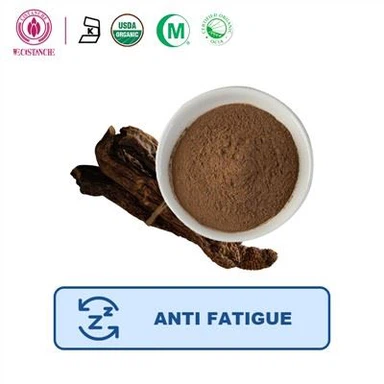
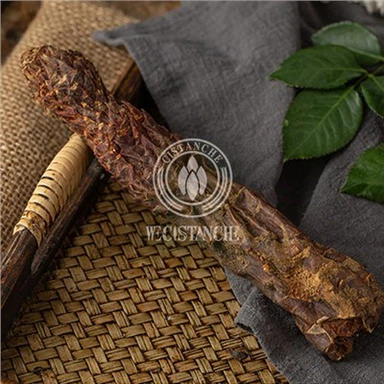
HERB CISTANCHE RAW MATERIAL FOR HEALTH SUPPLEMENTS
2.1 Overseas Product Development
As a highly valued traditional Chinese medicinal resource, Cistanche has played an important role in international markets over the past decade, especially in Japan, Russia, and Southeast Asia. These regions import large volumes of dried Cistanche from China for research and commercial use. In Japan, the dried stems of C. salsa (syn. C. salsa sensu lato), C. deserticola, and C. tubulosa have been officially included in the Japanese Pharmacopoeia as the natural medicine "Nikujuyou." Early Japanese research focused on isolating and elucidating structures of active constituents such as phenylethanoid glycosides and iridoid-type cyclic enol ether terpenes [45–47]. Building on this, studies explored vasodilation, hepatoprotection, and improved glucose tolerance, and applied Cistanche extracts to produce refined products. By blending with other actives and excipients, more than 30 advanced dosage forms have been commercialized, including pharmaceuticals, lozenges, and confectioneries, aimed at improving conditions such as diabetes and psychosomatic disorders. Among these, Yomeishu produced by Yomeishu Seizo Co., Ltd. is particularly well known [48]. In the United States, research has primarily utilized echinacoside-rich extracts as dietary supplements to support immune function [49].
Practical notes for global developers:
Japan recognizes Cistanche as Nikujuyou with pharmacopoeial status, supporting medical-grade sourcing.
Marketed formats overseas span medicinal tonics, lozenges, and functional candies, often positioned for vascular, metabolic, and hepatic support.
Echinacoside-driven immune-support supplements have traction in North America.
2.2 Domestic Product Development (China)
China, as a major cultivation base for Cistanche, enjoys inherent advantages in industry development. However, overall product diversification remains limited. Presently, Cistanche is mainly used in:
Medical preparations,
Ingredients for fruit wines and other alcoholic beverages,
Health foods: According to the State Administration for Market Regulation's Special Food Information Query Platform (ypzsx.gsxt.gov.cn), there were 34 registered Cistanche health food products as of October 6, 2024. As summarized in Tables 2 and 3, dosage forms are primarily tablets, with claimed functions centered on enhancing immunity and alleviating exercise fatigue.
Table 2. Statistics on Product Dosage Forms of Cistanche Health Food Products
| Dosage Form | Quantity |
|---|---|
| Tablets | 11 |
| Oral Liquids (Tinctures) | 7 |
| Capsules | 6 |
| Tea Preparations | 4 |
| Oral Solutions | 3 |
| Granules | 3 |
Note: Data sourced from the Special Food Information Inquiry Platform of the State Administration for Market Regulation.
Table 3. Statistics on the Efficacy of Cistanche Health Food
| Efficacy | Quantity |
|---|---|
| Enhances immunity | 23 |
| Relieves physical fatigue | 14 |
| Anti-aging | 1 |
| Liver protection | 1 |
| Promotes bowel movement | 1 |
Let me know if you'd like these tables in LaTeX, Word, or HTML format as well!

HERB CISTANCHE RAW MATERIAL FOR HEALTH SUPPLEMENTS
Representative product R&D examples include:
A compound Cistanche health wine prepared by macerating Cistanche, Codonopsis, Licorice, and Sandalwood in baijiu, aimed at strengthening vitality [50].
A low-alcohol fermented beverage made from fresh C. tubulosa, flavored with concentrated apple juice, exhibiting distinctive sensory characteristics and health appeal [51].
Cistanche–rose tablets formulated with C. tubulosa, Rosa rugosa, Licorice, and Cordyceps cicadae-ferment (Isaria sinclairii), achieving glossy, intact tablets with high echinacoside and verbascoside contents (2.236 mg/g and 0.460 mg/g, respectively) [52]. An oral liquid prepared from the same ingredients enhanced immunity in mice after 30 days of gavage [53].
A composite yogurt combining Cistanche, jujube, and yogurt, featuring uniform texture and favorable mouthfeel, with notable antioxidant activity [54].
A Cistanche coffee functional beverage using C. tubulosa with coffee and milk powder for novel flavor and wellness positioning [55].
Productization insights:
Dominant claims: immune enhancement and anti-fatigue; most common form: tablets.
Innovation whitespace: non-alcoholic RTD functional beverages, synbiotic formulations, gummies/chews, stick packs, and dermocosmetics leveraging antioxidant and barrier-support mechanisms.
Standardization anchors: echinacoside + verbascoside content, polysaccharide profile, and species authentication.

HERB CISTANCHE RAW MATERIAL FOR HEALTH SUPPLEMENTS
2.3 Current Status and Challenges in Processing and Industrialization
Despite strong potential in pharmaceuticals and health foods, the Cistanche industry faces several constraints:
Regional development imbalance: Xinjiang, as the main production area, has achieved a relatively integrated supply chain-from cultivation to primary/advanced processing and marketing. Yet product diversification and market expansion still have room to grow. In lower-yield regions, the industrial chain is incomplete and cultivation scale remains small.
Policy levers: Targeted support for cultivation and downstream processing in specific regions can incentivize expansion, improve yields and competitiveness, and foster sustainable development-driving local economic growth and farmer income.
R&D gaps: Current research emphasizes phenylethanoid glycosides and polysaccharides due to high abundance and robust bioactivity. Iridoid-type cyclic enol ether terpene glycosides and other constituents are underexplored. Future work should broaden pharmacological research on these classes-particularly in antioxidant, anti-fatigue, and neuroprotective domains-using modern approaches (e.g., molecular docking, target deconvolution, omics, and cell/tissue models) to elucidate mechanisms at molecular and cellular levels. This entails comprehensive screening, activity validation, and mechanistic clarification, thereby strengthening the scientific basis for applications.

Market opportunities:
Rising global demand for natural health products expands Cistanche's market space. Current development concentrates on TCM drugs and health foods (e.g., tablets, tonic wines), leveraging traditional functions (immune support, bowel regularity).
Unmet needs: Product development remains insufficient in modern indications such as anti-fatigue (sports recovery), healthy aging/anti-senescence, adjuvant oncology support, and broader cosmetic/functional food applications (e.g., skin barrier, hair/scalp vitality, gut–brain axis).
Conclusions and Outlook
Cistanche Herba has attracted sustained attention at home and abroad. Significant progress has been made in artificial cultivation, chemical characterization, and bioactivity research, positioning the industry for substantial growth. To further promote development across pharmaceuticals, health foods, and foods, deeper foundational studies are needed-especially connecting complex phytochemistry to specific physiological functions-to discover novel bioactives and new indications. This will provide a rigorous scientific foundation for product innovation, enrich product portfolios, increase value-add, and meet diverse market demands.
Industry advancement calls for coordinated policy support, scientific research, and market development to:
Scale up production sustainably,
Continuously improve product quality and standardization,
Expand applications in pharmaceuticals, health supplements, and modern medicine,
Ultimately building an internationally competitive Cistanche industry.
Selected references for verification and further study:
[44] Chao H. Xinjiang Daily (Chinese), 2024-1-22(5).
[45–47] Kobayashi et al., Yakugaku Zasshi 1983; Chem Pharm Bull 1984, 1985.
[48] Jia XG et al., Journal of Xinjiang Medical University, 2012, 35(7): 878–880.
[49] Hou L et al., Shandong Agricultural Science, 2020, 52(12): 133–140.
[50] Li JH et al., Henan Agriculture, 2023(15): 60–61.
[51] Guo AM et al., Food Research and Development, 2019, 40(20): 59–64.
[52] Zhao L et al., Food and Fermentation Science and Technology, 2024, 60(3): 42–48.
[53] Zhao L et al., Food and Fermentation Science and Technology, 2023, 59(5): 58–63.
[54] Sun BL et al., Food Industry Science and Technology, 2022, 43(24): 225–234.
[55] Dai SJ et al., Food Research and Development, 2012, 33(9): 113–116.