The Complete Guide To Dietary Therapy With Cistanche (Rou Cong Rong): A Composed, Unhurried Restoration Plan For Those With Chronic Deficiency And Insufficient Kidney Qi
Sep 20, 2026
Deficiency builds up slowly; restoring it must be done just as unhurriedly.
"Body deficiency" and "weak kidney qi" are not strict modern medical diagnoses. Rather, they describe a body that has long been running in a low-efficiency state: sensitivity to cold, fatigue, soreness and weakness in the waist and knees, an inability to lift one's spirits, shallow sleep, and frequent nighttime urination. Such a state rarely appears overnight; it results from depletion accumulated over years, even decades. That is why recovery cannot be rushed - expecting results in three to five days is itself a misunderstanding of deficiency patterns.

Cistanche is hailed as the "ginseng of the desert." Fittingly, the name carries the meaning of "composed and unhurried." Ancient physicians praised it as "warm without being hot, tonifying without being harsh, warming without being drying, moistening without causing discharge." Its medicinal nature is warm, gentle, and long-lasting - precisely suited to the slow, steady nourishment that those with chronic deficiency need. In November 2023, it was added to China's catalog of substances that are both food and traditional medicine, providing a compliant basis for everyday dietary use.
I. First, Identify Clearly: Where Exactly Is Your "Deficiency"?
1.1 Kidney Qi Deficiency, Kidney Yang Deficiency, and Kidney Essence Depletion: Three Levels
In Chinese medicine, the "kidney" is far broader than the anatomical organ. It stores essence, governs reproduction and development, governs the bones and produces marrow, governs water metabolism, and grasps qi; it is the congenital foundation of the body. Even within "kidney deficiency," there are at least three levels:

Effects of Cistanche: Improve Kidney Function
Kidney qi deficiency: a decline in function, with failure of the kidney's storing and qi-grasping capacity. Symptoms include shortness of breath and fatigue, sweating upon slight exertion, soreness and weakness of the waist and knees, frequent nighttime urination, and copious, pale, forceless urination.
Kidney yang deficiency: qi deficiency taken a step further, with cold signs emerging. Symptoms include fear of cold and cold limbs, cold pain in the waist and knees, mental lethargy, a pale and lusterless complexion, and "fifth-watch diarrhea" (early-morning diarrhea). The tongue is pale, enlarged, and has teeth marks on the edges; the pulse is deep and slow.
Kidney essence depletion: a loss of substance. Symptoms include premature aging, prematurely graying hair, loose teeth, dizziness and tinnitus, declining memory, and flaccid, weak sinews and bones.
These three often overlap: qi deficiency over time extends to yang; yang deficiency over time consumes essence. Cistanche's distinctive strength is that it both supplements kidney yang and boosts essence and blood - one end connected to function, the other to substance. This is exactly what sets it apart from medications that merely warm yang.
1.2 A Self-Assessment Checklist and the Sources of Depletion
The more items that apply - and the longer they have persisted (over three months) - the more likely kidney qi deficiency is: still feeling sleepy upon waking; an unavoidable nap each afternoon; tiring after only slight exertion; being more cold-sensitive than peers, with hands and feet that stay cool; soreness and weakness in the waist and knees after prolonged standing or sitting; waking easily and urinating more than twice a night; stools that tend toward dryness without signs of internal heat; hair loss and tinnitus, with a dull, lusterless complexion; a tongue that is pale, enlarged, and tooth-marked with a white, moist coating; and a pulse that is deep, thin, and weak at the chi (kidney) position.
How is deficiency depleted in the first place? Congenital insufficiency, chronic sleep deprivation, prolonged stress and overwork, poor recovery after serious illness, surgery, or childbirth, excessive sexual activity, a fondness for cold foods and drinks plus overuse of bitter-cold medications, and the physiological decline of kidney qi that comes with age - the Su Wen (Plain Questions) noted long ago that "at forty, the yin qi is naturally half depleted." What these causes share is prolonged, low-intensity, continuous depletion. Therefore, the recuperation period must be measured in months, not days.

1.3 The Role of Dietary Therapy: Nourishing, Not Treating
Dietary therapy is suited to sub-optimal health and functional decline, chronic fatigue without organic lesions, the recovery period after illness or surgery, normal age-related decline in older adults, and as an adjunct in managing chronic conditions - but it cannot replace standard diagnosis and treatment. If fatigue keeps worsening, if there is unexplained weight loss, recurrent fever, marked anemia, or noticeable edema, one should first be screened for conditions such as hypothyroidism, diabetes, chronic kidney disease, and anemia.
II. Why Cistanche?
2.1 The Pharmacopoeia Definition and the Code of Its Medicinal Nature
The Chinese Pharmacopoeia states: Cistanche (Rou Cong Rong) is the dried fleshy stem with scale leaves of Cistanche deserticola or Cistanche tubulosa of the Orobanchaceae family. It is sweet and salty in flavor, warm in nature, and enters the Kidney and Large Intestine meridians. Its functions are to supplement kidney yang, boost essence and blood, and moisten the intestines to relieve constipation. The decoction dose is 6–10 g, used for patterns of kidney yang insufficiency and essence-blood depletion presenting as impotence and infertility, soreness and weakness of the waist and knees, weakness of the sinews and bones, and constipation due to intestinal dryness.

Cistanche tubulosa
The Ben Cao Gang Mu (Compendium of Materia Medica) explains its name: "This substance supplements without being harsh, hence the designation 'composed and unhurried.'" The Ben Cao Hui Yan describes it as "warm without being hot, tonifying without being harsh, warming without being drying, moistening without causing discharge." These four "withouts" are, in effect, its instructions for use: warm without being hot - unlike the scorching intensity of aconite (fu zi) or cinnamon bark (rou gui), it is unlikely to fuel fire and damage yin; tonifying without being harsh - unlike deer antler velvet (lu rong) or sea horse (hai ma), it can be borne even by those whose deficiency is so severe they cannot tolerate strong tonics; warming without being drying - it warms and nourishes the gate of vitality without robbing the yin fluids, so it can be taken long term; moistening without causing discharge - it moistens the bowels without the harsh, downward-draining action of rhubarb (da huang) that damages healthy qi. The Shen Nong Ben Cao Jing (Divine Farmer's Classic of Materia Medica) classifies it as a superior-grade herb, noting that "prolonged use lightens the body."
2.2 Comparison with Other Similar Tonic Herbs
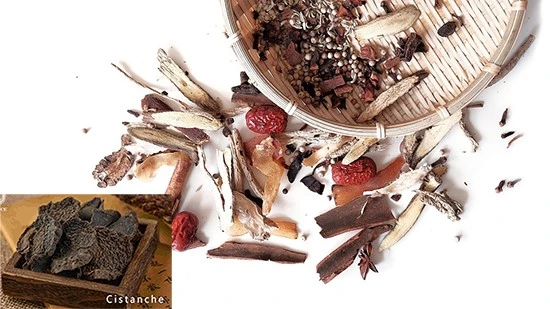
Chinese medicinal materials such as Cistanche tubulosa
|
Category |
Potency and Bias |
Additional Actions |
Best Suited For |
|
Cistanche (Rou Cong Rong) |
Gentle, even supplementation; warm and moistening - mild in force, with little byway bias |
Boosts essence and blood; moistens the intestines to relieve constipation |
Chronic deficiency with constipation; those so deficient they cannot tolerate strong tonics; suitable for long-term, gradual nourishment |
|
Deer Antler Velvet & Sea Horse (Lu Rong, Hai Ma) |
Harsh, forceful supplementation; warm and drying - very strong in action |
Powerfully supplements essence and blood, fortifies primordial yang, strengthens sinews and bones |
Cases of severe depletion and serious deficiency-damage; not the choice for slow, long-term gentle nourishment |
|
Aconite & Cinnamon Bark (Fu Zi, Rou Gui) |
Very acrid and very hot - intensely warming and dispersing |
Warms yang, dispels cold, and relieves pain |
Acute, severe patterns with extreme cold signs and declining yang qi; not suitable for prolonged use |
|
Epimedium & Morinda (Yin Yang Huo, Ba Ji Tian) |
Warms and supplements kidney yang; drying in nature |
Strengthens sinews and bones; dispels wind-dampness |
Yang-deficiency painful obstruction (Bi syndrome); rheumatic joint pain accompanied by yang deficiency |
|
Cynomorium (Suo Yang) |
Warms and supplements kidney yang; somewhat warm and drying |
Moistens the intestines to relieve constipation |
Constipation accompanied by kidney yang deficiency; use with caution in yin deficiency with effulgent fire |
|
Prepared Rehmannia & Goji Berry (Shu Di, Gou Qi Zi) |
Nourishes yin and replenishes essence; rich and cloying in nature |
Nourishes the liver and brightens the eyes |
Yin and essence-blood depletion; guards against the cloying greasiness that can impair digestion |
It occupies a distinctive position: situated between warming yang and nourishing enrichment, between supplementation and unblocking. It can be combined with yang-warming herbs to increase "firepower," and used alongside yin-nourishing herbs without creating conflict - while also conveniently addressing the dry-intestine constipation commonly seen in those with constitutional weakness. This compatibility - warming yet moistening, supplementing yet unblocking - is precisely the quality most needed for long-term regulation.
2.3 Textual Support
• Shennong Bencao Jing (Shennong's Classic of Materia Medica): " Governs the five types of exhaustion and seven types of injury; supplements the center... nourishes the five zang organs, strengthens yin, boosts essence-qi, and promotes fertility. Prolonged use lightens the body."
• Rihuazi Bencao (Materia Medica of Rihuazi): "Treats failure of male yang to rise and failure of female yin to bear offspring; moistens the five zang organs, grows muscle, and warms the waist and knees."
• Bencao Tujing (Illustrated Classic of Materia Medica): "Westerners often use it as food... cooked with Chinese yam and mutton into a soup, it benefits the person; eating it surpasses taking tonic medicines."
III. Modern Research: What Does Cistanche Actually Supplement?
3.1 Active Constituents
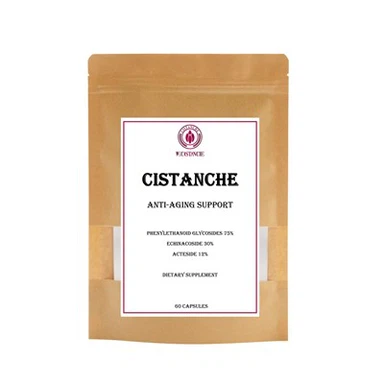
It contains mainly phenylethanoid glycosides (echinacoside, acteoside/verbascoside, isoacteoside, cistanosides A, B, and C), iridoids, polysaccharides and oligosaccharides (including galactitol), lignans, betaine, amino acids, and trace elements. Echinacoside and acteoside are the assay markers specified in the Pharmacopoeia and serve as important reference points for judging quality.

Main Chemical Constituents of Cistanche tubulosa
3.2 Anti-Fatigue and Neuroendocrine Effects
Phenylethanoid glycosides can optimize glycolysis and reduce lactate dehydrogenase activity, decreasing lactate accumulation while accelerating its clearance, thereby shortening fatigue recovery time. Studies also suggest they help mitigate exercise-induced declines in serum testosterone and promote pituitary–gonadal hormone secretion - echoing the TCM view that "the kidney is the root of physical strength." Research by Professor Li Xiaobo's group at the School of Pharmacy, Shanghai Jiao Tong University, has confirmed that total glycosides of Cistanche coordinately regulate the HPA axis, inflammatory factors, and neurotransmitters, providing a modern neuroendocrine explanation for "supplementing kidney yang" - possibly corresponding to the restoration of stress-axis function and the re-establishment of homeostasis.

Effects of Cistanche on anti-fatigue
Click here to view Relieve Physical Fatigue Cistanche products
【Ask for more】Email:cindy.xue@wecistanche.com / WhatsApp: 0086 18599088692 / WeChat: 18599088692
3.3 Antioxidant, Immune, and Laxative Effects

Desert ginseng- improves immunity
Echinacoside, acteoside, and polysaccharides scavenge free radicals, inhibit lipid peroxidation, and modulate the Nrf2/HO-1 pathway; in experiments, superoxide dismutase activity rose while malondialdehyde fell. Polysaccharides also activate macrophages, promote lymphocyte proliferation, and enhance natural killer cell activity - corresponding to the principle that "when upright qi is preserved within, pathogenic qi cannot invade," and explaining why the frequency of infection often decreases in deficiency-prone individuals after regulation.
Regarding bowel movement: galactitol and oligosaccharides raise intestinal osmotic pressure and soften the stool, while the water decoction improves intestinal peristalsis and inhibits excessive water absorption in the large intestine. Crucially, it contains no stimulant anthraquinone constituents and is unlikely to produce dependency, making it suitable for long-term management of constipation in the elderly, the debilitated, and postpartum women. It also shows research potential in bone metabolism, cognitive protection, and cardiovascular, cerebrovascular, and hepatic protection; total cistanoside preparations have been included in the Pharmacopoeia for mild-to-moderate vascular dementia.
3.4 The Limits of the Evidence
The studies above largely derive from animal and cell experiments; high-quality randomized controlled trials in humans are limited, and sample sizes are small. It is more prudent to read them as directional corroboration rather than a promise of efficacy - to discuss benefits apart from constitution is another form of misreading.
IV. Only with the Right Selection Can Supplementation Take Effect
4.1 Species, Processing, and Production Regions
Cistanche deserticola is mainly produced in Alxa, Inner Mongolia, and Gansu. It is flat-cylindrical, densely covered with imbricate scale leaves; its cut surface shows dot-like vascular bundles arranged in wavy rings, with a supple, oily texture and a stronger warm-moistening nature. Cistanche tubulosa is mainly produced in Hotan and Qiemo, Xinjiang. It is spindle-shaped, with a granular cut surface and scattered dot-like vascular bundles; yields are large, and marker constituent levels are often higher, but the texture is harder. Both are official Pharmacopoeia species: choose the former for warm-moistening regulation; the latter is also acceptable when marker constituent content is prioritized.
Those harvested in spring and sun-dried are "sweet Cistanche" (sweet dayun); autumn-harvested ones have high water content and are traditionally cured in salt lakes for one to three years, then de-salted before use - these are called "salted Cistanche," with greater constituent loss. Caution is warranted if the surface is whitish or the taste is excessively salty. Wine-processed Cistanche, steamed or stewed with yellow wine, has stronger kidney-warming and yang-assisting action and reduced laxative effect, suiting those with pronounced cold intolerance and cold lumbar sensations. Alxa in Inner Mongolia is the authentic (daodi) production area; Jiuquan and Dunhuang in Gansu, and Qiemo and Hotan in Xinjiang, are also major producing regions.
4.2 Five Selection Steps and Common Pitfalls

Cistanche tubulosa slice
• Look: the cut surface should show pale brown dot-like vascular bundles arranged in wavy rings. Be wary of jet-black, glossy, or unusually bright pieces, which may indicate dyeing or sulfur fumigation.
• Touch: the substance should be heavy, solid, and flexible, not easily broken. Pieces that are light and snap easily were usually dug too early or stored too long.
• Smell: the odor is faint with a slightly sweet aroma. Reject any with sour, musty, or pungent sulfurous odors.
• Taste: sweet with slight bitterness and a sticky quality. Excessive saltiness indicates salt curing; excessive sourness suggests spoilage.
• Soak: after soaking in warm water, the water should turn pale yellow to light brown and remain clear. A rapid change to deep soy-sauce color suggests a dyed product.
Common problems: mixing in other plants of the same family; sulfur fumigation for whitening; dyeing to freshen appearance; salt curing to add weight; and substitution with Cynomorium songaricum (suoyang), whose cut surface lacks the wavy ring pattern and whose texture is harder. Purchase from hospitals, licensed pharmacies, or qualified brands. Store in a ventilated, dry place, protected from moisture, mold, and insects; sealed refrigeration is acceptable. Discard immediately if mold spots, insect damage, or a rancid odor appear.