The Same Source Of Medicine And Food Helps Chinese Medicine Integrate Into Life
May 15, 2023
In recent years, the concept of "medicine and food from the same source" and "diet therapy" has gradually attracted the attention of the market, especially products such as bird's nests and black sesame pills are selling well. However, some people are also asking: Is it suitable for everyone to eat bird's nest, can black sesame pills be eaten for a long time, can health products with the same source of medicine and food be eaten as a meal... Around these issues, a reporter from the "Economic Information Daily" interviewed Several industry experts and business people.

Click to Traditional Chinese Medicine cistanche tubulosa extract
They said that "the same source of medicine and food" is a unique health theory of traditional Chinese medicine. After thousands of years of practice, it has been effectively verified and lasted forever. The correct use of "source" products is inseparable from the guidance of the holistic view of TCM syndrome differentiation and treatment.
They suggested that government departments and authoritative organizations should increase the dissemination of "medicine and food from the same source" knowledge, and guide consumers to correctly use "medicine and food from the same source" products, to effectively improve public health, reduce the occurrence of diseases and the consequent The pressure on medical expenditure in the future will promote the construction of a healthy China.
01 Broad prospects
According to reports, the idea of "the same origin of medicine and food" has a long history. "Huangdi Neijing·Taisu" records that "eating on an empty stomach is food, and patients are eating it as medicine". Many foods can be used as medicines, and many medicines can also be used as food.
"Shen Nong's Materia Medica" also clearly records 120 kinds of top-grade medicines, middle-grade medicines, and low-grade medicines, of which 120 kinds of top-grade medicines are "non-toxic, and will not hurt people when taken frequently."
In 2002, the then Ministry of Health announced a list of 86 kinds of Chinese herbal medicines that can be used for both medicine and food. In 2014, another 15 kinds of Chinese herbal medicines were added to the list, making a total of 101 varieties of medicine and food with the same origin.
On January 6, 2020, the National Health and Medical Commission and the State Food and Drug Administration jointly issued an announcement to include 6 substances including angelica, kaempferol, saffron, Tsaoguo, turmeric, and longan into the "Catalogue of Food and Drug Substances". Soon Codonopsis pilosula and other 9 substances were included in the pilot list of food and drug materials management.
Wu Xian, Chairman of China Traditional Chinese Medicine Holdings Co., Ltd., emphasized in an interview with a reporter from the "Economic Information Daily" that the concepts of traditional Chinese medicine, such as medicine and food, and disease prevention, contain a very broad market, and its volume is even larger than that of traditional Chinese medicine. Especially this epidemic will bring about a big change in people's concepts, that is, we should pay attention to health preservation and enhance immunity in life, instead of waiting for getting sick to get injections and medicines.
"This provides a good opportunity for drug homology." Wu Xian said. However, he also pointed out that people's trust in traditional Chinese medicine should be further enhanced, which requires more efforts in the popularization of traditional Chinese medicine science, as well as the help of the "whole industry chain" of China Traditional Chinese Medicine Holdings Co., Ltd.
Lei Jufang, chairman of Qizheng Tibetan Medicine, believes that with the advent of an aging society, China is facing a huge burden of chronic diseases and geriatric diseases, and the pressure on medical insurance expenditures is huge. Concepts and empirical methods such as "medicine and food are of the same origin" in traditional Chinese medicine if an authoritative organization conducts science popularization and becomes common sense in people's daily life, it will help improve the health of the whole people and effectively reduce the medical insurance expenditure faced by the government The saved expenses can be used for other serious illnesses, serious illnesses and other places where they are more needed.
"Of course, the industrialization of medicine and food homology is the second priority, and the first should be corporate social responsibility. Medicine and food homology should not be fully commercialized, but should be effectively integrated into people's lives." Lei Jufang said.
Relevant studies have shown that since 2013, the national healthcare product market, including the output value of "medicine and food homology" products, has reached more than 300 billion yuan, and has grown at a rate of 14% every year.
The adjustment of the economic structure of China's "medicine and food from the same source" food therapy is expected to be concentrated in recent years. The cooperative production and merger among Chinese traditional Chinese medicine and healthcare production enterprises will gradually break out in the next few years and will re-integrate with the food industry for development.
It is understood that Yifang, Tianjiang, Feng Liaoxing, and other enterprises under China Traditional Chinese Medicine, as well as many Chinese medicine enterprises including Qizheng Tibetan Medicine, Tongrentang, Dong'e Ejiao, Zixin Pharmaceutical, Jiangzhong Group, etc., have launched their own medicinal and edible homologous products.
02 Theoretical guidance of traditional Chinese medicine is very important
"It should be pointed out that in the classic theory and clinical practice of traditional Chinese medicine, any kind of food (medicine) material has its bias, the characteristics of 'four qi' and 'five flavors', that is, the four medicinal properties of cold, heat, warm and cool. And five different tastes: sour, bitter, sweet, pungent, and salty. The food (medicine) materials of "medicine and food from the same source" are also biased, but the bias is relatively small and weak." Inheritor of a family of traditional Chinese medicine, Jiangsu Province Jiang Tian, the inheritor of the intangible cultural heritage "Zhu Liangchun Yishen Juanbi Method" and the inheritor of Menghe School of Medicine, said: "'Medicine and food are of the same origin' and 'diet therapy' cannot be separated from the guidance of syndrome differentiation and treatment of traditional Chinese medicine and the holistic view."
Jiang Tian said that when using "medicine and food from the same source" products, you need to know your "current" physical condition, where there is an imbalance, and which biased ingredients you need to use to adjust the balance.
"Ingredients with the same origin of medicine and food, if used correctly, can also restore yang, save the adversity, and bring the dead back to life; on the contrary, even if the ingredients are good, they are not suitable for your physical condition, they will be harmful if you use them, and the harm will be even greater if you use them for a long time. "Jiang Tian said.

Huang Jinchang, a professor at Beijing University of Traditional Chinese Medicine and director of the Department of Acupuncture and Minimally Invasive Oncology at the Third Affiliated Hospital of Beijing Traditional Chinese Medicine, pointed out in an interview with a reporter from the Economic Information Daily that Chinese medicine treats diseases by using the bias of materials to correct the bias of the body. The ingredients with the same origin of medicine and food are used correctly, which is very good for the body.
"However, some medicines are tonic, and some are to relieve, not everyone is suitable. At present, the common people do not understand the same origin of medicine and food, and the second is that they do not know the dosage."
"The application of 'medicine and food from the same source' has obvious advantages in preventing diseases, and its market space is huge." Jiang Tian said, for example, that women are prone to irregular menstruation. If they are afraid of a cold, the pain will be severe on the first day. It means that the blood flow is not smooth, and the warming force of the meridians is weak. Red dates, brown sugar, and roses can be used instead of tea two or three days before menstruation, and the menstrual period will be smoother.
03 The policy is conservative
"China's relevant policies and regulations on 'medicine and food from the same source' are conservative, and the dosage regulations are too cautious."
Lei Jufang said, "Taking Angelica as an example, the industry has worked hard for many years. Although angelica has entered the catalog of homologous medicine and food, it has encountered great problems in the process of use. According to the requirements, angelica can only be used as a seasoning, and the dosage of 3 Grams, is completely out of touch with reality.
Angelica has been used as a soup material for hundreds of years in Guangdong, Taiwan, and other places. As a business, only one serving of 30 grams can be marked for 10 uses. Is there any side effect of using 5 grams at a time? But in reality, it is common to use more than 5 grams at a time.
Such "taboos" are not conducive to the convenience of life nor the development of the industry. "
Lei Jufang suggested that the scope of the catalog of homologous medicines and food should be further expanded, and the management method of "negative list" should be adopted to include drugs with strong medicinal properties or indeed toxic drugs on the negative list.
04 Segmentation by Geography
One side's water and soil support one side's people, and different regions have created different lifestyles and also created different natural gifts of authentic medicine and food from the same source.

Jiang Tian believes that to make the homology of medicine and food widely used in the daily life of ordinary people, we should further include common, easy-to-obtain, and good-tasting homologous varieties of medicine and food into the catalog, and subdivide them by region, and adjust measures to local conditions. Work out the usage method of medicine and food homologous.
"The same source of medicine and food should increase scientific research in terms of safety and effectiveness, and there should be data support. At the same time, a detailed user manual should be issued, such as what are the effects of these ingredients, what kind of people are suitable for them, and what symptoms occur When to use and how much to use, we should tell everyone in a way that modern people can understand and in popular language.” Huang Jinchang suggested.
The effect of Traditional Chinese Medicine Cistanche herb
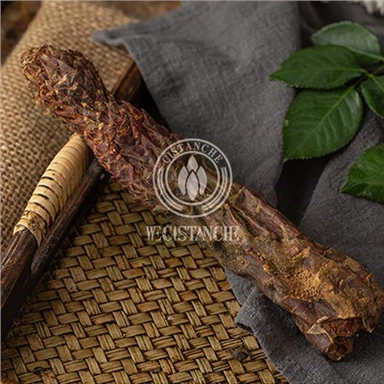
Cistanche is a parasitic plant that grows in the deserts of China, Mongolia, and Tibet. It has been used in traditional Chinese medicine for centuries to treat a variety of health conditions. Recent scientific studies have identified several potential health benefits associated with its use. In this brief, we will explore the effects of Cistanche on human health.
Anti-aging effects
One of the most well-known effects of Cistanche is its anti-aging properties. This is due to the plant's high content of phenylethanoid glycosides (PhGs), which have been shown to have antioxidant and anti-inflammatory effects. These properties help to protect the body from the damage caused by free radicals, which are molecules that can cause cellular damage and contribute to the aging process.

Studies have shown that Cistanche extract can help to improve cognitive function and memory in aging rats, suggesting that it may have similar benefits for humans. Additionally, it has been found to improve skin elasticity and reduce the appearance of wrinkles in human subjects.
Immune system support
Cistanche has been found to have immune system-supporting properties. Studies have shown that it can stimulate the production of white blood cells, which are key components of the immune system. Additionally, it has been found to have anti-inflammatory effects, which can help to reduce the risk of infections and other inflammatory conditions.
Sexual health benefits
Cistanche has long been used in traditional Chinese medicine as a treatment for sexual dysfunction. Recent studies have found that it may have several sexual health benefits, including:
Increased libido: Cistanche has been found to increase sexual desire in both male and female rats.Improved erectile function: In a study of male rats with erectile dysfunction, Cistanche was found to have an erectile function and increased nitric oxide levels, which play a key role in the development of an erection.Increased sperm count: In a study of male rats, Cistanche was found to increase sperm count and improve sperm quality.Anti-cancer properties
Several studies have found that Cistanche may have anti-cancer properties. It has been found to inhibit the growth of several types of cancer cells, including lung, liver, and breast cancer cells. Additionally, it has been found to have antioxidant and anti-inflammatory effects, which can help to reduce the risk of cancer.
Anti-fatigue effects
Cistanche has been found to have anti-fatigue effects. In a study of mice, it was found to improve endurance and reduce fatigue by increasing the production of ATP, which is the primary source of energy for cells. Additionally, it has been found to reduce the levels of lactic acid in the blood, which can contribute to fatigue.
Cardiovascular health benefits
Cistanche has been found to have several cardiovascular health benefits. It has been found to reduce blood pressure and improve blood lipid levels, which can help to reduce the risk of cardiovascular disease. Additionally, it has been found to improve endothelial function, which plays a key role in the development of cardiovascular disease.
Neuroprotection
Recent studies have found that Cistanche may have neuroprotective properties. It has been found to protect neurons from damage caused by oxidative stress, which can contribute to the development of neurodegenerative diseases such as Alzheimer's and Parkinson's disease.
In conclusion, Cistanche has several potential health benefits, including anti-aging effects, immune system support, sexual health benefits, anti-cancer properties, anti-fatigue effects, cardiovascular health benefits, and neuroprotective properties. While more research is needed to fully understand the effects of this plant on human health, the available evidence suggests that it may be a useful addition to a healthy lifestyle