The Serum Level Of IL-31 in Patients With Chronic Kidney Disease-Associated Pruritus: What Can We Expect?
Dec 08, 2023
Abstract: Chronic-kidney-disease-associated pruritus (CKD-aP) is one of the most common and burdensome dermatological symptoms affecting patients undergoing dialysis, and its etiopathogenesis has still not been fully discovered. This study was designed to investigate the possible contribution of interleukin-31 (IL-31) to the pathogenesis of itch in patients undergoing maintenance hemodialysis (HD). We evaluated the serum level of IL-31 in HD patients with pruritus, in HD patients without pruritus and in healthy controls, as well as its correlation to the severity of itch. The study enrolled 175 adult subjects. The participants were divided into three groups. Group A included 64 patients on maintenance HD with CKD-aP, Group B included 62 patients on maintenance HD not reporting CKDaP and Group C included 49 healthy controls. Pruritus severity was assessed using the Numerical Rating Scale (NRS), and the serum levels of IL-31 were measured. The results showed that the IL-31 serum level was significantly higher in the itchy group (p < 0.001) in comparison to the patients free from pruritus. Moreover, a marginal trend towards significance (r = 0.242, p = 0.058) was observed between the IL-31 serum level and itch intensity. Our study supports earlier findings on the extended role of IL-31 in the development of CKD-aP.
Keywords: interleukin-31; chronic-kidney-disease-associated pruritus; hemodialysis patients; renal failure

Key Contribution: Elevated serum interleukin-31 (IL-31) levels were found in patients suffering from CKD-aP in comparison to both non-itchy hemodialysis patients and healthy controls. Therefore, this study points out the possible contribution of IL-31 to the pathogenesis of itch in patients undergoing maintenance hemodialysis.
1. Introduction
Chronic kidney disease-associated pruritus (CKD-aP) is one of the most common and burdensome dermatological symptoms affecting patients undergoing dialysis. The prevalence of CKD-aP has been very variable over the years, yet according to the most comprehensive observational study of hemodialysis (HD) that included patients from 12 different countries, approximately 40% of patients with end-stage renal disease (ESRD) report moderate-to-severe pruritus [1]. So far, conducted studies have unequivocally proven that this condition not only hurts sleep, mood, daily activities and quality of life (QoL), but it also increases the mortality risk of HD patients [2,3]. Despite the high international prevalence, this problem seems to be markedly underestimated in clinical practice. The reason for this trend may be the lack of knowledge regarding effective therapies for CKD-aP [4]. Despite the long-standing studies and many suggested theories,the complex etiopathogenesis of CKD-aP has still not been fully discovered. Among the most important factors contributing to the development of CKD-aP, the following ones can be mentioned: uremic toxins (UTs), immune dysfunction, altered opioid transmission, skin dryness (xerosis), neuropathy, dialysis modality and its parameters [5]. Thereby, gold-standard therapy in this condition remains unclearly defined, and determining an effective clinical approach is still a challenge for dermatologists and nephrologists. CKD-aP is often recurrent and does not respond to available therapeutic methods. Further research in the field of the pathophysiology of CKD-aP may lead to a revolution in the therapeutic management of HD patients suffering from pruritus.
Reduced renal function in patients with chronic kidney disease (CKD) precludes the proper elimination of various metabolites, which are known as UTs. Recently, more and more studies indicate the key role of UTs in the progression of CKD and its wide range of severe complications. In the list of medium molecules classified as UTs, a few interleukins can be found, namely interleukin-10, -18, -1β and -6 [6]. Therefore, the role of the immune system seems to play a vital role in CKD-aP. Some studies point out a deranged balance of T helper (TH) cell differentiation towards Th1 predominance in patients with CKD-aP, which allows one to consider this condition as a systemic inflammatory phenomenon. This hypothesis was supported by the elevated serum levels of the C-reactive protein (CRP) and the inflammatory cytokines interleukin (IL)-2 and IL-6 in HD patients with pruritus versus those free from pruritus [7,8].

Supportive Service Of Wecistanche-The largest cistanche exporter in the China:
Email:wallence.suen@wecistanche.com
Whatsapp/Tel:+86 15292862950
Shop For More Specifications Details:
https://www.xjcistanche.com/cistanche-shop
CLICK HERE TO GET NATURAL ORGANIC CISTANCHE EXTRACT WITH 25% ECHINACOSIDE AND 9% ACTEOSIDE FOR KIDNEY INFECTION

Interleukin-31 (IL-31) is a T-cell-derived cytokine that takes part in the symptomatology of pruritus, and both IL-31 and its receptor have become potential therapeutic targets for a range of pruritic disorders [9]. It was found that IL-31 signaling through a heterodimeric receptor complex composed of an IL-31Rα subunit and an oncostatin M receptor β subunit (OSMRβ), expressing on the keratinocytes and the epithelial cells, induces severe dermatitis and pruritus in transgenic mice [10]. Moreover, the serum level of IL-31 was elevated in patients with atopic dermatitis. Performed studies revealed a positive correlation between the IL-31 serum level and the Scoring Atopic Dermatitis Index (SCORAD) and also between IL-31 levels and the severity of pruritus-[11–13]. Similar findings were reported in clinical studies concerning other pruritic dermatological diseases, such as prurigo nodularis and psoriasis [14,15]. Although the majority of so-far published studies reported an increased serum IL-31 level in patients suffering from CKD-aP, the correlation between IL-31 and itch intensity is still not clear [16–19]. Therefore, this study was designed to investigate the possible contribution of IL-31 to the pathogenesis of itch in patients undergoing maintenance HD. We aimed not only to evaluate the serum level of IL-31 in HD patients with pruritus, in HD patients without pruritus and in healthy controls, but also to correlate the serum level of IL-31 with itch severity. To evaluate the characteristics and the intensity of the itch, the Numerical Rating Scale (NRS) and a new instrument-the Uraemic Pruritus in Dialysis Patient (UP-Dial) questionnaire-were used.
2. Results
In the group of HD patients suffering from CKD-aP, 50% were males, and the average age was 61.1 ± 15.9 years. The mean NRS score was 4.9 ± 2.2 points. According to the NRS cut-offs, mild pruritus was reported in 14.5% of the cases, moderate in 59.7%, severe in 22.6% and very severe in 3.2%. The mean UP-Dial score was 14.2 ± 9.8 points. In 58% of the CKD-aP patients, itch interfered with their sleep, and only 29% did not report the influence of itch on the following activities: work or study, social interaction, mood or any sexual activities. The mean serum level of IL-31 was 679.9 ± 1112.3 pg/mL in a group of HD patients reporting CKD-aP, 176.1 ± 290.7 pg/mL in a group of HD patients not suffering from CKD-aP and 57.3 ± 65.1 pg/mL in a group of healthy controls (Figure 1). The IL-31 serum level was significantly higher in the itchy group (p < 0.001) in comparison to the patients free from pruritus. Moreover, there was a significant difference (p < 0.001) in IL-31 serum levels between HD patients with and without pruritus and healthy controls (p < 0.001 and p = 0.019, respectively).

Figure 1. Serum level of IL-31 in study groups. IL-31-interleukin-31, Group A-patients with ESRD on maintenance HD reporting CKD-aP, Group B-patients with ESRD on maintenance HD not reporting CKD-aP, Group C-healthy contr

Despite the above-mentioned results, a marginal trend towards significance (r = 0.242, p = 0.058) was observed between the IL-31 serum level and the worst itch intensity during the last 3 days as assessed by the NRS (Figure 2). The UP-Dial questionnaire total score strongly correlated with the NRS (r = 0.399, p = 0.001). Additionally, each domain of the UP-Dial showed a significant correlation with the NRS scores (detailed data not shown). However, the correlation between the serum level of the IL-31 and the UP-Dial total score was not statistically significant
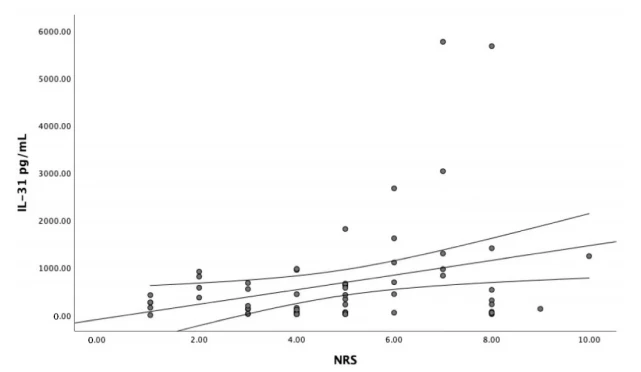
Figure 2. Dependence between IL-31 serum levels and NRS score (r = 0.242, p = 0.058). NRS-Numerical Rating Scale, IL-31-interleukin-31, circles-the serum level of interleukin-31.