Exploring The Hypoxia Pathway In URSA: How Bushen Guchong Decoction May Regulate Decidual NK Cells Via KLF2 (With A Supplier Perspective On Cistanche Extract)
Jul 20, 2026
Abstract
Objective: To investigate functional abnormalities of natural killer (NK) cells at the maternal–fetal interface in unexplained recurrent spontaneous abortion (URSA) and to explore upstream regulatory mechanisms-particularly the hypoxia pathway and the transcription factor Krüppel-like factor 2 (KLF2)-thereby clarifying potential mechanisms of Bushen Guchong Decoction (a traditional Chinese herbal formula) in URSA.
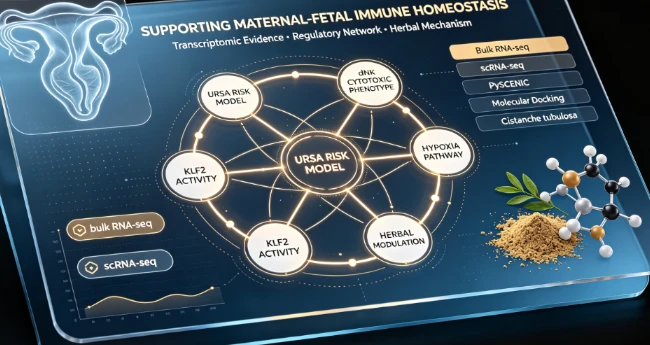
Methods: We integrated transcriptomic evidence from bulk RNA-seq and single-cell RNA-seq (scRNA-seq) to systematically compare immune-cell abundance and NK-cell functional states between URSA and normal pregnancy decidual tissue. Standard bioinformatics workflows were applied (Seurat, DESeq2, ClusterProfiler, UCell, limma, PySCENIC) for quality control, differential expression, pathway enrichment, and transcription-factor activity scoring. We also used molecular docking to examine interactions between key constituents of Bushen Guchong Decoction and KLF2.
Results: URSA decidual tissue showed a higher relative abundance of decidual NK (dNK) cells, and these dNK cells displayed a more cytotoxic/activated phenotype. scRNA-seq-based pathway scoring indicated significant enhancement of the hypoxia pathway in URSA dNK cells. Transcription-factor regulon analysis suggested that KLF2 activity is significantly elevated in URSA dNK cells and positively correlated with hypoxia-pathway activity. Targets predicted for serum-absorbed components of Bushen Guchong Decoction overlapped significantly with dNK differential genes, with enrichment pointing toward regulation of hypoxia-associated pathways and transcriptional programs including KLF2. Docking suggested strong binding potential between major formula constituents and KLF2 protein.
Conclusion: In URSA, dNK-cell hypoxia signaling is activated, and KLF2 appears to be a key regulatory factor linked to this activation. Bushen Guchong Decoction may exert therapeutic potential by modulating the KLF2–hypoxia axis, improving dNK functional balance and maternal–fetal immune homeostasis.
Keywords: Herb Extract For Recurrent Miscarriage Support; Herb Extract For Immune Balance; Herb Extract For Hypoxia Pathway; Herb Extract For Pregnancy Immune Tolerance; Bushen Guchong Decoction; Decidual NK cells; KLF2; Hypoxia signaling; URSA.

1. Background: Why URSA Needs a Mechanism-Driven Approach
URSA typically refers to two or more consecutive miscarriages before 20 weeks' gestation where standard clinical workups do not identify a clear cause. Immune dysregulation is widely viewed as a major contributor to URSA pathogenesis, especially at the maternal–fetal interface.
During early pregnancy, decidual NK (dNK) cells are the dominant lymphocyte population in decidua (often reported as a very large proportion of decidual lymphocytes). dNK cells are not simply "killer cells"-they also participate in immune tolerance, tissue remodeling, and support of placental development. A practical way to view URSA risk is that the "regulatory" vs. "cytotoxic" balance of dNK functional states may shift in a way that destabilizes implantation and placentation.
A second key background concept is physiological hypoxia in early pregnancy. Hypoxia-related signaling (often mediated by HIF-related programs) helps coordinate placental development and immune adaptation. But when hypoxia signaling becomes excessive or dysregulated, it may contribute to pathology.

2. Study Design (Data + Tools) in Plain Business-Readable Language
To explain "what changes in URSA" and "what might herbs modulate," the study integrates two transcriptomic layers:
2.1 Datasets
Bulk RNA-seq (SRA: SRP052612): 10 URSA vs 10 normal pregnancy decidual tissue samples.
scRNA-seq (GSA: CRA002181): 2 URSA vs 3 normal pregnancy decidual tissue samples.
2.2 Bioinformatics workflow (high level)
Bulk RNA-seq: QC → alignment → counts → differential expression (DESeq2) → pathway enrichment (GSEA via ClusterProfiler).
Single-cell: Seurat preprocessing/integration → clustering/annotation → NK subset extraction → pathway activity scoring (UCell Hallmark sets) → differential pathway testing (limma) and GSEA validation.
Regulatory inference: PySCENIC to infer regulons and quantify transcription factor (TF) activity at single-cell resolution.
Herbal mechanism mapping: predicted targets of absorbed constituents intersected with NK differential genes; enrichment and PPI networks constructed; molecular docking performed against KLF2.

3. Core Findings (From Shallow to Deep)
3.1 URSA shows increased dNK abundance and a more cytotoxic program
Across multiple immune deconvolution approaches applied to bulk RNA-seq, dNK cell relative abundance increases in URSA, and pathways linked with NK cytotoxicity and proliferation appear enriched.
Business takeaway: URSA is not only "inflammation" in general-there is a measurable shift in a specific immune cell compartment relevant to implantation.
3.2 Hypoxia pathway is strongly activated in URSA dNK cells (single-cell evidence)
When focusing on NK cells in scRNA-seq, pathway scoring shows hypoxia signaling is significantly higher in URSA dNK cells, supported by GSEA confirmation.
Interpretation: In URSA, dNK cells are more likely to sit in a hypoxia-associated transcriptional state, which may push them toward an unfavorable functional balance (e.g., excessive activation/cytotoxicity).
3.3 KLF2 emerges as a key TF associated with hypoxia activity in URSA dNK cells
Regulon-level analysis indicates:
KLF2 activity is higher in URSA dNK cells.
KLF2 activity positively correlates with hypoxia pathway activity.
This supports a model where KLF2 is not just "present," but functionally active in the regulatory network linked to hypoxia in decidual NK cells.

4. Herbal Formula Hypothesis: Bushen Guchong Decoction and the KLF2–Hypoxia Axis
4.1 Formula composition (as provided)
Bushen Guchong Decoction includes: Cuscuta, Taxillus, Eucommia, Ejiao, Scutellaria, Chenpi, Atractylodes, Licorice.
UHPLC-MS/MS identified 34 absorbed constituents in medicated plasma (pre-study basis). Predicted targets for these constituents significantly intersect with dNK differential genes, and functional enrichment points to hypoxia-related pathways and TF regulation including KLF2.
4.2 Docking supports potential KLF2 binding by key constituents
Docking suggests strong binding potential between representative constituents and KLF2 (with some components ranking higher than others in affinity in the provided results narrative).
Important nuance: docking is a hypothesis generator-it supports plausibility but does not prove in vivo mechanism.
5. Where Cistanche Fits Naturally
Many reproductive- and immune-positioned herbal products are built around kidney-tonifying and anti-oxidative stress concepts in traditional practice, alongside modern pathways such as oxidative stress and neuro-/immuno-protection.

CISTANCHE EXTRACT SUPPLEMENTS FOR IMPROVING KIDNEY AND PROSTATE HEALTH

Supportive Service Of Wecistanche-For more details about cooperation
Email:wallence.suen@wecistanche.com
Cistanche (Rou Cong Rong, typically Cistanche tubulosa) is frequently marketed as a tonic herb; the Wecistanche product pages describe extract powders with active constituents such as echinacoside and verbascoside (acteoside), plus total phenylethanoid glycosides and flavonoids. They list typical commercial specifications (brown powder, ≤100 mesh, oral use, suggested 3–5 g/day, drum packaging, shelf life 3 years) suitable for B2B buyers evaluating supply form and logistics. (xjcistanche.com)
From a mechanism narrative standpoint, those pages emphasize antioxidant-related and functional-support language and discuss learning/memory and neuroprotective mechanisms in experimental contexts. (xjcistanche.com)
How to integrate Cistanche into a URSA-oriented R&D story (without overclaiming):
Herb Extract For Oxidative Stress Support: hypoxia and oxidative stress often co-occur in inflammatory microenvironments; antioxidants are a common upstream theme.
Herb Extract For Immune Homeostasis: dNK balance is an immune homeostasis topic; ingredient positioning can focus on "immune modulation support."
Herb Extract For Kidney-Tonifying Tradition (TCM): in traditional context, "kidney" relates to reproductive vitality; for international markets, translate carefully to "reproductive vitality support," not disease treatment.

6. Conclusion
This integrated bulk + single-cell transcriptomic analysis supports a coherent URSA immune model: dNK cells increase in abundance and show an activated/cytotoxic tendency, with hypoxia signaling elevated at the single-cell pathway level. Within that hypoxia-associated program, KLF2 stands out as a key transcriptional regulator correlated with hypoxia activity. Bushen Guchong Decoction may influence URSA outcomes by modulating the KLF2–hypoxia axis and improving dNK functional balance.
For ingredient companies, Cistanche extract (Cistanche tubulosa) can be positioned as a standardized herb extract within broader "immune balance + oxidative stress support" solutions, with clear industrial specs and export-ready formats described by suppliers. (xjcistanche.com)
References / Sources
Wecistanche product page (Cistanche extract for anti-Alzheimer's positioning; composition/specs and mechanism narrative). (xjcistanche.com)
Wecistanche product page (Cistanche for kidney disease/nourishing kidney; composition/specs and general effects narrative). (xjcistanche.com)
URSA & dNK background and hypoxia in pregnancy (peer-reviewed context):
von Woon et al., Hum Reprod Update, 2022 (systematic review on uterine NK cells). (Included in your reference list)
Garcés-Lázaro et al., Front Immunol, 2022 (NK cells under hypoxia). (Included in your reference list)
Dimitriadis et al., Nat Rev Dis Primers, 2020 (recurrent pregnancy loss). (Included in your reference list)