Wealth Beneath The Tamarisk Roots: A True Story Of Cistanche Tubulosa Growers
Nov 13, 2026
Along the southern edge of the Taklamakan Desert, wind carries yellow sand from the foot of the Kunlun Mountains northward. In villages near Yutian and Hotan counties, sand dunes and farmland are separated only by a thin fence of tamarisk bushes. Decades ago, locals called the desert a curse. Today, the same sand grows something quiet and valuable: Cistanche tubulosa.

It has no real leaves, no independent roots, and almost no presence above ground until harvest. It hides beside the roots of Tamarix - commonly called tamarisk or red willow - feeding silently underground. Local people call it "Dayun," and the market knows it as "desert ginseng."
1. Eziz and His First Eight Mu of Sand
Eziz Matrozi still remembers 2009. In Tawuhazi Village, Aytoghrak Township, Yutian County, he rented eight mu of sandy land.
Neighbors laughed. "You think money grows in sand?"
He did not argue. First, he planted tamarisk. The shrub tolerates alkali soil, drought, and burial by sand. With basic drip irrigation, it builds a root network within two or three years. Once the tamarisk survives, the sand stops moving. Only then can you talk about "inoculating Cistanche."
Cistanche tubulosa is a parasite with a strict condition: its tiny seeds will not germinate on their own. They must touch the fine feeder roots of tamarisk and sense chemical signals from the root exudates. Only then do they wake up, penetrate the root, and form a structure called the "parasitic disk." From that disk, the fleshy stems can be harvested again and again for several seasons.
"In the first year we plant tamarisk. In the second year, we open trenches and inoculate. In the third year, we finally take a spade and check," Eziz says.
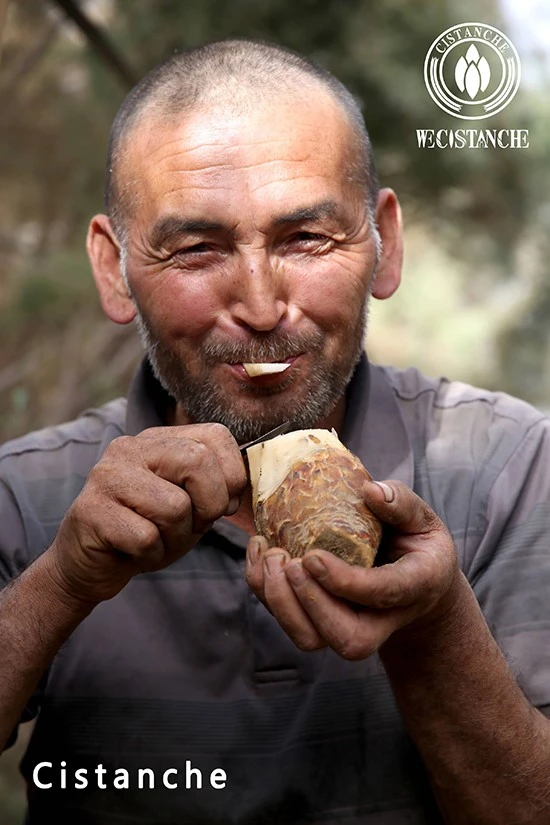
The first Cistanche he pulled out was plump, pale, and covered in scale-like leaves, like a small arm pulled from the earth. He brought it home. His wife could not believe it. "This thing sells?"
It does. After drying and slicing, the samples are tested for markers such as echinacoside, acteoside, and total phenylethanoid glycosides. Pharmaceutical factories and extract manufacturers both want it.
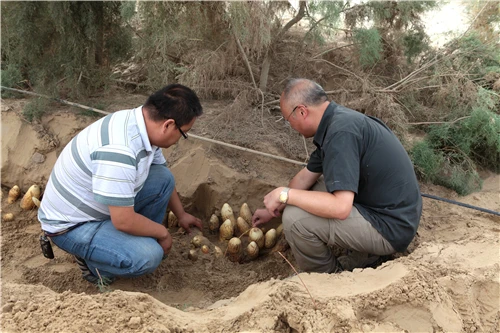
Cistanche tubulosa: a nourishing legend that crosses regions
2. Not Mining, but Tending Roots
Many outsiders think Cistanche farming is luck. In reality, the worst mistake is greed.
Every experienced grower knows one rule: never damage the main tamarisk root.
Workers kneel by the bush, brush away loose sand with a small shovel, expose the creamy-white stem, cut it cleanly near the parasitic disk, and carefully refill the trench. The motion looks gentle, almost surgical. A heavy hand can break the host root. If the root system is hurt, that clump may refuse to feed new Cistanche next year.
"This plant does not let you take and leave. It makes you deal with the root," says Maimaitiming, another local grower who later managed 500 mu of sandy fields.
He cares about two things: rejuvenating old tamarisk by coppicing, and preserving the parasitic disk. Coppicing means cutting back part of the mature shrub so it pushes out more fine roots. More fine roots mean more inoculation points. Keeping the disk means one inoculation can produce harvests for three to four years.
Mechanization changed the math. Beidou navigation plants tamarisk in straight lines. Inoculation machines open trenches and spray seed suspension near the roots. In demonstration fields, fresh yield rose from about 80 kg per mu to 200 kg per mu, while labor cost dropped by around 400 yuan per mu.
Still, no machine replaces the eyes that read sand, roots, and weather.
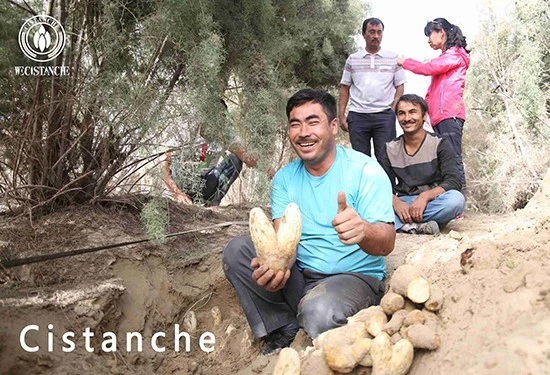
Cistanche tubulosa - a bumper harvest for farmers
Click here to view Cistanche Tubulosa Extract Natural Supplement Powder
【Ask for more】 Email:cindy.xue@wecistanche.com / WhatsApp: 0086 18599088692 / WeChat: 18599088692
3. From Begging the Sand to Earning from the Sand
In Ying'airike Township, Hotan County, the story of Tursun Juma is typical.
He used to grow cotton and wheat. A single sandstorm could bury the seedlings. Most years, the harvest only covered the family's food. After 2010, the township allocated sandy plots to households: first, grow tamarisk, then inoculate Cistanche. His income moved from 70,000 yuan to 100,000 yuan, and then he aimed higher.
"The tamarisk holds the sand. The Cistanche holds our life together," he says.
In Yutian, he is not alone. Across the county, tens of thousands of mu are now under tamarisk and saxaul with Cistanche inoculation. About 30 percent of village households take part. Spring pruning, autumn digging, winter sorting - even elderly residents and women can work.
The desert is also retreating. Where sandstorms once swallowed field ridges, tamarisk walls now stall the dunes. The hard science built over decades by Peking University teams and local researchers - artificial inoculation, frost protection, high-yield management, disk-preserving harvest - finally became practical know-how in farmers' hands.
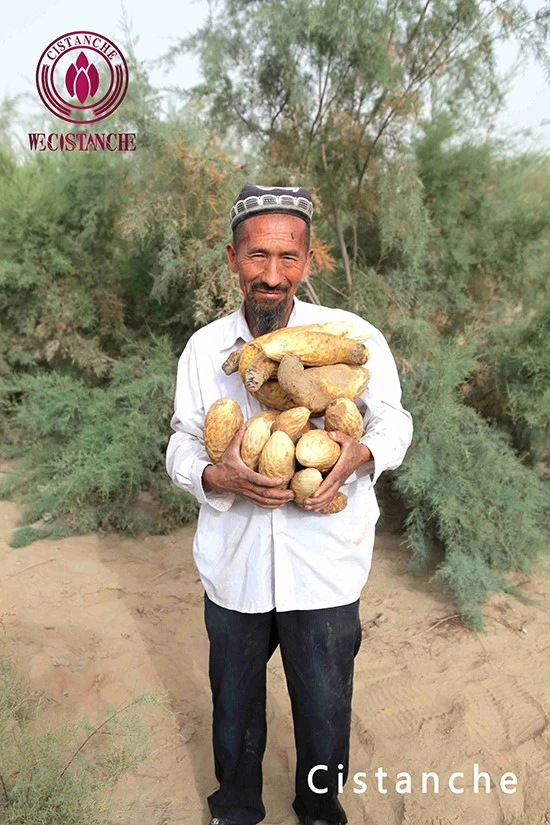
Harvest of Cistanche tubulosa
4. The Industry Behind One Stem
Fresh Cistanche cannot simply wait for buyers.
A good base manages it like this:
Sort fresh stems the same day; remove rotten tops and cracked pieces.
Use heat treatment to deactivate enzymes and protect active compounds.
Slice and dry under controlled temperature.
Test for moisture, heavy metals, pesticides, and marker compounds.
Split the output: pharmaceutical-grade slices go to traditional medicine factories; extract-grade material goes to health products, tablets, teas, and functional drinks.
Companies such as Amway and Jingpai entered the chain, linking seeds, farming, harvesting, processing, and extraction. Yutian's Cistanche extract now travels inside health products to the United States, Japan, and Southeast Asia. Domestically, it becomes Cistanche wine, capsules, solid beverages, and medicinal-food kits.
For growers, the biggest change is standards:
Harvest only in autumn and winter, before flowering.
Keep stems above 15 cm.
Trace every batch to a field and a farmer.
Reject material with weak active-compound content, no matter how big the root looks.
"In the past we sold raw material to whoever paid cash. Now we sign base contracts, get floor prices, and meet lab specs," Eziz says. "Even the sand can have a brand."
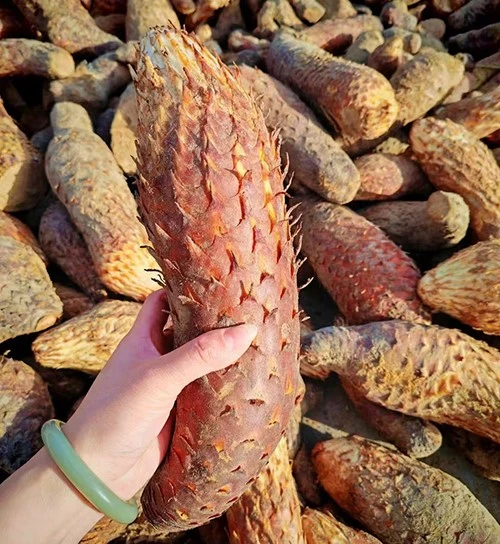
cistanche benefits for men
5. The Younger Hand on the Spade
Zhang Yuanjie came from inland China to Hotan years ago to source raw material. His first trial plot was 300 mu. For five or six years, sandstorms buried the tamarisk seedlings; he replanted again and again until he found the right inoculation depth, trench width, and irrigation rhythm.
Today his son, Zhang Hengjia, runs a 3,000-mu base.
The younger generation does not only count this year's profit. They count a twenty-year ledger:
Tamarisk spends three years building roots before real returns.
Cistanche becomes stable only around the fourth year.
Processing, testing, and traceability require continuous investment.
But once the chain closes, greener sand brings tighter customers.
"My father fought the desert. I fight batch variance," Zhang Hengjia jokes.
His phone stores sampling photos from every plot: which clump has dense disks, which stem tests lower in sweetness, which row needs coppicing next season. Desert farming finally has a sense of data.
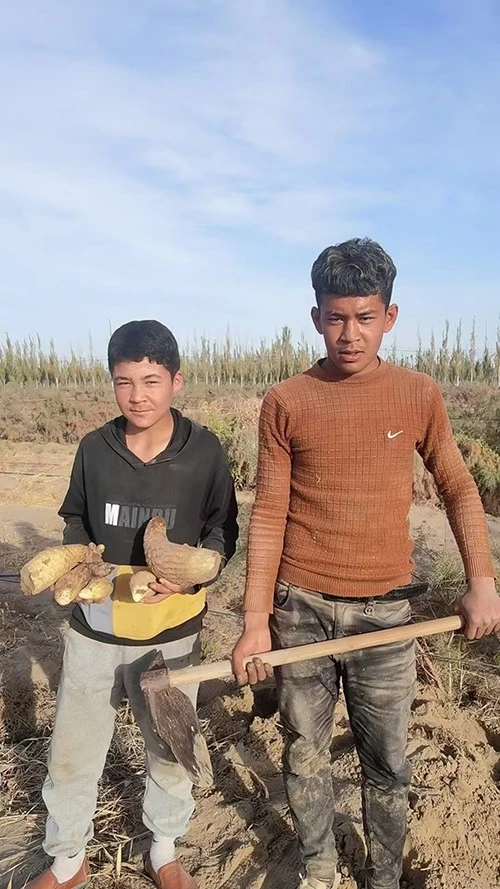
The villagers of Hotan Village in Xinjiang are digging and harvesting Cistanche tubulosa
6. The Wealth Is Not in the Sand, but in the Relationship Between Root and Human
The miracle of Cistanche tubulosa is not that it is expensive. It is that it forces people to live differently.
If you want something from the sand, you must first give something back to the sand.
If you want to cut the Cistanche, you must first protect the tamarisk.
If you want to sell far away, you must farm cleanly.
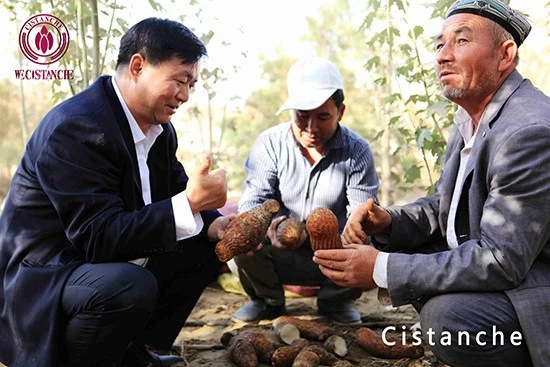
It teaches growers one quiet lesson: parasitism is not plunder. Tamarisk fixes the sand. Cistanche returns income. People guard the land, and the land feeds the people.
On harvest day, Eziz squats by a tamarisk clump, brushes the sand away, and exposes a cluster of plump white stems. The wind blows the red tamarisk flowers sideways. He says softly:
"Others see medicine. I see a letter the tamarisk writes back to our family."
The Taklamakan is still there. The wind is still there.
But along the sand line, a green wall now stands - and beneath it grows the confidence of a generation that refused to stay poor.