Will This Ancient Desert Ginseng Be The Next Potential Source Of Medicinal And Edible Resources?
Jun 13, 2024
In September 2023, Cistanche deserticola was officially included in the list of medicinal and edible sources. It is a famous traditional Chinese medicinal herb commonly known as Dayun. Cistanche deserticola is a parasitic plant with extremely high medicinal value, belonging to the genus Cistanche in the family Araceae.

Desert living cistanche
The ancient "desert ginseng"
As a parasitic plant, Cistanche deserticola mainly parasitizes the roots of flowering trees such as Tamarix, Haloxylon ammodendron, and Haloxylon ammodendron. Due to its extremely high medicinal value, it is known as "desert ginseng". In ancient China, many nourishing preparations and spirits contained this medicinal herb. Cistanche deserticola is recorded in the oldest surviving herbal classic, the Shennong Materia Medica Classic (around 100 AD). Afterward, it was recorded in many famous Chinese herbal medicine classics from different dynasties, including the Treatise on Medicinal Properties and the Compendium of Materia Medica. It is a prescription drug commonly used throughout Chinese history to improve chronic kidney disease. The Chinese Pharmacopoeia also records that Cistanche deserticola tablets and Huangjiu steamed Cistanche deserticola tablets can be used as the main decoctions for clinical use. After steaming rice wine, the anti-aging and kidney yang tonifying effects are enhanced.
Guanhua Cistanche is a unique species in China, and it is also the most common variety in the current market. Along with Guanhua Cistanche, it is recognized as a basic plant in the Chinese Pharmacopoeia. Inner Mongolia Autonomous Region is the highest-producing area of this variety, and the Cistanche deserticola produced in Ningxia Hui Autonomous Region has only been used locally in recent years. Although Cistanche deserticola is a conventional traditional medicinal herb, in recent years, due to excessive development and destruction by parasitic plants, its population has been decreasing and its distribution area has been continuously shrinking. To protect resources, it has been included in the national second-level protected species list.
modern research
Modern research has found that the main chemical components of Cistanche deserticola include phenylethanol glycosides, iridoid terpenoids and their glycosides, lignan glycosides, oligosaccharides and oligosaccharide esters, polysaccharides, mannitol, and other elements, which endow Cistanche deserticola with many health benefits. Modern pharmacological research has shown that the main functions of Cistanche deserticola involve endocrine regulation, neuroprotection, immune regulation, anti-inflammatory, and liver protection.

Main Chemical Constituents of Cistanche deserticola
(1) Alzheimer's disease (AD)
Research has shown that the content of phenylethanol glycoside (PhG) extracted from Cistanche deserticola exceeds 80%. PhGs, as the main active ingredient of Cistanche deserticola, have a significant impact on vascular dementia and have a positive effect on the prevention and treatment of AD. A 2019 animal study showed that Cistanche deserticola extract could improve cognitive function in experimental Alzheimer's disease and exert potential neuroprotective effects, mainly involving antioxidant stress and anti-apoptotic effects. Therefore, Cistanche deserticola extract may become a candidate drug for clinical trials of Alzheimer's disease.

Benefits of cistanche tubulosa-Anti Alzheimer's disease
(2) Enhance immunity
In some regions of China and Japan, consuming Cistanche deserticola is believed to have a longevity effect. The extract of Cistanche deserticola can activate the phagocytic function of mouse macrophages and enhance the body's immunity. Carbohydrates account for a high proportion of the quality of dried Cistanche deserticola. The polysaccharides of Cistanche deserticola are closely related to enhancing immunity. Galactol is one of the monosaccharides in Cistanche deserticola that has a laxative effect. Individual compounds such as oligosaccharides have a perfect effect on the activity of the mouse spleen, increasing the phagocytic activity of macrophages and stimulating the production of antibodies. In 2014, researchers found that extracts of Polygonum multiflorum can antagonize immune-related aging in SAM-P8 mice and prolong their lifespan. Moreover, supplementing with extracts from flowers and plants in the diet can reduce peripheral memory T cell levels and increase immature T cell levels. In addition, the water extract of Cistanche deserticola has been shown to prevent bone loss caused by ovarian hormone deficiency by regulating some bone metabolism-related genes.

Benefits of cistanche tubulosa-Immprove immunity
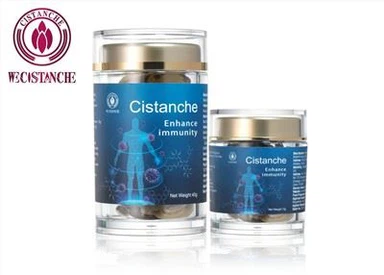
Click here to view Cistanche Enhance Immunity products
【Ask for more】 Email:cindy.xue@wecistanche.com / Whats App: 0086 18599088692 / Wechat: 18599088692
(3) Antioxidant and anti-aging effects
Cistanche deserticola exhibits antioxidant, free radical scavenging, and anti-apoptotic activities through different mechanisms. Research has shown that Cistanche deserticola has antioxidant activity, especially in clearing all types of free radicals in vivo and in vitro, enhancing the activity of antioxidant enzymes in vivo, and inhibiting the formation of peroxidized lipids and brown fat. Current research indicates that cell apoptosis or programmed cell death is determined by genetics and is associated with oxidation. PhGs in Cistanche deserticola are considered effective ingredients with antioxidant and anti-apoptotic activities. Its antioxidant mechanism is mainly related to free radical scavenging activity. PhG compounds often contain varying amounts of phenolic hydroxyl groups and can serve as hydrogen donors for reducing free radicals, thereby achieving the goal of scavenging free radicals. According to reports, Cistanche deserticola has two main ways of clearing free radicals: directly participating in the clearance of free radicals or blocking the production of free radicals, regulating antioxidant enzymes related to free radical metabolism in the body, such as SOD, CAT, GPX, etc. On the other hand, polysaccharides from Cistanche deserticola can prevent apoptosis of cerebellar granule neurons by inhibiting the activity of caspase-3 and caspase-8. Therefore, Cistanche deserticola has good antioxidant and anti-aging abilities.

Desert living cistanche-Antioxidant
(4) Regulating gut microbiota
Many studies have reported that polysaccharides can regulate the structure and composition of gut microbiota, promote the growth of probiotics, and play an important role in maintaining intestinal health. The biological activity test results indicate that the neutral polysaccharides obtained from Cistanche deserticola can significantly promote the growth of Bacteroides and some probiotics, such as Lactobacillus casei, Lactobacillus plantarum, and Lactobacillus reuteri, which help maintain intestinal homeostasis. Phenylethanolamine is also the main active ingredient of Cistanche deserticola, and the gut microbiota plays an important role in the metabolism and pharmacology of Cistanche deserticola. An animal experiment has confirmed that phenylethanolamine can be metabolized into a series of small molecule compounds 3-HPP and HT under the action of gut microbiota, which have a protective effect on the liver. Another study found that phenylethanolamine can regulate the structure of rat gut microbiota, reduce the relative abundance of Firmicutes and Bacteroidetes, and alter the functional pathways of gut microbiota. In summary, the gut microbiota may play an important role in the metabolism of Cistanche deserticola after ingestion.
(5) Anti-inflammatory
Cyclone ether terpenes are one of the main chemical components of Cistanche deserticola, which have antibacterial, anti-inflammatory, and analgesic effects. Researchers conducted qualitative analysis on the chemical components of the flowers and lignified stems of desert deserticola, and found that the content of cyclic ether terpenoids in the flowers and stems of deserticola was higher than that in the stems. At present, about 27 types of cyclic ether terpenoids have been isolated from Cistanche deserticola, and their structures contain glucose monoglycosides, which promote the research of Cistanche deserticola in neuroprotection, liver protection, and hypoglycemic and lipid-lowering aspects. Cistanche deserticola is a traditional Chinese medicine with high medicinal value in the history of traditional Chinese medicine. It has multiple nutritional and functional characteristics and is expected to become the next potential source of medicinal and food homology.

Desert living cistanche-anti-inflammatory