A Man’s Rejuvenation Formula: Cistanche + Bupleurum
Aug 20, 2026
Warm the Kidneys, Unbind the Mood, and Restore What Overwork Drains
Many men grow up with a silent rule: "Real men don't cry." But from a Traditional Chinese Medicine (TCM) perspective, emotions don't simply disappear when suppressed-they often shift into other kinds of imbalance.
TCM says "the Liver governs the free flow of Qi" (the body's functional energy) and is closely connected with emotional expression. There's also a classical linkage: "the Liver opens into the eyes; tears are related to Liver function." When feelings are repeatedly pushed down, the Liver's ability to "move and regulate" can become constrained-this is commonly described as Liver Qi stagnation (often translated as "Liver Qi constraint").
This isn't only about mood. In TCM physiology, the Liver also "governs the tendons" and is associated with the body's smooth functional responsiveness. So when emotional constraint persists, it may show up indirectly as fatigue, low motivation, tension, and reduced functional vitality-including issues many men care about but rarely talk about.
At the root of many male vitality concerns, TCM places great emphasis on the Kidneys.
Why TCM Focuses on the Kidneys for Male Vitality
In TCM, the Kidneys are the foundation of congenital vitality-a storehouse of Essence (Jing) and a source of Kidney Yang (warming, activating power) and Kidney Yin (nourishing, cooling support). Whether the imbalance is described as Kidney Yin deficiency or Kidney Yang deficiency, the end result can be a decline in functional resilience.
In modern life, two patterns commonly show up together and reinforce each other:
Kidney Yang insufficiency (low "warming/drive")
Liver Qi stagnation (emotional constraint, "stuck" regulation)
This is why many TCM-based formulations aim to "warm the Kidneys while soothing the Liver"-supporting both the body's core energy and the stress-emotion axis.
One classic product-logic example is Compound Cistanche Capsule (复方苁蓉胶囊), which contains Cistanche (Rou Cong Rong), Epimedium, Ginseng, Polygonatum, and Bupleurum (Chai Hu)-a five-herb strategy that combines warming + unblocking + rebuilding.

Supportive Service Of Wecistanche-For more details about cooperation
Email:wallence.suen@wecistanche.com
1) Formula Logic: Five Herbs, One Coherent Strategy (TCM-Friendly, Western-Readable)
Even with only five herbs, the roles are clearly structured-each supports a different part of the problem.
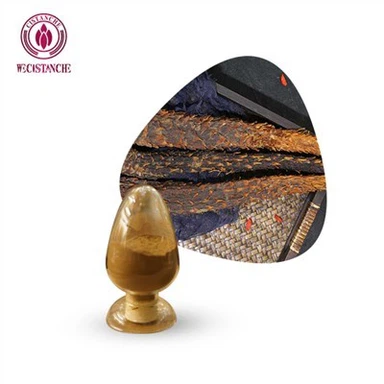
(1) Chief herb: Cistanche (Rou Cong Rong) - warm, nourishing support for Kidney Essence & Blood
Cistanche is traditionally described as warm in nature yet "moist" in character-meaning it tonifies without excessive dryness. It's often nicknamed "Desert Ginseng" in popular herbal culture.
In TCM language, it can:
Warm Kidney Yang
Nourish Essence and Blood
Moisten the intestines (supporting regularity)
Why does the "moistening" matter? Because some strong "warming" strategies can feel too drying for certain people. Cistanche is often positioned as warming but not harsh, which makes it attractive for long-term vitality-style products.
Also, TCM emphasizes that smooth bowel function supports smooth Qi movement-so the traditional "moisten the intestines" attribute is not only about comfort; it's part of a broader "keep the system flowing" philosophy.
For product developers: this is one reason consumers often ask how to take Cistanche to get the most effect-TCM logic cares about flow and regulation, not just a single isolated target.
(2) Deputy herb: Epimedium (Yin Yang Huo) - strong Kidney Yang support, strengthen tendons/bones
Epimedium is considered a classic "Kidney Yang" herb and is often described as more vigorous/activating.
In this pairing:
Epimedium provides the "engine" (strong warming/activation)
Cistanche provides supportive "fuel + moisture" (warm, nourishing, not overly drying)
Together they aim for warmth with balance-power without roughness.
(3) Assistant herbs: Ginseng + Polygonatum (Huang Jing) - rebuild Qi, support fluids, strengthen the middle
In TCM, the Spleen/Stomach system is responsible for transforming food into usable energy. When men are overworked, sleep-deprived, or chronically stressed, this system can weaken-so even "tonic" herbs may feel heavy if digestion is poor.
Ginseng: strongly supports Qi (drive, stamina) and helps generate fluids.
Polygonatum (Huang Jing): supports Qi and Yin, gentle and steady; often used to support endurance over time.
This pair helps the formula feel more complete and more tolerable, especially for people who need both energy and nourishment.
(4) Guide herb: Bupleurum (Chai Hu) - soothe the Liver, release constraint, lift clear Yang
Bupleurum is crucial here because it addresses the emotional-regulatory side:
Soothes Liver Qi constraint (helping mood, tension, "stuckness")
Helps lift clear Yang and support the upward distribution of functional energy
Prevents "tonics" from feeling cloying or stagnant by keeping movement in the system

2) What This Combination Is Traditionally Used For
This formula strategy is generally aimed at a combined pattern:
Kidney Yang deficiency + Liver Qi stagnation
Common TCM-style features may include:
Kidney Yang insufficiency signs
Reduced functional vitality
Feeling cold easily (cold hands/feet)
Soreness/weakness in lower back and knees
Fatigue, low drive
Liver Qi stagnation signs
Low mood, irritability, or emotional "flatness"
Sensation of tightness or fullness in chest/rib-side/upper abdomen
A feeling of discomfort that seems tied to stress
Tongue/Pulse (for TCM practitioners)
Tongue tends to be pale with thin white coating
Pulse may feel deep and/or wiry (often interpreted as internal deficiency + constraint)
3) Core Reminders (Safety & Real-World Use)
(1) Pattern differentiation is essential
This approach is designed for Kidney Yang deficiency with Liver constraint. It is not automatically appropriate for:
Yin deficiency with "empty heat"
Damp-heat patterns (especially in the lower burner)
Situations where there is deficiency but no constraint
Using the wrong warming strategy may worsen discomfort. In practice, consult a qualified professional-especially if symptoms are persistent or severe.
(2) Think "supportive regulation," not a standalone cure
Many product instructions (and responsible TCM clinicians) frame such formulas as supportive. For functional concerns, a comprehensive plan is often necessary: sleep, stress regulation, training, relationship/psychological support, and medical evaluation where indicated.
(3) Lifestyle determines whether you get the "most effect"
If you're asking how to take Cistanche for the most effective results, TCM would answer: you don't "take" your way out of chronic depletion.
Key supportive habits include:
Reduce long-term overwork and late nights
Moderate sexual activity (avoid repeated "overdraft")
Regular movement/exercise
Emotional expression and stress processing (don't bottle it up)
Marketing & R&D Angle: Why Cistanche (Especially Cistanche tubulosa) Fits Modern Vitality Products
For Western audiences, it helps to translate the TCM framework into a modern wellness narrative:
"Kidney Yang" can be described as metabolic drive, warmth, and functional activation.
"Liver Qi stagnation" maps well to stress-related tension, mood constraint, and reduced adaptability.
The formula's logic resembles a combined approach: support energy + support stress regulation + support utilization.
Our Factory Focus: Cistanche tubulosa Extract with Higher Active-Compound Potential
We operate a dedicated Cistanche extract supply chain and emphasize Cistanche tubulosa ("管花肉苁蓉"), a species widely used in modern Cistanche development.
Click to get more details about herb cistanche factory


According to our company profile and published capability description, our group reports an integrated Cistanche industry chain (cultivation, collection/storage, and GMP processing), a 100,000-class GMP workshop, advanced ultrafiltration/nanofiltration, and a 10,000-class microorganism incubation lab, along with multiple certifications and Cistanche-related patents. We also highlight long-term academic cooperation and positioning as a major Cistanche developer. (Company profile details provided in the page content you supplied.)
From a product-development standpoint, Cistanche tubulosa extract is often chosen because it can be standardized toward key phenylethanoid glycosides-commonly discussed actives include echinacoside and acteoside/verbascoside-which makes it easier to build:
consistent specs,
repeatable QA,
and clear ingredient narratives for global markets.
If you're building formulas and content around "how to take Cistanche to get the most effect," standardization matters-because "effect" depends heavily on dose consistency, extract ratio, marker compounds, and compliance.
How to Take Cistanche to Get the Most Effect
Below is a product-education style section (not medical advice) that works well for supplement pages and brand blogs:
Choose standardized extracts
For "most effective" use, look for a Cistanche extract that specifies marker compounds (e.g., echinacoside / acteoside) and provides CoA testing.
Take it consistently, not sporadically
TCM tonifying logic generally favors steady use rather than "one-time boosts." Consistency improves the chance of noticeable changes in energy, resilience, and wellbeing.
Pair with a routine that protects recovery
If sleep is short, alcohol is frequent, and stress is constant, any vitality supplement will feel weaker. The "most effect" comes when supplements support a recovery plan.
Match the formula to your pattern
If you're heat-prone, anxious, dry, or have signs of internal heat, a strongly warming approach may not be the best fit-consider professional guidance.
Summary
This five-herb strategy reflects a classic TCM idea: treat the root and the branch together. By warming and supporting Kidney vitality while soothing Liver constraint, it offers a coherent explanation for men who feel both depleted and emotionally "stuck." That said, the safest and most effective approach is still pattern-appropriate use + lifestyle repair.