Men Get Menopause Too: A TCM Guide For Men & Women To Navigate The Change (Naturally)
Sep 18, 2026
Editor's Note (Read This First)
Most people assume "menopausal syndrome" is only a women's issue. But men can experience a similar midlife transition too-often showing up as sleep problems, irritability, sweating, low energy, and mood swings.
From the perspective of Traditional Chinese Medicine (TCM), this stage isn't a "disease name" in the modern sense-it's a turning point in the body's long-term rhythm. Classical theory says women follow cycles of seven and men follow cycles of eight. That means many women begin to feel major shifts around 7×7 = 49 years old, and many men around 8×8 = 64 years old-a reminder to start paying attention to your body's changing needs.
Below is a practical, step-by-step TCM-style guide-from gentle home remedies to commonly used Chinese patent formulas-so readers in the US/Europe can understand how TCM approaches this topic from the "root cause" to the symptom patterns.
What Can "The Change" Feel Like?
Menopause-related discomfort can include a wide range of symptoms. Not everyone experiences them, and they don't always appear all at once. The timing, severity, and duration vary from person to person.
In real life, many people adapt smoothly-especially those with strong metabolic capacity and good self-regulation. For example, some women adjust well after ovarian function declines, so their symptoms may be mild or hardly noticeable. On the other hand, people with weaker regulatory capacity often feel more intense discomfort.
How TCM Understands Menopausal Syndrome (In Plain English)
In classical TCM texts, there isn't a single disease name that exactly matches "menopausal syndrome." Related symptom pictures are described across patterns such as "elderly uterine bleeding," "return of bleeding after menopause," "zang zao" (restless organ agitation), and "lily disease" (bai he bing). Today, it's generally discussed under the umbrella of "symptoms before and after the cessation of menstruation."
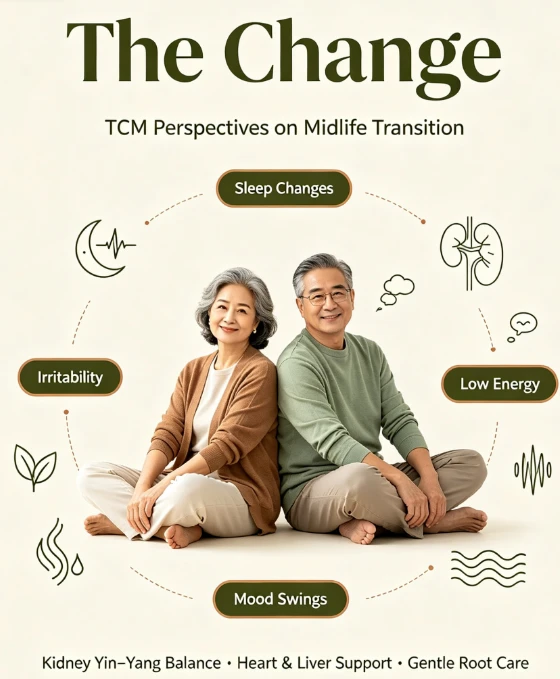
From a TCM mechanism perspective, the root is often Kidney deficiency. When the Yin–Yang balance of the Kidneys becomes unstable, it can affect the Heart and Liver, leading to a chain of imbalances and many different symptom patterns.

Home-Friendly TCM "Little Tips" (Practical Remedies)
Tip 1 (For Liver–Kidney Yin Deficiency): Simple Tea to Calm Sweating & Restlessness
Ingredients
Floating wheat (Fu Xiao Mai) 30 g
Red dates / jujube (Da Zao) 5 pieces
Licorice root (Gan Cao) 10 g
How to use
Decoct in water and drink as a tea throughout the day.
Tcm Cistanche Good For Alzheimer's Disease

How TCM "Patterns" Work Here
From a TCM viewpoint, menopausal syndrome is often grouped into two main types:
Liver–Kidney Yin Deficiency
Heart–Spleen Dual Deficiency
As we age, organ functions naturally decline-especially the Liver and Kidneys. In TCM, the Liver "stores Blood," and the Kidneys "govern Water," so Liver–Kidney weakness often shows up as Yin deficiency. When Yin becomes relatively insufficient, Yang can appear "too active," leading to symptoms like:
irritability
insomnia
emotional instability
sweating episodes
So clinically, Liver–Kidney Yin deficiency is one of the first patterns to consider.
Key signs to look for
dizziness, tinnitus (ringing in the ears)
"five-center heat" (warm palms/soles/chest)
night sweats, hot flashes
soreness/weakness in the lower back and knees
A classic hallmark is sudden sweating in waves-it comes and goes with little warning.
TCM approach
For this pattern, the focus is to nourish Yin and support the Liver and Kidneys.
Formula Explanation (Why These Herbs Are Used)
This tea is derived from the classic formula Gan Mai Da Zao Tang from Jin Gui Yao Lue (Essential Prescriptions of the Golden Cabinet) by the famed Han dynasty physician Zhang Zhongjing.
Floating wheat (Fu Xiao Mai): sweet and cool in nature; traditionally used to astringe sweating, benefit Qi, and relieve irritability. It's also considered food-medicine and is often used for "surface heat" and spontaneous sweating.
Jujube / red dates (Da Zao): supports the middle burner, nourishes Blood, and calms the spirit-helpful when sleep quality is poor.
Raw licorice (Sheng Gan Cao): harmonizes the formula; also supports Qi, can ease tension/cramping, and is used broadly across many formulas.
Many people going through this stage experience spontaneous sweating, palpitations, insomnia, and vivid dreams. In TCM language, this often relates to Kidney Qi weakness leading to insufficient Essence and Blood. This combination aims to clear internal agitation, reduce sweating, and nourish Blood to support sleep-helping with symptoms such as heavy sweating, restless sleep, mood swings (including crying/laughing easily), palpitations, and dream-disturbed sleep.

Tip 2 (For Liver–Kidney Yin Deficiency): A Common Chinese Patent Formula (Also Suitable for Men When Pattern-Matched)
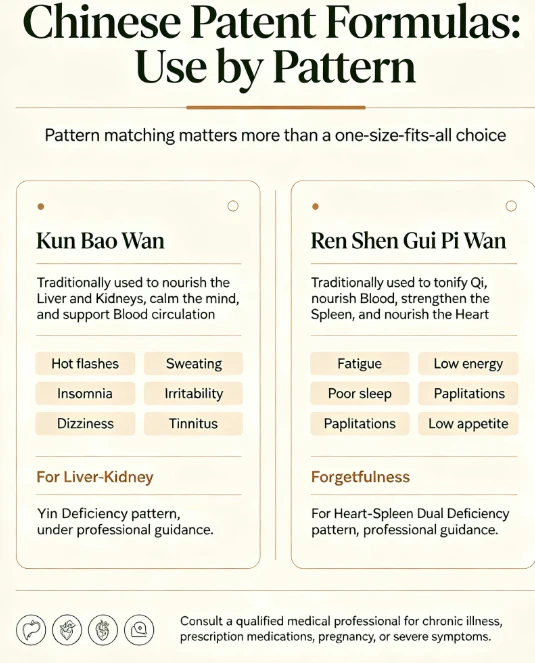
Kun Bao Wan (坤宝丸)
Suggested on the original reference: 50 pills per dose, twice daily.
Important note: Women have menopause, and men can have a similar midlife transition too. In TCM, if the pattern matches, men may also use the same type of formula under professional guidance.
What it's traditionally used for
This formula is commonly described as helping to:
nourish Liver and Kidneys
calm the mind
nourish Blood and promote circulation through the channels
In clinical use, it's often chosen for people around the menopausal window with Liver–Kidney Yin deficiency signs such as:
irregular cycles before menopause (for women)
hot flashes and sweating
insomnia, forgetfulness
irritability and restlessness
dizziness and tinnitus
Tip 3 (For Heart–Spleen Dual Deficiency): Herbal Tea for Low Energy + Poor Sleep
Ingredients
Agrimony (Xian He Cao) 30 g
Angelica sinensis / dong quai (Dang Gui) 15 g
Albizia bark (He Huan Pi) 20 g
Sour jujube seed (Suan Zao Ren) 20 g
How to use
Decoct in water and drink as a tea.
Who this fits (Pattern features)
People with the Heart–Spleen dual deficiency pattern often felt "weaker" even when younger. As they enter this stage, they may feel:
low energy and fatigue
little motivation to talk or move
poor appetite
a sense of "aging overnight"
Key signs
dizziness or lightheadedness
mental and physical fatigue
reduced appetite, reluctance to speak
TCM approach
Tonify and nourish the Heart and Spleen. In TCM, the Heart governs Blood and the Spleen is the source of Qi and Blood transformation-so strengthening them supports both energy and mental-emotional stability.
Formula Explanation
Agrimony (Xian He Cao): often known for stopping bleeding, but in many traditional uses it also supports deficiency fatigue (it's called "脱力草" in folk usage-an herb for exhaustion).
Dong quai (Dang Gui): nourishes and moves Blood; often used for Blood deficiency-related issues.
Albizia bark (He Huan Pi): calms the mind, relieves constraint, supports sleep.
Sour jujube seed (Suan Zao Ren): nourishes Heart and Liver, calms the spirit, helps with sweating and dryness.
This tea both tonifies and settles the mind, making it suitable for Heart–Spleen deficiency patterns-especially when insomnia is part of the picture.
Practical note: This is also a sleep-supporting tea approach in TCM-agrimony for deficiency fatigue, dong quai for Blood nourishment, albizia bark to help "turn off the mind," and sour jujube seed to nourish and calm.
Tip 4 (Universal Food Therapy): A Gentle Porridge for Ongoing Support
Ingredients
Lotus seed (Lian Zi) 30 g
Lily bulb (Bai He) 30 g
Gorgon fruit / fox nut (Qian Shi) 30 g
Lotus leaf (He Ye) 10 g
Glutinous rice (as needed)
Optional: a small amount of sugar to taste
How to use
Rinse ingredients and cook into a congee/porridge.
What it's used for
This can be used across different menopausal-type discomfort patterns. Traditionally, it may help with issues often seen around this stage such as:
palpitations and uneasy sleep
anxiety-like restlessness
forgetfulness
fatigue
rough or dull skin
Why these foods are chosen (TCM properties)
All four are "food-medicine" ingredients:
Lotus seed: supports the Spleen, helps stabilize digestion, calms the mind
Lily bulb: nourishes Yin, moistens, clears Heart heat and calms the mind
Gorgon fruit: supports the Kidneys, stabilizes Essence, strengthens the Spleen
Lotus leaf: clears summer-heat and dampness, supports the lifting of clear Yang
Together, lotus seed + gorgon fruit are more neutral, lily bulb + lotus leaf are slightly cool-creating a balanced congee often used for restlessness and sleep issues in this life stage.
Another Common Option for Heart–Spleen Deficiency
For the Heart–Spleen dual deficiency pattern, another widely used Chinese patent medicine is:
Ren Shen Gui Pi Wan (人参归脾丸)
Traditionally described as:
tonifying Qi and nourishing Blood
strengthening the Spleen and nourishing the Heart
It's often selected when symptoms fit Heart–Spleen deficiency (fatigue, poor sleep, palpitations, low appetite, poor memory).
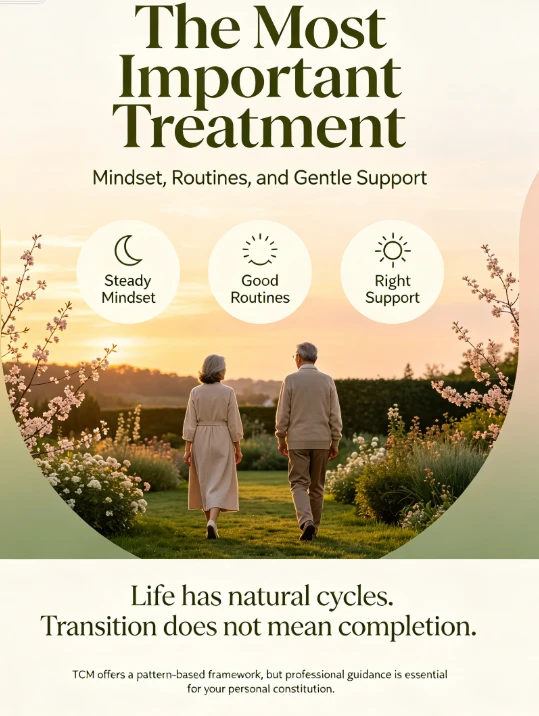
The Most Important "Treatment": Your Mindset
For many people, the key isn't only remedies-it's also learning to relate to this stage differently. Flowers bloom and fade; seasons come and go. Life has natural cycles too.
This transition is a necessary stop on the journey, but it does not mean you're "finished" or suddenly old. A steady mindset, good routines, and the right support can make this period far more manageable.
Gentle Reminder
TCM pattern-based approaches can be very personal. If you have chronic illness, take prescription medications, are pregnant, or have severe symptoms (e.g., heavy bleeding, chest pain, severe depression, persistent insomnia), consult a qualified medical professional. If you choose herbs or patent formulas, consider working with a licensed TCM practitioner for pattern identification and safety.