Processing Technology Of Cistanche Deserticola: Inheritance And Innovation
Nov 06, 2024
1, The historical origins of the processing technology of Cistanche deserticola
The processing method of Cistanche deserticola has a long history, and the method of replicating wine cakes has been recorded in the "Lei Gong" since the Southern Song Dynasty. In the Song Dynasty, the processing methods were more diverse, including soaking, wine washing, water boiling, wine boiling, wine steaming, and baking. In the Yuan and Ming dynasties, there were also methods such as noodle stewing, wine stir-frying, and pastry stir-frying, which further required cooking techniques. In the Qing Dynasty, the method of "steeping light" was added, emphasizing the use of "steaming with a steamer" and "avoiding iron utensils" when steaming wine. At this point, there are fifteen or sixteen methods of preparation.
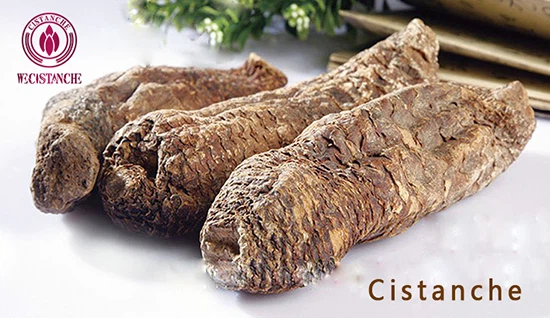
Cistanche deserticola
During the Northern and Southern Dynasties, the "Lei Gong Pao Zhi Lun" proposed soaking Cistanche deserticola in wine overnight and using a brown brush to remove nonmedicinal parts such as "floating armor". This method was widely used in later generations. As recorded by Zhang Lu in the "Benjing Fengyuan" during the Qing Dynasty, "Wine is used to wash away armor and decay, and then sliced and baked. The Taiping Shenghui Formula Volume 97 contains records of "removing wrinkles from the skin, finely cutting" and "soaking in wine overnight, slicing, and baking", and this method has been used to this day.
The Han Dynasty's "Huashi Zhongzang Jing" recorded "soaking wine overnight", and there are also many records in ancient books about the method of making Cistanche deserticola wine. As recorded in "Taiping Shenghui Fang", "soak in wine, remove wrinkles, stir fry slightly, and roast", "New Book of Preschoolers" records "soak in wine overnight, scrape off wrinkles, and dry", "Renshu Bianlan" records "soak in wine, bake", and "Women's Complete Collection of Good Prescriptions" records "soak in wine". The "Xianxingzhai Medical Notes" records in more detail that soaking in wine overnight, softening and then brushing off the "floating armor", splitting and removing the internal "white film", steaming in a pot for 6-8 hours, avoiding iron utensils.

superman herbs cistanche
The Qing Dynasty's "Compendium of Materia Medica" proposed the method of preparing Cistanche deserticola float, while the "Treatise on Diseases Volume Three" mentioned "soaking lightly," which may be similar to the modern method of salt-roasted Cistanche deserticola float, but further research is still needed.
According to ancient herbal records, the processing technology of Cistanche deserticola has been developing continuously, such as "removing scurvy", "removing wrinkle skin", "slicing", and "steaming with wine". At the same time, some unnecessary procedures have been abandoned, reflecting the characteristics of taking its essence and removing its dross.
2, Detailed explanation of modern processing technology
(1) Drug selection process
In the modern processing technology of Cistanche deserticola, the selection of drugs is crucial. Firstly, it is necessary to strictly eliminate moldy and insect-infested medicinal materials to ensure their quality. For Cistanche deserticola with fibrous roots, it should also be removed to ensure the purity of the medicinal material. At the same time, place the Cistanche deserticola in baskets according to its diameter for subsequent processing. Generally speaking, larger diameter Cistanche deserticola may require longer soaking, steaming, and drying times.
(2) Washing steps
Washing is an important step in ensuring the cleanliness of Cistanche deserticola. Usually, high-pressure water guns are used to rinse Cistanche deserticola, and high-pressure water flow can effectively remove soil and impurities on the surface of Cistanche deserticola. After rinsing, use a clean brush to scrub, especially in areas such as the folds of Cistanche deserticola that are prone to dirt and grime accumulation. Be careful to scrub. After brushing, place the Cistanche deserticola on the filter rack for later use, allowing excess water to drain naturally.

Cistanche deserticola slice
(3) Soaking process
Different specifications of Cistanche deserticola require different soaking methods. Generally, Cistanche deserticola is put into a stainless steel barrel, and an appropriate amount of Baijiu is added for soaking. The degree of Baijiu can be selected according to the actual situation. Generally, Baijiu with a height of more than 50 degrees is better. The soaking time depends on the size and texture of the Cistanche deserticola, usually ranging from 24 to 48 hours. During the soaking process, it is necessary to ensure that Cistanche deserticola is completely immersed in Baijiu to give full play to the role of Baijiu.
(4) Steaming process
Steaming medicine is one of the key processes in the processing of Cistanche deserticola. According to the specifications of Cistanche deserticola, evenly spread it flat on the steamer, taking care not to stack it too thick to avoid affecting the steaming effect. The temperature for steaming is generally controlled between 80 ℃ and 100 ℃, and the time is 2 hours to 4 hours. During the steaming process, it is important to closely observe the changes in Cistanche deserticola to ensure even heating. After steaming, remove the Cistanche deserticola and spread it in a well-ventilated area for cooling, gradually lowering its temperature.
(5) Drying operation
The drying operation requires placing the drying tray on the drying cart, and then evenly spreading the Cistanche deserticola on the drying tray. Push the drying car into the drying room for drying, and the temperature in the drying room is generally controlled between 50 ℃ and 60 ℃. The cooling time depends on the humidity and size of the Cistanche deserticola, usually ranging from 8 to 12 hours. During the drying process, it is necessary to regularly check the dryness of Cistanche deserticola to avoid excessive or insufficient drying. After drying, remove the Cistanche deserticola and let it cool to obtain the prepared Cistanche deserticola.

Cistanche deserticola slice
(6) Packaging requirements
According to packaging requirements, pack the prepared Cistanche deserticola separately. During the packaging process, it is necessary to ensure that the packaging quantity is not less than 97% of the labeled quantity. Sealed bags, glass bottles, and other packaging materials can be used to ensure that Cistanche deserticola is not damp or contaminated during storage and transportation. At the same time, the packaging should indicate the origin, specifications, production date, and other information of Cistanche deserticola for consumers to understand and choose.
3, Characteristics of different processing methods
(1) Biological efficacy
Raw Cistanche deserticola is effective in tonifying the kidneys, stopping turbidity, smoothing the intestines, and promoting bowel movements. It is commonly used for conditions such as kidney qi deficiency, intestinal dryness, constipation, and white turbidity. Cistanche deserticola can help yang and smooth the intestines, so it is not suitable for people with yin deficiency, excessive fire, and diarrhea. It should also be avoided for people with damp and hot gastrointestinal conditions and constipation. Raw Cistanche deserticola is often used in combination with Angelica sinensis, Achyranthes bidentate, and Fructus aurantii, which can effectively improve the condition of elderly people or those who suffer from intestinal dryness, constipation, kidney yang deficiency, essence deficiency, and blood deficiency after an illness.
(2) The function of alcohol production
After being brewed with alcohol, Cistanche deserticola significantly enhances its ability to nourish the kidneys and promote yang. It is commonly used for conditions such as kidney yang deficiency, impotence, lower back pain, and infertility. Wine-made Cistanche can be combined with various medicinal herbs to achieve different effects. For example, when combined with dodder seeds, dodder seeds have the effect of nourishing the kidneys and consolidating the essence, which can enhance the effect of strengthening the yang and nourishing the essence. They are suitable for diseases such as kidney deficiency, impotence, and cold pain in the waist and knees; When combined with Suoyang, they can enhance the effects of tonifying kidney yang, nourishing essence and blood, and moistening intestines, and are suitable for patients with kidney deficiency, impotence, and constipation; When combined with Cornus officinalis, it has the effects of tonifying kidney yang, consolidating essence and qi, and is suitable for kidney deficiency impotence, waist and knee weakness, etc; When combined with Eucommia ulmoides, it can enhance the effect of tonifying the kidney and strengthening the waist, and is suitable for conditions such as kidney deficiency, lower back pain, soreness, and weakness. In addition, Cistanche deserticola can also be combined with traditional Chinese medicines such as Morinda officinalis, Hemp Seed, Rehmannia glutinosa, Psoraleae, and Agarwood. However, the use of medication should be guided by a doctor to avoid adverse consequences.
4, Modern Research and Value
Cistanche deserticola mainly contains components such as betaine, mannitol, ergosterol glycosides, and free amino acids. Modern research shows that the content of betaine in Cistanche deserticola is significantly increased after being heated and processed. Temperature is the main factor for the content change, and almost half of it is lost after soaking. The processing of Baijiu in the auxiliary materials is not as good as that of yellow rice wine. At the same time, the content of ergosterol glycoside in the processed products decreased by about half, especially after high-pressure treatment, and the content decreased even more. The content of water-soaked tablets did not decrease much because they were not heated. In addition, Huangjiu contains abundant amino acids. Processing Cistanche deserticola with Huangjiu can increase its amino acid content, but the heating time should not be too long, preferably 12 hours.
In pharmacological research, the observation of hormone-like effects on young and large mice showed that both raw Cistanche deserticola and wine Cistanche deserticola can significantly increase the weight of the seminal vesicles, prostate, and testes of mice. Raw products also significantly increase the weight of the spleen in rats, while wine products significantly increase the weight of the thymus, but there is no significant difference between the two. Observation of androgen-like effects in castrated rats shows that both raw and processed products can significantly increase the weight of seminal vesicles and prostate, while alcoholic products also significantly increase the weight of the thymus. The effect of raw or alcoholic products on the phagocytic function of peritoneal macrophages in mice can significantly enhance the phagocytic percentage and index of macrophages in female mice and can restore non-specific immunity suppressed by prednisone to a certain level, but there is no significant difference between the two.

Main Chemical Constituents of Cistanche deserticola
Click here to view Cistanche products
【Ask for more】 Email:cindy.xue@wecistanche.com / Whats App: 0086 18599088692 / Wechat: 18599088692
Cistanche deserticola has a laxative effect. Experiments have shown that Cistanche deserticola, saline Cistanche deserticola, sand Cistanche deserticola, tube flower Cistanche deserticola, and their processed products can significantly improve the intestinal motility of mice. The four medicinal herbs can also significantly shorten the laxative time of mice, but this effect is not significant after alcohol production. Among them, Cistanche deserticola has the strongest laxative effect, while Cistanche deserticola has the weakest laxative effect. After processing, the laxative effect of the medicinal material is weakened. Studies have shown that Cistanche deserticola can cause contractions in the gastric fundus muscles of rats and the ileal muscles of guinea pigs, and can be inhibited by atropine. One of the main active ingredients in Cistanche deserticola, betaine, has a structure very similar to choline, suggesting its cholinergic activity. Therefore, it is believed that the mechanism of Cistanche deserticola's laxative effect is related to betaine.
In summary, as a traditional Chinese medicinal herb, the continuous development of its processing technology and the deepening of modern research have provided a more scientific basis and broader prospects for its clinical application.