Difficult! What Are The Roadblocks For Traditional Chinese Medicine Export?
Nov 20, 2024
How do German patients buy Chinese medicine?
German patients can generally get Chinese medicine through two channels: one is the legal channel recognized by the government, and the other is the gray channel.
The formal channel is that the Chinese medicine clinic prescribes the medicine, and the patient takes the prescription to the pharmacy of his choice to buy the medicine. The pharmacy provides patients with a series of pharmaceutical process services such as dispensing, powdering, paste making, pill making, and decoction according to the prescription, which can only be carried out in the pharmacy according to the law (equivalent to the internal preparation of hospitals in China).
Chinese medicine clinics are divided into two types: one is a doctor's clinic, and the other is a health practitioner's clinic. The difference is that the former has the right to prescribe, while the latter does not. The "prescription" here is a "prescription" in the legal sense. Many drugs are prescription drugs, and these drugs can only be bought at the pharmacy with a valid doctor's prescription. Except for a few flavors such as Aconitum (Aconite, Chuanwu, Aconitum kusnezoffii), Senna and Ephedra, the rest of the Chinese herbal medicine pieces and single-flavor formula granules are over-the-counter drugs or pharmaceutical raw materials, and can be bought at the pharmacy without a legal prescription.

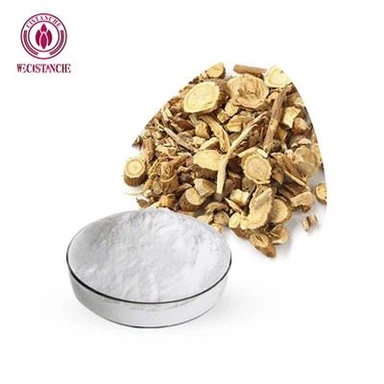
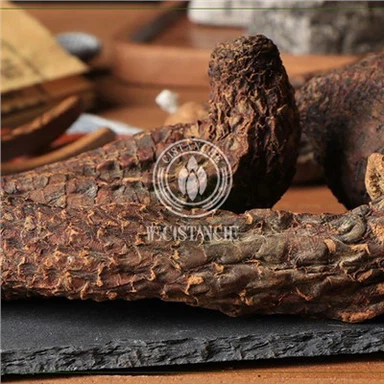
Chinese medicine Cistanche Extract Export To German

According to Articles 6 and 11 of the Pharmacy Operation Regulations, German pharmacies must analyze and test the Chinese herbal medicine slices and formula granules used in the formula and record them for future reference to ensure that all the initial raw materials of the formula meet the quality requirements of the official pharmacopoeia, which mainly includes qualitative identification, purity, effective ingredients and quantitative analysis and testing of harmful pollutants (pesticide residues, heavy metals, microbial indicators, fungal toxins such as aflatoxin content, and specific toxic ingredients such as aconitine content in aconite-type medicinal materials).

Such inspections must be repeated every time goods are purchased. A pharmacy has to pay a considerable amount of testing fees. The instruments and equipment used in many testing methods far exceed the financial expenditure capacity of a pharmacy. The scale of German pharmacy chains is limited. All chain pharmacies under the same owner are independent in operation and cannot share test results. This means that it is actually impossible for a German pharmacy to independently carry out Chinese medicine formula business.
There are now about 500 pharmacies in Germany that have Chinese medicine formula business. How do they do it? The answer is that when they choose suppliers, they consider whether the initial Chinese herbal medicine slices and single-ingredient formula granules they purchase have been inspected in accordance with the German "Pharmacy Business Regulations" and have an officially recognized inspection certificate. On this basis, the pharmacy only needs to conduct qualitative identification of the initial raw materials of the formula. At present, formula granules are greatly restricted in Germany because German pharmacies lack qualitative identification methods that are simple to operate, low in cost, and reliable in results.

The appearance of the Angelica dahurica planted by Bavarian farmers in the field
Students majoring in biology at the University of Bayreuth visited and studied at Dezhongtang Company

While Chinese medicine is strictly regulated in the official market in Germany, the share of the gray market exceeds that of the official market. The EU is a common market composed of member states without customs. Each member state has many different laws and regulations. The treatment of Chinese medicine in each member state also varies greatly. Germany is the leader of the EU and is the most stringent in product quality management and consumer protection, sacrificing a lot of economic interests for this. Taking the Chinese medicine industry as an example, Germany has the largest consumer market and the most stringent market supervision. Investment in the Chinese medicine industry has been transferred to neighboring countries such as the Netherlands, Belgium, and Luxembourg. While job opportunities have been handed over to these countries, food and drug risk control has not only not improved at all, but has increased accordingly. Products from neighboring countries enter Germany unimpeded, but quality and market supervision measures are not under Germany's sovereign control. More than two-thirds of the Chinese medicine market in Germany is achieved through gray channels that do not comply with German laws and regulations. For example, a Chinese medicine clinic in Germany prescribes a prescription for a German patient and sends the prescription directly to an importer, wholesaler or retailer outside of Germany, who then expresses the relevant medicine to the German patient's home. These countries regulate Chinese herbal medicine slices as groceries, and regulate the sales of single-ingredient formula granules and even Chinese patent medicines as health products or functional foods. According to the author's observation, the retail prices of these products that have not been strictly inspected in the German market are often lower than the retail prices of similar products in the Chinese market, so they are highly competitive.
From the perspective of the long-term development of traditional Chinese medicine, quality control of traditional Chinese medicine is the key. This is an unavoidable threshold. The quality of traditional Chinese medicine determines the efficacy of traditional Chinese medicine, and the efficacy of traditional Chinese medicine determines the future development of traditional Chinese medicine.
The German government tries to support farmers to grow Chinese medicinal materials locally
As mentioned earlier, the development of Chinese medicine in Europe experienced a climax in the 1990s. One proof is that the German Bundestag passed a resolution to launch a very special research project - the localization of traditional Chinese medicine plants in Germany. The project lasted for 19 years, officially started on January 1, 1999, and ended on December 31, 2017.
It was hosted by the Bavarian Agricultural Research Institute and collaborated with the University of Munich, the University of Graz, the University of Applied Sciences in Wiesen, the German International Chinese Medicine Association, the German Association for Documentation of Chinese Medicine Treatment Experience Materials, and the Martin Bauer Company Laboratory. Professor Boehme of the Bavarian Agricultural Research Institute was responsible for the implementation of the project. After his retirement in 2010, his successor, Dr. Hoberg, took over his research work from a commercial perspective. Based on factors such as market demand, difficulty in importing and price of medicinal pieces, the first batch of 16 plants were selected for field cultivation trials: Astragalus, Scutellaria, Saposhnikovia, Leonurus, Siegesbeckia, Prunella Vulgaris, Rhubarb, Salvia, Tribulus, Bupleurum, Artemisia Capillaris, Angelica Dahurica, Angelica Sinensis, Paeonia lactiflora, Xanthium sibiricum.
In 2005, the commercial trial planting phase began. The first batch of 7 species, namely Angelica Dahurica, Salvia, Saposhnikovia, Scutellaria, Artemisia Capillaris, Leonurus, and Siegesbeckia, were planted in an area of 1 hectare each, which was expanded to 3 hectares in 2006. Students majoring in biology from the University of Bayreuth visited the Dezhongtang Company at the time. Joseph Miller, then governor of Bavaria, visited the site in person and was interviewed by reporters. In 2007, five farmers began to commercially plant eight species (including Astragalus), and the planting area was further expanded. Although the botanical origins of local Chinese medicines are clear and traceable, the products produced and sold locally are fresh, and the content of harmful substances is strictly controlled, local products are not favored by the market, and farmers had to reduce the planting area in 2008.
This poured cold water on the project leaders who were immersed in the joy of success. They complained that they did not understand why the market was cold to the local Chinese medicines. In fact, the real reason for the cold market response was that German farmers did not master the traditional processing technology of Chinese medicine pieces and the price of localized products was higher than that of imported goods.
Later, they got a lot of inspiration from the information feedback from the market and made great improvements to the processing process to meet customer requirements as much as possible.
After more than 20 years of hard work, the Bavarian Agricultural Research Institute has conducted field cultivation experiments on more than 20 Chinese medicinal plants. At present, there are 11 varieties with mature planting technology suitable for large-scale promotion: Angelica dahurica, Artemisia capillaris, Astragalus membranaceus, Bupleurum chinense, Leonurus japonicus, Salvia miltiorrhiza, Saposhnikovia divaricata, Scutellaria baicalensis, Siegesbeckia sibiricum, Paeonia lactiflora, and Xanthium sibiricum.
A year ago, the author contacted German growers and asked them to make a quotation, but did not get a positive response. It is estimated that they have been brooding over the "cold reception" they suffered in the market in the past and have lost interest in growing Chinese medicine.

Now, under the pressure of the market, they are becoming more and more interested in locally grown products. There are two important reasons for this analysis: First, China's labor costs continue to rise, resulting in a sharp increase in the market price of Chinese medicinal materials every year, which has approached or even exceeded the price of locally grown products in Germany. Second, the quality traceability of Chinese medicine grown in Germany is strong. The botanical origin has been strictly identified, screened and scientifically checked, which is very clear and without suspense; the indicators of pesticide residues, heavy metals and microorganisms are reliable and fully meet the requirements of the various indicators of the European Pharmacopoeia. Third, the EU continues to raise the threshold for the import of Chinese medicine, and China also imposes export restrictions on many varieties.
Although the above introduction is about the general situation in Germany, it is similar for the whole of Europe. Chinese medicine is greatly restricted in the use of medicines, and can only use physical therapy methods such as acupuncture, massage, and qigong, while the most widely used treatment method of Chinese medicine - drug therapy cannot be used. The reputation of Chinese medicine overseas is very disproportionate to its actual role. It can be predicted that if this development continues, the localization of Chinese medicinal plants will be the general trend.
The only obstacle at present is the preparation of Chinese medicine pieces, but this is also a technical threshold that can be overcome.